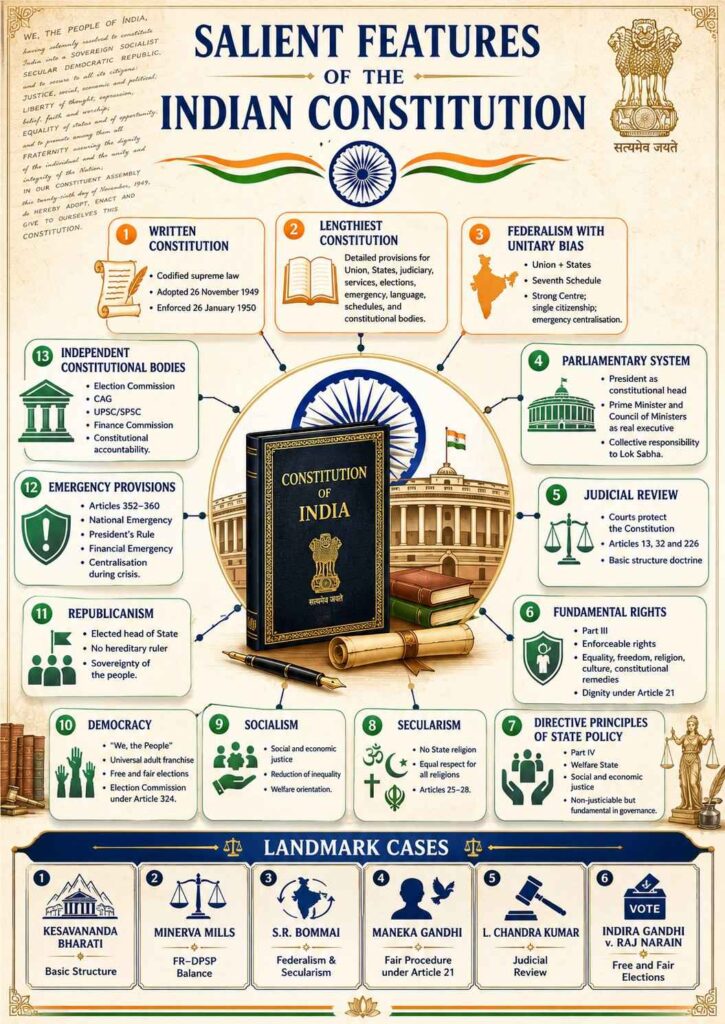
Meaning of the Indian Constitution
● Constitution as Supreme Law: The Constitution of India is the supreme legal document of India. It creates the organs of the State, distributes powers between them, limits governmental authority, and protects individual liberties. Every law, executive action, policy, and constitutional amendment must conform to the Constitution.
● Constitutional Identity: The Preamble declares India to be a Sovereign Socialist Secular Democratic Republic and promises Justice, Liberty, Equality and Fraternity. These words are not merely decorative; they express the constitutional philosophy and guide interpretation of the whole Constitution. The words “socialist”, “secular” and “integrity” were added by the Constitution (Forty-second Amendment) Act, 1976. (Indian Kanoon)
Written Constitution
● Codified Constitutional Law: India has a written Constitution, unlike the British Constitution which is largely unwritten and based on conventions, statutes, judicial decisions and customs. The Indian Constitution is contained in a formal written document adopted by the Constituent Assembly on 26 November 1949 and brought fully into force on 26 January 1950.
● Clarity and Certainty: A written Constitution provides certainty because citizens, courts, governments and authorities can refer to the exact text of constitutional provisions. For example, Fundamental Rights are expressly written in Part III, Directive Principles in Part IV, emergency provisions in Part XVIII, and amendment procedure in Article 368.
● Supremacy of Constitution: Since the Constitution is written and supreme, Parliament and State Legislatures cannot make laws beyond their constitutional powers. If they do so, courts may declare such laws unconstitutional through judicial review.
Lengthiest Constitution
● Detailed Constitutional Scheme: The Indian Constitution is one of the lengthiest written constitutions in the world because it deals not only with broad principles but also with detailed administrative, legislative, judicial and financial matters. It contains provisions regarding Union and State governments, Parliament, State Legislatures, judiciary, services, elections, emergency powers, language, schedules, constitutional bodies and amendment procedure.
● Reason for Length: The Constitution is lengthy because India is a vast, diverse and complex country. The framers had to address historical inequalities, linguistic diversity, caste discrimination, religious plurality, federal relations, minority protections and administrative continuity after colonial rule.
● Borrowed but Adapted Features: The Constitution adopted suitable features from several constitutional systems, such as parliamentary government from Britain, judicial review and fundamental rights from the United States, Directive Principles from Ireland, emergency provisions from Germany and federal structure from Canada. However, these features were modified according to Indian conditions.
Federalism with Unitary Bias
● Federal Structure: India has a federal system because powers are divided between the Union and the States. The Constitution creates two levels of government, provides separate legislative fields, and gives States constitutional existence. Legislative powers are distributed mainly through the Union List, State List and Concurrent List in the Seventh Schedule.
● Constitutional Distribution of Powers: Article 245 deals with the territorial extent of laws made by Parliament and State Legislatures, while Article 246 distributes subject-matter legislative powers between Union and States. Parliament has exclusive power over Union List matters, States have power over State List matters, and both can legislate on Concurrent List matters, subject to Union supremacy in case of conflict.
● Unitary Bias: Although India is federal, it has a strong Centre. This is why it is often described as a federation with unitary bias. The Union has residuary powers, greater financial control, emergency powers, power to reorganise States under Article 3, and power to legislate on State subjects in certain circumstances.
● Single Constitution and Single Citizenship: Unlike the United States where each State has its own Constitution, India generally has one Constitution for the Union and the States. India also follows single citizenship, meaning every citizen is a citizen of India and not separately a citizen of any State.
● Emergency Centralisation: During a national emergency, constitutional distribution of powers may become highly centralised. Parliament can legislate on State List subjects, and the executive authority of the Union expands. This shows the unitary tendency of the Indian federal system.
● Landmark Case – S.R. Bommai v. Union of India, AIR 1994 SC 1918; (1994) 3 SCC 1: In this case, several State governments had been dismissed under Article 356 by imposing President’s Rule. The Supreme Court held that federalism is part of the basic structure of the Constitution and that the President’s satisfaction under Article 356 is subject to judicial review. The Court clarified that Article 356 cannot be used for political convenience and that floor test in the Assembly is normally the proper method to test majority. The case strengthened Indian federalism and limited arbitrary central intervention in States.
Parliamentary System of Government
● Responsible Government: India follows a parliamentary system where the real executive is responsible to the legislature. At the Union level, the President is the constitutional head, but real executive power is exercised by the Council of Ministers headed by the Prime Minister.
● President and Council of Ministers: Article 52 provides for the President of India. Article 74 provides that there shall be a Council of Ministers with the Prime Minister at the head to aid and advise the President. Article 75 makes the Council of Ministers collectively responsible to the House of the People, i.e., Lok Sabha.
● Collective Responsibility: Collective responsibility means the Council of Ministers works as one team and remains in office only so long as it enjoys the confidence of the Lok Sabha. If the Lok Sabha passes a no-confidence motion, the entire Council of Ministers must resign.
● Fusion of Executive and Legislature: In a parliamentary system, the executive is drawn from the legislature. Ministers are usually Members of Parliament and participate in legislative business. This creates close coordination between law-making and administration.
● Prime Ministerial Leadership: Though the President is the formal head, the Prime Minister is the real centre of executive power. The Prime Minister selects ministers, leads government policy, coordinates ministries and represents the government in Parliament.
● Landmark Case – Shamsher Singh v. State of Punjab, (1974) 2 SCC 831: The Supreme Court held that the President and Governors are constitutional heads who generally act on the aid and advice of the Council of Ministers. The case confirmed the parliamentary character of Indian government and rejected the idea that the President or Governor ordinarily exercises personal discretion in executive matters.
Judicial Review
● Meaning of Judicial Review: Judicial review is the power of courts to examine the constitutionality of laws, executive actions and constitutional amendments. If any law or action violates the Constitution, courts may strike it down.
● Constitutional Basis: Judicial review flows from several provisions, especially Articles 13, 32, 226, 131, 136, 141 and 142. Article 13 declares that laws inconsistent with Fundamental Rights are void to the extent of inconsistency. Article 32 gives the right to approach the Supreme Court for enforcement of Fundamental Rights, and Article 226 gives High Courts wide writ jurisdiction.
● Guardian Role of Judiciary: The Supreme Court and High Courts act as guardians of the Constitution. Judicial review ensures that Parliament, State Legislatures and executive authorities remain within constitutional limits.
● Landmark Case – Kesavananda Bharati v. State of Kerala, (1973) 4 SCC 225: The petitioner challenged constitutional amendments affecting property rights and religious institutional rights. The legal issue was whether Parliament’s power to amend the Constitution under Article 368 was unlimited. By a 7:6 majority, the Supreme Court held that Parliament may amend any part of the Constitution, but it cannot destroy or damage the basic structure of the Constitution. This case established the basic structure doctrine and made constitutional supremacy stronger than parliamentary supremacy.
● Landmark Case – L. Chandra Kumar v. Union of India, AIR 1997 SC 1125; (1997) 3 SCC 261: The issue was whether tribunal decisions could exclude the jurisdiction of High Courts and the Supreme Court. The Supreme Court held that judicial review by High Courts under Articles 226/227 and by the Supreme Court under Article 32 is part of the basic structure. Tribunals may exist, but their decisions remain subject to constitutional judicial review.
● Landmark Case – I.R. Coelho v. State of Tamil Nadu, AIR 2007 SC 861; (2007) 2 SCC 1: The issue was whether laws placed in the Ninth Schedule after Kesavananda Bharati could be completely protected from judicial review. The Supreme Court held that even Ninth Schedule laws inserted after 24 April 1973 are open to judicial review if they damage or destroy basic structure, especially the essence of Fundamental Rights.
Fundamental Rights
● Basic Civil Liberties: Fundamental Rights are contained in Part III, Articles 12 to 35. They protect individual dignity and liberty against arbitrary State action. They are enforceable in courts, which means a person can approach the Supreme Court under Article 32 or High Courts under Article 226 for their protection.
● Six Main Groups: The main Fundamental Rights are: Right to Equality under Articles 14 to 18, Right to Freedom under Articles 19 to 22, Right against Exploitation under Articles 23 to 24, Right to Freedom of Religion under Articles 25 to 28, Cultural and Educational Rights under Articles 29 to 30, and Right to Constitutional Remedies under Article 32.
● Negative and Positive Duties: Fundamental Rights mainly restrict State power, but some rights also impose positive obligations. For example, Article 21 has been expanded to include rights necessary for dignified life, such as privacy, legal aid, speedy trial, clean environment and livelihood.
● Reasonable Restrictions: Fundamental Rights are not absolute. Article 19 freedoms may be restricted on grounds such as sovereignty and integrity of India, public order, decency, morality, security of State and contempt of court, depending on the specific freedom involved.
● Landmark Case – Maneka Gandhi v. Union of India, (1978) 1 SCC 248: The petitioner’s passport was impounded without giving reasons. The issue was whether deprivation of personal liberty under Article 21 only required a formal law or whether the law must be fair, just and reasonable. The Supreme Court held that procedure under Article 21 must be right, just and fair, not arbitrary or oppressive. This case transformed Article 21 into a broad guarantee of due process-like fairness.
● Landmark Case – Justice K.S. Puttaswamy v. Union of India, (2017) 10 SCC 1: A nine-judge Bench held that the right to privacy is a fundamental right protected under Articles 14, 19 and 21. The case strengthened dignity, autonomy and informational privacy as core constitutional values.
Directive Principles of State Policy
● Welfare State Principles: Directive Principles of State Policy are contained in Part IV, Articles 36 to 51. They are non-justiciable, meaning they cannot be directly enforced in courts. However, they are fundamental in the governance of the country and guide the State in making laws and policies.
● Social and Economic Justice: DPSPs aim to establish a welfare State. They direct the State to reduce inequalities, provide adequate livelihood, protect workers, promote education, improve public health, organise village panchayats, protect environment and promote international peace.
● Difference from Fundamental Rights: Fundamental Rights are enforceable legal rights, while DPSPs are constitutional instructions for governance. Fundamental Rights protect individual liberty, while DPSPs promote social justice and collective welfare.
● Harmony between FR and DPSP: Indian constitutional law does not treat Fundamental Rights and DPSPs as enemies. Both are complementary. Fundamental Rights provide the means of liberty, while DPSPs provide the goals of social transformation.
● Landmark Case – Minerva Mills Ltd. v. Union of India, AIR 1980 SC 1789; (1980) 3 SCC 625: The issue was whether Parliament could give unlimited primacy to DPSPs over Fundamental Rights through constitutional amendment. The Supreme Court held that harmony and balance between Fundamental Rights and Directive Principles is part of the basic structure. The State must pursue social welfare, but it cannot destroy essential freedoms while doing so.
Secularism
● Equal Respect for All Religions: Secularism under the Indian Constitution does not mean hostility to religion. It means the State has no official religion and must treat all religions equally. The Constitution protects freedom of conscience and religion under Articles 25 to 28.
● Positive Secularism: Indian secularism allows the State to regulate secular activities connected with religion and to introduce social reform. For example, the State may regulate religious endowments, prevent social evils and ensure equality within religious institutions.
● Preamble and Basic Structure: The word “secular” is expressly used in the Preamble after the 42nd Amendment, but the constitutional idea existed from the beginning through equality, non-discrimination and religious freedom provisions.
● Landmark Case – S.R. Bommai v. Union of India, AIR 1994 SC 1918; (1994) 3 SCC 1: The Supreme Court held that secularism is part of the basic structure of the Constitution. The Court explained that religion and State power cannot be mixed and that a State government acting against secular principles may attract constitutional consequences under Article 356.
Socialism
● Constitutional Socialism: The word “socialist” in the Preamble reflects the goal of social and economic justice. Indian socialism does not require complete State ownership of all property. It means reducing inequality, preventing exploitation, promoting welfare and ensuring fair distribution of opportunities.
● Link with DPSP: Socialism is closely connected with Directive Principles, especially Articles 38, 39, 39A, 41, 42, 43 and 47. These provisions direct the State to reduce inequalities, ensure equal justice, promote livelihood, provide humane working conditions and improve public health.
● Balanced Economic Model: India’s constitutional socialism is compatible with a mixed economy, private enterprise and welfare regulation. The Constitution permits economic development but requires that development must not ignore social justice.
● Landmark Case – D.S. Nakara v. Union of India, (1983) 1 SCC 305: The Supreme Court interpreted pension benefits in light of socialist principles and held that pension is not a bounty but a measure of socio-economic justice. The case reflects how socialism influences welfare-oriented interpretation.
Democracy
● Government by the People: Democracy means that political power ultimately belongs to the people. The Preamble begins with “We, the people of India”, showing that the Constitution derives authority from the people.
● Representative Democracy: India follows representative democracy. Citizens elect representatives to Parliament, State Legislatures and local bodies. The government must remain accountable to elected institutions.
● Universal Adult Franchise: Every adult citizen has the right to vote subject to constitutional and statutory qualifications. This gives political equality to citizens irrespective of caste, religion, gender, wealth or education.
● Free and Fair Elections: Democracy requires genuine elections, independent election machinery, political competition and peaceful transfer of power. Article 324 establishes the Election Commission of India for superintendence, direction and control of elections.
● Landmark Case – Indira Nehru Gandhi v. Raj Narain, 1975 Supp SCC 1: After the election of the Prime Minister was set aside by the Allahabad High Court, Parliament inserted Article 329A to protect certain elections from judicial scrutiny. The Supreme Court held that free and fair elections and democracy are basic features of the Constitution. The amendment was struck down because it damaged democratic equality and rule of law.
Republicanism
● Meaning of Republic: India is a republic because the head of the State is elected, directly or indirectly, and not a hereditary monarch. The President of India is elected according to the constitutional process and holds office for a fixed term.
● No Hereditary Political Authority: Republicanism rejects inherited political power. Public offices are open according to constitutional rules, democratic process and legal qualifications.
● Popular Sovereignty: Republicanism is closely linked with democracy because both are based on the idea that authority belongs to the people and public offices exist for public service, not private privilege.
Emergency Provisions
● Extraordinary Constitutional Mechanism: Emergency provisions are contained mainly in Part XVIII, including Articles 352 to 360. They enable the Constitution to respond to war, external aggression, armed rebellion, failure of constitutional machinery in States, and financial instability.
● National Emergency: Under Article 352, National Emergency may be proclaimed on grounds of war, external aggression or armed rebellion. During such emergency, the federal structure becomes more unitary because Union powers expand.
● State Emergency or President’s Rule: Under Article 356, President’s Rule may be imposed if the constitutional machinery in a State fails. However, after S.R. Bommai, this power is subject to judicial review and cannot be used arbitrarily for political purposes.
● Financial Emergency: Article 360 deals with Financial Emergency. It may be proclaimed if the financial stability or credit of India or any part of India is threatened. It has never been used in India.
● Rights during Emergency: Emergency provisions can affect Fundamental Rights. However, after the 44th Amendment, Articles 20 and 21 cannot be suspended even during National Emergency. This protects core criminal justice and life-liberty guarantees.
● Landmark Case – A.D.M. Jabalpur v. Shivkant Shukla, (1976) 2 SCC 521: During the 1975 Emergency, the issue was whether detained persons could seek habeas corpus when Article 21 was suspended. The majority held that such remedy was unavailable. This judgment is widely criticised and has been expressly disapproved in later constitutional jurisprudence, especially after the recognition of privacy and constitutional liberty in Puttaswamy.
Independent Constitutional Bodies
● Purpose of Constitutional Bodies: The Constitution creates independent institutions to protect neutrality, accountability, financial discipline, electoral fairness and federal balance. These bodies are not ordinary departments of the government; they derive authority directly from the Constitution.
● Election Commission of India: Article 324 establishes the Election Commission. It supervises, directs and controls elections to Parliament, State Legislatures and the offices of President and Vice-President. Its independence is essential for democracy and free and fair elections.
● Comptroller and Auditor General of India: Articles 148 to 151 deal with the CAG. The CAG audits government accounts and ensures financial accountability. This institution protects public money from misuse.
● Union Public Service Commission and State Public Service Commissions: Articles 315 to 323 provide for Public Service Commissions. They help ensure merit-based recruitment and reduce political influence in public services.
● Finance Commission: Article 280 provides for the Finance Commission. It recommends distribution of financial resources between the Union and States, strengthening fiscal federalism.
● Special Officer for Linguistic Minorities and Commissions for SCs/STs/Backward Classes: The Constitution also provides institutions to protect vulnerable groups and minorities, including constitutional mechanisms for Scheduled Castes, Scheduled Tribes and backward classes.
Memory Table: Salient Features at a Glance
| Feature | Core Meaning | Key Constitutional Link |
|---|---|---|
| Written Constitution | Formal codified supreme law | Entire Constitution |
| Lengthiest Constitution | Detailed governance framework | Parts, Schedules, Articles |
| Federalism with Unitary Bias | Division of powers with strong Centre | Articles 245–246, Seventh Schedule |
| Parliamentary System | Executive responsible to legislature | Articles 74–75 |
| Judicial Review | Courts test constitutionality | Articles 13, 32, 226 |
| Fundamental Rights | Enforceable liberties | Part III |
| Directive Principles | Welfare governance goals | Part IV |
| Secularism | Equal treatment of all religions | Preamble, Articles 25–28 |
| Socialism | Social and economic justice | Preamble, DPSP |
| Democracy | Rule through elected representatives | Preamble, Article 324 |
| Republicanism | Elected head of State | Articles 52–62 |
| Emergency Provisions | Crisis powers | Articles 352–360 |
| Independent Bodies | Neutral constitutional institutions | Articles 148, 280, 315, 324 |
Conclusion
● Integrated Constitutional Vision: The salient features of the Indian Constitution together create a balanced constitutional system. The Constitution is written and detailed, but also flexible enough to adapt through amendments. It is federal, but with a strong Union. It creates parliamentary democracy, but limits political power through judicial review and Fundamental Rights.
● Balance of Liberty and Welfare: Fundamental Rights protect individual freedom, while Directive Principles guide the State toward social and economic justice. Secularism protects religious equality, socialism promotes welfare, democracy ensures public participation, and republicanism rejects hereditary rule.
● Basic Structure Protection: Through cases such as Kesavananda Bharati, Minerva Mills, S.R. Bommai, Indira Nehru Gandhi, L. Chandra Kumar and I.R. Coelho, the Supreme Court has protected the Constitution’s core identity. These features are not isolated ideas; they work together to preserve constitutional supremacy, human dignity, rule of law and democratic governance in India.