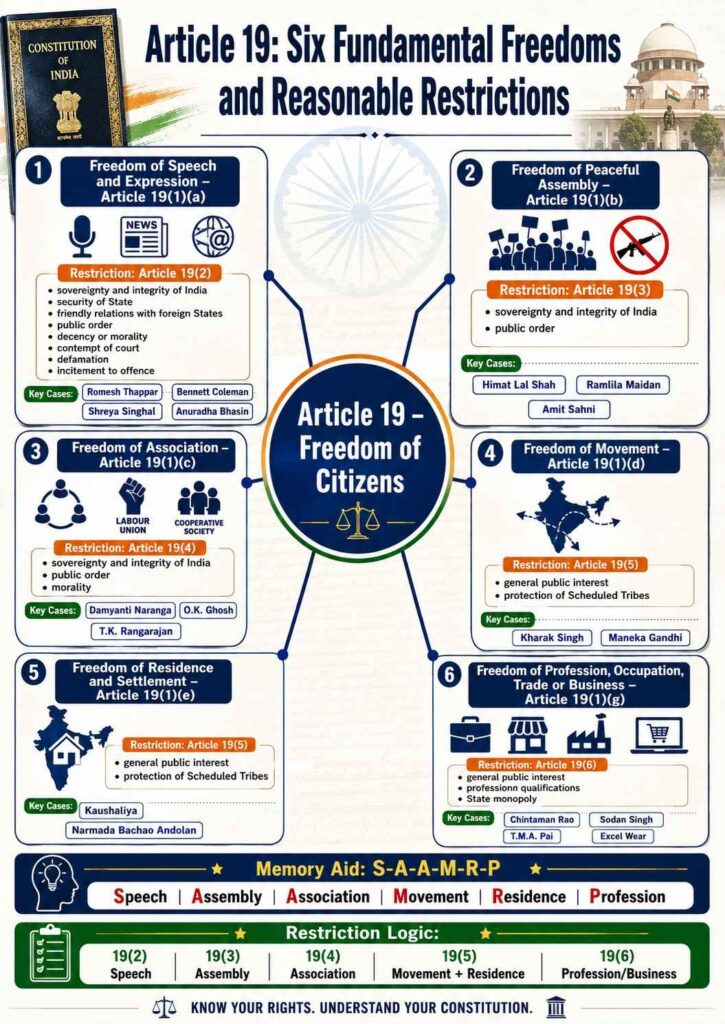
Meaning and Constitutional Position of Article 19
❖ Core idea of Article 19: Article 19 is one of the most important provisions in Part III of the Constitution of India because it protects the basic civil freedoms of citizens. It gives citizens the freedom to speak, assemble, associate, move, reside, and practise any profession or carry on any occupation, trade or business. Article 19(1) originally contained seven freedoms, but the right “to acquire, hold and dispose of property” under Article 19(1)(f) was deleted by the Constitution (Forty-fourth Amendment) Act, 1978. Therefore, Article 19 presently protects six freedoms. The text of Article 19(1) recognises: speech and expression, peaceful assembly without arms, association or unions or co-operative societies, movement throughout India, residence and settlement in any part of India, and profession/occupation/trade/business.
❖ Available only to citizens: Article 19 freedoms are available only to citizens of India, unlike Articles 14 and 21, which are available to “persons”. Therefore, a foreign national cannot claim Article 19 rights, though he may claim protection under other constitutional provisions where applicable.
❖ Not absolute freedoms: Article 19 does not create uncontrolled liberty. Each freedom is subject to constitutionally permitted reasonable restrictions under Articles 19(2) to 19(6). This means the State can regulate these freedoms, but only by law, and only on the grounds specifically mentioned in the Constitution. Restrictions cannot be arbitrary, excessive, vague, disproportionate or unrelated to the constitutional ground.
❖ Freedom and social control: Article 19 represents a balance between individual liberty and social order. The Constitution protects personal freedom, but also recognises that liberty must operate in a society where sovereignty, security, public order, morality, rights of others and general public interest are also important.
Six Freedoms under Article 19 at a Glance
| Freedom | Constitutional Clause | Restriction Clause | Main Grounds of Restriction |
|---|---|---|---|
| Freedom of speech and expression | Article 19(1)(a) | Article 19(2) | Sovereignty and integrity of India, security of State, friendly relations with foreign States, public order, decency or morality, contempt of court, defamation, incitement to offence |
| Freedom of peaceful assembly without arms | Article 19(1)(b) | Article 19(3) | Sovereignty and integrity of India, public order |
| Freedom to form associations, unions or co-operative societies | Article 19(1)(c) | Article 19(4) | Sovereignty and integrity of India, public order, morality |
| Freedom of movement throughout India | Article 19(1)(d) | Article 19(5) | Interests of general public, protection of interests of Scheduled Tribes |
| Freedom to reside and settle in any part of India | Article 19(1)(e) | Article 19(5) | Interests of general public, protection of interests of Scheduled Tribes |
| Freedom of profession, occupation, trade or business | Article 19(1)(g) | Article 19(6) | Interests of general public, professional/technical qualifications, State monopoly |
Reasonable Restrictions under Article 19
❖ Meaning of reasonable restriction: A restriction is reasonable when it has a rational connection with the object sought to be achieved, is not excessive, is not arbitrary, and does not destroy the freedom itself. The word “reasonable” gives courts the power to review whether the restriction imposed by the State is constitutionally valid. Article 19(2) was shaped by constitutional amendments and judicial interpretation to ensure that the State’s power to restrict free speech remains connected with specific constitutional grounds.
❖ Restriction must be by law: The State cannot curtail Article 19 freedoms merely through executive convenience or informal pressure. There must be legal authority. The law must also fall within the exact grounds mentioned in Articles 19(2) to 19(6). For example, speech cannot be restricted merely because it is unpopular; it must fall within one of the grounds in Article 19(2).
❖ Doctrine of proportionality: Modern Article 19 analysis uses proportionality. The State must show that the restriction pursues a legitimate aim, has a rational connection with that aim, is necessary in the sense that less restrictive alternatives are inadequate, and maintains a proper balance between individual freedom and public interest. In Modern Dental College and Research Centre v. State of Madhya Pradesh, (2016) 7 SCC 353, the Supreme Court applied proportionality principles in the context of regulation of private educational institutions and explained that regulatory restrictions must be balanced and not excessive.
Freedom of Speech and Expression under Article 19(1)(a)
❖ Meaning and importance: Article 19(1)(a) protects the right to express one’s thoughts, opinions, beliefs, ideas and information through words, writing, print, electronic media, art, symbols, silence, internet and other forms of communication. Freedom of speech is the foundation of democracy because people can criticise the government, discuss public issues, participate in political debate, receive information and form opinions.
❖ Includes freedom of press: Although “freedom of press” is not separately written in Article 19, the Supreme Court has held that press freedom is part of Article 19(1)(a). In Romesh Thappar v. State of Madras, AIR 1950 SC 124, the Supreme Court struck down a ban on the circulation of a journal and held that freedom of circulation is essential for political discussion. In Brij Bhushan v. State of Delhi, AIR 1950 SC 129, the Court invalidated pre-censorship imposed on a newspaper and treated prior restraint as a serious interference with free speech. These early cases established that democratic debate cannot survive if the State controls what may be published before publication.
❖ Circulation and business side of press: In Sakal Papers (P) Ltd. v. Union of India, AIR 1962 SC 305, the Supreme Court struck down restrictions on newspaper pages and price because they directly affected circulation and free expression. In Bennett Coleman & Co. v. Union of India, (1972) 2 SCC 788, the Court held that newsprint control policy could not be used in a manner that reduced newspaper pages and restricted freedom of the press. The ratio is that press freedom includes not only the right to publish but also the right to reach readers effectively.
❖ Commercial speech: In Tata Press Ltd. v. MTNL, (1995) 5 SCC 139, the Supreme Court held that commercial advertisements also enjoy protection under Article 19(1)(a), because advertisements may convey information useful to the public. However, misleading, fraudulent or harmful advertisements may be regulated.
❖ Right to know and receive information: Article 19(1)(a) also protects the right of citizens to receive information. In Secretary, Ministry of Information & Broadcasting v. Cricket Association of Bengal, (1995) 2 SCC 161, the Supreme Court held that freedom of speech includes the right to communicate and receive information through electronic media. This principle later supported transparency, open governance and the citizen’s right to know.
❖ Cinema and artistic expression: In S. Rangarajan v. P. Jagjivan Ram, (1989) 2 SCC 574, the Supreme Court protected the exhibition of a film despite opposition. The Court held that freedom of expression cannot be suppressed unless the situation created by allowing the expression is dangerous to the community or public interest. Mere threat of demonstration or hostile audience cannot become a ground for censorship; otherwise, the State would be allowing violent objectors to silence lawful expression.
❖ Online speech and vagueness: In Shreya Singhal v. Union of India, (2015) 5 SCC 1, the Supreme Court struck down Section 66A of the Information Technology Act, 2000 as unconstitutional for violating Article 19(1)(a). The provision criminalised online messages using vague expressions such as “grossly offensive” and “menacing”. The Court held that vague restrictions chill free speech and that only speech connected to incitement, public order or other Article 19(2) grounds can be restricted. The decision is a leading authority on internet speech and constitutional vagueness.
❖ Internet as a medium of speech and trade: In Anuradha Bhasin v. Union of India, (2020) 3 SCC 637, the Supreme Court held that freedom of speech and expression through the internet is protected under Article 19(1)(a), and freedom of trade through the internet is protected under Article 19(1)(g), subject to restrictions under Articles 19(2) and 19(6). The Court emphasised publication of restriction orders, review of internet shutdowns, and proportionality.
❖ Speech of public functionaries: In Kaushal Kishor v. State of Uttar Pradesh, (2023) 4 SCC 1, the Supreme Court held that additional restrictions beyond Article 19(2) cannot be imposed on free speech by judicial interpretation. The case is important because it confirms that Article 19(2) is exhaustive for restricting speech.
Reasonable Restrictions on Speech under Article 19(2)
❖ Sovereignty and integrity of India: Speech that threatens India’s unity, secession, armed rebellion or territorial integrity may be restricted. This ground protects the constitutional existence of India.
❖ Security of the State: This ground deals with serious threats such as war, rebellion, insurrection and violent overthrow of government. It is narrower than ordinary public disorder.
❖ Friendly relations with foreign States: Speech that seriously damages India’s international relations may be restricted, but the restriction must still be reasonable.
❖ Public order: Public order means public peace, safety and tranquillity. In Superintendent, Central Prison v. Ram Manohar Lohia, AIR 1960 SC 633, the Supreme Court held that there must be a proximate connection between speech and public disorder. Remote or imaginary danger is not enough.
❖ Decency or morality: Obscene or grossly indecent expression may be regulated. In Aveek Sarkar v. State of West Bengal, (2014) 4 SCC 257, the Supreme Court applied the contemporary community standards test and held that alleged obscenity must be judged in context.
❖ Contempt of court: Speech that scandalises or obstructs administration of justice may be restricted, but fair criticism of judicial decisions is permissible.
❖ Defamation: Reputation is protected as part of dignity. In Subramanian Swamy v. Union of India, (2016) 7 SCC 221, the Supreme Court upheld criminal defamation, holding that free speech must be balanced with the right to reputation.
❖ Incitement to an offence: Mere discussion or advocacy is protected. Incitement to commit an offence may be restricted. Shreya Singhal clearly separated discussion, advocacy and incitement; only incitement may justify restriction.
Freedom of Peaceful Assembly under Article 19(1)(b)
❖ Meaning: Article 19(1)(b) gives citizens the right to assemble peaceably and without arms. It includes meetings, public gatherings, processions, demonstrations, dharnas and peaceful protests. This freedom is essential because citizens often express collective opinion through public assembly.
❖ Peaceful and without arms: The right is protected only when the assembly is peaceful and unarmed. Violent assemblies, armed processions, riots or gatherings intended to create public disorder do not enjoy protection.
❖ Right to protest: In Kameshwar Prasad v. State of Bihar, AIR 1962 SC 1166, the Supreme Court held that peaceful demonstrations are protected by Article 19(1)(a) and Article 19(1)(b). However, government servants may be subject to reasonable service discipline, and violent or disorderly demonstrations are not protected.
❖ Public streets and regulation: In Himat Lal K. Shah v. Commissioner of Police, (1973) 1 SCC 227, the Supreme Court held that the State cannot completely deny citizens the right to hold public meetings on streets, though it may regulate the use of public places through reasonable conditions. The State may require permission, prescribe time, place and manner, and prevent obstruction, but it cannot create an arbitrary licensing system.
❖ Police action and protest rights: In Ramlila Maidan Incident, In re, (2012) 5 SCC 1, the Supreme Court discussed the rights to speech and peaceful assembly and held that restrictions must be reasonable and linked to Article 19 grounds. The case arose from police action during a public gathering at Ramlila Maidan, and the Court emphasised that State power must be exercised with constitutional responsibility.
❖ Balancing protest and public convenience: In Mazdoor Kisan Shakti Sangathan v. Union of India, (2018) 17 SCC 324, the Supreme Court recognised peaceful protest as part of democratic rights under Articles 19(1)(a) and 19(1)(b), but held that protest rights must be balanced with traffic, public order, residents’ rights and administrative concerns.
❖ No indefinite occupation of public roads: In Amit Sahni v. Commissioner of Police, (2020) 10 SCC 439, popularly connected with the Shaheen Bagh protest, the Supreme Court held that public ways and public spaces cannot be occupied indefinitely in a manner that causes serious public inconvenience. The right to protest exists, but it must be exercised in designated or regulated spaces subject to public order.
Reasonable Restrictions on Assembly under Article 19(3)
❖ Grounds of restriction: Article 19(3) permits reasonable restrictions on assembly only in the interests of sovereignty and integrity of India and public order. Therefore, a restriction on assembly must be connected to these grounds.
❖ Examples of valid regulation: Law may require prior permission for processions, regulate routes, restrict loudspeakers, prohibit arms, impose curfew during emergencies, or restrict gatherings in sensitive areas. However, a blanket ban on all assemblies without adequate reason is unconstitutional.
Freedom to Form Associations, Unions or Co-operative Societies under Article 19(1)(c)
❖ Meaning: Article 19(1)(c) protects the right to form associations, unions and co-operative societies. It includes political parties, trade unions, clubs, societies, student organisations, professional bodies and voluntary associations.
❖ Right includes continuity of association: In Damyanti Naranga v. Union of India, (1971) 1 SCC 678; AIR 1971 SC 966, the Supreme Court held that the right to form an association includes the right to continue the association with its chosen composition. The State cannot force unwanted members into an association in a way that destroys its identity. The case concerned statutory interference with Hindi Sahitya Sammelan, and the Court protected associational autonomy.
❖ Association and service discipline: In O.K. Ghosh v. E.X. Joseph, AIR 1963 SC 812, the Supreme Court considered service rules restricting government servants from joining associations. The Court held that restrictions must satisfy Article 19(4). The State may regulate conduct of public servants, but cannot impose arbitrary restrictions unrelated to public order, morality or sovereignty and integrity.
❖ No fundamental right to strike: In T.K. Rangarajan v. Government of Tamil Nadu, (2003) 6 SCC 581, the Supreme Court held that government employees have no fundamental, legal or moral right to strike. Article 19(1)(c) protects formation of associations or unions, but it does not automatically protect every method adopted by the association, such as strike, especially in essential public services.
❖ Association and internal autonomy: In Zoroastrian Co-operative Housing Society Ltd. v. District Registrar, Co-operative Societies, (2005) 5 SCC 632, the Supreme Court dealt with membership restrictions in a co-operative housing society and discussed associational autonomy in the context of bye-laws and co-operative society membership. The case shows that Article 19(1)(c) may protect voluntary association, though such protection is subject to statutory regulation and constitutional limits.
Reasonable Restrictions on Association under Article 19(4)
❖ Grounds of restriction: Article 19(4) allows restrictions in the interests of sovereignty and integrity of India, public order, and morality. These grounds justify laws against unlawful associations, terrorist organisations, violent groups or associations formed for immoral or criminal purposes.
❖ Unlawful associations: A law may validly ban an association if it threatens national unity, encourages violence, disturbs public order or supports secession. However, the mere fact that an association criticises government policy is not enough to ban it.
Freedom of Movement under Article 19(1)(d)
❖ Meaning: Article 19(1)(d) gives every citizen the right to move freely throughout the territory of India. It protects internal mobility from one State to another and from one place to another within India.
❖ Movement and personal liberty: In Kharak Singh v. State of Uttar Pradesh, AIR 1963 SC 1295, the Supreme Court considered police surveillance and domiciliary visits. Though the majority did not fully recognise privacy as a fundamental right then, the case became important for later development of liberty, privacy and movement. In K.S. Puttaswamy v. Union of India, (2017) 10 SCC 1, the Supreme Court later clarified that privacy is protected by constitutional freedoms and personal liberty, and earlier narrow approaches were overtaken by later jurisprudence such as R.C. Cooper and Maneka Gandhi.
❖ Movement and passport: In Satwant Singh Sawhney v. D. Ramarathnam, AIR 1967 SC 1836, the Supreme Court held that the right to travel abroad is part of personal liberty under Article 21. Though Article 19(1)(d) concerns movement within India, the case is important because it connects movement, liberty and due process.
❖ Maneka Gandhi and integrated rights: In Maneka Gandhi v. Union of India, (1978) 1 SCC 248, the petitioner’s passport was impounded without giving reasons. The Supreme Court held that any law affecting personal liberty must be just, fair and reasonable. The case connected Articles 14, 19 and 21 and rejected a narrow compartmental view of fundamental rights. It is one of the most important decisions in Indian constitutional law.
Freedom to Reside and Settle under Article 19(1)(e)
❖ Meaning: Article 19(1)(e) gives citizens the right to reside and settle in any part of India. “Reside” means to live temporarily or permanently, while “settle” suggests making a place one’s permanent home, occupation base or community location.
❖ National unity function: This right supports Indian unity by allowing citizens to live anywhere in India, subject to reasonable restrictions. It discourages excessive regional barriers and promotes common citizenship.
❖ Restrictions for Scheduled Tribes: Article 19(5) expressly allows restrictions for protecting the interests of Scheduled Tribes. Therefore, special rules for tribal areas, land transfer restrictions, inner line permit systems, and protective regulations in sensitive tribal regions may be valid when they preserve tribal culture, land and social identity.
❖ Movement of certain persons may be regulated: In State of Uttar Pradesh v. Kaushaliya, AIR 1964 SC 416, the Supreme Court upheld restrictions on the movement and residence of persons engaged in prostitution under law intended to protect public health and public morals. The case shows that Article 19(1)(d) and 19(1)(e) may be reasonably restricted in the interests of the general public.
❖ Displacement and settlement: In Narmada Bachao Andolan v. Union of India, (2000) 10 SCC 664, questions of displacement, rehabilitation and development were considered in the context of large public projects. Though the case is not only about Article 19(1)(e), it is relevant for understanding that residence and settlement issues must be balanced with rehabilitation, development and public interest.
Reasonable Restrictions on Movement and Residence under Article 19(5)
❖ Grounds of restriction: Article 19(5) permits reasonable restrictions on Article 19(1)(d) and 19(1)(e) in the interests of the general public or for the protection of interests of Scheduled Tribes.
❖ Examples of restrictions: Externment laws, epidemic control measures, restrictions in protected tribal areas, security zones, curfew, border-area regulation, and environmental restrictions may be valid if they are reasonable, non-arbitrary and proportionate.
Freedom of Profession, Occupation, Trade or Business under Article 19(1)(g)
❖ Meaning: Article 19(1)(g) gives citizens the right to practise any profession or carry on any occupation, trade or business. This includes the right to choose one’s livelihood, start a business, run a shop, engage in industry, provide professional services, carry on trade, and conduct lawful economic activity.
❖ Profession, occupation, trade and business: “Profession” usually involves specialised knowledge or skill, such as law, medicine, accountancy or teaching. “Occupation” is broader and includes any regular activity for livelihood. “Trade” involves buying and selling goods or services. “Business” includes organised commercial activity for profit.
❖ No right to carry on illegal or harmful trade: Article 19(1)(g) protects lawful economic activity. In Cooverjee B. Bharucha v. Excise Commissioner, Ajmer, AIR 1954 SC 220, the Supreme Court upheld strict regulation of liquor trade and recognised that certain trades, especially intoxicants, may be heavily controlled in public interest.
❖ Total prohibition may sometimes be valid: In State of Gujarat v. Mirzapur Moti Kureshi Kassab Jamat, (2005) 8 SCC 534, the Supreme Court upheld restrictions connected with cow slaughter and held that economic rights may be restricted in the interests of general public, animal preservation and social policy. The case shows that Article 19(1)(g) does not prevent the State from imposing strong public-interest regulation.
❖ Excessive restriction invalid: In Chintaman Rao v. State of Madhya Pradesh, AIR 1951 SC 118, the Supreme Court struck down a law that completely prohibited bidi manufacturing during agricultural season in certain areas. The Court held that a restriction which is excessive and goes beyond what public interest requires is not reasonable.
❖ Right to street vending: In Sodan Singh v. New Delhi Municipal Committee, (1989) 4 SCC 155, the Supreme Court held that street trading is protected under Article 19(1)(g), but it is subject to reasonable regulation. Pavements and public streets cannot be treated as private business spaces, yet hawkers cannot be completely excluded without considering their livelihood and proper regulation.
❖ Right to close business: In Excel Wear v. Union of India, (1978) 4 SCC 224, the Supreme Court held that the right to carry on business includes, in appropriate circumstances, the right to close business. However, closure can be regulated in public interest, especially where workers and industrial relations are affected.
❖ Education as occupation: In T.M.A. Pai Foundation v. State of Karnataka, (2002) 8 SCC 481, the Supreme Court held that establishing and administering educational institutions can fall within occupation under Article 19(1)(g), subject to regulatory measures maintaining excellence, fairness and preventing maladministration. Later cases developed the balance between autonomy of private institutions and State regulation.
❖ Internet trade: As held in Anuradha Bhasin v. Union of India, (2020) 3 SCC 637, trade and commerce through the internet are protected under Article 19(1)(g), subject to Article 19(6). Therefore, internet shutdowns may affect not only speech but also business, e-commerce, journalism, professional work and livelihood.
Reasonable Restrictions on Profession and Business under Article 19(6)
❖ Interests of general public: The State may regulate business for public health, safety, morality, consumer protection, labour welfare, environment, taxation, urban planning, food safety, financial discipline and economic justice.
❖ Professional qualifications: Article 19(6) allows the State to prescribe professional or technical qualifications. For example, a person may be required to have a law degree and enrolment to practise as an advocate, or a medical degree and registration to practise medicine.
❖ State monopoly: Article 19(6)(ii) permits the State to carry on any trade, business, industry or service by itself, either completely or partially, to the exclusion of citizens. Therefore, nationalisation or State monopoly may be constitutionally valid if authorised by law.
❖ Regulation versus destruction: A regulatory law is valid when it organises, supervises or controls business in public interest. But if a law effectively destroys the right without adequate public justification, it may violate Article 19(1)(g).
Important Doctrines Connected with Article 19
❖ Doctrine of direct and inevitable effect: Courts examine the real impact of State action on fundamental rights. If a law directly and inevitably restricts speech, press, movement or business, it must satisfy Article 19 restrictions.
❖ Doctrine of chilling effect: A vague or overbroad law may discourage citizens from exercising their rights because they fear punishment. Shreya Singhal is the leading case where the Supreme Court recognised that vague speech offences create a chilling effect on free expression.
❖ Doctrine of proportionality: Restrictions must not be more severe than necessary. The State must choose a measure that minimally impairs the right while achieving the public purpose.
❖ Doctrine of overbreadth: If a law restricts both harmful and harmless conduct in a broad manner, it may be unconstitutional. This is especially important in free speech and internet regulation.
❖ Prior restraint principle: Pre-censorship and prior restraint are generally viewed with suspicion because they stop expression before it reaches the public. Brij Bhushan and later press cases show that prior restraint must meet strict constitutional scrutiny.
Memory Aid for Article 19
S-A-A-M-R-P
❖ S – Speech and Expression: Article 19(1)(a)
❖ A – Assembly: Article 19(1)(b)
❖ A – Association: Article 19(1)(c)
❖ M – Movement: Article 19(1)(d)
❖ R – Residence: Article 19(1)(e)
❖ P – Profession/Trade/Business: Article 19(1)(g)
Restrictions Memory Aid:
❖ Speech has the widest list under Article 19(2).
❖ Assembly has two grounds: sovereignty/integrity and public order.
❖ Association adds morality to sovereignty/integrity and public order.
❖ Movement and residence share Article 19(5): general public and Scheduled Tribes.
❖ Business has Article 19(6): general public, qualifications and State monopoly.
Conclusion
❖ Constitutional importance: Article 19 is the practical heart of democratic freedom in India. It allows citizens to think, speak, publish, protest, organise, travel, settle and work. Without Article 19, democracy would become formal rather than real.
❖ Balanced liberty: The freedoms under Article 19 are not absolute, but the restrictions are also not unlimited. The State must justify restrictions through law, constitutional grounds, reasonableness and proportionality.
❖ Modern relevance: Article 19 continues to evolve with new challenges such as internet shutdowns, social media regulation, hate speech, protest movements, professional regulation, digital trade and public order. The Supreme Court’s jurisprudence shows that constitutional freedom must remain meaningful even as society, technology and governance change.