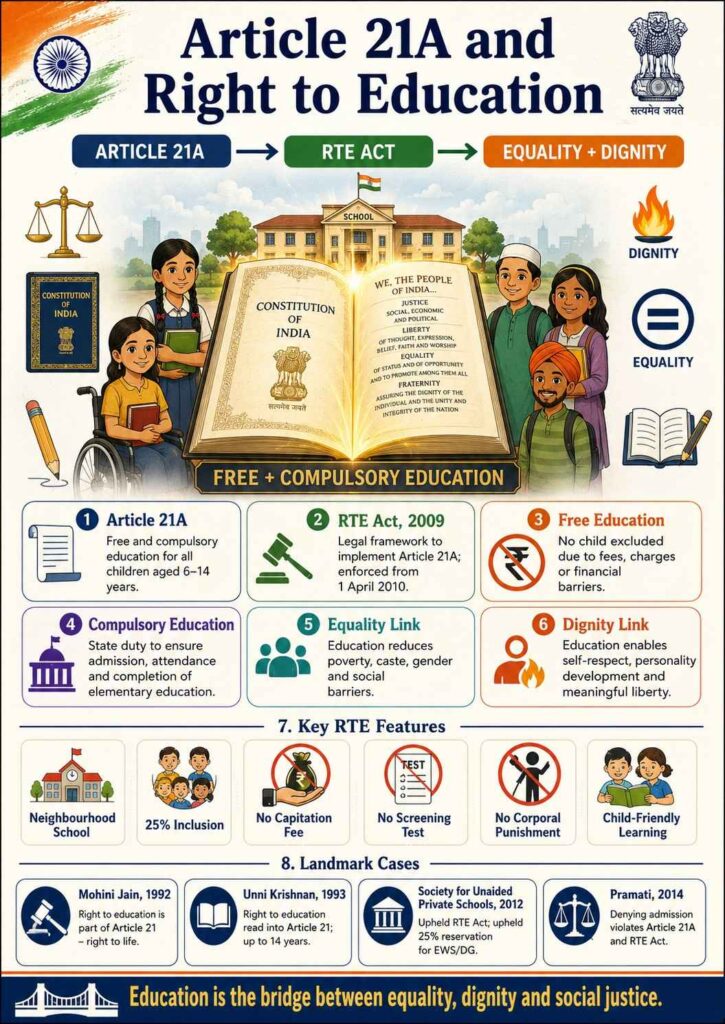
Introduction: Right to Education as a Constitutional Guarantee
➤ Core idea: The Right to Education means that every child must get meaningful access to elementary education, not merely formal admission into a school. Education is the foundation through which a person learns to think, participate in society, understand rights and duties, and live with dignity.
➤ Constitutional status: Article 21A of the Constitution of India provides that “The State shall provide free and compulsory education to all children of the age of six to fourteen years in such manner as the State may, by law, determine.” This provision was inserted by the Constitution (Eighty-sixth Amendment) Act, 2002, and the statutory mechanism for giving effect to it is mainly the Right of Children to Free and Compulsory Education Act, 2009, commonly called the RTE Act, 2009. The Ministry of Education records the RTE Act as Act No. 35 of 2009, enacted on 26 August 2009 and enforced from 1 April 2010.
➤ Separate treatment of concepts: The topic has four connected but separate parts: free and compulsory education, Article 21A, RTE Act, 2009, and the link of education with equality and dignity. Article 21A creates the constitutional right; the RTE Act explains how the right is to be implemented; equality ensures that poor and disadvantaged children are not excluded; dignity explains why education is necessary for a meaningful human life.
Historical Development of Right to Education in India
➤ Directive principle stage: Originally, the Constitution did not place the right to education expressly in Part III as a fundamental right. Instead, education for children was part of the Directive Principles of State Policy. The original Article 45 directed the State to endeavour to provide free and compulsory education to children until they completed the age of fourteen years.
➤ Judicial recognition before Article 21A: Before Article 21A was inserted, the Supreme Court read the right to education into Article 21, which guarantees the right to life and personal liberty. This was a major example of the broad interpretation of Article 21, where “life” was understood not merely as animal existence but as a life with human dignity.
➤ Constitutional amendment stage: The 86th Constitutional Amendment, 2002 changed the constitutional structure in three important ways: it inserted Article 21A as a fundamental right; substituted Article 45 to focus on early childhood care and education for children below six years; and inserted Article 51A(k), making it a fundamental duty of parents or guardians to provide opportunities for education to children between six and fourteen years. The Government of India’s official release records that Article 21A was inserted by the 86th Amendment and specifically guarantees free and compulsory education to children aged six to fourteen years.
Meaning of Free and Compulsory Education
➤ Free education: “Free” education means that a child should not be prevented from completing elementary education because of inability to pay. It is not limited to exemption from tuition fee. The idea is that no fee, charge, expense or financial burden should operate as a barrier to schooling. Therefore, the right becomes meaningful only when education is accessible to poor children, children from weaker sections, children from disadvantaged groups, children with social barriers, and children who are first-generation learners.
➤ Compulsory education: “Compulsory” does not mean that the child is punished for not attending school. It means that the State has a compulsory duty to ensure admission, attendance and completion of elementary education. The burden is shifted from the child or parents to the State machinery. The RTE framework therefore treats non-enrolment and dropout as governance issues, not as the fault of the child.
➤ Elementary education: Under the RTE Act, the focus is on education from Class I to Class VIII, corresponding to the age group of six to fourteen years. Article 21A does not expressly cover children below six years or education beyond fourteen years, though other constitutional provisions and welfare laws may be relevant for those stages.
➤ Neighbourhood school concept: A major feature of the RTE framework is that children should have access to a school in or near their neighbourhood. The idea is simple: the right becomes hollow if a child has to travel an unreasonable distance, face unsafe routes, or incur expenses that effectively exclude them from school.
Article 21A: Nature, Scope and Constitutional Importance
➤ Text and obligation: Article 21A imposes a constitutional obligation on the State to provide free and compulsory education to all children aged six to fourteen years. Its words “in such manner as the State may, by law, determine” mean that Parliament or the competent legislature can create a detailed statutory framework for implementation.
➤ Positive right: Article 21A is a positive fundamental right. Many fundamental rights restrain the State from interfering with liberty, but Article 21A requires the State to actively create conditions for education. This includes schools, teachers, infrastructure, admission systems, child-friendly classrooms, and mechanisms to include disadvantaged children.
➤ Connection with Article 21: Article 21A has an independent textual place in Part III, but its moral foundation comes from Article 21. Education enables a dignified life, informed choice, participation in democracy, and development of personality. A person who is denied basic education is often denied the real ability to use other rights.
➤ Connection with Directive Principles: Article 21A also reflects the movement of a Directive Principle into the field of enforceable fundamental rights. What was initially a directive constitutional promise became a justiciable right after the 86th Amendment.
RTE Act, 2009: Legislative Framework for Article 21A
➤ Purpose of the Act: The RTE Act, 2009 was enacted to give effect to Article 21A. Its long title states that it is an Act to provide for free and compulsory education to all children of the age of six to fourteen years. India Code identifies the Act as administered by the Ministry of Education and enforced from 1 April 2010.
➤ Section 3 — Right of child to free and compulsory education: Section 3 is the heart of the Act. It provides that every child of the age of six to fourteen years has a right to free and compulsory education in a neighbourhood school till completion of elementary education.
➤ Section 4 — Special training for non-admitted children: If a child above six years has not been admitted to any school or could not complete elementary education, the Act provides for admission in an age-appropriate class and special training. This is important because many children are out of school due to poverty, migration, labour, gender discrimination, disability, or social exclusion.
➤ Section 5 — Transfer to another school: The Act protects continuity of education when a child needs to move from one school to another. This is especially important for migrant children and children whose families shift residence.
➤ Sections 6 to 9 — Duties of government and local authority: These provisions place duties on the appropriate government and local authority to establish schools, ensure admission, provide infrastructure, train teachers, monitor attendance, and identify children requiring education. The Ministry of Education describes the RTE framework as specifying duties of governments and local authorities and providing for age-appropriate admission of non-admitted children.
➤ Section 10 — Duty of parents or guardians: Parents and guardians have a duty to admit or cause the child to be admitted to elementary education. However, the Act does not treat poverty-stricken parents as criminals; the main constitutional responsibility remains on the State.
➤ Section 11 — Pre-school education: Though Article 21A covers six to fourteen years, Section 11 enables the appropriate government to make necessary arrangements for pre-school education. This connects Article 21A with the substituted Article 45, which focuses on early childhood care and education for children below six years.
Schools, Admission and Inclusion under the RTE Act
➤ Section 12 — Responsibility of schools: Section 12 distributes obligations among government schools, aided schools, specified category schools, and unaided schools. Government schools must provide free and compulsory elementary education to all admitted children. Aided schools must provide free education at least in proportion to the aid received. Private unaided schools and specified category schools are required to admit children from weaker sections and disadvantaged groups to the extent of at least 25% of the strength of Class I or pre-school entry class, as applicable, and provide free and compulsory elementary education.
➤ Weaker section and disadvantaged group: The RTE Act uses these categories to ensure that formal equality does not hide real social inequality. “Weaker section” generally relates to economic disadvantage, while “disadvantaged group” covers social, cultural, geographical, linguistic, gender-based or other forms of disadvantage as notified or recognised under the Act and rules.
➤ No screening and no capitation fee: The Act prohibits admission screening procedures and capitation fee. This is crucial because interviews, tests, donations and informal charges often exclude poor children even before they enter school.
➤ No denial of admission for age or documents: The spirit of the Act is that procedural requirements should not defeat the child’s right. A child should not be denied education merely because of technical barriers such as late admission, lack of prior schooling, or difficulty in producing documents.
Child-Friendly Education under the RTE Act
➤ Section 16 — No detention policy and amendment: Originally, Section 16 prohibited holding back a child or expelling the child till completion of elementary education. Later, the law was amended to allow regular examination in Classes V and VIII and possible detention after additional instruction and re-examination, subject to the policy adopted by the appropriate government. PRS explains that the amendment allows the relevant central or state government to decide the manner and conditions in which a child may be held back after failure in re-examination.
➤ Section 17 — Prohibition of physical punishment and mental harassment: Section 17 prohibits physical punishment and mental harassment. This provision connects education directly with dignity. A child cannot be educated through fear, humiliation or violence. A school is constitutionally expected to be a safe and child-friendly environment.
➤ Section 21 — School Management Committee: The Act provides for School Management Committees in many schools to encourage local participation, parental involvement and community accountability.
➤ Section 23 — Teacher qualifications: Quality education requires trained teachers. The RTE framework therefore deals not only with admission but also with teacher qualifications, pupil-teacher ratio and educational standards.
➤ Section 24 — Duties of teachers: Teachers are expected to maintain regularity and punctuality, complete curriculum, assess learning ability, provide supplementary instruction where required, and hold meetings with parents.
➤ Section 25 — Pupil-teacher ratio: The Act requires maintenance of prescribed pupil-teacher ratios. This ensures that children do not merely sit in overcrowded classrooms without meaningful learning.
➤ Section 29 — Curriculum and evaluation: Curriculum must conform to constitutional values, all-round development of the child, child-centred learning, learning through activities and discovery, and making the child free from fear, trauma and anxiety. This is one of the strongest dignity-based provisions of the Act.
Connection between Right to Education, Equality and Dignity
➤ Education and equality: Education is a great equaliser because it reduces inherited social disadvantage. Without education, equality under Articles 14, 15 and 16 remains formal for millions of children. A child born into poverty, caste-based exclusion, gender discrimination, disability, migration or linguistic marginalisation cannot compete equally unless the State ensures basic education.
➤ Article 14 connection: Article 14 guarantees equality before law and equal protection of laws. Article 21A gives practical content to this equality by requiring the State to build a system where children are not excluded because of birth, poverty or social location.
➤ Article 15 connection: Article 15 prohibits discrimination and permits special provisions for children, socially and educationally backward classes, Scheduled Castes and Scheduled Tribes. The RTE Act’s 25% inclusion model in private unaided non-minority schools reflects this constitutional philosophy of substantive equality.
➤ Article 21 dignity connection: Education is part of a dignified life because it develops personality, self-respect, freedom of thought and capacity to participate in public life. The Supreme Court in Mohini Jain v. State of Karnataka, (1992) 3 SCC 666 directly linked education with Article 21 and dignity, holding that the right to life and dignity cannot be assured unless accompanied by the right to education.
➤ Democratic dignity: In a constitutional democracy, education is not only a private benefit. It enables citizens to understand voting, public institutions, laws, rights, duties, social justice and constitutional morality. A democracy with large-scale illiteracy cannot fully realise liberty, equality and fraternity.
Important Landmark Case Laws on Right to Education
Mohini Jain v. State of Karnataka, (1992) 3 SCC 666
➤ Facts, issue and ratio: In this case, the petitioner challenged the charging of heavy capitation fee by private medical colleges in Karnataka. The issue was whether such capitation fee violated the constitutional right to education and equality. The Supreme Court held that the right to education flows directly from Article 21 and that dignity under Article 21 cannot be assured without education. The Court treated capitation fee as destructive of equal access because it made education available only to the rich. This case is important because it first strongly constitutionalised education as part of the right to life.
Unni Krishnan, J.P. v. State of Andhra Pradesh, (1993) 1 SCC 645
➤ Facts, issue and ratio: Private professional educational institutions challenged State regulation of admissions and fees. The issue was whether the right to education is a fundamental right and, if yes, what is its extent. The Supreme Court partly modified Mohini Jain and held that the right to education is implicit in Article 21, but its enforceable content is limited by the State’s economic capacity and development. Importantly, the Court held that every child has a fundamental right to free education until the age of fourteen years, after which the right is subject to the State’s capacity. This judgment laid the direct judicial foundation for Article 21A.
T.M.A. Pai Foundation v. State of Karnataka, (2002) 8 SCC 481
➤ Facts, issue and ratio: An eleven-judge Bench examined the rights of private unaided and minority educational institutions to establish and administer educational institutions. The issue was how to balance institutional autonomy with State regulation in education. The Court held that establishing and administering educational institutions is protected under Article 19(1)(g), and minority institutions have special protection under Article 30. However, the State can impose reasonable regulations to maintain standards, transparency and fairness. This case is important because later RTE litigation had to balance Article 21A with Article 19(1)(g) and Article 30 rights.
Avinash Mehrotra v. Union of India, (2009) 6 SCC 398
➤ Facts, issue and ratio: This case arose from concerns about safety standards in schools, especially after tragic school fire incidents. The issue was whether school safety is part of the right to education and right to life. The Supreme Court treated safe school infrastructure as essential to Article 21 and Article 21A. The case is important because it shows that the right to education is not satisfied by opening schools alone; schools must be safe, humane and fit for children.
Society for Unaided Private Schools of Rajasthan v. Union of India, (2012) 6 SCC 1
➤ Facts, issue and ratio: Private unaided schools challenged the constitutional validity of the RTE Act, especially Section 12(1)(c), which required admission of at least 25% children from weaker sections and disadvantaged groups. The issue was whether this obligation violated the right of private schools under Article 19(1)(g) and the rights of minority institutions under Article 30. The Supreme Court upheld the RTE Act as valid for government schools, aided schools and private unaided non-minority schools, and held that the 25% obligation is not an unreasonable restriction. However, unaided minority institutions were protected from its application.
Pramati Educational and Cultural Trust v. Union of India, (2014) 8 SCC 1
➤ Facts, issue and ratio: Petitioners challenged the validity of Article 21A, Article 15(5), and the RTE Act on the ground that they affected private unaided and minority educational institutions. The issue was whether the constitutional provisions and RTE obligations were valid and how they applied to minority institutions. The Supreme Court upheld the constitutional validity of Article 21A and the RTE Act, but held that the RTE Act would not apply to minority educational institutions, whether aided or unaided, because it would affect their rights under Article 30(1). This case is important for understanding the current constitutional balance between child rights and minority educational autonomy.
Bandhua Mukti Morcha v. Union of India, (1997) 10 SCC 549
➤ Facts, issue and ratio: The case concerned child labour in the carpet industry and the exploitation of children below fourteen years. The issue was whether the State must take active measures to rescue children and provide welfare support. The Supreme Court directed measures relating to prohibition of child labour and access to education, health and welfare facilities. This case connects the right to education with freedom from exploitation under Articles 23 and 24 and with the dignity-based meaning of Article 21.
RTE Act and Substantive Equality
➤ Formal equality is insufficient: Treating all children the same on paper does not create equality in reality. A child from a wealthy household and a child from a poor, marginalised household do not begin from the same position. The RTE Act recognises this by providing special inclusion for children from weaker sections and disadvantaged groups.
➤ 25% admission rule as inclusion: Section 12(1)(c) is based on the idea that social integration in classrooms is part of constitutional equality. It is not merely about giving poor children seats in private schools; it is about reducing social segregation and giving every child the chance to learn in a diverse environment.
➤ No segregation principle: Children admitted under RTE should not be treated as a separate category within the classroom. If they are humiliated, segregated, marked differently, or denied participation, the purpose of equality is defeated.
➤ Gender equality: The right to education has special importance for girls because education delays child marriage, improves health, enhances economic independence and increases participation in public life.
➤ Caste and class equality: Education weakens inherited barriers of caste and class by giving children literacy, confidence, mobility and awareness of constitutional rights.
➤ Disability inclusion: Although Article 21A uses general language, inclusive education for children with disabilities must be read with equality, dignity and disability rights law. Reasonable accommodation, accessible infrastructure and trained teachers are necessary to make education real for children with disabilities.
RTE Act and Human Dignity
➤ Dignity in access: A child must not be forced to beg for admission, pay illegal charges, face discriminatory interviews, or remain out of school because of poverty. Dignity begins with equal entry.
➤ Dignity in classroom: The classroom must be free from corporal punishment, verbal abuse, caste insults, gender stereotypes, disability-based ridicule and economic humiliation. Section 17 of the RTE Act is therefore a dignity provision, not just a discipline rule.
➤ Dignity in learning: True education respects the child’s pace, language, background and individuality. A child-friendly curriculum under Section 29 recognises that fear and trauma are enemies of learning.
➤ Dignity in completion: The right is not only to enrol but to complete elementary education. Dropout due to poverty, discrimination or unsafe school conditions is a failure of the constitutional system.
Relationship with Other Constitutional Provisions
➤ Article 14: Article 21A advances equal protection by making basic education available to all children aged six to fourteen.
➤ Article 15(3): Special provisions for children are constitutionally permitted, and the RTE Act is an example of child-centred affirmative constitutional action.
➤ Article 19(1)(a): Freedom of speech and expression becomes meaningful when a person has basic literacy, awareness and reasoning ability.
➤ Article 19(1)(g): Private educational institutions have freedom to establish and administer institutions, but this freedom may be reasonably regulated to protect children’s right to education.
➤ Article 21: Education is necessary for life with dignity, personality development and meaningful liberty.
➤ Article 24: Prohibition of child labour in hazardous employment supports the right to education because a child forced into labour is effectively denied schooling.
➤ Article 30: Minority institutions have special constitutional protection, and the Supreme Court has balanced this protection against RTE obligations in Society for Unaided Private Schools and Pramati.
➤ Article 45: Early childhood care and education below six years supports readiness for Article 21A education.
➤ Article 51A(k): Parents and guardians have a fundamental duty to provide educational opportunities to children aged six to fourteen, but this does not dilute the State’s primary obligation under Article 21A.
Important Memory Table
| Concept | Simple Meaning | Constitutional/Statutory Link |
|---|---|---|
| Free education | No child should be excluded due to fees or expenses | Article 21A, Section 3 RTE Act |
| Compulsory education | State must ensure admission, attendance and completion | Article 21A, Sections 6–9 RTE Act |
| Neighbourhood school | School must be reasonably accessible | RTE Act framework |
| 25% inclusion | Private unaided non-minority schools must admit weaker/disadvantaged children at entry level | Section 12(1)(c) RTE Act |
| No capitation fee | No donation or illegal admission charge | RTE Act |
| No screening | No interview/test barrier for admission | RTE Act |
| No corporal punishment | No physical punishment or mental harassment | Section 17 RTE Act |
| Child-centred curriculum | Learning must be fear-free and dignity-based | Section 29 RTE Act |
Key Principles for Quick Revision
➤ State obligation principle: Article 21A primarily creates a duty on the State to provide free and compulsory education.
➤ Dignity principle: Education is part of the right to live with dignity under Article 21.
➤ Substantive equality principle: The RTE Act goes beyond formal equality by protecting weaker sections and disadvantaged groups.
➤ Access plus quality principle: The right to education includes not only admission but also safe schools, trained teachers, proper infrastructure and child-friendly learning.
➤ No exclusion principle: Poverty, caste, gender, disability, lack of documents, migration or social disadvantage should not exclude a child from elementary education.
➤ Balanced rights principle: Article 21A must be balanced with the autonomy of private and minority educational institutions, as explained in T.M.A. Pai, Society for Unaided Private Schools and Pramati.
Conclusion
➤ Final understanding: Article 21A transformed education from a policy goal into a fundamental right for children between six and fourteen years. The RTE Act, 2009 gives operational shape to this right by creating duties of governments, local authorities, schools, teachers and parents. Its provisions on free education, compulsory admission and completion, 25% inclusion, prohibition of screening, prohibition of capitation fee, child-friendly curriculum and protection from corporal punishment show that the right to education is not merely about entering a school building.
➤ Constitutional essence: The right to education is deeply connected with equality because it reduces social and economic exclusion. It is connected with dignity because education enables self-respect, personality development, informed choice and meaningful participation in democracy. In this sense, Article 21A is not an isolated provision; it is a bridge between liberty, equality, dignity and social justice.