Meaning and Constitutional Importance of Right Against Exploitation
➤ Core idea: Articles 23 and 24 of the Constitution of India create the constitutional protection known as the Right Against Exploitation. These provisions are placed in Part III, which means they are Fundamental Rights and are enforceable through constitutional remedies, especially Article 32 before the Supreme Court and Article 226 before High Courts.
➤ Human dignity: The purpose of Articles 23 and 24 is to protect human dignity from economic, social and physical exploitation. These Articles recognise that liberty is not real if a poor person, child, woman, migrant worker, bonded labourer or trafficked person is forced by helplessness to work in inhuman conditions.
➤ Social justice approach: These rights are not merely negative rights against State action. They impose a constitutional duty on the State to prevent exploitative practices in society. Article 23 expressly prohibits traffic in human beings, begar and other similar forms of forced labour, while Article 24 prohibits the employment of children below 14 years in factories, mines and hazardous employment.
➤ Horizontal application: Articles 23 and 24 are special because they operate not only against the State but also against private persons, contractors, employers, traffickers and exploiters. For example, a private contractor employing workers below minimum wage or a private factory employing a child in hazardous work may violate these constitutional rights.
Bare Text and Structure of Article 23
➤ Article 23(1): It prohibits “traffic in human beings and begar and other similar forms of forced labour” and declares that contravention of this prohibition shall be an offence punishable according to law.
➤ Article 23(2): It permits the State to impose compulsory service for public purposes, but while imposing such service, the State cannot discriminate only on grounds of religion, race, caste, class or any of them.
➤ Two-part design: Article 23 has one prohibitory part and one exception. The prohibitory part protects individuals against exploitation. The exception allows compulsory public service, such as national service, emergency service, community service or other legally authorised public duties, provided it is not discriminatory.
Meaning of Traffic in Human Beings under Article 23
➤ Human trafficking: “Traffic in human beings” means treating human beings as objects of trade, exploitation or profit. It includes recruitment, transportation, transfer, harbouring or receipt of persons for exploitation by force, fraud, coercion, abuse of power or inducement.
➤ Constitutional harm: Human trafficking violates personal liberty, bodily autonomy, dignity, equality and freedom. It may take many forms, including trafficking for sexual exploitation, forced labour, domestic servitude, begging, forced marriage, child labour, organ exploitation and other exploitative practices.
➤ Statutory support: Article 23 is supported by penal and welfare legislation. Presently, Section 143 BNS, 2023, corresponding broadly to earlier Section 370 IPC, deals with trafficking of persons. The Immoral Traffic (Prevention) Act, 1956 punishes keeping brothels, living on earnings of prostitution, procuring, inducing or taking a person for prostitution and detaining a person where prostitution is carried on.
➤ Not limited to sex trafficking: Article 23 is wider than sexual exploitation. It includes labour trafficking, bonded labour, trafficking of children for begging, trafficking for domestic work and trafficking for hazardous industries.
Meaning of Begar under Article 23
➤ Begar: Begar means labour or service taken from a person without payment or without the person’s free and voluntary consent. Historically, begar was a feudal practice where poor persons, lower caste communities and vulnerable labourers were forced to provide unpaid services to landlords, rulers or powerful persons.
➤ Constitutional abolition: Article 23 constitutionally abolishes such practices. The important point is that exploitation can exist even where there is no physical violence. Economic helplessness, social pressure, caste dominance, debt bondage or threat of losing livelihood can also make labour involuntary.
➤ Example: If a landlord forces a landless labourer to work without wages because the labourer’s family owes a debt, it is begar and bonded labour. If a local authority or influential person forces poor villagers to perform unpaid manual work without valid legal authority, it violates Article 23.
Meaning of Forced Labour under Article 23
➤ Wide meaning: “Forced labour” is not limited to slavery or physical compulsion. It includes labour extracted by physical force, legal coercion, economic compulsion, social pressure, debt bondage or helpless poverty.
➤ Minimum wage principle: The Supreme Court has interpreted Article 23 to mean that if a person is made to work for less than the statutory minimum wage, the labour may amount to forced labour because poverty may compel the worker to accept exploitative wages.
➤ Economic necessity: A person may appear to have agreed to work, but if the agreement is caused by hunger, poverty, debt, migration, illiteracy or lack of bargaining power, the consent is not truly free. Constitutional law therefore looks at the reality of the relationship, not merely the form of consent.
➤ Illustration: A construction worker accepts wages below the statutory minimum because otherwise his family will starve. Though he has technically “agreed”, the labour is constitutionally forced because the choice is not free in any real sense.
Bonded Labour and Article 23
➤ Bonded labour: Bonded labour exists when a person is forced to work because of debt, advance payment, caste obligation, customary duty or inherited liability. The worker’s freedom to leave employment is controlled by the creditor, employer or dominant person.
➤ Bonded Labour System (Abolition) Act, 1976: This Act abolishes the bonded labour system throughout India. It came into force from 25 October 1975 and relieves bonded labourers from any obligation to render bonded labour.
➤ Constitutional effect: Since bonded labour is a direct form of forced labour, it violates Article 23. The abolition of bonded labour is not complete merely by releasing workers. Rehabilitation, livelihood support, housing, health, education and protection from re-bondage are also important.
➤ Practical reality: Bonded labour often appears in disguised forms, such as advance-based employment, brick kiln labour, stone quarry labour, agricultural bondage, domestic servitude, forced migration work, caste-based labour and child bondage.
Article 23(2): Compulsory Service for Public Purpose
➤ Permissible compulsory service: Article 23 does not prohibit every kind of compulsory service. The State may impose compulsory service if it is for a public purpose. Examples may include compulsory civic duties, emergency relief work, disaster management duties, military or national service if legally provided, or community service required by law.
➤ Non-discrimination condition: The State cannot impose compulsory service in a discriminatory manner only on grounds of religion, race, caste, class or any of them.
➤ Important distinction: Compulsory service for public purpose is valid only when it is authorised by law, connected with public interest and non-discriminatory. It cannot be a mask for caste labour, unpaid private work or exploitation of poor persons.
Bare Text and Structure of Article 24
➤ Article 24: It provides that no child below the age of fourteen years shall be employed to work in any factory or mine or engaged in any other hazardous employment.
➤ Purpose: Article 24 protects childhood, health, education and development. It recognises that children must not be pushed into dangerous labour at an age when they should be protected, educated and allowed to grow safely.
➤ Absolute prohibition in covered areas: Article 24 absolutely prohibits employment of children below 14 in factories, mines and hazardous employment. It does not merely regulate their working conditions; it forbids such employment itself.
Child Labour and Hazardous Employment
➤ Child labour: Child labour means employment or engagement of children in work that deprives them of childhood, education, health, dignity or development. All work done by children is not automatically treated alike, but exploitative and hazardous work is constitutionally prohibited.
➤ Hazardous employment: Hazardous employment means work that is dangerous to the child’s physical or mental health, safety, morals or development. It includes work in factories, mines, explosives, chemicals, dangerous machinery, toxic substances, excessive heat, unsafe construction, and other harmful processes.
➤ Child and Adolescent Labour Act: The Child and Adolescent Labour (Prohibition and Regulation) Act, 1986, as amended in 2016, prohibits the engagement of children below 14 years in all occupations and processes and prohibits adolescents between 14 and 18 years in hazardous occupations and processes. The 2016 amendment came into force from 1 September 2016 and also made punishments stricter and the offence cognizable.
➤ Child and adolescent distinction: A child means a person below 14 years. An adolescent means a person who has completed 14 years but has not completed 18 years. The law gives stronger protection to children and special protection to adolescents against hazardous work.
Relationship between Articles 23, 24, 21, 21A and Directive Principles
➤ Article 21: Exploitation violates the right to life with dignity. Forced labour, trafficking, bonded labour and hazardous child labour reduce human beings to instruments of profit and therefore offend Article 21.
➤ Article 21A: Children between 6 and 14 years have a fundamental right to free and compulsory education. Child labour directly conflicts with education because a child working in exploitative conditions cannot effectively attend school.
➤ Article 39(e): The State must ensure that the health and strength of workers and the tender age of children are not abused.
➤ Article 39(f): Children must be given opportunities and facilities to develop in a healthy manner and in conditions of freedom and dignity.
➤ Article 45: The State must endeavour to provide early childhood care and education for children below 6 years.
➤ Article 51A(k): Parents or guardians have a fundamental duty to provide opportunities for education to children between 6 and 14 years.
➤ Integrated reading: Articles 23 and 24 must be read with Articles 21, 21A, 39, 45 and 51A(k). Together, they create a constitutional framework against exploitation and for dignity, education, rehabilitation and social justice.
Landmark Supreme Court Cases on Article 23
People’s Union for Democratic Rights v. Union of India, (1982) 3 SCC 235
➤ Facts: This case arose from the exploitation of workers engaged in construction projects connected with the Asian Games in Delhi. Workers were allegedly paid below minimum wages and labour laws were violated.
➤ Issue: Whether payment below minimum wages and exploitative conditions could amount to forced labour under Article 23.
➤ Ratio: The Supreme Court held that Article 23 has a wide meaning and includes labour obtained through economic compulsion. The Court held that where a person provides labour for less than the minimum wage, it may amount to forced labour because poverty and helplessness can compel acceptance of such work.
➤ Importance: This case is the foundation for the principle that non-payment of minimum wages is not merely a labour law violation but may also be a constitutional violation under Article 23.
Sanjit Roy v. State of Rajasthan, (1983) 1 SCC 525
➤ Facts: Workers were employed in famine relief work in Rajasthan and paid less than minimum wages under a law that exempted famine relief work from labour law requirements.
➤ Issue: Whether the State could pay less than minimum wages in relief work on the ground that the work was meant to provide aid during famine.
➤ Ratio: The Supreme Court held that even famine relief workers must be paid minimum wages. A law excluding minimum wages in such work could not survive against Article 23.
➤ Importance: The case clarifies that poverty, drought or famine cannot be used as an excuse by the State to extract underpaid labour. Public welfare work must also respect human dignity.
Bandhua Mukti Morcha v. Union of India, (1984) 3 SCC 161
➤ Facts: A public interest petition exposed the condition of bonded labourers working in stone quarries in Haryana. The petition alleged non-implementation of labour welfare laws and existence of bonded labour.
➤ Issue: Whether the Court could intervene through PIL to identify, release and rehabilitate bonded labourers.
➤ Ratio: The Supreme Court treated bonded labour as a grave violation of Articles 21 and 23. It issued directions for identification, release, welfare and rehabilitation of bonded labourers.
➤ Importance: The case expanded PIL jurisdiction and made the Court an active protector of bonded labourers. It recognised that constitutional rights are meaningless unless the State identifies and rehabilitates victims.
Neeraja Chaudhary v. State of Madhya Pradesh, (1984) 3 SCC 243
➤ Facts: The case concerned rehabilitation of released bonded labourers who had been freed but not properly rehabilitated.
➤ Issue: Whether release from bondage alone is sufficient compliance with Article 23 and bonded labour laws.
➤ Ratio: The Supreme Court emphasised that rehabilitation is essential. If released bonded labourers are not rehabilitated, they may fall back into bondage.
➤ Importance: The case established that freedom from bonded labour includes meaningful rehabilitation, not merely formal release.
Deena v. Union of India, (1983) 4 SCC 645
➤ Facts: The case concerned labour taken from prisoners and the question of proper remuneration.
➤ Issue: Whether taking labour from prisoners without proper remuneration could violate Article 23.
➤ Ratio: The Supreme Court accepted that prison labour cannot become a form of exploitation. Conviction does not destroy human dignity.
➤ Importance: The case shows that Article 23 protects even persons in custody from exploitative labour practices.
Landmark Supreme Court Cases on Human Trafficking and Exploitation
Vishal Jeet v. Union of India, (1990) 3 SCC 318
➤ Facts: A public interest petition was filed concerning forced prostitution, child prostitution, Devadasi and Jogin practices, and trafficking of women and children.
➤ Issue: Whether the Supreme Court should issue directions for prevention, rescue and rehabilitation of victims of trafficking and forced prostitution.
➤ Ratio: The Court directed the Union and State Governments to take effective steps under existing laws to eradicate child prostitution and rehabilitate victims.
➤ Importance: This case is a landmark in treating trafficking and sexual exploitation as constitutional wrongs requiring rescue, protection and rehabilitation.
Gaurav Jain v. Union of India, (1997) 8 SCC 114
➤ Facts: The case concerned the rights and rehabilitation of children of women in prostitution.
➤ Issue: Whether children of women in prostitution should receive special protection, education and rehabilitation.
➤ Ratio: The Supreme Court emphasised that children must not be allowed to fall into the same exploitative cycle and directed measures for their education, protection and rehabilitation.
➤ Importance: The case connects Article 23 with child dignity, education, rehabilitation and the State’s duty to prevent intergenerational exploitation.
Landmark Supreme Court Cases on Article 24 and Child Labour
M.C. Mehta v. State of Tamil Nadu, (1996) 6 SCC 756
➤ Facts: The case concerned child labour in hazardous industries, especially the match and fireworks industries of Sivakasi. The Supreme Court considered the serious risks to children working in such hazardous conditions.
➤ Issue: What directions should be issued to eliminate child labour in hazardous employment and rehabilitate affected children.
➤ Ratio: The Court directed that employers illegally employing children in hazardous work must pay compensation of ₹20,000 per child into a Child Labour Rehabilitation-cum-Welfare Fund. It also directed the State to provide employment to an adult member of the child’s family where possible, or contribute financial assistance.
➤ Importance: This case converted Article 24 into an enforceable rehabilitation framework. It recognised that merely removing a child from hazardous work is not enough; the economic condition of the family must also be addressed.
Bandhua Mukti Morcha v. Union of India, (1997) 10 SCC 549
➤ Facts: This later child labour-related decision concerned children working in the carpet industry and the need for welfare measures.
➤ Issue: Whether employment of children in hazardous industries and exploitative conditions violated constitutional guarantees.
➤ Ratio: The Supreme Court stressed the need for education, health, nutrition, sanitation and protection of children from exploitative labour. It connected child labour with poverty and lack of education.
➤ Importance: The case strengthened the principle that child labour cannot be solved only by prohibition; it requires education, family support and welfare measures.
Bachpan Bachao Andolan v. Union of India, (2011) 5 SCC 1
➤ Facts: The case concerned children allegedly trafficked and employed in circuses and similar exploitative conditions.
➤ Issue: Whether children could be kept in such exploitative work environments and what protective directions were needed.
➤ Ratio: The Supreme Court directed rescue, rehabilitation and protection of children and emphasised strict action against child exploitation.
➤ Importance: The case shows the modern application of Articles 23 and 24 to child trafficking, forced labour and exploitative entertainment or informal industries.
Comparative Table: Article 23 and Article 24
| Basis | Article 23 | Article 24 |
|---|---|---|
| Main protection | Prohibits trafficking, begar and forced labour | Prohibits employment of children below 14 in factories, mines and hazardous employment |
| Beneficiaries | All persons, including adults and children | Children below 14 years |
| Nature | Broad anti-exploitation right | Specific child-protection right |
| Against whom enforceable | State and private persons | State and private employers |
| Key concern | Human dignity, free labour, anti-slavery, anti-trafficking | Childhood, health, education, safety |
| Exception | Compulsory service for public purpose, without discrimination | No constitutional exception for hazardous employment below 14 |
| Important laws | BNS, Immoral Traffic Act, Bonded Labour Act, labour welfare laws | Child and Adolescent Labour Act, Factories law, Mines law, education laws |
| Landmark cases | PUDR, Sanjit Roy, Bandhua Mukti Morcha, Neeraja Chaudhary | M.C. Mehta, Bandhua Mukti Morcha, Bachpan Bachao Andolan |
Important Legal Principles for Quick Revision
➤ Article 23 is wider than slavery: It covers trafficking, begar, bonded labour, underpaid forced labour and labour obtained through economic compulsion.
➤ Consent is not always real: If poverty, debt, hunger, caste pressure or helplessness compels a person to work, the law may treat the labour as forced.
➤ Minimum wage is constitutional: Payment below minimum wage can amount to forced labour under Article 23.
➤ Private exploitation is covered: Articles 23 and 24 can apply against private employers, contractors and traffickers.
➤ Bonded labour requires rehabilitation: Release without rehabilitation is incomplete because the worker may return to bondage.
➤ Article 24 protects childhood: Children below 14 cannot be employed in factories, mines or hazardous employment.
➤ Child labour is linked with education: Article 24 must be read with Article 21A because child labour often destroys the child’s right to education.
➤ Hazardous employment is absolutely prohibited for children below 14: The Constitution does not allow balancing of economic necessity against child safety in such cases.
➤ Adolescents also receive statutory protection: Under the Child and Adolescent Labour law, adolescents between 14 and 18 years are protected from hazardous occupations and processes.
➤ Trafficking needs rescue and rehabilitation: Constitutional protection is incomplete without victim identification, protection, compensation, counselling, education and reintegration.
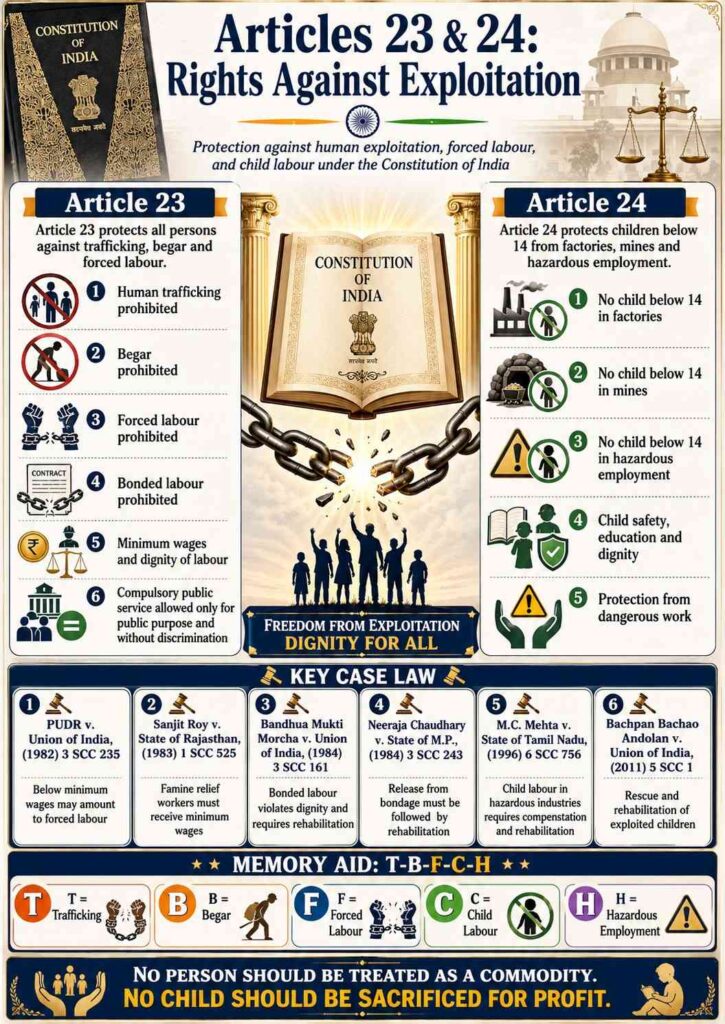
Memory Aid: “T-B-F-C-H”
➤ T — Trafficking: Article 23 prohibits traffic in human beings.
➤ B — Begar: Article 23 prohibits unpaid compulsory labour.
➤ F — Forced labour: Article 23 prohibits labour extracted by force, poverty, debt or compulsion.
➤ C — Child labour: Article 24 protects children below 14 from factory, mine and hazardous work.
➤ H — Hazardous employment: Dangerous work for children is constitutionally prohibited.
Conclusion
➤ Final understanding: Articles 23 and 24 are powerful constitutional weapons against exploitation. Article 23 attacks the exploitation of human beings through trafficking, begar, bonded labour and forced labour. Article 24 protects children from being pushed into factories, mines and hazardous employment before the age of 14.
➤ Judicial development: The Supreme Court has given these Articles a broad, humane and purposive interpretation. Through cases such as PUDR, Sanjit Roy, Bandhua Mukti Morcha, Neeraja Chaudhary, Vishal Jeet and M.C. Mehta, the Court has made it clear that exploitation is not limited to visible chains. Poverty, debt, social domination, trafficking networks and lack of education can also create invisible chains.
➤ Constitutional message: The right against exploitation is based on one central idea: no person should be treated as a commodity, and no child should be sacrificed for profit. These Articles convert the promise of dignity into enforceable constitutional protection for the most vulnerable sections of society.