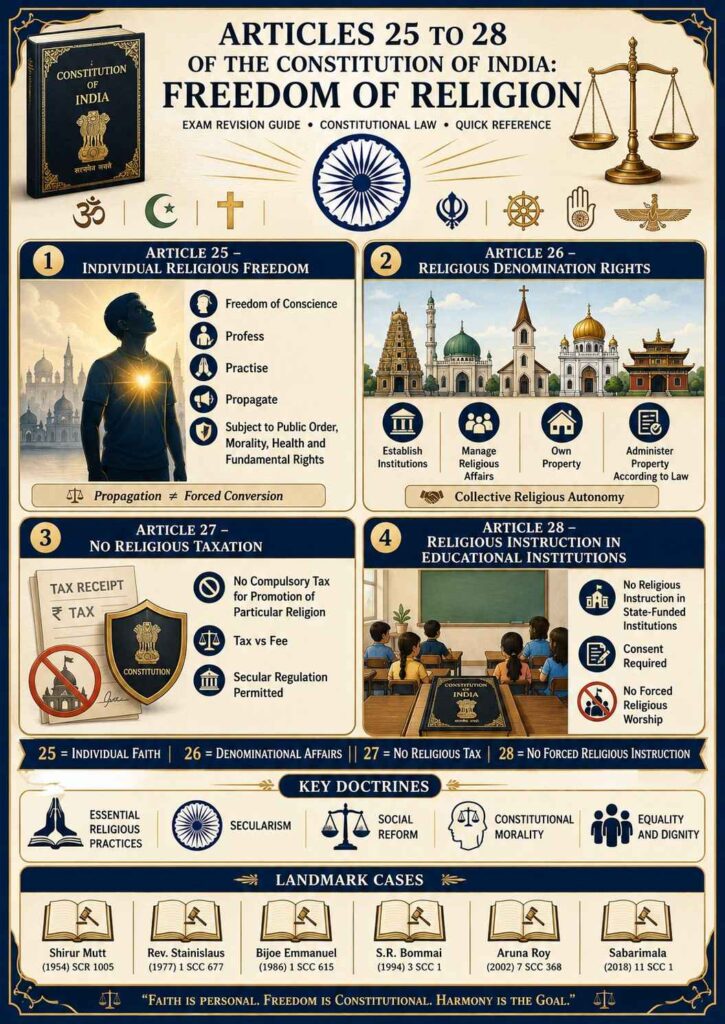
Meaning and Constitutional Scheme of Freedom of Religion
➤ Core idea: Articles 25 to 28 of the Constitution of India protect the Right to Freedom of Religion. These provisions recognise that religion, faith, worship, belief, conscience and religious identity are deeply personal matters, but they also ensure that religious freedom does not disturb public order, morality, health, equality, dignity and social reform.
➤ Indian model of secularism: Indian secularism does not mean hostility towards religion. It means that the State does not identify itself with any one religion and must treat all religions with equal respect. The Supreme Court in S.R. Bommai v. Union of India, AIR 1994 SC 1918: (1994) 3 SCC 1 held that secularism is a basic feature of the Constitution. The Court clarified that religion and State power cannot be mixed in a manner that destroys constitutional equality, unity and neutrality.
➤ Articles covered: The freedom of religion chapter contains four provisions: Article 25 protects individual religious freedom; Article 26 protects collective denominational religious freedom; Article 27 prevents compulsory taxation for promoting a particular religion; and Article 28 regulates religious instruction and worship in educational institutions. The Constitution of India lists Articles 25 to 28 as part of the Fundamental Rights under Part III.
➤ Not absolute: Religious freedom is not unlimited. Article 25 itself makes it subject to public order, morality, health and other Fundamental Rights. Article 26 is subject to public order, morality and health. Therefore, religious liberty must be harmonised with constitutional morality, gender justice, social welfare, public safety and the rights of others.
Article 25: Freedom of Conscience and Free Profession, Practice and Propagation of Religion
➤ Textual essence: Article 25(1) says that, subject to public order, morality, health and other provisions of Part III, all persons are equally entitled to freedom of conscience and the right freely to profess, practise and propagate religion. Article 25 applies to all persons, not merely citizens. This means that foreigners and non-citizens present in India can also claim this protection. The official constitutional text recognises freedom of conscience and the rights to profess, practise and propagate religion under Article 25.
➤ Freedom of conscience: Conscience means the inner freedom of a person to believe, not believe, change belief, question belief or follow a moral-religious conviction. It protects the internal forum of belief. A person may believe in God, many gods, no god, or a philosophical way of life. The State cannot compel a person to accept a religious belief.
➤ Profession of religion: Profession means the open declaration of one’s religious faith. For example, wearing religious symbols, declaring one’s religious identity, observing rituals publicly or identifying oneself as belonging to a particular religion may fall within profession, subject to constitutional limits.
➤ Practice of religion: Practice means performance of religious acts, rituals, ceremonies, observances and modes of worship. However, only those practices that are religious in nature and constitutionally protected can claim protection. Practices that are economic, financial, political or secular may be regulated by the State under Article 25(2)(a).
➤ Propagation of religion: Propagation means transmitting, explaining, spreading or communicating the tenets of one’s religion. It does not mean a fundamental right to forcibly convert another person. The distinction is important: a person may explain and spread religious ideas, but cannot destroy another person’s freedom of conscience by force, fraud, coercion or inducement.
➤ Rev. Stainislaus v. State of Madhya Pradesh, 1977 SCR (2) 611: (1977) 1 SCC 677: The petitioners challenged anti-conversion laws of Madhya Pradesh and Odisha, arguing that the right to propagate religion included the right to convert others. The legal issue was whether Article 25 protects conversion as part of propagation. The Supreme Court upheld the laws and held that the right to propagate means the right to transmit or spread one’s religion, but it does not include a fundamental right to convert another person. The ratio is that every person has freedom of conscience; therefore, one person’s religious propagation cannot become another person’s coerced religious conversion.
➤ Bijoe Emmanuel v. State of Kerala, (1986) 3 SCC 615: In this case, three Jehovah’s Witness students respectfully stood during the National Anthem but did not sing it because their religious belief prevented them from doing so. They were expelled from school. The issue was whether refusal to sing, while standing respectfully, violated law or justified punishment. The Supreme Court held that the expulsion violated their rights under Articles 19(1)(a) and 25. The ratio is that genuine freedom of conscience must be protected when the conduct is peaceful, respectful and does not disturb public order. The case is important because it shows that Article 25 protects not only loud or visible religious acts but also quiet conscientious refusal.
Article 25(2): State Power to Regulate Secular Activities and Bring Social Reform
➤ Secular activities connected with religion: Article 25(2)(a) allows the State to regulate or restrict economic, financial, political or other secular activity associated with religious practice. This means that the State cannot ordinarily interfere with essential religious belief or worship, but it may regulate administration, finance, property, public order, management and secular arrangements connected with religious institutions.
➤ Social welfare and reform: Article 25(2)(b) allows the State to make laws for social welfare and reform and for throwing open Hindu religious institutions of a public character to all classes and sections of Hindus. Explanation II clarifies that, for this purpose, references to Hindus include Sikhs, Jains and Buddhists. This clause enables constitutional reform of exclusionary practices in public religious institutions.
➤ Kirpan protection: Explanation I to Article 25 states that wearing and carrying kirpans shall be deemed to be included in the profession of the Sikh religion. This is a specific constitutional recognition of a Sikh religious practice.
➤ Constitutional balance: Article 25(2) shows that India protects religion but does not freeze society in the name of religion. If a practice is purely secular, exploitative, exclusionary or contrary to constitutional values, the State may regulate it. The key question is whether the regulated matter is truly religious or merely secular activity associated with religion.
Article 26: Freedom to Manage Religious Affairs
➤ Collective religious freedom: Article 26 gives every religious denomination or any section thereof the right to manage its own religious affairs, subject to public order, morality and health. While Article 25 mainly protects individual religious freedom, Article 26 protects group or denominational autonomy.
➤ Four rights under Article 26: A religious denomination has the right to establish and maintain institutions for religious and charitable purposes; manage its own affairs in matters of religion; own and acquire movable and immovable property; and administer such property in accordance with law. Article 26 therefore protects both spiritual autonomy and institutional existence, but property administration remains subject to law.
➤ Religious denomination meaning: A religious denomination generally means a collection of individuals having a common faith, common organisation and distinctive name. A sect or sub-sect may qualify if it has a distinct religious identity and organisational structure.
➤ Commissioner, Hindu Religious Endowments, Madras v. Sri Lakshmindra Thirtha Swamiar of Sri Shirur Mutt, AIR 1954 SC 282: 1954 SCR 1005: This is the foundational case on Articles 25 and 26. The Madras Hindu Religious and Charitable Endowments Act was challenged by the head of Shirur Mutt. The issue was the extent to which the State could control religious institutions. The Supreme Court held that religion includes matters of faith, doctrine and acts done in pursuance of religion. It also held that religious denominations have autonomy in matters of religion, while secular administration can be regulated. The case laid the foundation of the essential religious practices doctrine.
➤ Ratilal Panachand Gandhi v. State of Bombay, AIR 1954 SC 388: 1954 SCR 1055: The Bombay Public Trusts Act was challenged as interfering with religious and charitable trusts. The issue was whether the State could control religious trust administration in a way that impaired religious freedom. The Supreme Court held that freedom of religion includes the right to manage religious affairs, but secular administration of property can be regulated. The ratio is that State regulation cannot destroy the substance of denominational religious freedom.
➤ Seshammal v. State of Tamil Nadu, (1972) 2 SCC 11: The Tamil Nadu law abolished hereditary appointment of archakas in temples. The issue was whether hereditary succession to priesthood was an essential religious practice. The Supreme Court held that hereditary succession was not essential to religion and could be abolished. The ratio is that performance of rituals according to Agamas may be religious, but hereditary office-holding is a secular or administrative matter capable of reform.
➤ N. Adithayan v. Travancore Devaswom Board, (2002) 8 SCC 106: A non-Brahmin priest was appointed in a temple and the appointment was challenged on caste-based grounds. The issue was whether only a Brahmin could be appointed as priest. The Supreme Court held that caste alone cannot disqualify a person from priesthood if the person is properly trained and qualified to perform rituals. The ratio is that caste-based exclusion cannot be treated as an essential religious practice when it violates constitutional equality and reformist principles.
Essential Religious Practices Doctrine
➤ Meaning of ERP doctrine: The Essential Religious Practices doctrine is a judicial test used to decide whether a particular practice is so essential and integral to a religion that it deserves constitutional protection under Articles 25 and 26. If the practice is essential, the State’s interference is more strictly examined. If it is secular, optional, superstitious, administrative or non-essential, it may be regulated.
➤ Origin: The doctrine developed prominently from Shirur Mutt, where the Supreme Court recognised that a religion may include rituals and observances that are integral to it. Later cases refined the doctrine by asking whether a claimed practice is essential according to the doctrines, beliefs and structure of that religion.
➤ Durgah Committee, Ajmer v. Syed Hussain Ali, AIR 1961 SC 1402: The issue concerned the management of the Ajmer Dargah and the rights claimed by certain persons associated with it. The Supreme Court warned that purely secular practices or practices that are merely superstitious or extraneous cannot automatically receive constitutional protection. The ratio is that courts may distinguish essential religious matters from non-essential accretions.
➤ Acharya Jagadishwarananda Avadhuta v. Commissioner of Police, Calcutta, (2004) 12 SCC 770: The Anand Margis claimed a right to perform the Tandava dance in public procession. The issue was whether the Tandava dance in public was an essential religious practice of the sect. The Supreme Court held that it was not proved to be essential. The ratio is that a practice introduced later or not shown to be fundamental to the faith may not qualify as essential.
➤ State of West Bengal v. Ashutosh Lahiri, (1995) 1 SCC 189: The issue was whether cow slaughter on Bakr-Id was an essential practice of Islam so as to justify exemption from animal slaughter restrictions. The Supreme Court held that cow slaughter on Bakr-Id was not an essential religious practice. The ratio is that a practice may be associated with a festival but still not be indispensable to the religion.
➤ Indian Young Lawyers Association v. State of Kerala, (2019) 11 SCC 1: In the Sabarimala case, women between the ages of 10 and 50 were prohibited from entering the Sabarimala temple. The issue was whether this exclusion was protected under Articles 25 and 26 or violated equality, dignity and non-discrimination. By a 4:1 majority, the Supreme Court held that the exclusion was unconstitutional. The majority reasoned that the practice violated constitutional principles of equality and dignity and was not protected as an essential religious practice in the manner claimed. The case is a major example of conflict between denominational autonomy and individual equality.
➤ Critical understanding: The ERP doctrine is useful because it prevents every custom from claiming immunity as religion. However, it is also criticised because judges are required to decide theological questions. The better understanding is that courts examine religious practices only to the extent necessary to apply constitutional limitations such as public order, morality, health, equality and dignity.
Article 27: Freedom from Taxation for Promotion of a Particular Religion
➤ Core protection: Article 27 says that no person shall be compelled to pay any tax, the proceeds of which are specifically appropriated for payment of expenses for the promotion or maintenance of any particular religion or religious denomination.
➤ Tax versus fee: The key distinction is between a tax and a fee. A tax is a compulsory exaction for general public purposes. A fee is generally charged for a specific service or regulatory purpose. Article 27 prohibits compulsory taxation for promoting a particular religion, but it does not prohibit regulatory fees for administration, safety, sanitation, public order or preservation of religious institutions.
➤ Constitutional purpose: Article 27 prevents the State from using public taxation to favour one religion. It protects taxpayers from being forced to financially support religious promotion against their conscience.
➤ Shirur Mutt and Article 27: In Shirur Mutt, the Supreme Court examined whether contributions imposed under the religious endowments law were taxes or fees. The case is important because it connected Article 27 with State regulation of religious institutions. The broader principle is that a levy for secular administration may survive, but a tax specifically used to promote a religion would offend Article 27.
➤ Permissible State spending: Article 27 does not prohibit all State expenditure connected with religious places. For example, expenditure for crowd control, heritage protection, public health, law and order, archaeological preservation or welfare facilities may be secular. What is prohibited is compulsory taxation specifically appropriated for promoting or maintaining a particular religion.
Article 28: Freedom Regarding Religious Instruction and Worship in Educational Institutions
➤ Basic rule: Article 28 deals with religious instruction and religious worship in educational institutions. It balances religious neutrality of State-funded education with the rights of institutions created under religious endowments or trusts.
➤ Article 28(1): No religious instruction shall be provided in any educational institution wholly maintained out of State funds. This ensures that State-funded education remains secular and does not become a tool for religious indoctrination.
➤ Article 28(2): The prohibition does not apply to an institution administered by the State but established under an endowment or trust requiring religious instruction. For example, if a trust created an institution with a mandate for religious teaching and the State later administers it, the original endowment condition may be respected.
➤ Article 28(3): No person attending an educational institution recognised by the State or receiving State aid shall be required to take part in religious instruction or worship without consent. For minors, consent of the guardian is relevant. This protects students from compelled religious participation.
➤ Aruna Roy v. Union of India, (2002) 7 SCC 368: The National Curriculum Framework was challenged on the ground that value education would introduce religious instruction. The issue was whether teaching about religions, culture and moral values violates Article 28. The Supreme Court held that education about religions and moral values is different from imparting religious instruction for conversion or indoctrination. The ratio is that comparative study, ethical education and constitutional values are permissible, but compulsory sectarian religious instruction in State-funded institutions is not.
➤ Bijoe Emmanuel connection: Article 28 protects students from compulsory religious instruction or worship, while Bijoe Emmanuel protects conscience even in a national-symbol context. Together, these principles show that education must not crush sincere conscience, provided the student’s conduct remains peaceful and respectful.
Public Order, Morality and Health as Limits on Religious Freedom
➤ Public order: Religious freedom cannot be used to justify violence, riots, coercion, obstruction of public streets, forced conversion, public disorder or activities threatening peace. The State may regulate processions, loudspeakers, gatherings and public rituals if necessary for maintaining order.
➤ Morality: Morality in constitutional law increasingly means constitutional morality, not merely popular morality. Practices degrading dignity, equality or bodily autonomy may be tested against constitutional values. The Sabarimala decision is a major example of equality and dignity being considered in the context of religious practice.
➤ Health: The State may regulate religious practices that endanger public health. For example, restrictions may be imposed during epidemics, unsafe gatherings, pollution-causing practices or physically harmful rituals. The right to practise religion does not include a right to endanger life and health.
➤ Other Fundamental Rights: Article 25 is expressly subject to other provisions of Part III. Therefore, religious freedom must coexist with equality under Article 14, non-discrimination under Article 15, freedom of speech under Article 19, life and dignity under Article 21 and abolition of untouchability under Article 17.
Secularism and Constitutional Morality
➤ Equal respect principle: Indian secularism is often described as principled distance or equal respect for all religions. The State may engage with religion for reform, welfare, equality and regulation, but it cannot identify itself with one religion or discriminate between religions.
➤ S.R. Bommai principle: In S.R. Bommai, the Supreme Court held that secularism is part of the basic structure. The ratio is that the State cannot pursue non-secular governance and political power cannot be used to advance religious domination.
➤ Ismail Faruqui v. Union of India, (1994) 6 SCC 360: The acquisition of land around the disputed Ayodhya site was challenged. The Supreme Court considered the relationship between places of worship and religious freedom. The broader ratio was that a mosque, temple or church may be important for worship, but State acquisition of property connected with a religious place is not automatically unconstitutional if worship itself is not extinguished and the acquisition serves a valid secular purpose. This case is often discussed for the distinction between religious worship and property rights.
➤ Shayara Bano v. Union of India, (2017) 9 SCC 1: Though mainly a personal law case concerning instant triple talaq, it is relevant to the relationship between religion, gender justice and constitutional values. The Supreme Court set aside the practice of talaq-e-biddat. The case shows that practices claimed under religion may be tested when they affect equality, dignity and legal rights.
Important Comparative Table for Quick Revision
| Provision | Protected Area | Beneficiary | Main Limitation | Key Idea |
|---|---|---|---|---|
| Article 25 | Conscience, profession, practice, propagation | All persons | Public order, morality, health, other Fundamental Rights | Individual religious freedom |
| Article 26 | Religious denomination’s affairs | Religious denominations or sections | Public order, morality, health | Collective religious autonomy |
| Article 27 | Protection from religious taxation | All taxpayers/persons | Does not bar secular regulatory fees | No tax for promotion of a particular religion |
| Article 28 | Religious instruction and worship in educational institutions | Students and institutions | Depends on State funding, trust/endowment and consent | Secular education and freedom from compulsion |
Important Doctrines and Principles
➤ Essential Religious Practices: Only practices essential and integral to a religion receive strong constitutional protection. Non-essential, secular or administrative matters may be regulated.
➤ Secular Regulation Doctrine: The State may regulate economic, financial, political and secular activities associated with religion under Article 25(2)(a).
➤ Social Reform Doctrine: The State may enact laws for social welfare and reform, including opening public Hindu religious institutions to all classes and sections under Article 25(2)(b).
➤ Freedom of Conscience: Article 25 protects the inner freedom to believe, not believe, change belief or refuse participation in conduct contrary to sincere conviction.
➤ No Forced Religious Support: Article 27 protects individuals from being compelled through taxation to support promotion of a particular religion.
➤ No Compulsory Religious Instruction: Article 28 protects students from compulsory religious instruction or worship in State-connected educational institutions.
Landmark Case-Law Summary
| Case | Citation | Main Point |
|---|---|---|
| Shirur Mutt Case | AIR 1954 SC 282; 1954 SCR 1005 | Religion includes essential practices; secular administration can be regulated |
| Ratilal Panachand Gandhi | AIR 1954 SC 388; 1954 SCR 1055 | Religious trusts have protection, but property administration may be regulated |
| Durgah Committee, Ajmer | AIR 1961 SC 1402 | Superstitious or non-essential practices are not automatically protected |
| Rev. Stainislaus | (1977) 1 SCC 677 | Propagation does not include right to convert another person |
| Bijoe Emmanuel | (1986) 3 SCC 615 | Genuine conscience deserves protection when conduct is peaceful |
| S.R. Bommai | (1994) 3 SCC 1 | Secularism is a basic feature of the Constitution |
| Seshammal | (1972) 2 SCC 11 | Hereditary priesthood is not essential religious practice |
| N. Adithayan | (2002) 8 SCC 106 | Caste alone cannot determine priestly eligibility |
| Aruna Roy | (2002) 7 SCC 368 | Value education is not the same as prohibited religious instruction |
| Indian Young Lawyers Association | (2019) 11 SCC 1 | Sabarimala exclusion of women held unconstitutional by majority |
Conclusion
➤ Final understanding: Articles 25 to 28 create a balanced constitutional framework. They protect the individual’s conscience, the community’s religious autonomy, the taxpayer’s freedom from compelled religious support and the student’s freedom from compulsory religious instruction. At the same time, these rights are controlled by public order, morality, health, equality, dignity, social reform and secular governance.
➤ Central theme: The Constitution protects faith, but not every activity done in the name of faith. It protects religious autonomy, but not practices that destroy constitutional values. It protects propagation, but not coercive conversion. It protects religious institutions, but permits regulation of their secular administration. It protects religious education in limited contexts, but prevents State-funded institutions from becoming instruments of sectarian instruction.