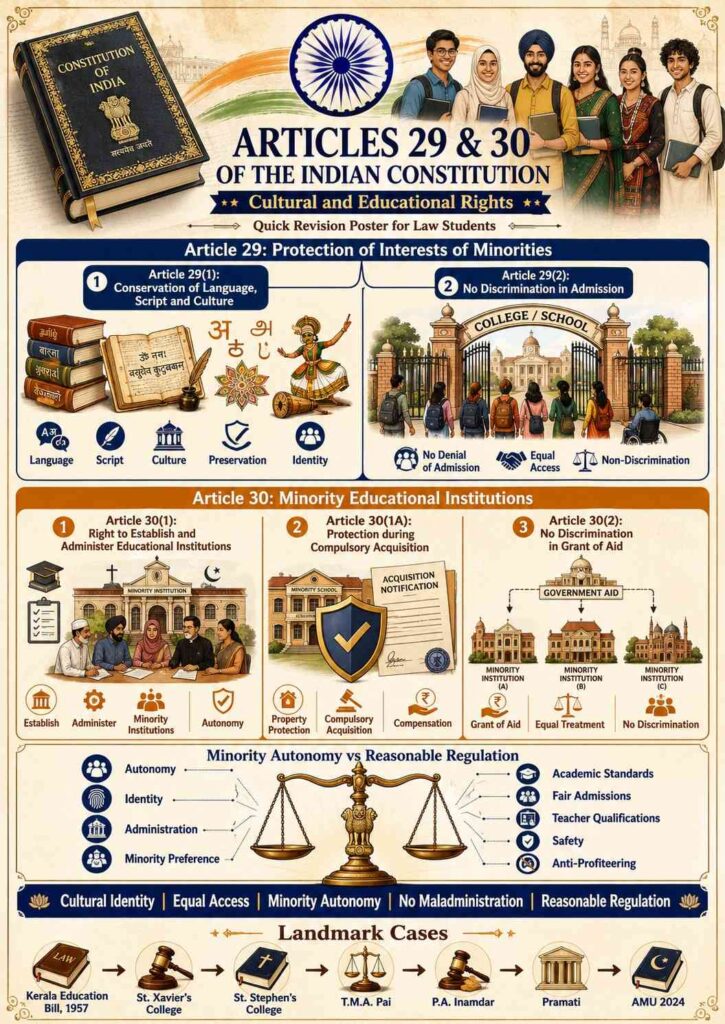
Introduction to Cultural and Educational Rights
✦ Core idea: Articles 29 and 30 of the Constitution of India protect India’s cultural, linguistic, religious and educational diversity. They ensure that groups with a distinct language, script or culture can preserve their identity, and that religious and linguistic minorities can establish and administer educational institutions of their choice.
✦ Constitutional purpose: These provisions are based on the idea that national unity does not mean cultural uniformity. India is a plural country, and the Constitution protects both individual equality and group identity. Article 29 protects cultural conservation, while Article 30 protects institutional autonomy of minorities in education.
✦ Placement in Part III: Articles 29 and 30 are Fundamental Rights. Therefore, if the State violates them, an aggrieved person or institution can approach the Supreme Court under Article 32 or the High Court under Article 226.
✦ Important distinction: Article 29 is wider in one sense because Article 29(1) is available to “any section of citizens” having a distinct language, script or culture. Article 30 is narrower because it is available only to religious and linguistic minorities, but it gives a special right to establish and administer educational institutions.
✦ Official constitutional text: Article 29(1) protects the right of any section of citizens residing in India or any part of India, having a distinct language, script or culture, to conserve the same. Article 29(2) prohibits denial of admission into State-maintained or State-aided educational institutions on grounds only of religion, race, caste, language or any of them. Article 30(1) gives all religious or linguistic minorities the right to establish and administer educational institutions of their choice; Article 30(1A) protects minority institutions in compulsory acquisition of property; and Article 30(2) prohibits discrimination in grant of aid on the ground that an institution is under minority management.
Meaning and Scope of Article 29
✦ Article 29(1) – Conservation of language, script and culture: Article 29(1) gives a protective right to any section of citizens having a distinct language, script or culture. The word “conserve” means to preserve, protect and maintain. This may include teaching the language, promoting literature, preserving cultural practices, running cultural associations and ensuring that the community’s identity is not erased.
✦ Not limited only to minorities: Though the marginal heading says “Protection of interests of minorities”, Article 29(1) uses the words “any section of the citizens”. Therefore, even a majority community in a particular local area may claim protection if it has a distinct language, script or culture.
✦ Citizenship requirement: Article 29(1) is available only to citizens because it expressly says “any section of the citizens”. Article 30 does not use the word “citizens”, but the right is practically exercised by minority communities and their institutions within India.
✦ Territorial connection: The group must reside in the territory of India or any part of it. This reflects India’s federal and cultural diversity because linguistic and cultural identity often differs from State to State.
✦ Article 29(2) – Non-discrimination in admission: Article 29(2) is an individual right of every citizen. It prevents denial of admission into a State-maintained or State-aided educational institution on grounds only of religion, race, caste, language or any of them. Its purpose is to ensure that public educational opportunities are not closed by communal or linguistic discrimination.
✦ Grounds only: The word “only” is important. If denial of admission is based exclusively on religion, race, caste, language or any of them, it violates Article 29(2). But if admission is denied on other valid grounds such as lack of merit, non-fulfilment of eligibility, residence requirement where legally valid, or institutional rules consistent with law, Article 29(2) may not be violated.
Meaning and Scope of Article 30
✦ Article 30(1) – Special right of minorities: Article 30(1) says that all minorities, whether based on religion or language, have the right to establish and administer educational institutions of their choice. The National Commission for Minority Educational Institutions also describes Article 30(1) as the fundamental right of religious and linguistic minorities to establish and administer educational institutions of their choice.
✦ Religious and linguistic minorities: Article 30 protects only two categories: religious minorities and linguistic minorities. The Constitution does not define the word “minority”. Judicially, minority status is generally determined by numerical strength in the relevant State, especially after T.M.A. Pai Foundation v. State of Karnataka, (2002) 8 SCC 481, where the Supreme Court held that minority status for Article 30 is to be determined with reference to the State, because States were reorganised largely on linguistic lines and education is administered substantially at the State level. The 2024 AMU judgment also refers to this State-based numerical minority test from T.M.A. Pai.
✦ Establish and administer: The two words are closely connected. “Establish” means to bring the institution into existence. “Administer” means to manage its affairs, including appointment of staff, admission policy, fee structure subject to law, disciplinary control, and overall institutional governance.
✦ Institution of their choice: The words “of their choice” give minorities freedom to decide the nature of the institution, the course of education, the level of education, the medium of instruction, and the community objectives of the institution, subject to academic standards and lawful regulation.
✦ Article 30(1A) – Protection during acquisition: Article 30(1A) was inserted to ensure that if the State compulsorily acquires property of a minority educational institution, the amount fixed or determined must not be such as to restrict or abrogate the Article 30 right. This prevents indirect destruction of minority institutions through inadequate compensation.
✦ Article 30(2) – Non-discrimination in aid: If the State grants aid to educational institutions, it cannot deny aid merely because the institution is managed by a religious or linguistic minority. However, once aid is accepted, reasonable conditions may be imposed to ensure proper use of public funds, academic standards and fairness.
Article 29 and Article 30: Key Differences
| Basis | Article 29 | Article 30 |
|---|---|---|
| Main purpose | Conservation of language, script and culture; non-discrimination in admission | Right of minorities to establish and administer educational institutions |
| Beneficiary | Article 29(1): any section of citizens; Article 29(2): every citizen | Religious and linguistic minorities |
| Nature of right | Cultural and anti-discrimination right | Educational-institutional autonomy right |
| Citizenship | Expressly connected with citizens | Does not expressly use “citizens” |
| Institutions covered | Article 29(2) applies to State-maintained or State-aided institutions | Applies to minority educational institutions of their choice |
| Core protection | Identity conservation and equal admission | Establishment, management and administration |
Minority Rights under Articles 29 and 30
✦ Protective equality: Articles 29 and 30 are not exceptions to equality; they are instruments of real equality. Formal equality treats everyone the same, but protective equality recognises that certain communities may need special safeguards to preserve identity and participate equally in national life.
✦ Community identity: Minority rights under Article 30 are meant to give confidence to religious and linguistic minorities that education will not become a tool of assimilation or cultural extinction.
✦ No right to separatism: These provisions protect cultural and educational identity within the constitutional framework. They do not permit anti-national activity, maladministration, commercial exploitation or violation of public order, morality or health.
✦ Secular character: The protection of religious minorities under Article 30 is not contrary to secularism. Indian secularism means equal respect and protection for all religions, including the right of religious communities to run educational institutions subject to constitutional discipline.
✦ Linguistic diversity: Article 30 also protects linguistic minorities. For example, a linguistic group that is numerically smaller in a State may establish schools or colleges to preserve its language and culture.
Conservation of Language and Culture under Article 29(1)
✦ Language as identity: Language is not merely a tool of communication. It carries literature, memory, tradition, values and social identity. Article 29(1) protects this link between language and culture.
✦ Script protection: Script means the written form of a language. Protection of script is important because a language may lose its distinctiveness if its script disappears.
✦ Culture protection: Culture includes customs, traditions, literature, art, music, dress, festivals, intellectual traditions and other markers of identity. Article 29(1) allows a group to conserve such culture.
✦ Positive and negative dimensions: Article 29(1) has a negative dimension because the State cannot destroy or suppress a distinct language, script or culture. It also has a positive dimension because communities may create associations, institutions and educational mechanisms to preserve their identity.
✦ Illustration: If a small linguistic community in a State wants to run classes to teach its script to children, publish books in that language, and organise cultural programmes, Article 29(1) supports such conservation.
Right to Establish Educational Institutions
✦ Meaning of establishment: Establishment means founding or bringing an institution into existence. A minority community must show that the institution was created by persons belonging to that minority or for the benefit and educational advancement of that minority.
✦ Purpose of establishment: It is not necessary that the institution should admit only minority students. The institution may serve society generally and still retain its minority character, provided its foundation, purpose and administration show a minority character.
✦ AMU minority-institution issue: In the 2024 Supreme Court AMU judgment, the Court discussed the criteria for determining whether an institution is a minority educational institution under Article 30, including establishment, administration and the State-based test of minority status. The judgment clarified that the inquiry into minority character requires careful examination of the institution’s origin, purpose, administration and constitutional position, and the question whether AMU itself is a minority institution was to be considered in accordance with the legal indicia laid down.
✦ Pre-Constitution institutions: A minority institution established before the Constitution may still claim Article 30 protection if it satisfies the relevant criteria. The fact that the institution was founded before 1950 does not automatically defeat its claim, because Article 30 protects existing and future minority educational institutions when the constitutional conditions are met.
Right to Administer Educational Institutions
✦ Administrative autonomy: The right to administer includes the right to manage internal affairs, appoint governing bodies, select staff, admit students, maintain discipline, frame institutional policies, and preserve the institution’s minority character.
✦ Not a right to maladminister: The most important limitation is that the right to administer does not mean the right to maladminister. Minority institutions cannot claim immunity from regulations that ensure educational excellence, public order, transparency, health, safety, service conditions or prevention of exploitation.
✦ Academic standards: The State may prescribe qualifications of teachers, curriculum standards, examination norms, infrastructure requirements, affiliation conditions and safety standards. Such regulations are valid if they do not destroy the minority character or take over the management.
✦ Staff appointments: Selection of teachers and principal is an important part of administration. However, the State may prescribe minimum qualifications and fair procedure. Regulations that completely remove the institution’s choice in selecting key staff may be unconstitutional if they destroy administrative autonomy.
✦ Admission policy: Minority institutions may give preference to students of their own minority community to preserve their character. But State-aided institutions must also respect Article 29(2), because public aid carries constitutional obligations of non-discrimination.
Reasonable Regulation of Minority Educational Institutions
✦ Core principle: Article 30 is strong but not uncontrolled. Reasonable regulation is valid when it promotes educational excellence, discipline, transparency, merit, welfare of teachers and students, or proper use of State aid.
✦ Permissible regulation: The State may regulate:
◦ Academic quality: curriculum, syllabus, teacher qualifications, examination standards and affiliation norms.
◦ Health and safety: building safety, sanitation, fire safety, child protection and campus security.
◦ Fair administration: prevention of capitation fee, profiteering and arbitrary conduct.
◦ Service conditions: minimum salary, security of tenure and grievance redressal for teachers and staff.
◦ Public funds: proper accounting and audit where State aid is received.
✦ Impermissible regulation: The State cannot:
◦ Take over management: replace the minority management with State-controlled bodies without constitutional justification.
◦ Destroy minority character: impose admission or staffing rules that make it impossible to preserve the institution’s minority identity.
◦ Discriminate in aid: deny grants only because the institution is managed by a minority.
◦ Impose excessive control: convert a regulatory framework into direct administration by the State.
✦ Test of validity: A regulation is usually valid if it is reasonable, non-discriminatory, educationally necessary, proportionate and does not annihilate the minority character of the institution.
Landmark Supreme Court Case Laws on Articles 29 and 30
✦ State of Madras v. Champakam Dorairajan, AIR 1951 SC 226; 1951 SCR 525: The State had communal reservations in educational admissions. The issue was whether admissions could be distributed on communal lines in a way that conflicted with Fundamental Rights. The Supreme Court held that denial of admission on grounds of religion, race, caste or language would violate Article 29(2). The case is historically important because it led to the First Constitutional Amendment and insertion of Article 15(4), enabling special provisions for socially and educationally backward classes.
✦ In re Kerala Education Bill, 1957, AIR 1958 SC 956: The President referred questions about the constitutional validity of provisions affecting minority educational institutions. The issue was how far the State could regulate minority institutions. The Supreme Court held that minorities have the right to establish and administer educational institutions, but the State can impose reasonable regulations for educational standards, discipline and efficiency. This case laid the foundation for the doctrine that Article 30 does not protect maladministration.
✦ Rev. Sidhajbhai Sabhai v. State of Bombay, AIR 1963 SC 540: The State required a minority teacher-training institution to reserve seats for government-nominated candidates. The issue was whether such interference violated Article 30(1). The Supreme Court held that regulations must be directed to making the institution effective as an educational institution and cannot destroy minority autonomy. The ratio is that a measure which in substance takes away the choice of a minority institution is unconstitutional.
✦ Rev. Father W. Proost v. State of Bihar, AIR 1969 SC 465; (1969) 2 SCR 73: The issue concerned minority administration of an educational institution. The Supreme Court recognised that Article 30 protects the right of minorities to manage institutions established by them. The case is important because it reaffirmed that the right under Article 30 is a real managerial right, not merely a symbolic right.
✦ D.A.V. College, Jullundur v. State of Punjab, (1971) 2 SCC 261: The dispute involved linguistic and educational rights after the establishment of Punjabi University and regulatory measures relating to language. The issue was whether linguistic and religious minorities could protect their educational interests. The Supreme Court recognised that minority rights under Articles 29 and 30 protect linguistic and cultural identity, while still permitting reasonable educational regulation.
✦ Ahmedabad St. Xavier’s College Society v. State of Gujarat, (1974) 1 SCC 717: This is one of the most important Article 30 judgments. The issue was whether provisions of the Gujarat University Act excessively interfered with a Christian minority college’s administration. The Supreme Court held that the right to administer includes the right to choose the governing body, appoint staff and manage internal affairs. However, the State may impose regulations to maintain educational standards. The ratio is that regulation is valid only when it facilitates excellence and does not destroy minority autonomy.
✦ Lilly Kurian v. Sr. Lewina, (1979) 2 SCC 124: The issue was disciplinary control over teachers in a minority institution. The Supreme Court held that excessive external control over disciplinary matters may violate Article 30. The case shows that staff discipline is part of administration, though it may be subject to fair procedure.
✦ Frank Anthony Public School Employees’ Association v. Union of India, (1986) 4 SCC 707: The issue was whether service-condition protections for employees could apply to unaided minority schools. The Supreme Court held that reasonable provisions ensuring fair service conditions and preventing exploitation of teachers do not necessarily violate Article 30. The ratio is that minority autonomy must coexist with fairness to employees.
✦ St. Stephen’s College v. University of Delhi, (1992) 1 SCC 558: St. Stephen’s College, a Christian minority institution, followed an admission process including interviews and gave preference to Christian students. The issue was the balance between Article 30(1) and Article 29(2). The Supreme Court held that a minority institution may give preference to its community to preserve its character, but because the college was aided and affiliated, it could not ignore merit and constitutional equality. The judgment accepted a limited minority preference and stressed that aided minority institutions must balance autonomy with non-discrimination.
✦ T.M.A. Pai Foundation v. State of Karnataka, (2002) 8 SCC 481: An eleven-judge bench considered the rights of private, aided, unaided, minority and non-minority educational institutions. The issue was the extent of institutional autonomy and State regulation. The Supreme Court held that minorities are to be determined State-wise; minority institutions have the right to establish and administer institutions; unaided institutions have greater autonomy; aided institutions are subject to greater regulation; and admissions must remain fair, transparent and merit-based. This is the leading authority on Article 30.
✦ Islamic Academy of Education v. State of Karnataka, (2003) 6 SCC 697: The issue was implementation of T.M.A. Pai, especially admissions and fee regulation in professional institutions. The Supreme Court permitted regulatory committees to ensure fair admissions and prevent profiteering. The case clarified that autonomy does not include capitation fee or commercialisation of education.
✦ P.A. Inamdar v. State of Maharashtra, (2005) 6 SCC 537: The issue was admissions and reservations in unaided professional institutions, including minority institutions. The Supreme Court held that unaided minority professional institutions have the right to admit students of their choice through a fair, transparent and non-exploitative process. The State cannot impose its reservation policy on unaided minority institutions, but it can regulate to ensure merit, transparency and absence of profiteering.
✦ Society for Unaided Private Schools of Rajasthan v. Union of India, (2012) 6 SCC 1: The issue was the validity of the Right of Children to Free and Compulsory Education Act, 2009 in relation to private schools. The Supreme Court upheld the RTE Act generally but protected unaided minority institutions from application that would affect their Article 30 rights. Later constitutional discussion continued in Pramati.
✦ Pramati Educational and Cultural Trust v. Union of India, (2014) 8 SCC 1: A Constitution Bench considered whether Article 21A and the RTE Act could apply to minority institutions. It held that applying the RTE Act to minority institutions, aided or unaided, may destroy their minority character; therefore, such institutions were exempted. A 2024 Supreme Court judgment restated that Pramati treated the application of RTE obligations to minority institutions as potentially destructive of minority character.
✦ Sk. Md. Rafique v. Managing Committee, Contai Rahamania High Madrasah, (2020) 6 SCC 689: The issue was whether State regulation of appointment of teachers in minority institutions violated Article 30. The Supreme Court upheld regulatory measures designed to ensure quality education and fair selection, emphasising that minority institutions are not outside regulatory control. The ratio is that regulations improving educational standards are valid if they do not destroy the institution’s minority character.
✦ Aligarh Muslim University minority status judgment, 2024: The Supreme Court revisited the legal tests for identifying a minority educational institution under Article 30. The judgment discussed whether an institution must be established and administered by a minority and referred to indicia for determining minority character, including origin, purpose, administration and constitutional context. It is important because it updated the doctrine on how minority status should be determined, particularly for historic institutions.
✦ Recent RTE/Pramati development, 2025: A later Supreme Court judgment observed that the complete exclusion of all minority institutions from the RTE Act, as held in Pramati, appeared doubtful because it may deprive children in such institutions of Article 21A benefits. However, this observation should be read carefully: unless a larger bench formally overrules Pramati, the binding position of Pramati remains significant.
Relationship between Article 29(2) and Article 30(1)
✦ Possible tension: Article 30(1) allows minority institutions to preserve their minority character, including preference for minority students. Article 29(2), however, prohibits denial of admission in State-maintained or State-aided institutions on grounds only of religion, race, caste or language.
✦ Harmonious interpretation: Courts do not read one provision as destroying the other. Minority institutions may preserve their character, but if they receive State aid, they must respect constitutional equality and cannot discriminate purely on prohibited grounds.
✦ Aided minority institutions: They have Article 30 protection, but because public funds are involved, the State can impose stronger conditions relating to admissions, merit, staff service conditions and accountability.
✦ Unaided minority institutions: They enjoy greater autonomy because they do not depend on State funds. However, even unaided institutions are subject to regulations preventing maladministration, capitation fee, exploitation and academic decline.
Minority Institution and State Aid
✦ No compulsory aid: Article 30 does not compel the State to grant aid to a minority institution. But if the State chooses to grant aid to educational institutions, it cannot discriminate against an institution merely because it is minority-managed.
✦ Aid with conditions: State aid may carry regulatory conditions. Conditions relating to audit, teacher qualifications, salary standards, infrastructure and admission transparency are generally valid.
✦ No surrender of identity: A minority institution does not lose its Article 30 identity merely because it receives aid. But it may become subject to greater constitutional obligations, especially Article 29(2).
National Commission for Minority Educational Institutions
✦ Statutory framework: The National Commission for Minority Educational Institutions Act, 2004 was enacted to constitute the NCMEI and provide for matters connected with minority educational institutions. India Code identifies the Act as Act No. 2 of 2005, enacted on 6 January 2005, under the Ministry of Education, Department of Higher Education.
✦ Purpose: NCMEI exists to safeguard the educational rights of minorities under Article 30(1). It deals with issues connected with recognition, minority status and protection of minority educational institutions. The NCMEI’s own website states that Article 30(1) provides religious and linguistic minorities the fundamental right to establish and administer educational institutions of their choice.
✦ Practical importance: Minority institutions often require certification of minority status for recognition, affiliation, administrative protection and legal disputes. NCMEI provides a specialised statutory forum for such matters.
Reasonable Regulation: Easy Memory Table
| Regulation | Usually valid or invalid? | Reason |
|---|---|---|
| Minimum teacher qualifications | Usually valid | Maintains academic standards |
| Fire safety and building norms | Valid | Protects students and staff |
| Complete State takeover of management | Usually invalid | Destroys Article 30 autonomy |
| Audit of government aid | Valid | Ensures proper use of public funds |
| Capitation fee prohibition | Valid | Prevents commercialisation |
| Total denial of minority preference | Usually invalid | May destroy minority character |
| Fair salary and service protections | Usually valid | Prevents exploitation |
| Compulsory admission rules destroying minority character | Invalid if disproportionate | Violates institutional choice |
Important Doctrines and Principles
✦ Doctrine of protective discrimination: Minority rights under Articles 29 and 30 are meant to protect vulnerable cultural and linguistic identities.
✦ Doctrine of harmonious construction: Article 29(2) and Article 30(1) must be balanced so that equality in admissions and minority autonomy both survive.
✦ Doctrine against maladministration: Article 30 protects administration, not maladministration. This is the central principle behind reasonable regulation.
✦ Proportionality: A regulation must not be excessive. It must be suitable for a legitimate educational purpose and must not destroy the minority character of the institution.
✦ State-wise minority test: Minority status is generally determined with reference to the State, not the whole of India, especially for Article 30 educational rights.
✦ Fair, transparent and non-exploitative admissions: This principle, developed in T.M.A. Pai, Islamic Academy and P.A. Inamdar, ensures that institutional autonomy does not become a cover for arbitrariness or profiteering.
Conclusion
✦ Final essence: Articles 29 and 30 form the constitutional shield for India’s cultural and educational pluralism. Article 29 protects the right to conserve language, script and culture and ensures non-discriminatory access to State-supported education. Article 30 gives religious and linguistic minorities the special right to establish and administer educational institutions of their choice.
✦ Balanced position: The right under Article 30 is neither decorative nor absolute. It is a powerful Fundamental Right, but it functions within the larger constitutional scheme of equality, educational excellence, child welfare, transparency and national integration.
✦ Best understanding: Minority institutions have autonomy in identity, management and educational choice, but they remain subject to reasonable regulation. The State may regulate to improve education, prevent exploitation and protect students and teachers, but it cannot use regulation as a tool to take over management or destroy minority character.