Introduction: Meaning and Constitutional Identity of the President of India
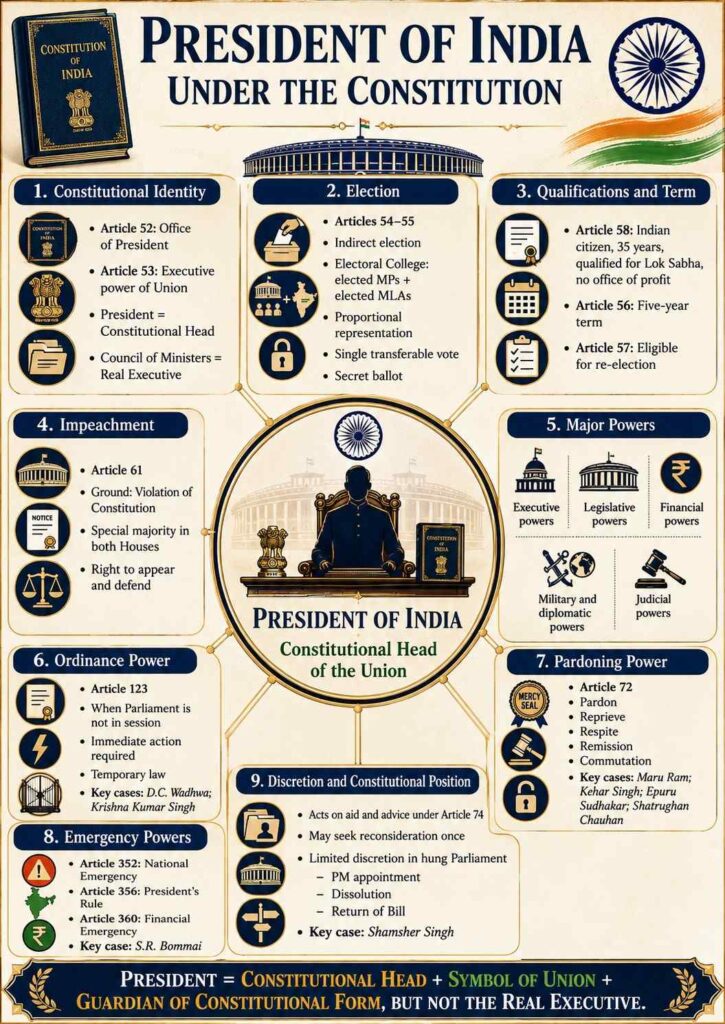
• Constitutional Head: The President of India is the formal head of the Union Executive. Article 52 provides that “there shall be a President of India”, and Article 53 vests the executive power of the Union in the President, to be exercised directly or through officers subordinate to him in accordance with the Constitution. This means that all executive acts of the Union are legally performed in the name of the President, but the real political responsibility lies with the Council of Ministers headed by the Prime Minister.
• Present Office-holder: As per the official website of the President of India, Smt. Droupadi Murmu was sworn in as the 15th President of India on 25 July 2022. This fact is relevant because the President is not merely a symbolic figure; the office represents constitutional continuity, national unity, and the dignity of the Republic.
• Parliamentary Form: India follows the parliamentary system, not the American presidential system. Therefore, the President is not the real executive in the political sense. The President acts on the aid and advice of the Council of Ministers under Article 74, except in limited constitutional situations where discretion or judgment may arise.
• Key Memory Line: The President is the constitutional head, the Prime Minister and Council of Ministers are the real executive, and Parliament provides democratic control.
Constitutional Provisions Relating to the President of India
| Area | Important Articles |
|---|---|
| Office of President | Article 52 |
| Executive power of Union | Article 53 |
| Election of President | Articles 54–55 |
| Term of office | Article 56 |
| Eligibility for re-election | Article 57 |
| Qualifications | Article 58 |
| Conditions of office | Article 59 |
| Oath | Article 60 |
| Impeachment | Article 61 |
| Vacancy and election | Article 62 |
| Aid and advice | Article 74 |
| Powers and functions | Articles 53, 72, 74, 77, 78, 85, 111, 123, 352, 356, 360 |
| Pardoning power | Article 72 |
| Ordinance power | Article 123 |
| National Emergency | Article 352 |
| President’s Rule | Article 356 |
| Financial Emergency | Article 360 |
Election of the President of India
• Indirect Election: The President is elected indirectly because India follows a parliamentary democracy. The people do not directly vote for the President. Instead, Article 54 provides that the President is elected by an Electoral College.
• Electoral College: The Electoral College consists of:
◦ Elected members of both Houses of Parliament, namely Lok Sabha and Rajya Sabha; and
◦ Elected members of the Legislative Assemblies of States; and
◦ Elected members of the Legislative Assemblies of Union Territories of Delhi, Puducherry and Jammu and Kashmir, where applicable under the constitutional scheme.
• Excluded Members: Nominated members of Parliament, nominated members of State Legislative Assemblies, members of Legislative Councils, and nominated members of Union Territory legislatures do not participate in the presidential election. The reason is that the President must be elected by elected representatives only.
• Principle of Uniformity: Article 55 aims to secure uniformity in the scale of representation of different States and parity between the States as a whole and the Union. This is done through the value of votes.
• Value of MLA’s Vote: The value of the vote of an elected MLA is calculated on the basis of the population of the State and the number of elected MLAs in that State. The object is to ensure that States with larger populations have proportionate representation.
• Value of MP’s Vote: The total value of votes of all elected MLAs is divided by the total number of elected MPs. This balances the Union and the States in the presidential election.
• System of Voting: The election is held by proportional representation by means of the single transferable vote, and voting is by secret ballot. The voter marks preferences, not merely one simple vote.
• Reason for Indirect Election: The President is the constitutional head, not the real executive. Direct election could have created a rival democratic authority against the Prime Minister and Parliament. Therefore, indirect election maintains harmony in the parliamentary system.
Landmark Case on Presidential Election
• Charan Lal Sahu v. Neelam Sanjiva Reddy, (1978) 2 SCC 500: In this case, the presidential election of Neelam Sanjiva Reddy was challenged. The Supreme Court clarified that the presidential election process is a special constitutional process and cannot be lightly disturbed. The Court emphasized that election disputes relating to the President must be dealt with strictly according to constitutional and statutory procedure. The case is important because it shows that the President’s election is protected by a structured constitutional mechanism and cannot be challenged casually.
Qualifications for Election as President
• Article 58 Requirements: A person is qualified for election as President if he or she:
◦ is a citizen of India;
◦ has completed 35 years of age;
◦ is qualified for election as a member of the Lok Sabha; and
◦ does not hold any office of profit under the Government of India, Government of any State, or any local or other authority subject to government control.
• Office of Profit Exception: The Constitution clarifies that a person is not disqualified merely because he or she is the President, Vice-President, Governor of a State, or a Minister either for the Union or for any State.
• Purpose of Qualifications: These qualifications ensure that the President is a mature Indian citizen, constitutionally eligible for national representative office, and independent from conflicting government employment.
Conditions of President’s Office
• Article 59 Conditions: The President cannot be a member of either House of Parliament or of a House of the Legislature of any State. If such a member is elected President, he or she is deemed to have vacated that seat on entering the office of President.
• No Other Office: The President must not hold any other office of profit.
• Official Residence and Emoluments: The President is entitled to official residence, salary, allowances and privileges as determined by Parliament.
• Independence of Office: The conditions of office protect the dignity, neutrality and independence of the President.
Oath of the President
• Article 60 Oath: Before entering office, the President takes an oath or affirmation before the Chief Justice of India, or in his absence, the senior-most judge of the Supreme Court available.
• Core Promise: The President promises to preserve, protect and defend the Constitution and the law and to devote himself or herself to the service and well-being of the people of India.
• Constitutional Meaning: The oath is not a mere formality. It reflects that the President is the guardian of constitutional form, legality and continuity.
Term of Office of the President
• Five-Year Term: Under Article 56, the President holds office for a term of five years from the date on which he or she enters office.
• Continuation Until Successor Enters Office: Even after the expiry of five years, the President continues until the successor enters office. This prevents a constitutional vacuum.
• Resignation: The President may resign by writing under his or her hand addressed to the Vice-President.
• Removal: The President may be removed by impeachment for violation of the Constitution under Article 61.
• Re-election: Article 57 provides that a person who holds or has held office as President is eligible for re-election. There is no constitutional bar on the number of terms.
Vacancy in the Office of President
• Article 62 Rule: An election to fill a vacancy caused by expiry of term must be completed before the expiry of the term.
• Casual Vacancy: If the office falls vacant due to death, resignation, removal or any other cause, election must be held as soon as possible and in no case later than six months from the date of vacancy.
• Vice-President as Acting President: During vacancy, the Vice-President acts as President. If the Vice-President is unavailable, the Chief Justice of India, and in his absence the senior-most judge of the Supreme Court, may discharge presidential functions under the relevant statutory arrangement.
Impeachment of the President of India
• Constitutional Ground: Article 61 provides impeachment for violation of the Constitution. The phrase is not exhaustively defined, which means it covers grave constitutional misconduct, deliberate abuse of constitutional power, or conduct inconsistent with the President’s constitutional oath.
• Initiation: Impeachment may be initiated in either House of Parliament.
• Notice Requirement: The proposal must be contained in a resolution signed by at least one-fourth of the total number of members of the House that initiates the charge, and at least fourteen days’ notice must be given.
• Special Majority: The resolution must be passed by a majority of not less than two-thirds of the total membership of that House.
• Investigation by Other House: After one House frames the charge, the other House investigates or causes the charge to be investigated.
• Right of Appearance: The President has the right to appear and be represented during such investigation.
• Final Removal: If the investigating House also passes the resolution by a majority of not less than two-thirds of its total membership, the President stands removed from office from the date of passing of that resolution.
• High Threshold: Impeachment is intentionally difficult because the President is the constitutional head of the Republic. It is not a political no-confidence motion; it is a constitutional removal process.
Powers of the President of India
Executive Powers of the President
• Executive Power under Article 53: The executive power of the Union is vested in the President. However, it is exercised according to the Constitution and normally on ministerial advice.
• Appointments: The President appoints the Prime Minister, other Ministers, Attorney General of India, Comptroller and Auditor General of India, Judges of the Supreme Court and High Courts, Governors, Election Commissioners, Finance Commission members, UPSC members, and other constitutional authorities as provided by law.
• Administration in President’s Name: Article 77 provides that all executive action of the Government of India shall be expressed to be taken in the name of the President.
• Information from Prime Minister: Article 78 requires the Prime Minister to communicate to the President all decisions of the Council of Ministers relating to administration and legislation, furnish information when called for, and submit matters for consideration of the Council of Ministers if the President so requires.
• Practical Control: The President may advise, warn and encourage the Council of Ministers, but normally cannot substitute personal opinion for ministerial advice.
Landmark Cases on Executive Position
• Ram Jawaya Kapur v. State of Punjab, AIR 1955 SC 549: The Supreme Court explained that the Indian Constitution has adopted the parliamentary system of executive responsibility. The executive power is co-extensive with legislative power, but it must operate subject to the Constitution and law. This case is important because it clarified the nature of executive power in India.
• U.N.R. Rao v. Indira Gandhi, (1971) 2 SCC 63: The issue was whether the Council of Ministers must continue even after dissolution of Lok Sabha. The Supreme Court held that Article 74 is mandatory and there must always be a Council of Ministers to aid and advise the President. This case confirms that the President cannot function as a personal executive ruler.
• Shamsher Singh v. State of Punjab, (1974) 2 SCC 831: A seven-judge Bench held that the President and Governors are constitutional heads and must exercise powers on the aid and advice of the Council of Ministers, except in areas where the Constitution expressly or by necessary implication allows discretion. This is the leading authority on the nominal position of the President in India.
Legislative Powers of the President
• Part of Parliament: Under Article 79, Parliament consists of the President and two Houses, namely the Rajya Sabha and Lok Sabha. Therefore, the President is an integral constitutional part of Parliament, though not a member of either House.
• Summoning and Proroguing: Under Article 85, the President summons and prorogues Parliament and may dissolve the Lok Sabha.
• Address to Parliament: The President addresses both Houses at the commencement of the first session after each general election and at the commencement of the first session each year.
• Messages to Parliament: The President may send messages to either House regarding pending bills or other matters.
• Assent to Bills: Under Article 111, when a Bill is presented to the President, the President may give assent, withhold assent, or return a non-Money Bill for reconsideration. If Parliament passes the Bill again, with or without amendments, the President must give assent.
• Money Bills: A Money Bill cannot be introduced in the Lok Sabha without the President’s recommendation.
• Certain Bills Requiring Recommendation: Some Bills, especially those affecting taxation, expenditure, States’ interests, or constitutional requirements, require presidential recommendation before introduction.
Ordinance-Making Power of the President
• Article 123 Power: The President may promulgate an Ordinance when both Houses of Parliament are not in session and the President is satisfied that circumstances exist requiring immediate action. An Ordinance has the same force and effect as an Act of Parliament, but it is temporary.
• Temporary Law: Every Ordinance must be laid before both Houses of Parliament and ceases to operate at the expiration of six weeks from the reassembly of Parliament unless approved earlier.
• Same Limits as Parliament: The President cannot issue an Ordinance on a matter on which Parliament lacks legislative competence. Ordinance-making is not an independent law-making power beyond the Constitution.
• Not a Parallel Legislature: Ordinance power is meant for urgent situations, not to bypass parliamentary debate or democratic accountability.
Landmark Cases on Ordinance Power
• D.C. Wadhwa v. State of Bihar, (1987) 1 SCC 378: The Bihar Government repeatedly re-promulgated ordinances without placing them before the Legislature. The Supreme Court held that repeated re-promulgation is a fraud on the Constitution. Though the case concerned Governor’s ordinance power, the principle applies equally to ordinance-making generally: ordinances are emergency legislative instruments, not substitutes for regular law-making.
• Krishna Kumar Singh v. State of Bihar, (2017) 3 SCC 1: A seven-judge Bench held that re-promulgation of ordinances is constitutionally impermissible except in exceptional circumstances. The Court also held that the satisfaction for promulgating an ordinance is subject to judicial review on limited grounds. This case strengthened legislative accountability and prevented misuse of ordinance power.
Financial Powers of the President
• Annual Financial Statement: The Union Budget is laid before Parliament in the name of the President.
• Money Bill Recommendation: No Money Bill can be introduced without the President’s recommendation.
• Demand for Grants: Demands for grants are made on the recommendation of the President.
• Contingency Fund: The President controls the Contingency Fund of India for urgent unforeseen expenditure, subject to parliamentary authorization.
• Finance Commission: The President constitutes the Finance Commission under Article 280 to recommend distribution of financial resources between the Union and States.
Judicial Powers and Pardoning Power of the President
• Article 72 Power: The President may grant pardons, reprieves, respites or remissions of punishment, or suspend, remit or commute sentences in three categories:
◦ cases where punishment or sentence is by a court martial;
◦ cases involving offences against laws relating to matters within Union executive power; and
◦ all cases where the sentence is a sentence of death.
• Meaning of Forms of Clemency:
◦ Pardon: Completely removes both sentence and conviction consequences.
◦ Commutation: Substitutes one form of punishment with a lighter form.
◦ Remission: Reduces the period of sentence without changing its nature.
◦ Respite: Awards a lesser sentence due to special circumstances, such as pregnancy or disability.
◦ Reprieve: Temporarily stays execution of sentence, especially death sentence.
• Humanitarian Function: Pardoning power acts as a constitutional safety valve. It allows correction of possible judicial error, consideration of mercy, public welfare, delay, health, age, conduct, or other special circumstances.
• Not Personal Mercy: The President does not exercise this power as a private individual. It is a constitutional power exercised on the aid and advice of the Council of Ministers.
Landmark Cases on Pardoning Power
• Maru Ram v. Union of India, (1981) 1 SCC 107: The Supreme Court held that the power under Articles 72 and 161 must be exercised on the aid and advice of the appropriate government. The Court emphasized that constitutional clemency cannot be arbitrary, mala fide, or based on irrelevant considerations. This case is important because it connects mercy power with rule of law.
• Kehar Singh v. Union of India, (1989) 1 SCC 204: The petitioner, convicted in the Indira Gandhi assassination case, sought presidential mercy. The Supreme Court held that the President may examine the evidence and merits of the case while considering mercy, even after the Supreme Court’s judicial decision. However, the President’s order is subject only to limited judicial review. The Court clarified that the President does not sit as a court of appeal but performs a constitutional function.
• Epuru Sudhakar v. Government of Andhra Pradesh, (2006) 8 SCC 161: The Supreme Court held that the exercise of pardoning power can be judicially reviewed if it is arbitrary, mala fide, discriminatory, based on irrelevant considerations, or excludes relevant considerations. This case is a leading authority for limited judicial review of clemency powers.
• Shatrughan Chauhan v. Union of India, (2014) 3 SCC 1: The Supreme Court held that unreasonable delay in deciding mercy petitions in death sentence cases may be a ground for commutation of death sentence to life imprisonment. The case strengthened the role of human dignity under Article 21 in the area of capital punishment.
Military and Diplomatic Powers of the President
• Supreme Commander: The President is the Supreme Commander of the Defence Forces of India. However, actual control is exercised by the elected government according to law.
• War and Peace: War and peace are formally declared in the name of the President, but such decisions are made on ministerial advice.
• Treaties and International Relations: Diplomatic representatives are appointed by the President, and foreign ambassadors present credentials to the President. Treaties are concluded in the name of the President but operate subject to constitutional and parliamentary requirements.
Emergency Powers of the President
National Emergency under Article 352
• Grounds: National Emergency may be proclaimed when the security of India or any part of its territory is threatened by war, external aggression, or armed rebellion.
• Written Cabinet Advice: After the 44th Constitutional Amendment, the President can proclaim National Emergency only on written advice of the Union Cabinet, not merely on the advice of the Prime Minister alone.
• Parliamentary Approval: The proclamation must be approved by both Houses of Parliament within one month.
• Special Majority: Approval requires a special majority: majority of the total membership of the House and two-thirds majority of members present and voting.
• Effect: During National Emergency, the Union’s executive power expands, Parliament may legislate on State List matters, and certain fundamental rights may be affected as per Articles 358 and 359.
Landmark Cases on National Emergency
• Minerva Mills Ltd. v. Union of India, (1980) 3 SCC 625: The Supreme Court held that the proclamation of emergency and related constitutional powers are subject to constitutional limitations and judicial review. The case is important because it rejected the idea that emergency powers are completely beyond judicial control.
• ADM Jabalpur v. Shivkant Shukla, (1976) 2 SCC 521: During the Emergency, the majority held that habeas corpus could be suspended when Article 21 enforcement was suspended. This decision is now treated as a deeply flawed constitutional moment. In K.S. Puttaswamy v. Union of India, (2017) 10 SCC 1, the Supreme Court expressly recognized that ADM Jabalpur was wrong. The modern position is that constitutional rights and human dignity cannot be casually extinguished.
President’s Rule under Article 356
• Failure of Constitutional Machinery: Article 356 allows the President to assume functions of a State government if he is satisfied, usually on the Governor’s report or otherwise, that the government of the State cannot be carried on according to the Constitution.
• Effect: The President may take over executive functions of the State, declare that powers of the State Legislature shall be exercisable by Parliament, and make incidental provisions.
• Parliamentary Approval: The proclamation must be approved by both Houses within two months.
• Federal Sensitivity: Article 356 affects elected State governments, so it must be used carefully and only when constitutional machinery has genuinely failed.
Landmark Case on Article 356
• S.R. Bommai v. Union of India, (1994) 3 SCC 1: Several State governments had been dismissed under Article 356. The Supreme Court held that presidential satisfaction under Article 356 is subject to judicial review. The Court ruled that majority should ordinarily be tested on the floor of the House, not merely through the Governor’s subjective report. It also held that secularism is part of the basic structure and that improper use of Article 356 can be struck down. This case is the most important authority on President’s Rule and Centre-State relations.
Financial Emergency under Article 360
• Ground: Financial Emergency may be proclaimed if the President is satisfied that the financial stability or credit of India or any part of India is threatened.
• Parliamentary Approval: The proclamation must be approved by both Houses of Parliament within two months.
• Effect: The Union may give financial directions to States, require reduction of salaries and allowances of government servants, and require money bills or financial bills passed by State legislatures to be reserved for the President’s consideration.
• Practical Note: Financial Emergency has never been proclaimed in India till date.
Discretionary Powers of the President
• General Rule: The President normally acts on the aid and advice of the Council of Ministers. After the 42nd and 44th Amendments, Article 74 makes ministerial advice binding, but the President may require the Council of Ministers to reconsider such advice once. After reconsideration, the President must act according to the advice.
• Appointment of Prime Minister: The President may exercise limited discretion when no party has a clear majority in the Lok Sabha. In such a situation, the President invites the person most likely to command majority support.
• Dissolution of Lok Sabha: If a Prime Minister who has lost majority advises dissolution, the President may examine whether an alternative stable government is possible.
• Return of Bill: Under Article 111, the President may return a non-Money Bill once for reconsideration.
• Pocket Veto: The Constitution does not prescribe a time limit for the President to act on a Bill. This has given rise to the idea of a “pocket veto”, where the President does not immediately give assent, withhold assent, or return the Bill.
• Hung Parliament Situations: The President’s role becomes more significant when electoral results are unclear, coalitions are unstable, or a caretaker government is functioning.
• No Personal Policy Power: Discretion does not mean personal rule. It means constitutional judgment within narrow limits to protect parliamentary democracy.
Constitutional Position of the President of India
• Nominal Executive: The President is the nominal executive, while the Council of Ministers is the real executive.
• Constitutional Guardian: The President safeguards constitutional procedure, ensures continuity of government, and acts as a stabilizing authority during political uncertainty.
• Not a Rubber Stamp: Though bound by ministerial advice, the President may ask questions, seek information, encourage reconsideration, and ensure constitutional propriety.
• Not an Alternative Government: The President cannot govern independently. India’s democratic accountability flows through the Lok Sabha and Council of Ministers.
• Symbol of Union: The President represents the unity, integrity and sovereignty of India. The office rises above party politics and reflects the dignity of the Republic.
Landmark Case on Constitutional Position
• Shamsher Singh v. State of Punjab, (1974) 2 SCC 831: The Supreme Court held that the President is the formal or constitutional head and acts on the aid and advice of the Council of Ministers. The Court stated that the real executive power is exercised by the elected government. This judgment is the foundation for understanding the President’s constitutional position in India.
Comparative Table: President’s Main Powers
| Power | Article | Nature | Limitation |
|---|---|---|---|
| Executive power | 53 | Formal Union executive authority | Aid and advice of Council of Ministers |
| Appointment powers | Various Articles | Constitutional appointments | Usually on ministerial advice or prescribed procedure |
| Assent to Bills | 111 | Legislative check | Must assent if returned Bill is passed again |
| Ordinance power | 123 | Temporary law-making power | Only when Parliament is not in session and urgent action is required |
| Pardoning power | 72 | Clemency and mercy power | Limited judicial review; exercised on advice |
| National Emergency | 352 | Security emergency | Written Cabinet advice and parliamentary approval |
| President’s Rule | 356 | State constitutional failure | Judicial review after S.R. Bommai |
| Financial Emergency | 360 | Financial stability protection | Parliamentary approval |
Memory Aid: The President’s Role in One Formula
• ELECTION: Indirect election by elected MPs and MLAs.
• QUALIFICATION: Indian citizen, 35 years, Lok Sabha qualification, no office of profit.
• TERM: Five years, eligible for re-election.
• REMOVAL: Impeachment for violation of Constitution.
• POWER: Executive, legislative, financial, judicial, military, diplomatic and emergency powers.
• LIMIT: Aid and advice of Council of Ministers.
• POSITION: Constitutional head, not real executive.
Conclusion: President as the Constitutional Head of the Indian Republic
• Balanced Office: The President of India is neither a ceremonial decoration nor an independent ruler. The office is designed as a balanced constitutional institution in a parliamentary democracy.
• Rule of Law: The President acts through constitutional forms, ministerial responsibility, parliamentary control and judicial review.
• Democratic Design: The President’s election reflects federal balance, the President’s powers reflect constitutional dignity, and the President’s limitations reflect democratic accountability.
• Final Understanding: The President is the guardian of constitutional form, the symbol of national unity, the formal executive head, and the constitutional conscience-keeper of the Union, but the real day-to-day governance belongs to the elected Council of Ministers responsible to the Lok Sabha.