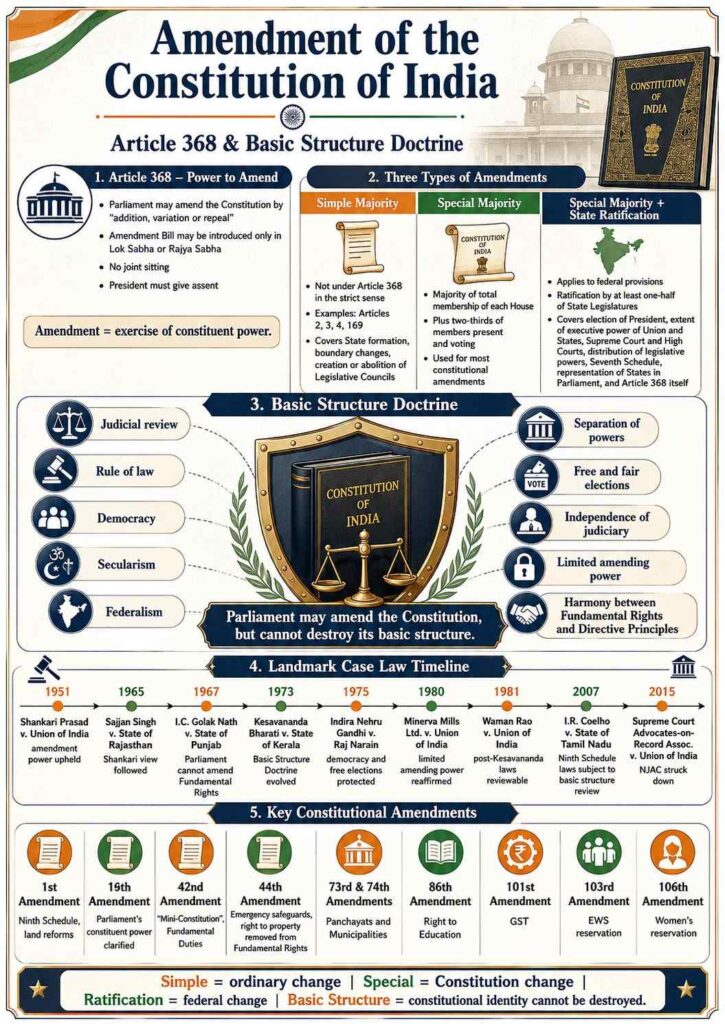
Meaning and Purpose of Constitutional Amendment
- Constitutional amendment means a formal change to the text of the Constitution. It may add a new provision, alter an existing provision, or repeal a provision. The purpose is to allow the Constitution to respond to social, political, economic and institutional changes while preserving its essential constitutional identity.
- Balance between flexibility and stability: The Indian Constitution is neither completely rigid nor completely flexible. Some matters can be changed through an ordinary legislative process, while matters affecting the constitutional framework require a higher parliamentary majority and, in some cases, approval by at least half of the State Legislatures.
- Constituent power: Parliament amends the Constitution not merely as an ordinary law-making body but by exercising its special constituent power under Article 368. This power is wider than ordinary legislative power, but it is not unlimited. Parliament cannot damage, destroy or alter the Constitution’s basic structure.
Article 368 of the Constitution of India
- Article 368(1): Power to amend: Parliament may amend any provision of the Constitution by way of addition, variation or repeal, using the procedure prescribed by Article 368. The expression “any provision” gives Parliament a broad amending power, including power to amend Fundamental Rights, subject to the basic structure limitation.
- Article 368(2): Initiation of Bill: A Constitution Amendment Bill can be introduced only in either House of Parliament, namely the Lok Sabha or the Rajya Sabha. A State Legislature cannot introduce a Constitutional Amendment Bill.
- No joint sitting: Each House must separately pass the Bill by the required constitutional majority. Therefore, the joint-sitting procedure under Article 108 is not available for a Constitutional Amendment Bill.
- President’s assent: Once the Bill is duly passed by Parliament and, where necessary, ratified by the States, it must be presented to the President. After the Twenty-fourth Amendment, the President is constitutionally required to give assent; the President cannot return or withhold assent from a duly passed Constitutional Amendment Bill.
- Article 368(3): Article 13 exclusion: Article 368(3) declares that Article 13 does not apply to an amendment made under Article 368. Thus, a constitutional amendment is not invalid merely because it abridges a Fundamental Right. However, it remains subject to judicial review on the ground that it violates the basic structure doctrine.
- Article 368(4) and 368(5): Invalid provisions: The Forty-second Amendment inserted clauses (4) and (5), seeking to bar judicial review of constitutional amendments and declaring that Parliament’s constituent power had no limitation. These clauses were later declared unconstitutional in Minerva Mills Ltd. v. Union of India, because limited amending power and judicial review are part of the basic structure. The official constitutional text accordingly records that these clauses were declared invalid.
Types of Constitutional Amendments in India
| Type of Change | Majority Required | Examples |
|---|---|---|
| Amendment by simple majority | Ordinary majority of members present and voting in Parliament; not treated as amendment under Article 368 | Formation of new States, alteration of State boundaries, creation or abolition of Legislative Councils |
| Amendment by special majority | Majority of total membership of each House and at least two-thirds of members present and voting in each House | Most provisions of the Constitution |
| Amendment by special majority plus State ratification | Special majority in Parliament plus ratification by Legislatures of at least one-half of the States | Federal provisions, Seventh Schedule, representation of States in Parliament and Article 368 itself |
Amendment by Simple Majority
- Nature: Certain constitutional changes are made by Parliament through an ordinary law. Though such laws may alter the First Schedule, Fourth Schedule or other constitutional provisions, the Constitution expressly states that they are not amendments under Article 368.
- Article 2, Article 3 and Article 4: Parliament may admit or establish new States, form new States, alter the area, boundaries or names of existing States, and make consequential changes in the First and Fourth Schedules. Article 4 expressly provides that such a law shall not be deemed a constitutional amendment for Article 368 purposes.
- Article 169: Parliament may create or abolish a State Legislative Council after the concerned State Legislative Assembly passes a resolution by a majority of its total membership and by not less than two-thirds of members present and voting. The Parliamentary law may amend the Constitution incidentally, but is not treated as an Article 368 amendment.
- Article 239A: Parliament may create a Legislature or Council of Ministers for the Union Territory of Puducherry. A law made for this purpose is not treated as a constitutional amendment even if it has the effect of altering constitutional provisions.
- Schedules: Parliament can also amend certain provisions of the Fifth and Sixth Schedules through ordinary legislation where the Constitution expressly permits it. Such changes are excluded from Article 368.
- Important distinction: A simple-majority change is often casually described as a constitutional amendment because it modifies constitutional text. Legally, however, it is not an amendment under Article 368.
Amendment by Special Majority
- Double requirement: A Constitution Amendment Bill must satisfy two separate requirements in each House of Parliament:
- Absolute majority: More than half of the total sanctioned membership of that House.
- Two-thirds majority: At least two-thirds of the members present and voting.
- Illustration: If a House has a total membership of 545, at least 273 members must support the Bill, even if fewer members are present. In addition, the votes in favour must be at least two-thirds of the members present and voting.
- Scope: This procedure applies to amendments relating to Fundamental Rights, Directive Principles of State Policy, Union and State institutions, emergency provisions, election provisions and most other constitutional provisions.
Amendment by Special Majority and Ratification by States
- Federal safeguard: When an amendment affects the federal balance between the Union and the States, Parliament’s special majority is insufficient. Ratification by at least one-half of the State Legislatures is also mandatory.
- Matters requiring State ratification: The proviso to Article 368(2) requires ratification where an amendment seeks to change:
- Articles 54 and 55 concerning election of the President;
- Articles 73 and 162 concerning Union and State executive power;
- Article 241 concerning High Courts for Union Territories;
- Chapter IV of Part V concerning the Supreme Court;
- Chapter V of Part VI concerning High Courts;
- Chapter I of Part XI concerning legislative relations between the Union and States;
- Any List in the Seventh Schedule;
- Representation of States in Parliament; or
- Article 368 itself.
- Meaning of ratification: Ratification is given by State Legislatures through resolutions. The Constitution does not prescribe a particular time-limit for obtaining such ratifications.
- No individual State veto: The consent of every State is not required. Ratification by Legislatures of at least one-half of the States is sufficient.
- Union Territories: Union Territories do not participate in ratification under the proviso to Article 368 because the provision refers to State Legislatures.
Basic Structure Doctrine
- Meaning: The basic structure doctrine means that Parliament may amend the Constitution, including Fundamental Rights, but cannot alter its fundamental identity or destroy its essential constitutional features.
- Purpose: The doctrine prevents a temporary parliamentary majority from converting the Constitution into an instrument of unlimited governmental power.
- No exhaustive list: The Supreme Court has not given a final, closed list of basic features. Whether an amendment damages the basic structure depends upon its effect on the Constitution as a whole.
- Frequently recognised basic features include:
- Supremacy of the Constitution
- Republican and democratic form of government
- Parliamentary form of government
- Rule of law
- Separation of powers
- Federalism
- Secularism
- Judicial review
- Independence of judiciary
- Free and fair elections
- Limited amending power
- Harmony and balance between Fundamental Rights and Directive Principles
- Dignity and liberty of the individual
- Unity and integrity of India
- Effect test: The Court does not invalidate an amendment merely because it changes an important provision. The question is whether the amendment has the effect of damaging or destroying a basic constitutional feature.
Judicial Development of Parliament’s Amending Power
Shankari Prasad Singh Deo v. Union of India, [1952] SCR 89
- Facts and issue: The First Constitutional Amendment, which inserted Articles 31A and 31B and created the Ninth Schedule, was challenged on the ground that it violated Fundamental Rights and was therefore void under Article 13.
- Ratio: The Supreme Court held that a constitutional amendment made under Article 368 was not “law” within Article 13(2). Parliament could therefore amend Fundamental Rights. This was the earliest judicial recognition of Parliament’s broad amendment power. The position was later modified by Golak Nath and ultimately replaced by the basic structure doctrine in Kesavananda Bharati.
Sajjan Singh v. State of Rajasthan, [1965] 1 SCR 933
- Facts and issue: The Seventeenth Amendment, which added more land-reform laws to the Ninth Schedule, was challenged for violating Fundamental Rights.
- Ratio: The Supreme Court reaffirmed Shankari Prasad and held that Parliament could amend Fundamental Rights. However, Justice Mudholkar expressed doubt about whether the Constitution had certain “basic features” beyond Parliament’s amending power. This observation later became significant in the development of the basic structure doctrine.
I.C. Golak Nath v. State of Punjab, [1967] 2 SCR 762
- Facts and issue: The validity of constitutional amendments affecting property rights and agrarian-reform legislation was challenged.
- Ratio: By a narrow majority, the Supreme Court held that constitutional amendments were “law” within Article 13 and that Parliament could not amend Fundamental Rights. The Court applied prospective overruling, meaning that earlier amendments remained valid but Parliament could not thereafter abridge Fundamental Rights. This position was superseded by the Twenty-fourth Amendment and the decision in Kesavananda Bharati.
Kesavananda Bharati v. State of Kerala, (1973) 4 SCC 225; 1973 Supp SCR 1
- Facts and issue: The head of a religious mutt challenged Kerala land-reform laws and the validity of the Twenty-fourth, Twenty-fifth and Twenty-ninth Amendments. The central issue was whether Parliament had unlimited power to amend every part of the Constitution.
- Ratio: A thirteen-Judge Bench, by a 7:6 majority, held that Parliament has wide power to amend the Constitution, including Fundamental Rights, but cannot alter its basic structure. The Court upheld the Twenty-fourth Amendment and established that Parliament’s amending power itself is limited. This is the foundation of modern Indian constitutional law.
Indira Nehru Gandhi v. Raj Narain, 1975 Supp SCC 1
- Facts and issue: The Thirty-ninth Amendment inserted Article 329A and attempted to place disputes relating to the election of the Prime Minister and Speaker beyond ordinary judicial scrutiny.
- Ratio: The Supreme Court struck down the relevant provisions that insulated the Prime Minister’s election from judicial review. It recognised free and fair elections, democracy, rule of law and judicial review as basic constitutional features. Parliament cannot use its amending power to create a class of persons whose elections are immune from legal challenge.
Minerva Mills Ltd. v. Union of India, (1980) 3 SCC 625; (1981) 1 SCR 206
- Facts and issue: Sections 4 and 55 of the Forty-second Amendment expanded Article 31C and inserted clauses (4) and (5) into Article 368, seeking to exclude judicial review and make Parliament’s amending power unlimited.
- Ratio: The Supreme Court declared these provisions unconstitutional. It held that limited amending power is itself part of the basic structure. The Court also held that harmony between Fundamental Rights and Directive Principles is a basic feature; neither Part III nor Part IV can be given absolute supremacy over the other.
Waman Rao v. Union of India, (1981) 2 SCC 362
- Facts and issue: The validity of laws placed in the Ninth Schedule was challenged.
- Ratio: The Supreme Court held that constitutional amendments made after 24 April 1973, the date of the Kesavananda Bharati decision, are open to challenge if they violate the basic structure. The date became important for reviewing Ninth Schedule protections.
L. Chandra Kumar v. Union of India, (1997) 3 SCC 261
- Facts and issue: Constitutional provisions and statutory provisions attempted to exclude the jurisdiction of High Courts and the Supreme Court over decisions of administrative tribunals.
- Ratio: The Court held that judicial review under Articles 32, 226 and 227 is part of the basic structure. Tribunals may function as supplementary bodies, but they cannot replace the constitutional role of High Courts and the Supreme Court.
I.R. Coelho v. State of Tamil Nadu, (2007) 2 SCC 1
- Facts and issue: Laws inserted into the Ninth Schedule after the Kesavananda Bharati decision were claimed to be immune from judicial review.
- Ratio: A nine-Judge Bench held that laws inserted in the Ninth Schedule after 24 April 1973 are not automatically protected. If such laws damage Fundamental Rights forming part of the basic structure, the constitutional amendment placing them in the Ninth Schedule can be struck down.
Supreme Court Advocates-on-Record Association v. Union of India, (2016) 5 SCC 1
- Facts and issue: The Ninety-ninth Amendment and the National Judicial Appointments Commission Act, 2014 introduced the NJAC for appointment of Supreme Court and High Court judges.
- Ratio: By majority, the Supreme Court struck down the Ninety-ninth Amendment and the NJAC Act. It held that judicial independence is a basic feature, and the amendment impermissibly affected the independence of the judiciary. The earlier collegium-based appointment framework revived after the amendment was invalidated.
Union of India v. Rajendra N. Shah, (2021) 6 SCC 1
- Facts and issue: The Ninety-seventh Amendment inserted Part IXB relating to co-operative societies without ratification by at least half of the States.
- Ratio: The Supreme Court held that Part IXB substantially affected the legislative powers of States over co-operative societies and therefore required State ratification under Article 368. The amendment was declared invalid insofar as it applied to co-operative societies operating solely within a State, while remaining valid for multi-State co-operative societies and Union Territories.
Key Constitutional Amendments
| Amendment | Main Constitutional Importance |
|---|---|
| First Amendment, 1951 | Inserted Articles 31A and 31B; created the Ninth Schedule; addressed land reform and restrictions on speech. |
| Seventh Amendment, 1956 | Reorganised States and altered the constitutional scheme of States and Union Territories. |
| Twenty-fourth Amendment, 1971 | Affirmed Parliament’s constituent power; amended Article 368; inserted Article 368(3); made Presidential assent mandatory. |
| Twenty-fifth Amendment, 1971 | Inserted Article 31C to protect laws implementing Article 39(b) and 39(c), subject to judicial interpretation. |
| Twenty-sixth Amendment, 1971 | Abolished privy purses and recognition of former rulers. |
| Thirty-ninth Amendment, 1975 | Inserted Article 329A; parts were struck down in Indira Nehru Gandhi v. Raj Narain. |
| Forty-second Amendment, 1976 | Added “Socialist”, “Secular” and “Integrity” to the Preamble; added Fundamental Duties; attempted to enlarge Parliament’s amending power. |
| Forty-third Amendment, 1977 | Reversed several provisions introduced during the Emergency period. |
| Forty-fourth Amendment, 1978 | Strengthened safeguards against misuse of Emergency powers; converted the right to property into a constitutional legal right under Article 300A. |
| Fifty-second Amendment, 1985 | Inserted the Tenth Schedule dealing with disqualification on the ground of defection. |
| Sixty-first Amendment, 1988 | Reduced voting age from 21 years to 18 years. |
| Sixty-ninth Amendment, 1991 | Inserted Article 239AA and created the constitutional framework for the National Capital Territory of Delhi. |
| Seventy-third Amendment, 1992 | Added Part IX and constitutionalised Panchayati Raj institutions. |
| Seventy-fourth Amendment, 1992 | Added Part IXA and constitutionalised Municipal governance. |
| Eighty-sixth Amendment, 2002 | Inserted Article 21A providing free and compulsory education for children aged 6 to 14 years. |
| Ninety-first Amendment, 2003 | Limited the size of Union and State Councils of Ministers and strengthened anti-defection provisions. |
| Ninety-seventh Amendment, 2011 | Added provisions concerning co-operative societies; Part IXB was partly invalidated for want of State ratification. |
| Ninety-ninth Amendment, 2014 | Introduced the NJAC; struck down for violating judicial independence. |
| One Hundred and First Amendment, 2016 | Introduced the Goods and Services Tax framework, including Articles 246A, 269A and 279A. |
| One Hundred and Second Amendment, 2018 | Granted constitutional status to the National Commission for Backward Classes and inserted Article 342A. |
| One Hundred and Third Amendment, 2019 | Introduced Articles 15(6) and 16(6), enabling up to 10% reservation for Economically Weaker Sections. |
| One Hundred and Fourth Amendment, 2020 | Extended reservation of seats for Scheduled Castes and Scheduled Tribes in legislatures; ended Anglo-Indian nomination provisions. |
| One Hundred and Fifth Amendment, 2021 | Restored States’ power to identify and maintain lists of socially and educationally backward classes for State purposes. |
| One Hundred and Sixth Amendment, 2023 | Inserted Articles 330A, 332A and 334A for reservation of seats for women in the Lok Sabha, State Legislative Assemblies and the Delhi Legislative Assembly. |
- Forty-second Amendment significance: It is often called the “Mini-Constitution” because it made extensive changes to the Preamble, Directive Principles, Fundamental Duties, Centre-State relations and judicial powers. Its attempt to make Parliament’s amendment power unlimited was rejected in Minerva Mills.
- One Hundred and First Amendment significance: The GST Amendment is an important example of a federal constitutional amendment because it restructured legislative and fiscal powers between the Union and States.
- One Hundred and Third Amendment significance: In Janhit Abhiyan v. Union of India, (2023) 5 SCC 1, the Supreme Court upheld the EWS reservation amendment by a 3:2 majority. The Court held that the EWS reservation scheme did not violate the basic structure.
- One Hundred and Sixth Amendment significance: The amendment provides for reservation of approximately one-third of seats for women in the Lok Sabha, State Legislative Assemblies and the Legislative Assembly of the National Capital Territory of Delhi. Its operation is linked to the publication of the relevant figures of the first census after commencement and a delimitation exercise.
Quick Revision Memory Aid
- Simple Majority: Constitutional text may change, but Article 368 is not invoked.
- Special Majority: Total membership majority plus two-thirds of members present and voting in each House.
- State Ratification: Required where the amendment affects federal balance, Supreme Court, High Courts, legislative relations, Seventh Schedule, State representation in Parliament or Article 368.
- Basic Structure: Parliament can amend the Constitution, but cannot destroy its identity.
- Judicial Review: Courts may examine whether a constitutional amendment violates the basic structure.
- Most important cases:
Shankari Prasad → Sajjan Singh → Golak Nath → Kesavananda Bharati → Indira Nehru Gandhi → Minerva Mills → Waman Rao → I.R. Coelho → L. Chandra Kumar → NJAC Case.