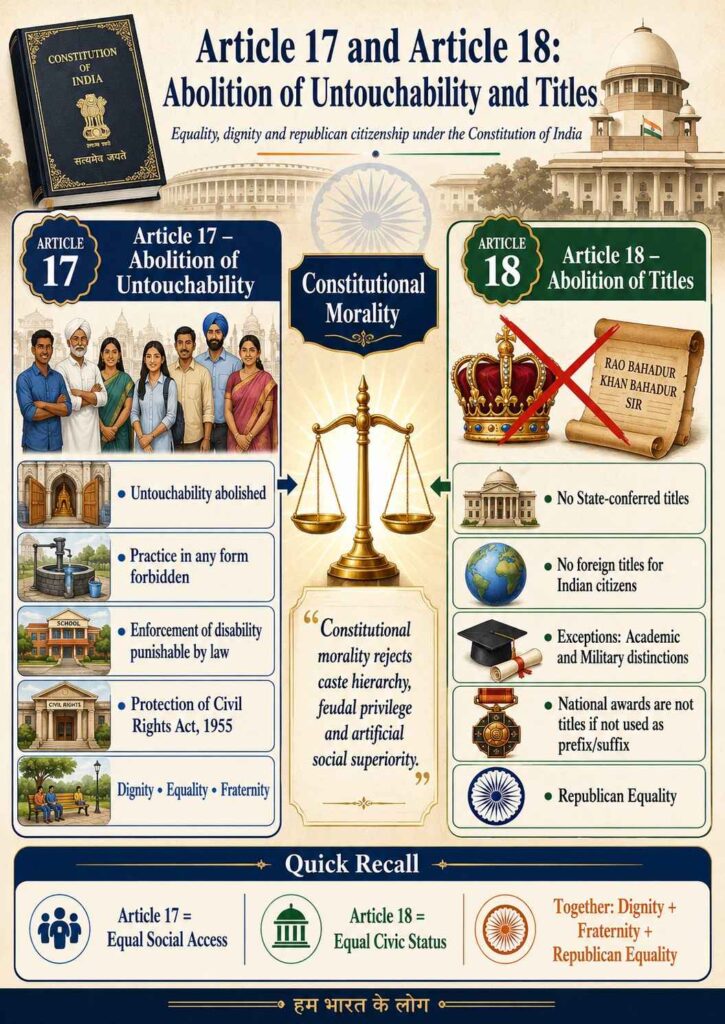
Introduction: Equality as Social Transformation
➤ Core idea: Articles 17 and 18 are part of the Right to Equality under Articles 14 to 18 of the Constitution of India. They do not merely declare formal equality; they attack two social practices that historically created inequality: untouchability and titles of social superiority.
➤ Transformative purpose: Article 17 abolishes untouchability and criminalises the enforcement of disabilities arising from untouchability. Article 18 abolishes titles, except military and academic distinctions, so that the Republic does not create artificial ranks of social superiority. Article 17 protects human dignity and social access, while Article 18 protects republican equality and democratic citizenship. The text of Article 17 states that “Untouchability” is abolished, its practice in any form is forbidden, and enforcement of any disability arising out of it shall be an offence punishable by law.
➤ Common constitutional philosophy: Both Articles reflect constitutional morality, which means that social practices, customs, caste hierarchies, inherited privileges, public honours, religious claims or majority opinion cannot override the basic constitutional values of liberty, equality, dignity, fraternity and non-discrimination.
Article 17: Abolition of Untouchability
Meaning and Scope of Article 17
➤ Constitutional text: Article 17 provides that “Untouchability” is abolished and its practice in any form is forbidden. It further provides that enforcement of any disability arising out of untouchability shall be an offence punishable according to law.
➤ Undefined expression: The Constitution does not define “untouchability”. This is deliberate because the framers wanted to prohibit not merely one fixed practice, but all forms of caste-based exclusion, humiliation and social disability connected with the historical practice of treating certain communities as “untouchable”.
➤ Historical meaning: The word “untouchability” in Article 17 is not used in its literal sense of physical contact. It refers to the historical Indian practice by which certain persons, mainly because of birth in particular castes, were denied access to wells, temples, roads, shops, public services, educational spaces, religious places, social interaction and equal human treatment.
➤ Practice in any form: The words “in any form” make Article 17 wide. It covers direct practices like denying entry into a temple or public well, and also indirect practices like social boycott, separate utensils, segregation, denial of barber services, denial of access to burial grounds, humiliating caste-based restrictions and exclusion from community resources.
➤ Positive duty of law: Article 17 does not only say that untouchability is unconstitutional. It expressly requires that enforcement of disabilities arising from untouchability must be made a punishable offence. This is why Parliament enacted the Untouchability (Offences) Act, 1955, later renamed and strengthened as the Protection of Civil Rights Act, 1955. The Ministry of Social Justice material notes that the 1955 Act was enacted in pursuance of Article 17.
Nature of Article 17 as a Fundamental Right
➤ Horizontal application: Article 17 is not limited to action by the State. It also applies against private individuals. This is important because untouchability is usually practised by private persons, village communities, religious groups, local dominant castes, social bodies or service providers.
➤ Absolute prohibition: Unlike some other Fundamental Rights, Article 17 does not contain an express exception. No defence of religion, custom, tradition, local practice or community sentiment can justify untouchability.
➤ Human dignity: Article 17 protects the dignity of persons who were historically treated as socially inferior. It is linked with Article 14, Article 15, Article 21 and the Preamble’s promise of equality of status and fraternity.
➤ Criminalisation: Article 17 is one of the clearest examples where the Constitution itself directs that a social evil must be treated as a punishable offence. It converts constitutional morality into enforceable legal duty.
Protection of Civil Rights Act, 1955
➤ Purpose of the Act: The Protection of Civil Rights Act, 1955 gives practical effect to Article 17. It defines “civil rights” as any right accruing to a person by reason of the abolition of untouchability under Article 17.
➤ Civil rights meaning: Civil rights under this Act include the right to access public places, use public wells, tanks, roads, cremation grounds, religious institutions, shops, restaurants, hotels, educational institutions, hospitals and other facilities without caste-based exclusion.
➤ Punishable conduct: The Act penalises denial of access to places of public worship, refusal of entry into shops, hotels or public entertainment places, refusal to sell goods or render services, denial of use of water sources, denial of professional or social services, social boycott and other disabilities connected with untouchability.
➤ Public worship: If a person is prevented from entering or worshipping in a place of public worship because of untouchability, the act becomes punishable. This protects religious access where exclusion is based on caste-based impurity or inherited social inferiority.
➤ Public resources: Denial of access to wells, tanks, roads, cremation grounds, bathing ghats, dharamshalas, educational institutions or medical institutions is prohibited because such spaces cannot be converted into instruments of caste hierarchy.
➤ Service-based discrimination: Refusal by a shopkeeper, hotel owner, barber, washerman, priest, public functionary or service provider to serve a person on the ground of untouchability violates the Act. The constitutional logic is that the market and social life must not reproduce caste exclusion.
➤ Social boycott: Boycott or obstruction of a person for exercising rights flowing from abolition of untouchability is also prohibited. The law recognises that untouchability often operates through community pressure, fear and collective punishment.
➤ Relation with SC/ST Act: The Protection of Civil Rights Act deals specifically with disabilities arising from untouchability. The Scheduled Castes and Scheduled Tribes (Prevention of Atrocities) Act, 1989 goes further and punishes serious caste-based atrocities, humiliations, violence, dispossession, social and economic boycott and other targeted offences against Scheduled Castes and Scheduled Tribes. The National Helpline Against Atrocities identifies Article 17, the Protection of Civil Rights Act and the PoA Act as connected constitutional and statutory measures against untouchability and atrocities.
Landmark Case Law on Article 17 and Untouchability
➤ State of Karnataka v. Appa Balu Ingale, AIR 1993 SC 1126; 1995 Supp (4) SCC 469: In this case, members of Scheduled Castes were obstructed from drawing water from a newly dug borewell. The issue was whether such obstruction amounted to enforcement of disability arising from untouchability under the Protection of Civil Rights Act. The Supreme Court treated untouchability as a deeply rooted social evil and upheld the need for strict enforcement of Article 17. The ratio is that Article 17 and the 1955 Act are intended to liberate society from caste-based exclusion and to establish equality, dignity and social justice in actual life.
➤ People’s Union for Democratic Rights v. Union of India, (1982) 3 SCC 235: Although this case is mainly known for bonded labour and labour rights, it is important for understanding horizontal application of Fundamental Rights. The Supreme Court recognised that some Fundamental Rights impose obligations not merely on the State but also on private actors. Article 17 is a classic example because it prohibits untouchability in any form and cannot be defeated merely because the violator is a private person.
➤ Indian Young Lawyers Association v. State of Kerala, (2019) 11 SCC 1 — Sabarimala case: The Supreme Court considered exclusion of women of a particular age group from the Sabarimala temple. The majority held the exclusion unconstitutional. The case is not a classic caste-untouchability case, but it is important because the Court discussed dignity, equality, religious freedom and constitutional morality. The judgment shows that practices justified by custom or religion must still satisfy constitutional values.
➤ Sukanya Shantha v. Union of India, decided on 3 October 2024: The Supreme Court examined caste-based discrimination and segregation in prisons. The Court discussed Article 17 and noted its special place in the Constitution as a provision ending the socially discriminatory practice of untouchability. This case is important because it shows that Article 17 is not limited to village practices; it also applies to modern State institutions like prisons when caste-based labour division, segregation or humiliation continues.
Constitutional Morality and Article 17
➤ Meaning of constitutional morality: Constitutional morality means loyalty to constitutional values rather than blind obedience to social customs. It requires society, courts and the State to prefer equality, dignity and fraternity over caste prejudice.
➤ Ambedkarite foundation: Article 17 reflects Dr. B.R. Ambedkar’s constitutional vision that political democracy cannot survive without social democracy. A person cannot be equal in voting but unequal in wells, temples, schools, streets and social life.
➤ Fraternity: Untouchability destroys fraternity because it divides human beings into pure and impure, touchable and untouchable, superior and inferior. Article 17 is therefore not only an anti-discrimination provision; it is a constitutional command to build social brotherhood.
➤ Public morality vs constitutional morality: Public morality may sometimes support caste customs or inherited exclusion. Constitutional morality rejects such customs when they violate dignity, equality and liberty.
➤ State obligation: The State must not remain neutral when untouchability is practised. It must prevent, punish and remedy such practices through criminal law, social welfare measures, awareness, education, prosecution and institutional reform.
Article 18: Abolition of Titles
Meaning and Scope of Article 18
➤ Constitutional text: Article 18 abolishes titles. It provides that no title, other than a military or academic distinction, shall be conferred by the State. It also restricts acceptance of titles, presents, emoluments or offices from foreign States in certain situations.
➤ Republican principle: Article 18 is based on the idea that India is a Republic where citizens are equal. The State cannot create hereditary or artificial ranks like “Sir”, “Rai Bahadur”, “Khan Bahadur”, “Maharaja” or similar colonial-style titles that suggest permanent social superiority.
➤ Anti-feudal object: Titles were historically used by monarchies and colonial governments to reward loyalty and create social hierarchy. Article 18 rejects this culture because democratic citizenship is incompatible with State-created nobility.
➤ Not a general ban on all recognition: Article 18 does not prevent genuine recognition of merit. It prevents the creation of titles that become part of a person’s name or social status. A reward may be valid if it honours achievement without creating a rank of nobility.
Clauses of Article 18 Explained
➤ Article 18(1): State cannot confer titles: The State cannot confer any title except military or academic distinctions. Therefore, academic degrees such as “Dr.”, “Professor”, “Ph.D.” and military distinctions such as gallantry awards or rank-related honours are not prohibited.
➤ Article 18(2): Indian citizens cannot accept foreign titles: No citizen of India can accept any title from a foreign State. This protects national loyalty and prevents foreign influence through honours.
➤ Article 18(3): Non-citizens holding office under the State: A non-citizen who holds an office of profit or trust under the Indian State cannot accept a title from a foreign State without the President’s consent.
➤ Article 18(4): Presents, emoluments and offices from foreign States: A person holding an office of profit or trust under the State cannot accept any present, emolument or office from or under a foreign State without the President’s consent. This prevents conflict of interest and foreign influence over public officials.
Exceptions: Academic and Military Distinctions
➤ Academic distinctions: Degrees, diplomas, honorary doctorates, professorial titles and educational distinctions are permitted because they show educational achievement or academic recognition. They do not create a hereditary class or feudal superiority.
➤ Military distinctions: Military ranks and gallantry awards are permitted because they recognise service, courage, command responsibility and sacrifice. They are functional or honour-based distinctions connected with national defence, not titles of social nobility.
➤ Reason for exceptions: The Constitution allows these distinctions because equality does not mean denial of excellence. It means that recognition must not become a badge of unequal citizenship.
National Awards and Article 18
➤ Balaji Raghavan v. Union of India, (1996) 1 SCC 361: The constitutional validity of Bharat Ratna, Padma Vibhushan, Padma Bhushan and Padma Shri was challenged on the ground that they were “titles” prohibited by Article 18. The Supreme Court held that these national awards are not titles within Article 18 if they are given for exceptional and distinguished service and are not used as prefixes or suffixes to the recipient’s name. The Court clarified that misuse of awards as titles would be unconstitutional in spirit, and the award may be withdrawn if used contrary to the prescribed rules.
➤ Ratio of Balaji Raghavan: National awards are constitutionally valid when they recognise merit, excellence and distinguished service, but they cannot create a separate privileged class. The awardee cannot style himself as “Padma Shri X” or “Bharat Ratna X” as a name-title.
➤ Practical distinction: A statement such as “X received the Padma Shri in 2020” is permissible. But using “Padma Shri” as a permanent prefix or suffix to one’s name is inconsistent with Article 18.
➤ Constitutional warning: Awards must remain rare, merit-based and transparent. If awards become political patronage, social hierarchy or personal glorification, they may violate the republican spirit behind Article 18 even if formally called awards.
Comparative Table: Article 17 and Article 18
| Point | Article 17 | Article 18 |
|---|---|---|
| Main object | Abolishes untouchability | Abolishes titles |
| Social evil targeted | Caste-based exclusion and humiliation | Feudal, colonial and artificial social hierarchy |
| Nature | Prohibitory and penal | Prohibitory and republican |
| Applies against | State and private persons | Primarily State, citizens, office-holders and persons dealing with foreign States |
| Legal consequence | Practice of untouchability is punishable | Titles cannot be conferred or accepted except as permitted |
| Exceptions | No express exception | Military and academic distinctions |
| Core value | Dignity, equality, fraternity | Equality, republicanism, public integrity |
| Important statute/case | Protection of Civil Rights Act, 1955; Appa Balu Ingale | Balaji Raghavan v. Union of India |
Relationship Between Articles 17 and 18
➤ Equality beyond formal law: Article 17 attacks caste-based inequality from below; Article 18 attacks State-created artificial superiority from above. Together, they create a society where no person is treated as polluted and no person is elevated as a superior citizen by title.
➤ Dignity and fraternity: Article 17 protects the dignity of historically oppressed communities. Article 18 protects the dignity of every citizen by preventing titles that suggest some citizens are constitutionally superior.
➤ Democratic citizenship: In a constitutional democracy, the worth of a person does not depend on caste, birth, inherited rank, royal favour, colonial recognition or State-created social titles.
➤ Transformative constitutionalism: Both Articles show that the Constitution is not limited to controlling government power. It also transforms society by rejecting caste hierarchy, feudal prestige and inherited inequality.
Memory Aid
➤ Article 17 = “No Untouchability”
Abolition + Prohibition + Punishment
➤ Article 18 = “No Titles”
No State titles + No foreign titles + Exceptions for Military and Academic distinctions
➤ Core formula:
Article 17 protects equal social access. Article 18 protects equal civic status.
Conclusion
➤ Constitutional essence: Article 17 and Article 18 are powerful equality provisions. Article 17 abolishes untouchability and makes its practice punishable. Article 18 abolishes titles and prevents the State from creating artificial ranks of superiority, except genuine military and academic distinctions.
➤ Civil rights protection: The Protection of Civil Rights Act, 1955 converts the promise of Article 17 into enforceable offences. It ensures that access to temples, wells, shops, hotels, roads, public services and social participation cannot be denied on the basis of untouchability.
➤ Republican equality: Article 18 ensures that India remains a Republic of equal citizens, not a society of legally honoured elites and socially inferior subjects. National awards may recognise merit, but they cannot become prefixes, suffixes or titles of rank.
➤ Constitutional morality: The deeper message of both Articles is that constitutional values must prevail over caste customs, feudal habits, social prejudice and symbolic inequality. The Constitution demands not merely equality before law, but equality in social life, public honour, civic identity and human dignity.