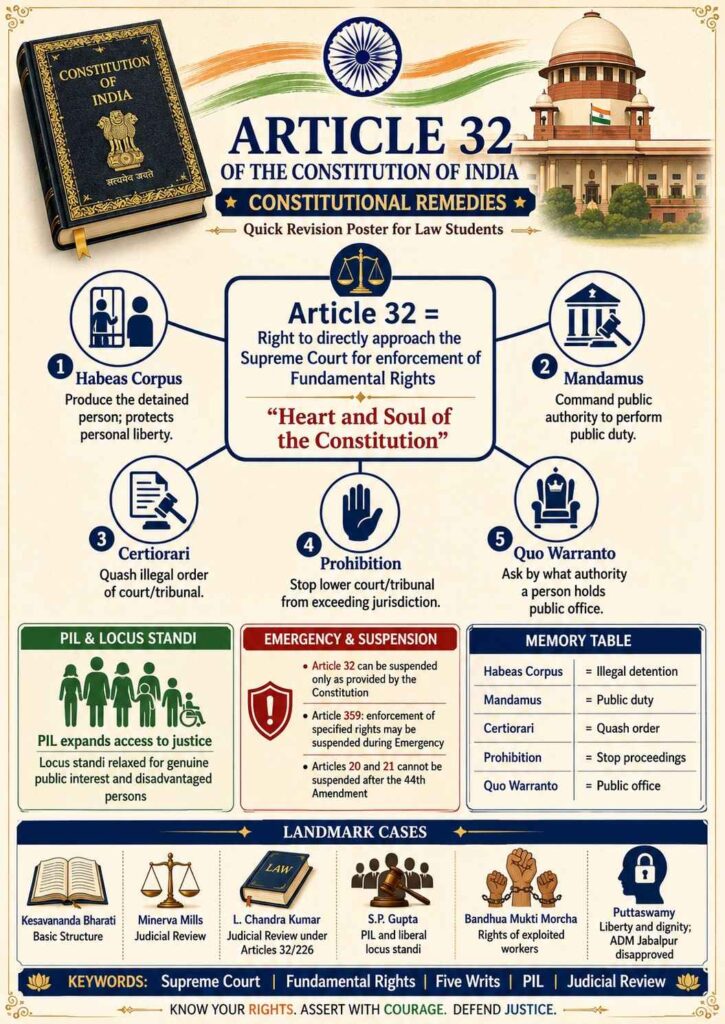
Meaning and Importance of Article 32: The Heart of Fundamental Rights
➤ Core meaning: Article 32 of the Constitution of India gives a person the guaranteed right to directly approach the Supreme Court for enforcement of Fundamental Rights contained in Part III of the Constitution. It is not merely a procedural remedy; it is itself a Fundamental Right. Article 32(1) guarantees the right to move the Supreme Court, Article 32(2) empowers the Supreme Court to issue directions, orders or writs including habeas corpus, mandamus, prohibition, quo warranto and certiorari, Article 32(3) allows Parliament to empower other courts to exercise such powers, and Article 32(4) states that this right shall not be suspended except as otherwise provided by the Constitution.
➤ Constitutional significance: Dr. B.R. Ambedkar famously described Article 32 as the “very soul” and “heart” of the Constitution because rights without remedies become only paper promises. A Fundamental Right becomes meaningful only when there is an effective judicial forum to enforce it. Article 32 therefore converts constitutional promises into enforceable legal rights.
➤ Nature of jurisdiction: The Supreme Court’s jurisdiction under Article 32 is original, because the aggrieved person may directly approach the Supreme Court without first filing a case before a lower court. It is also constitutional, because the power flows directly from the Constitution and not from an ordinary statute. It is also remedial, because its object is to repair or prevent the violation of Fundamental Rights.
➤ Limited purpose: Article 32 is available only for enforcement of Fundamental Rights. It cannot ordinarily be invoked for violation of ordinary statutory rights, contractual rights or non-fundamental legal rights unless such violation also results in infringement of a Fundamental Right.
Article 32 and Article 226: Key Difference
➤ Article 32: The Supreme Court can issue writs only for enforcement of Fundamental Rights. Since Article 32 itself is a Fundamental Right, the Supreme Court normally cannot refuse relief merely because another remedy exists, though it may regulate procedure and may decline petitions that are frivolous, premature, politically motivated or not connected with Fundamental Rights.
➤ Article 226: The High Courts can issue writs not only for enforcement of Fundamental Rights but also “for any other purpose.” Therefore, Article 226 is wider in subject-matter. However, Article 32 is stronger in constitutional status because it is itself guaranteed as a Fundamental Right.
➤ Practical distinction: A person may approach the Supreme Court under Article 32 when a Fundamental Right is directly violated, while a person may approach the High Court under Article 226 for Fundamental Rights as well as other legal rights. Article 226(4) also clarifies that the High Court’s writ power does not derogate from the Supreme Court’s power under Article 32.
Writ Jurisdiction under Article 32
➤ Meaning of writ: A writ is a formal command issued by a constitutional court to enforce legal or constitutional rights. Under Article 32, writs are issued by the Supreme Court to protect Fundamental Rights against unconstitutional State action, unlawful detention, jurisdictional errors, misuse of public office and failure of public authorities to perform public duties.
➤ Scope of orders: Article 32(2) uses broad words: “directions or orders or writs.” This means the Supreme Court is not restricted only to traditional English writs. It may design suitable remedies such as compensation, continuing mandamus, guidelines, monitoring mechanisms, investigation directions, rehabilitation orders, environmental directions and structural remedies wherever necessary for complete enforcement of Fundamental Rights.
Habeas Corpus: Protection Against Illegal Detention
➤ Meaning: Habeas corpus literally means “produce the body.” It is a writ issued to command the authority or person detaining someone to produce the detained person before the court and justify the legality of detention.
➤ Purpose: This writ protects personal liberty under Article 21 and prevents unlawful arrest, secret detention, custodial abuse and executive arbitrariness. It is the most immediate remedy where a person’s physical liberty is illegally restrained.
➤ Who may file: The detained person, family member, friend or even a public-spirited person may file the petition, especially when the detenue cannot approach the court personally.
➤ When issued: It may be issued when detention is without legal authority, when mandatory procedure is not followed, when detention order is mala fide, when grounds of detention are not communicated as required, or when custody continues after expiry of lawful authority.
➤ Landmark case — A.D.M. Jabalpur v. Shivkant Shukla, (1976) 2 SCC 521: During the Internal Emergency, detenues filed habeas corpus petitions challenging preventive detention. The legal issue was whether a person could move court for habeas corpus when the right to enforce Article 21 was suspended under Article 359. The majority held that during such suspension, courts could not examine habeas corpus petitions for enforcement of personal liberty. This decision was later condemned as a grave constitutional error. In Justice K.S. Puttaswamy v. Union of India, (2017) 10 SCC 1, the Supreme Court held that life and personal liberty are not gifts of the State and expressly disapproved the reasoning of A.D.M. Jabalpur.
Mandamus: Command to Perform Public Duty
➤ Meaning: Mandamus means “we command.” It is issued to compel a public authority, statutory body, tribunal, government officer or other authority performing public functions to perform a legal or public duty.
➤ Purpose: Mandamus prevents administrative inaction. It ensures that authorities do not sit idle where the law requires them to act.
➤ When issued: It may be issued where a public authority refuses to exercise jurisdiction, fails to perform a statutory duty, acts arbitrarily, violates Fundamental Rights, or ignores constitutional obligations.
➤ When not issued: It is generally not issued to enforce a purely private contract, to compel performance of a discretionary act in a particular manner, against the President or Governor for official constitutional functions, or where no legal duty exists.
➤ Illustration: If a statute requires a licensing authority to consider an application within a reasonable time and the authority refuses to act without justification, mandamus may be issued directing the authority to decide the application according to law.
Certiorari: Correcting Jurisdictional and Legal Errors
➤ Meaning: Certiorari means “to be certified” or “to be informed.” It is issued by a superior court to quash an order passed by an inferior court, tribunal or quasi-judicial authority when such order suffers from jurisdictional error, violation of natural justice or error apparent on the face of the record.
➤ Purpose: Certiorari is corrective. It does not merely prevent future illegality; it sets aside an already passed illegal order.
➤ When issued: It may be issued where the authority acts without jurisdiction, exceeds jurisdiction, fails to exercise jurisdiction, violates natural justice, considers irrelevant matters, ignores mandatory law, or makes a patent legal error.
➤ Natural justice connection: Certiorari is often used where a person was not given notice, hearing, impartial adjudication or reasoned decision where law required fairness.
➤ Illustration: If a tribunal decides a matter against a person without giving any opportunity of hearing, the Supreme Court may quash the order through certiorari if a Fundamental Right is involved.
Prohibition: Preventing Excess of Jurisdiction
➤ Meaning: Prohibition is issued by a superior court to an inferior court, tribunal or quasi-judicial body to prevent it from continuing proceedings beyond its jurisdiction.
➤ Purpose: Prohibition is preventive, while certiorari is corrective. Prohibition stops an illegal proceeding before final order; certiorari quashes an illegal order after it is made.
➤ When issued: It may be issued when a tribunal is hearing a matter over which it has no jurisdiction, is exceeding its jurisdiction, or is proceeding in violation of natural justice.
➤ Illustration: If a tax tribunal starts deciding a criminal matter that it has no power to decide, prohibition may be issued restraining it from continuing such proceedings.
Quo Warranto: Testing Authority to Hold Public Office
➤ Meaning: Quo warranto means “by what authority.” It is issued to question the legal authority of a person holding a public office.
➤ Purpose: This writ protects public offices from illegal occupation. It ensures that only legally eligible persons occupy public positions.
➤ Conditions: The office must be public, substantive, created by Constitution or statute, and the holder must lack legal eligibility or appointment must be contrary to law.
➤ Special feature: Unlike other writs, the petitioner need not prove personal injury. Any person may seek quo warranto because the public has an interest in lawful occupation of public offices.
➤ Illustration: If a statute requires a university vice-chancellor to possess specified qualifications and a person without those qualifications is appointed, quo warranto may be filed to challenge the authority of that person to hold office.
Public Interest Litigation under Article 32
➤ Meaning of PIL: Public Interest Litigation is a procedural innovation by which courts allow public-spirited persons to approach the Supreme Court or High Court for enforcement of rights of disadvantaged, poor, detained, exploited, marginalised or voiceless persons who cannot approach the court themselves.
➤ Reason for development: Traditional litigation required the person directly injured to file the case. This strict rule worked harshly in a country where poverty, illiteracy, social oppression, bonded labour, custodial violence and administrative neglect often prevented victims from accessing courts. PIL relaxed procedure to make Fundamental Rights practically enforceable.
➤ Constitutional basis: PIL under Article 32 is mainly used where violation of Fundamental Rights affects a class of persons or the public at large. It has been used in matters involving bonded labour, undertrial prisoners, prison reforms, environment, sexual harassment, child labour, pavement dwellers, custodial violence, right to food, shelter, education and dignity.
➤ Epistolary jurisdiction: In some PIL cases, the Supreme Court treated letters, postcards or newspaper reports as writ petitions. This reflected the idea that procedural technicalities must not defeat substantive justice where Fundamental Rights of helpless persons are involved.
➤ Landmark case — S.P. Gupta v. Union of India, 1981 Supp SCC 87: The case concerned issues relating to transfer and appointment of judges and independence of the judiciary. The legal issue included whether persons not personally injured could approach the court in matters of public importance. The Supreme Court liberalised locus standi and accepted that where legal wrong is caused to a person or class unable to approach the court due to poverty, disability or socially disadvantaged position, a public-spirited person may maintain an action. This became a foundation of PIL jurisprudence in India.
➤ Landmark case — Bandhua Mukti Morcha v. Union of India, (1984) 3 SCC 161 / AIR 1984 SC 802: The petition alleged existence of bonded labourers in stone quarries. The issue was whether the Supreme Court could entertain a PIL and issue investigative and remedial directions for enforcement of Articles 21, 23 and 24. The Court held that Article 32 is not confined to adversarial litigation and may be used to secure release and rehabilitation of bonded labourers. The ratio is that the right to live with dignity, free from exploitation, is enforceable through Article 32, and procedural flexibility is justified where the oppressed cannot access justice.
➤ Limits on PIL: PIL is not meant for publicity, political rivalry, private disputes, service matters disguised as public interest, commercial competition or personal gain. Courts insist on bona fides because misuse of PIL can waste judicial time and harm genuine public causes.
Locus Standi under Article 32
➤ Traditional rule: Locus standi means the legal capacity to bring a case. Traditionally, only a person whose own right was violated could file a writ petition.
➤ Liberalised rule: In constitutional matters involving disadvantaged persons or public wrongs, Indian courts relaxed locus standi. A person acting bona fide and having sufficient interest may approach the court on behalf of those who cannot do so.
➤ Reason for relaxation: Fundamental Rights are not only individual claims; they also express constitutional values such as dignity, equality, liberty and rule of law. Where violation affects persons who are poor, imprisoned, bonded, socially oppressed or otherwise disabled from approaching court, strict locus standi would make rights meaningless.
➤ Balanced approach: Liberal locus standi does not mean open permission for busybodies. The petitioner must act in good faith, must not seek personal benefit, and must raise a genuine constitutional issue.
Article 32 and Judicial Review as Basic Structure
➤ Judicial review: Judicial review is the power of courts to examine whether laws, executive actions and administrative orders are consistent with the Constitution. Article 32 is a central tool of judicial review because it allows direct challenge before the Supreme Court for violation of Fundamental Rights.
➤ Landmark case — Kesavananda Bharati v. State of Kerala, (1973) 4 SCC 225: The issue was the extent of Parliament’s power to amend the Constitution. The Supreme Court held that Parliament may amend the Constitution but cannot destroy its basic structure. Judicial review and Fundamental Rights form part of constitutional supremacy. Article 32 draws strength from this doctrine because without judicial review, Fundamental Rights would lose practical force.
➤ Landmark case — Minerva Mills Ltd. v. Union of India, (1980) 3 SCC 625 / AIR 1980 SC 1789: The issue concerned the validity of constitutional amendments restricting judicial review and giving primacy to Directive Principles over Fundamental Rights. The Court held that limited amending power and judicial review are part of the basic structure. The case strengthens Article 32 because it confirms that courts must remain available to test constitutional violations.
➤ Landmark case — L. Chandra Kumar v. Union of India, (1997) 3 SCC 261 / AIR 1997 SC 1125: The issue was whether tribunal decisions could be excluded from High Court and Supreme Court judicial review. The Supreme Court held that judicial review under Articles 32 and 226/227 is part of the basic structure. Tribunals may act as courts of first instance in specialised areas, but constitutional judicial review cannot be completely excluded.
Suspension of Article 32 During Emergency
➤ Article 32(4): Article 32 states that the right guaranteed by Article 32 shall not be suspended except as otherwise provided by the Constitution. This means the Constitution itself recognises limited emergency situations where enforcement of certain Fundamental Rights may be suspended.
➤ Article 359: During a Proclamation of Emergency, the President may by order declare that the right to move any court for enforcement of specified Fundamental Rights shall remain suspended for the emergency period or a shorter period. After the 44th Constitutional Amendment, enforcement of Articles 20 and 21 cannot be suspended under Article 359. This is a major constitutional safeguard because protection against conviction for offences and protection of life and personal liberty remain enforceable even during Emergency.
➤ Effect of suspension: Article 359 does not automatically suspend all Fundamental Rights. It suspends the right to move court for enforcement of only those rights specifically mentioned in the Presidential Order, and only for the period and area covered by the order. The right may remain theoretically in existence, but its judicial enforcement is temporarily barred.
➤ Difference between Article 358 and Article 359: Article 358 concerns automatic suspension of Article 19 freedoms during a National Emergency on the ground of war or external aggression. Article 359 concerns suspension of the right to move courts for enforcement of specified Fundamental Rights, except Articles 20 and 21 after the 44th Amendment.
➤ Emergency lesson from A.D.M. Jabalpur: The majority view in A.D.M. Jabalpur allowed executive detention to escape judicial scrutiny during Emergency. This position is now constitutionally unacceptable after Puttaswamy and the 44th Amendment’s protection of Articles 20 and 21. The present constitutional understanding is that human dignity, life and liberty cannot be treated as mere State-granted privileges.
Important Principles for Revision
| Concept | Simple Meaning | Main Use |
|---|---|---|
| Article 32 | Direct remedy before Supreme Court | Enforcement of Fundamental Rights |
| Habeas Corpus | Produce the detained person | Illegal detention |
| Mandamus | Command to perform duty | Public duty not performed |
| Certiorari | Quash illegal order | Jurisdictional error or natural justice violation |
| Prohibition | Stop illegal proceeding | Prevent excess of jurisdiction |
| Quo Warranto | By what authority | Illegal occupation of public office |
| PIL | Public interest action | Rights of disadvantaged or public wrongs |
| Locus Standi | Right to file case | Relaxed in genuine PIL |
| Article 359 | Suspension of enforcement during Emergency | Cannot suspend Articles 20 and 21 enforcement |
Conclusion
➤ Final understanding: Article 32 is the constitutional shield of Fundamental Rights. It gives direct access to the Supreme Court, empowers the Court to issue writs, supports PIL, relaxes locus standi in genuine public causes and preserves judicial review as a basic feature of the Constitution. Its importance lies not only in providing remedies but in maintaining rule of law, constitutional supremacy and accountability of State power.
➤ Essential memory point: Fundamental Rights are the promises of the Constitution, but Article 32 is the mechanism that makes those promises enforceable. Habeas corpus protects liberty, mandamus compels public duty, certiorari corrects illegal orders, prohibition prevents excess jurisdiction, quo warranto protects public offices, PIL expands access to justice, and Article 359 explains the limited emergency suspension of enforcement.