About HNLU
Hidayatullah National Law University, a premier institute for legal education and research is celebrating its 20th Year of establishment. The University’s motto, ‘ धर्म संस्थापनार्थम, ‘ translates to ‘for the sake of establishing the primacy of laws of eternal values.’ In line with this ethos, HNLU strives to provide advanced legal education that shapes students into more than just legal professionals; it instils in them a profound responsibility to contribute to society.
In recent years, the university has introduced a series of ground-breaking programs, including Lex Osmose, Ex-Arca, HNLU Press, Sui Generis, HEXA, HAAI and R-Has, with the new spoke model of research centers setting a new standard for innovation and academic excellence.
About Centre for Study of Law and Indigenous People (CLIP)
The Centre for law and indigenous people is one-of-a-kind initiative established under the school for Law and Humanities to explore, understand and preserve the intersection of legal scholarship and indigenous perspective. It aims to provide a platform for rigorous research, thoughtful discussions and collaborative initiatives regarding the rich traditions of the indigenous peoples. The centre is committed not only to the scholarly pursuit of legal knowledge but also to profound understanding of the unique challenges faced by indigenous communities and to that extent it envisions to contribute meaningfully to the development of legal frameworks that respect and integrate indigenous perspective.
About the Conference
Indigenous and tribal communities today stand at the crossroads of history. On the one hand, they bear the heaviest burdens of displacement, ecological loss, cultural erasure, and political marginalisation. On the other, they carry with them resilient knowledge systems, community structures, and alternative visions of justice that offer the world fresh ways of thinking about democracy, environment, and human dignity.
Conventional academia has often failed to capture this dual reality. Legal studies tend to remain confined to statutes and judgments; social sciences often abstract lived experiences into theories; and public policy debates are dominated by technocratic voices that rarely listen to the communities themselves. The result is a fragmented understanding of Indigenous lives; when what is needed is a holistic, interdisciplinary conversation.
This conference is an attempt to rethink tribal justice by breaking disciplinary silos. We invite scholars of law, sociology, anthropology, political science, environmental studies, history, women’s studies, and cultural studies to place their perspectives in dialogue. Here, customary laws will be read alongside constitutional promises, oral traditions alongside human rights standards, and ecological ethics alongside development policies.
Crucially, this conference recognises that youth voices, especially those of Indigenous and first-generation scholars, are often absent from mainstream academic platforms. By foregrounding their perspectives, the conference aims not only to generate academic knowledge but also to imagine Indigenous futures shaped by justice, resilience, and solidarity.
To move beyond theory into practice, the conference will welcome not only research papers but also policy briefs, community case studies, and ethnographic narratives. This openness reflects our belief that knowledge is plural, and that the future of Indigenous studies lies in embracing diverse ways of knowing and speaking.
Objectives of the Conference
- To explore the meaning of justice for Indigenous and tribal communities in the context of globalization, ecological crises, cultural erasure, and political marginalisation.
- To foster interdisciplinary dialogue across law, sociology, anthropology, political science, environmental studies, history, women’s studies, and cultural studies.
- To centre youth perspectives and student voices, thereby challenging academic hierarchies and creating inclusive spaces for dialogue.
- To encourage participation of first-generation scholars, tribal/Indigenous students, and researchers working at the intersections of multiple disciplines.
- To ensure the long-term scholarly and policy impact of student contributions through publication in an edited book/journal on Law and Indigenous Studies.
- To cultivate comparative and global perspectives by engaging with Indigenous struggles worldwide and building transnational solidarity.
Key Themes & Sub-Themes
Law, Rights, and Justice
- Customary law and state legal systems: conflicts and convergence
- International law, human rights, and Indigenous peoples (UNDRIP, ILO conventions)
- Restorative and community-based justice models
Culture, Identity, and Lived Experience
- Cultural resilience, language preservation, and identity politics
- Gender roles, intersectionality, and agency in tribal societies
- Oral traditions, performance, and Indigenous knowledge systems
- Media and representation of Indigenous communities
III. Human Rights and Public Policy
- Health, education, and social protection in tribal regions
- Governance, decentralisation, and participatory democracy
- Witch-hunting, displacement, and other forms of structural violence
Climate, Ecology, and Sustainability
- Indigenous ecological knowledge and climate adaptation
- Tribal cosmologies and environmental ethics
- Just transitions: extractive economies, energy, and climate justice
Development, Economy, and Globalisation
- Development-induced displacement and rehabilitation challenges
- Mining, infrastructure, and corporate interventions
- Tribal economies, sustainable livelihoods, and social entrepreneurship
- Technology, digitalisation, and the transformation of Indigenous life
Comparative and Global Dialogues
- Comparative legal systems on Indigenous rights
- South–South exchanges: Latin America, Africa, South Asia
- Cross-continental student perspectives on Indigenous struggles
- Building transnational solidarity among Indigenous communities
Note: The sub-themes are only suggestive areas and are not exhaustive. Research papers that are not covered under the abovementioned sub themes but have relevance in the thrust area of the conference may also be submitted.
Important Dates
- Submission of Abstract: 15 February 2026
- Intimation of Acceptance: 22 February 2026
- Registration Deadline: 7 March 2026
- Submission of Full Paper: 15 March 2026
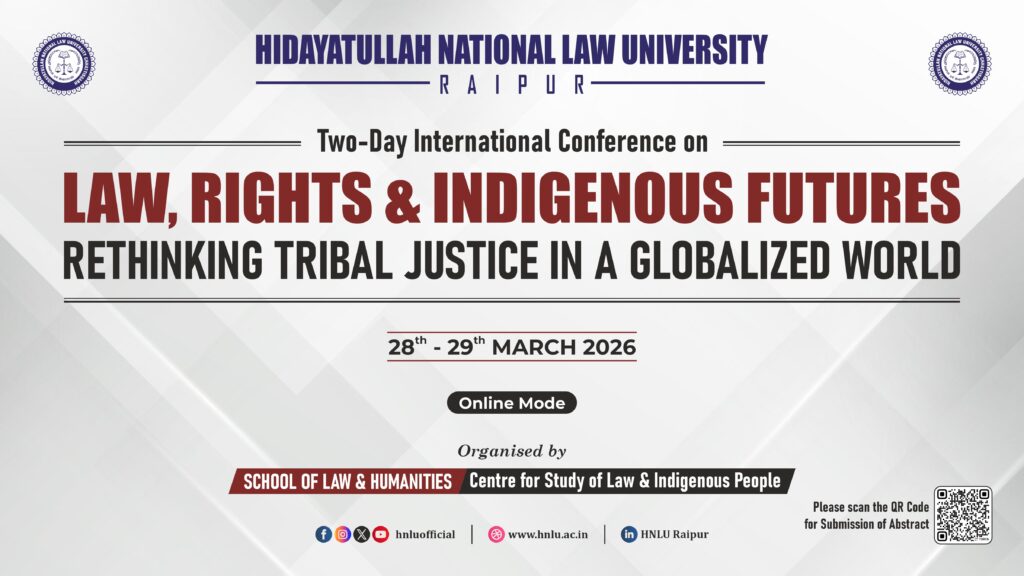
- Conference Dates: 28–29 March 2026
Submission Guidelines:
Abstract
Research Papers → Abstract (250–300 words) (inclusive of 4 keywords)
Policy Briefs → Executive Summary (150–200 words)
Community Case Studies → Abstract (150–200 words)
Ethnographic Notes → Context Note (100–150 words)
For abstract: must be accompanied by a brief bio-note (in 100 words) of the author indicating his/her email ID, contact number, designation, and official address.
All submissions must include:
- Author’s full name
- Institutional affiliation
- Contact email
- Short bio (100 words)
The abstract should be in the following format:
- Times New Roman, Font Size 12 & Line spacing 1.5, Justified.
- 1-inch margins on all the four sides.
- Submissions are to be made in MS Word format only.
The abstract must identify a research problem clearly to be discussed by the author in the full paper, and the particular theme of the conference associated with the paper.
Please name your abstract file as follows:
Full Name_abstract e.g. if author’s name is John Doe then the file name should be John Doe_abstract. The abstracts can be submitted through this link:
- Research Papers (4000–6000 words)
- Must present original research with clear research questions, methodology, analysis, and conclusion.
- Should engage with existing literature and contribute to theoretical or policy debates.
- Abstract (250–300 words) required, summarising the research problem, method, and findings.
- Proper citation and referencing required (APA/Bluebook style – as per conference format).
- Policy Briefs (2000–3000 words)
- Should focus on a specific policy issue affecting Indigenous/tribal communities.
- Must provide evidence-based analysis with concrete recommendations for policymakers.
- Concise writing style, using headings, bullet points, and visuals (tables, charts) where relevant.
- Executive Summary (150–200 words) required, highlighting the issue, evidence, and key recommendations.
- References and data sources must be clearly indicated.
- Community Case Studies (2500–4000 words)
- Must highlight lived experiences, grassroots initiatives, or specific community struggles.
- Can be narrative in style but should include analytical reflection.
- May include photographs, testimonies, or qualitative data (with consent).
- Should connect the local case to broader academic or policy debates.
- Abstract (150–200 words) required, outlining the case context, method, and insights.
- Ethnographic Notes (1500–2000 words)
- Based on fieldwork, participant observation, or engagement with Indigenous communities.
- Should capture cultural practices, oral histories, rituals, or everyday life.
- Reflexive approach expected: author’s role and perspective must be acknowledged.
- Use descriptive clarity while linking to wider theoretical or cultural discussions.
- Context Note (100–150 words) required, describing the field site and thematic focus
For citation, the author is required to follow the APA Formatting and Blue book Citation (12th Ed.).
The final paper should mandatorily have the suggestions/ recommendations made by the author(s).
The language of submissions should preferably be English and Hindi.
For Publication of Papers
- Selected research papers may be published in an edited book by a reputable publisher with an ISBN.
- The authors willing to consider their paper for publication must submit a duly filled in and scanned ‘DECLARATION OF RESPONSIBILITY & ASSIGNMENT OF COPYRIGHT FORM’ to be provided with the communication of acceptance of paper.
- The submitted papers shall be checked through a similarity software approved by the University.
- Any paper exceeding 10% similarity shall be outrightly rejected.
- The submitted papers shall go through a blindfolded peer review process before selection for publication in an edited book with ISBN as per the University Policies.
- Selection for paper presentation does not entitle publication in the book
Who Can Participate
- Academicians, Postgraduate and Undergraduate students from law, social sciences, humanities, environmental studies, and related disciplines.
- First-generation scholars and tribal/Indigenous students are especially encouraged to participate.
- Young researchers and interdisciplinary scholars working on issues related to law, rights, justice, culture, ecology, and Indigenous futures.
- Students interested in presenting research papers, policy briefs, community case studies, or ethnographic notes within the conference themes.
Registration and Fee
- For International Professionals and Academicians: 30 USD
- Academicians and Professionals: INR 1000
- Research Scholars: INR 750
- Students: INR 500
NOTE
- Registration fee is payable only after the acceptance of the abstract. Participants are required to attach a screenshot of the successful payment to the registration form. Once deposited, the payment is non-refundable, the screenshot of the successful payment is in the registration form. The said payment is non-refundable once it’s deposited.
- Participants are required to fill out a copyright form, which will be circulated at the time of registration.
- As the event will be for a day, the slot for the presentation will be made available beforehand. Hence, the slot for the presentation will be made available beforehand day day-wise and session-wise.
- Only quality papers will be selected for publication. Merely a candidate allowed for presentation will not be the sole ground to claim publication until the author responds to scrutiny suggested in the paper from time to time.
- In case of more than one author in one paper, each author will pay a fee mentioned above individually.
- There would not be any fee for faculties and students of HNLU.
- Certificate of participation/ presentation will be provided to the participants.
- The registration fee covers only the paper presentation. Authors of selected papers will be required to pay an additional Rs. 1000 for the publication of their paper in the edited book.
Panel Experts and Resource Persons
The conference will host a diverse group of experts and practitioners to guide student participants, provide feedback, and enrich discussions.
- Academics and Scholars: Eminent professors and researchers from law, sociology, anthropology, history, political science, environmental studies, and cultural studies.
- Legal Practitioners: Judges, lawyers, and advocates working on issues of constitutional rights, Indigenous justice, and human rights.
- Policy Experts: Specialists from government bodies, think tanks, and international organisations dealing with tribal/Indigenous issues, rights, and development.
- Community Leaders and Activists: Tribal elders, grassroots organisers, and Indigenous rights activists who bring lived experiences and community knowledge.
- Writers and Media Persons: Journalists, cultural practitioners, and documentary filmmakers representing Indigenous voices and struggles.
- International Experts: Scholars and practitioners working on Indigenous rights across Latin America, Africa, Australia, and other regions to foster comparative global dialogue.
Outcomes & Impact (Highlights)
- Amplifying Voices: Centre student, first-generation scholar, and Indigenous perspectives in global debates.
- Knowledge & Policy: Produce research and policy insights with real-world relevance for law, governance, and rights.
- Collaboration & Dialogue: Foster interdisciplinary and transnational solidarity across regions and disciplines.
- Capacity Building: Equip students with research, writing, and policy engagement skills for academic and professional growth.
Conference Advisory Board
- Prof. (Dr.) V. C. Vivekanandan, Hon’ble Vice-Chancellor
- Dr. Deepak Kumar Shrivastav, Registrar (I/c)
- Dr. Avinash Samal, Director, School of Law, and Humanities
Conference Secretariate
- Dr. Ayan Hazra, Secretary, Head, Centre for Study of Law and Indigenous People
- Aashutosh Kumar Aahire, Convenor, Head, Centre for Law and Public Health
- Dr.Ankit Awasthi, Co- Secretary, Head, Centre for Law and WTO
- Mr. Jeevan Sagar, Co-Secretary
- Dr. Pravesh Rajput, Co-Secretary, Head, Centre for Infrastructure Laws
Members
- Mr. Pradeep Barman
- Ms.Archana Ghartoe
- Ms.Priyanka Mohod
- Mr. Deepak Kumar
Contact Details
For further queries and information, please contact:
Email Id: conftrib@hnlu.ac.in
Contact No.: 7587017829
Official Links
- Abstract Submission Link: https://forms.gle/DZgjqJcunRC4zLXk6
- Brochure Link : https://drive.google.com/file/d/1Qzx_EVaYYmixdaAeQ8Gu5wheZ1SDZb3c/view?usp=sharing