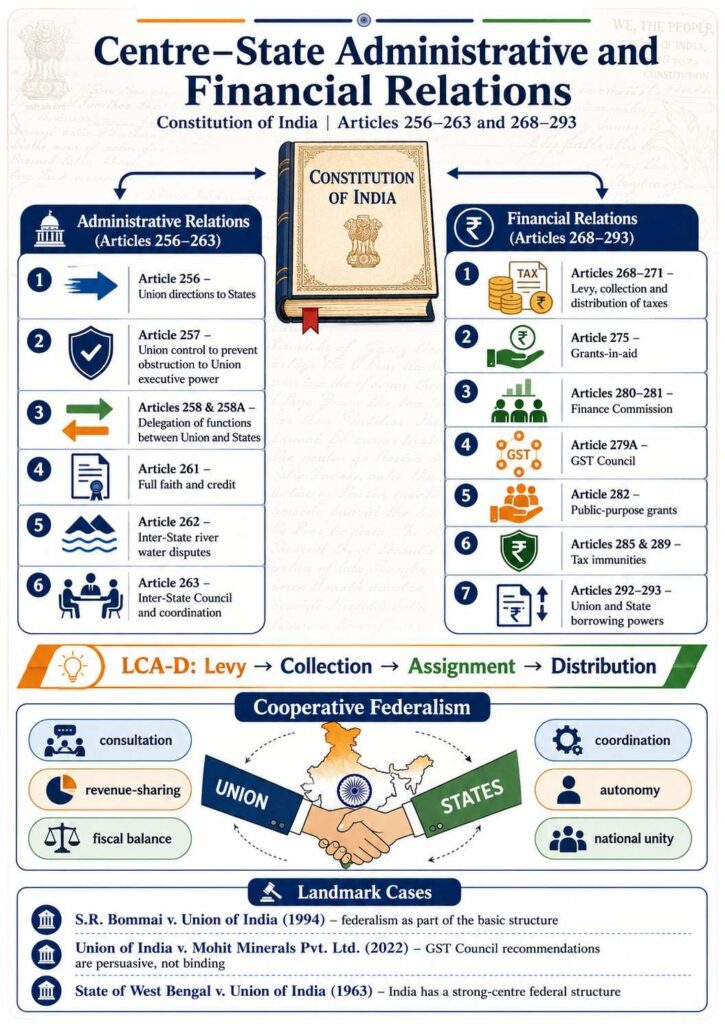
Constitutional Foundation of Centre–State Relations
• Federal design: India is a federation with a constitutionally strong Union. Legislative, executive and financial powers are distributed between the Union and the States, but the Constitution also creates mechanisms for Union supervision, coordination, fiscal equalisation and dispute resolution.
• Administrative relations: Articles 256–263 mainly regulate how the Union and States exercise executive power, issue directions, delegate functions, recognise public acts and resolve inter-State issues.
• Financial relations: Articles 268–293 regulate levy, collection, assignment and distribution of taxes; grants-in-aid; fiscal institutions; immunity from taxation; and borrowing powers.
• Core balance: The Constitution seeks to preserve State autonomy in their allotted fields while maintaining national unity, coordinated governance and fiscal stability. Articles 256–263 and 268–293 therefore combine central authority with consultation, delegation and revenue-sharing.
Judicial Meaning of Indian Federalism
• Strong-centre federalism — State of West Bengal v. Union of India, AIR 1963 SC 1241; (1964) 1 SCR 371: The Union enacted the Coal Bearing Areas (Acquisition and Development) Act, 1957, enabling acquisition of coal-bearing land, including land owned by a State. West Bengal challenged Parliament’s competence to acquire State property. The Supreme Court held that States are not sovereign entities independent of the Union; sovereignty rests in the people under the Constitution. Parliament may legislate and acquire State property when acting within a valid legislative field. The case explains that Indian federalism has a strong Union orientation, though States retain constitutionally protected powers in their respective spheres.
• Constitutional autonomy — State of Karnataka v. Union of India, (1977) 4 SCC 608: Karnataka challenged the Union’s action connected with a Commission of Inquiry into allegations concerning the State’s Chief Minister. The principal issue was whether Union action and Parliamentary legislation could improperly invade State autonomy. The Supreme Court upheld the constitutional validity of the relevant framework and clarified that States possess constitutional status and autonomy, but not separate sovereignty. The Union–State relationship must be assessed through the text and structure of the Constitution, not through an assumption that States are completely independent political units.
• Federalism as a basic feature — S.R. Bommai v. Union of India, (1994) 3 SCC 1: Several proclamations under Article 356, dissolving State governments and Legislative Assemblies, were challenged. The Supreme Court held that federalism is part of the basic structure of the Constitution. Presidential satisfaction under Article 356 is subject to judicial review, and majority in a Legislative Assembly should ordinarily be tested on the floor of the House. The ruling protects elected State governments from arbitrary Union intervention and gives substantive meaning to constitutional federalism.
• Cooperative federalism — Government of NCT of Delhi v. Union of India, (2018) 8 SCC 501: The dispute concerned the relationship between the elected Government of the National Capital Territory of Delhi and the Union-appointed Lieutenant Governor. The Supreme Court emphasised constitutional trust, collaborative governance and cooperative federalism. It held that constitutional authorities should avoid obstruction and work within their allocated domains. Though Delhi has a special constitutional position, the decision is important for the wider principle that Union–State disputes should, where possible, be resolved through dialogue and coordination rather than institutional confrontation.
Administrative Relations under Articles 256–263
Article 256: Obligation of States and Union Directions
• Compliance duty: Article 256 requires every State to exercise its executive power so as to ensure compliance with laws made by Parliament and existing laws applicable in that State.
• Union directions: The executive power of the Union extends to issuing directions to a State where such directions are necessary to secure implementation of Parliamentary laws.
• Purpose: Article 256 prevents a State from defeating a valid Central law merely by refusing, delaying or neglecting administrative implementation.
• Consequence of non-compliance: Failure to comply with constitutional directions may become relevant under Article 365, under which the President may conclude that a situation has arisen in which the government of the State cannot be carried on in accordance with the Constitution. This is not an automatic consequence; constitutional action remains subject to the principles laid down in S.R. Bommai.
Article 257: Union Control in Specific Administrative Matters
• Non-obstruction principle: Under Article 257(1), State executive power must not impede or prejudice the exercise of Union executive power. The Union may issue directions necessary to prevent such obstruction.
• Communications: Article 257(2) permits Union directions regarding construction and maintenance of means of communication declared to be of national or military importance.
• Railway protection: Article 257(3) authorises Union directions concerning measures necessary for protection of railways within a State.
• Additional costs: Where compliance with a direction under Article 257(2) or 257(3) causes extra expenditure beyond the State’s ordinary obligations, the Union must pay the additional cost. If the governments do not agree on the amount, it is determined by an arbitrator appointed by the Chief Justice of India. This preserves fiscal fairness while allowing national coordination.
• Article 257A omitted: Article 257A, inserted by the Forty-second Amendment for Union deployment of armed forces in States, was omitted by the Forty-fourth Amendment. Union assistance in security matters is now understood through other constitutional and statutory provisions.
Articles 258 and 258A: Mutual Entrustment of Functions
• Union-to-State delegation — Article 258(1): The President may, with the consent of the State Government, entrust Union executive functions to a State Government, its officers or authorities. The entrustment may be conditional or unconditional.
• Parliamentary conferral — Article 258(2): Parliament may, through a law applicable in a State, confer powers or impose duties on the State or its officers even where the State Legislature has no legislative competence over that subject.
• Financial protection: Under Article 258(3), the Union must compensate the State for additional administrative expenses caused by Union functions entrusted or imposed upon State authorities.
• State-to-Union delegation — Article 258A: A Governor may, with the consent of the Government of India, entrust State executive functions to the Union or its officers. Thus, delegation is not one-sided; the Constitution allows administrative cooperation in both directions.
Articles 259–261: Other Administrative Provisions
• Article 259 omitted: Article 259 relating to armed forces in former Part B States was omitted by the Seventh Amendment.
• Article 260 — foreign jurisdiction: The Government of India may, by agreement with the government of a territory outside India, undertake executive, legislative or judicial functions vested in that government. Such an agreement remains subject to Indian law concerning foreign jurisdiction.
• Article 261 — full faith and credit: Public acts, records and judicial proceedings of the Union and every State must be recognised throughout India. Parliament may prescribe the method of proof and legal effect of such records. Final civil court judgments and orders are capable of execution anywhere in India according to law. This provision ensures legal continuity across State boundaries.
Article 262: Inter-State River Water Disputes
• Special constitutional mechanism: Article 262 empowers Parliament to provide for adjudication of disputes concerning waters of inter-State rivers or river valleys.
• Exclusion of courts: Parliament may exclude the jurisdiction of the Supreme Court and other courts in relation to such disputes. This is a specific constitutional exception to the general rule that inter-State disputes may reach the Supreme Court under Article 131.
• Statutory framework: Parliament enacted the Inter-State River Water Disputes Act, 1956. The Act provides for reference of qualifying water disputes to tribunals and contains a bar on the jurisdiction of the Supreme Court and other courts in matters that may be referred under the Act.
• Water-dispute precedent — In re: Cauvery Water Disputes Tribunal, 1993 Supp (1) SCC 96: The Cauvery Water Disputes Tribunal issued an interim order directing release of water. Questions arose regarding the legal status of the Tribunal’s order and the Union’s duty to act upon it. The Supreme Court held that the Tribunal’s decision under the statutory framework had binding legal significance and that the Union could not disregard the adjudicatory mechanism created under Article 262 and the 1956 Act. The decision illustrates that inter-State water disputes are meant to be addressed through specialised constitutional and statutory processes rather than political unilateralism.
Article 263: Inter-State Council
• Enabling provision: Article 263 authorises the President to establish an Inter-State Council whenever public interest requires it.
• Functions: The Council may inquire into and advise upon inter-State disputes; investigate and discuss subjects of common interest between States or between the Union and States; and make recommendations for better coordination of policy and action.
• Nature: The Council is primarily a consultative and recommendatory body, not a court or tribunal. Its importance lies in preventing disputes through deliberation, information-sharing and consensus-building.
• Institutional development: The Inter-State Council was established through a Presidential Order dated 28 May 1990. It is an important forum for cooperative federalism and Centre–State consultation.
Financial Relations under Articles 268–293
Revenue Distribution: Basic Constitutional Pattern
| Provision | Levy | Collection | Final Destination of Revenue |
|---|---|---|---|
| Article 268 | Union | States, except in Union Territories | States |
| Article 269 | Union | Union | Assigned to States |
| Article 269A | Union for inter-State GST | Union | Apportioned between Union and States |
| Article 270 | Union | Union | Distributed between Union and States |
| Article 271 | Parliament may impose surcharge | Union | Entirely Union |
• Memory aid — LCA-D: Levy, Collection, Assignment and Distribution are distinct concepts. A tax may be levied by one authority, collected by another, and finally appropriated by a third.
Articles 268–272: Tax Assignment and Distribution
• Article 268 — Union levy, State collection: Stamp duties mentioned in the Union List are levied by the Union but collected by States where leviable. The proceeds do not form part of the Consolidated Fund of India; they are assigned to the State concerned. After the Constitution (One Hundred and First Amendment) Act, 2016, duties of excise on medicinal and toilet preparations were removed from this Article.
• Article 268A omitted: Article 268A earlier dealt with service tax levied by the Union and collected and appropriated by the Union and States. It was omitted after the GST constitutional amendment.
• Article 269 — Union tax assigned to States: Taxes on inter-State sale or purchase of goods and inter-State consignment of goods, except matters covered by Article 269A, are levied and collected by the Union but assigned to States according to principles fixed by Parliament.
• Article 269A — inter-State GST: GST on supplies in the course of inter-State trade or commerce is levied and collected by the Government of India and apportioned between the Union and States according to Parliamentary law made on GST Council recommendations. Imports are constitutionally deemed to be inter-State supplies. Parliament also determines principles relating to place of supply and the point at which a supply becomes inter-State.
• Article 270 — divisible pool: Taxes and duties referred to in the Union List are generally levied and collected by the Union and then distributed between the Union and States. However, Articles 268, 269 and 269A taxes, surcharges under Article 271 and cesses imposed for specific purposes are excluded from the ordinary divisible pool.
• Article 271 — surcharge: Parliament may increase taxes or duties referred to in Articles 269 and 270 by imposing a surcharge for Union purposes. The entire surcharge forms part of the Consolidated Fund of India. GST under Article 246A cannot be subjected to such surcharge.
• Article 272 omitted: Article 272, which earlier dealt with Union taxes distributable among States, was omitted by the Eightieth Amendment.
Articles 273–279: Grants, State Taxation and Net Proceeds
• Article 273 — jute grants: Article 273 provides grants-in-aid from the Consolidated Fund of India to Assam, Bihar, Odisha and West Bengal in lieu of their share in export duty on jute and jute products. It is a historically specific fiscal arrangement.
• Article 274 — Presidential recommendation: A Bill affecting taxation in which States are interested requires prior recommendation of the President before introduction or movement in Parliament. A State is interested where it receives a share in the net proceeds of the relevant tax or duty.
• Article 275 — grants-in-aid: Parliament may provide grants-in-aid out of the Consolidated Fund of India to States found to be in need of assistance. Different States may receive different amounts. The Article also supports grants for promoting welfare of Scheduled Tribes and administration of Scheduled Areas and tribal areas. These grants are an instrument of fiscal equalisation.
• Article 276 — profession tax: States and local authorities may impose taxes on professions, trades, callings and employments. The constitutional ceiling is ₹2,500 per person per year. This State power does not limit Parliament’s authority to tax income arising from professions, trades or callings.
• Article 277 — savings: Taxes, duties, cesses and fees lawfully imposed before commencement of the Constitution could continue until Parliament otherwise provided.
• Article 278 omitted: Article 278 related to financial agreements with former Part B States and was omitted by the Seventh Amendment.
• Article 279 — net proceeds: “Net proceeds” means tax or duty proceeds after deducting collection costs. The Comptroller and Auditor-General certifies net proceeds, and that certificate is final.
Finance Commission under Articles 280–281
• Constitutional body: Article 280 requires the President to constitute a Finance Commission within two years of the Constitution’s commencement and thereafter every five years, or earlier if necessary.
• Composition: The Commission consists of a Chairperson and four other members appointed by the President. Qualifications, selection method and powers are governed by Parliamentary law, principally the Finance Commission (Miscellaneous Provisions) Act, 1951.
• Vertical devolution: The Commission recommends the share of the divisible pool to be distributed between the Union and all States.
• Horizontal devolution: The Commission recommends how the aggregate State share should be allocated among individual States.
• Grants-in-aid: The Commission recommends principles governing Article 275 grants-in-aid.
• Local bodies: The Commission recommends measures needed to augment a State’s Consolidated Fund to supplement the resources of Panchayats and Municipalities, based on recommendations of State Finance Commissions.
• Additional references: The President may refer any other matter in the interests of sound finance.
• Article 281 accountability: Every Finance Commission recommendation, along with an explanatory memorandum stating action taken by the Union, must be laid before both Houses of Parliament. Recommendations are highly influential but do not automatically operate as self-executing law.
• Current institutional context: The Sixteenth Finance Commission, chaired by Dr Arvind Panagariya, submitted its report to the President on 17 November 2025.
GST Council under Article 279A
• Constitutional origin: Article 279A was inserted by the Constitution (One Hundred and First Amendment) Act, 2016. It created the GST Council as a joint Union–State forum for GST policy.
• Composition: The Union Finance Minister is Chairperson; the Union Minister of State in charge of Revenue or Finance is a member; and each State is represented by its Finance or Taxation Minister, or another nominated Minister.
• Recommendations: The Council recommends taxes, cesses and surcharges to be subsumed in GST; exemption lists; model GST laws; rate structures; threshold limits; place-of-supply principles; special rates during disasters; and special provisions for specified States.
• Petroleum products: Petroleum crude, high-speed diesel, petrol, natural gas and aviation turbine fuel become subject to GST only from a date recommended by the GST Council.
• Voting: One-half of total members constitutes quorum. Decisions require at least three-fourths of weighted votes of members present and voting. The Union has one-third weightage, while States collectively have two-thirds weightage.
• Dispute resolution: Article 279A(11) requires the GST Council to establish a mechanism for disputes arising from its recommendations or their implementation.
• GST Council precedent — Union of India v. Mohit Minerals Pvt. Ltd., (2022) 10 SCC 700: Importers challenged IGST imposed on ocean freight under the reverse-charge mechanism in CIF import contracts. The Supreme Court held the impugned levy unconstitutional because it resulted in impermissible double taxation in the factual statutory framework. More importantly, the Court held that GST Council recommendations are not binding on Parliament or State Legislatures. Article 246A gives the Union and States simultaneous legislative power over GST, while Article 279A promotes cooperative and collaborative federalism through recommendations, negotiation and harmonisation. The ruling protects fiscal autonomy while recognising that departures from collective GST policy should remain limited in the interest of a common national market.
Articles 282–291: Grants, Funds and Tax Immunities
• Article 282 — discretionary public-purpose grants: The Union or a State may make grants for any public purpose even where the purpose is outside its legislative field. This provision constitutionally supports discretionary grants and many cooperative spending arrangements.
• Articles 283–284 — custody of funds: These provisions regulate custody, payment and withdrawal from Consolidated Funds, Contingency Funds, public accounts, suitors’ deposits and other moneys received by courts or public servants.
• Article 285 — Union property immunity: Union property is exempt from State taxation unless Parliament otherwise provides. A limited historical exception permits continuation of certain pre-Constitution taxes until Parliament legislates otherwise.
• Article 286 — restrictions on State taxation: States cannot tax supplies occurring outside the State or in the course of import into, or export out of, India. Parliament determines the principles for identifying such supplies.
• Articles 287–288 — electricity and water protection: States face constitutional restrictions on taxation of electricity used by the Union or railways and on taxation of water or electricity connected with authorities regulating or developing inter-State rivers or river valleys.
• Article 289 — State immunity: State property and income are exempt from Union taxation. However, Parliament may tax a trade or business carried on by, or on behalf of, a State, including related income and property. Parliament may also declare particular State activities incidental to ordinary governmental functions, thereby protecting them from such taxation.
• Articles 290 and 290A: Article 290 permits adjustments between Consolidated Funds regarding certain expenses and pensions. Article 290A requires an annual payment from Kerala’s Consolidated Fund to the Travancore and Cochin Devaswom Funds.
• Article 291 omitted: Article 291 concerning privy purses was omitted by the Twenty-sixth Amendment.
Borrowing Powers under Articles 292–293
• Union borrowing — Article 292: The Union may borrow on the security of the Consolidated Fund of India within limits, if any, fixed by Parliament. It may also give guarantees within such limits.
• State borrowing — Article 293(1): A State may borrow within India on the security of its Consolidated Fund, within limits fixed by its Legislature, and may give guarantees within those limits.
• Union loans and guarantees — Article 293(2): The Union may make loans to States and may guarantee State loans, subject to Parliamentary limits and conditions.
• Union consent requirement — Article 293(3): A State cannot raise a loan without Union consent where any part of a Union loan or Union-guaranteed loan remains outstanding.
• Conditional consent — Article 293(4): The Union may impose conditions while granting consent. This provision gives the Union an important tool for maintaining national fiscal discipline, but it should be exercised consistently with fiscal federalism and State autonomy.
Quick Revision Matrix
• Administrative relation: Union directions, State compliance, delegation of functions, recognition of judicial acts, water-dispute adjudication and inter-State consultation.
• Financial relation: Tax assignment, tax sharing, grants-in-aid, Finance Commission recommendations, GST coordination, public-purpose grants, tax immunities and borrowing control.
• Cooperative federalism: Articles 258, 258A, 263, 275, 279A, 280 and 282 are major constitutional channels through which the Union and States work together.
• Centralising safeguards: Articles 256, 257, 262, 271 and 293 preserve Union authority where national implementation, inter-State coordination, fiscal stability or national economic integration is involved.