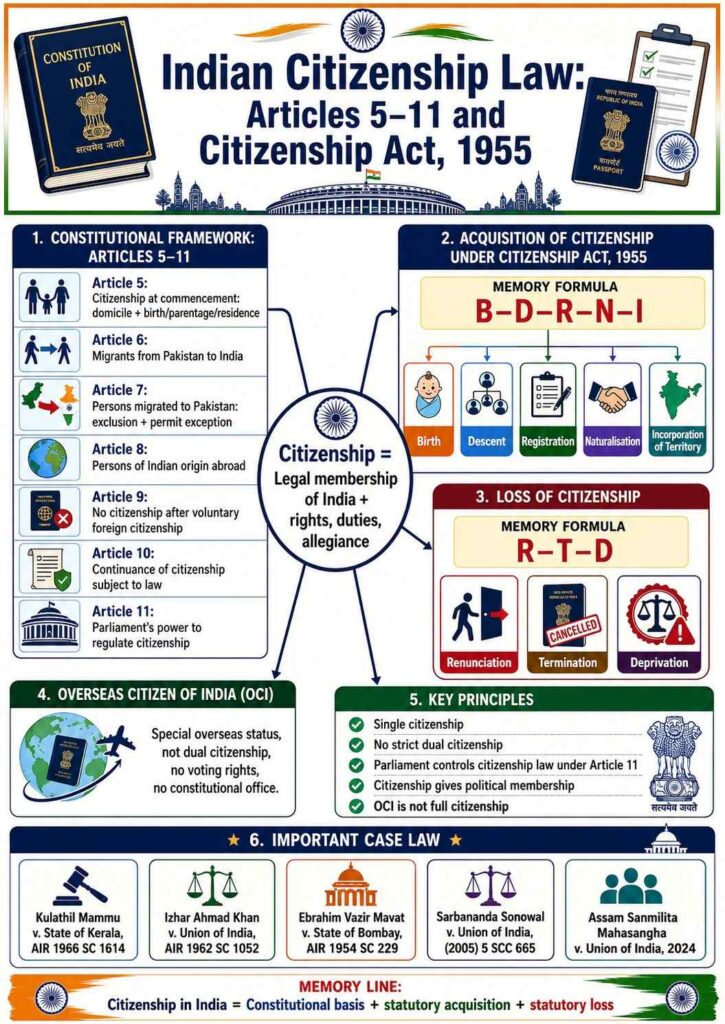
Introduction to Citizenship in India
➤ Meaning of Citizenship: Citizenship means the legal relationship between an individual and the State by which the individual becomes a full member of that State and receives political and civil rights, subject to duties and allegiance. In India, citizenship is important because only citizens can enjoy certain rights such as Article 15, Article 16, Article 19, Article 29, Article 30, the right to vote, and eligibility for many constitutional offices.
➤ Single Citizenship: India follows the principle of single citizenship, unlike federal systems such as the United States where both national and state citizenship exist. A person is either a citizen of India or not; there is no separate citizenship of any State such as Maharashtra, Kerala, Punjab, or Assam.
➤ Constitutional and Statutory Scheme: The Constitution deals with citizenship in Part II, Articles 5 to 11. These provisions mainly determined who became an Indian citizen at the commencement of the Constitution. After commencement, Parliament was empowered by Article 11 to make laws on acquisition and termination of citizenship. Parliament enacted the Citizenship Act, 1955, which governs acquisition, loss, termination, deprivation, and Overseas Citizen of India status.
➤ Important Distinction: Articles 5 to 11 are mainly concerned with citizenship at the commencement of the Constitution, while the Citizenship Act, 1955 deals with citizenship after commencement through birth, descent, registration, naturalisation, incorporation of territory, renunciation, termination, deprivation, and OCI registration.
Constitutional Provisions on Citizenship: Articles 5 to 11
Article 5: Citizenship at the Commencement of the Constitution
➤ Basic Rule: Article 5 provided that every person who had his domicile in the territory of India at the commencement of the Constitution became a citizen of India if he satisfied any one of the following conditions: he was born in India; either of his parents was born in India; or he had been ordinarily resident in India for at least five years immediately before the commencement of the Constitution.
➤ Domicile as Core Requirement: The most important requirement under Article 5 was domicile in India. Domicile means a permanent home or intention to reside permanently in a country. Mere residence is not always domicile; a person may live temporarily in one country but have permanent attachment to another.
➤ Simple Illustration: If A was born in India, lived in India, and intended to make India his permanent home at the commencement of the Constitution, A became an Indian citizen under Article 5. If B was only temporarily present in India without intention to make India his permanent home, B could not claim citizenship merely on physical presence.
Article 6: Citizenship of Persons Migrating from Pakistan to India
➤ Partition Context: Article 6 dealt with persons who migrated from Pakistan to India due to Partition. It gave citizenship to certain migrants from Pakistan if they or their parents or grandparents were born in India as defined in the Government of India Act, 1935.
➤ Migration Before 19 July 1948: A person who migrated from Pakistan to India before 19 July 1948 became a citizen if he had been ordinarily resident in India since the date of migration.
➤ Migration On or After 19 July 1948: A person who migrated on or after 19 July 1948 had to be registered as a citizen by an officer appointed by the Government of India, after residing in India for at least six months immediately before the application.
➤ Return Under Permit: A person who migrated to Pakistan but later returned to India under a permit for resettlement or permanent return could also be treated under the scheme of Article 6.
Article 7: Persons Who Migrated to Pakistan
➤ General Rule of Exclusion: Article 7 provided that a person who migrated from India to Pakistan after 1 March 1947 would not be deemed to be a citizen of India under Article 5 or Article 6.
➤ Exception for Resettlement: If such person returned to India under a permit for resettlement or permanent return issued by lawful authority, he could be treated as having migrated to India after 19 July 1948 and could claim citizenship according to the procedure.
➤ Important Case – Kulathil Mammu v. State of Kerala, AIR 1966 SC 1614: In this case, the Supreme Court examined the meaning of “migration” under Article 7. The issue was whether a person who had gone to Pakistan could still claim Indian citizenship under Articles 5 or 6. The Court held that Article 7 creates an exception to Articles 5 and 6, and a person covered by Article 7 cannot claim citizenship merely under Article 5 or Article 6 unless he satisfies the exception relating to return under a valid permit. The ratio is that migration to Pakistan after the relevant date had serious constitutional consequences for citizenship.
Article 8: Persons of Indian Origin Residing Outside India
➤ Indian Origin Abroad: Article 8 dealt with persons of Indian origin who were ordinarily residing outside India. A person whose parent or grandparent was born in India as defined in the Government of India Act, 1935 could be registered as an Indian citizen by an Indian diplomatic or consular representative.
➤ Purpose: Article 8 recognised the Indian diaspora and allowed persons of Indian origin living abroad to connect legally with India through registration.
Article 9: Voluntary Acquisition of Foreign Citizenship
➤ No Dual Citizenship: Article 9 states that no person shall be a citizen of India under Article 5, or be deemed to be a citizen under Article 6 or Article 8, if he has voluntarily acquired the citizenship of a foreign State.
➤ Core Principle: Indian constitutional law does not recognise dual citizenship in the strict legal sense. Voluntary acquisition of foreign citizenship is inconsistent with Indian citizenship.
➤ Important Case – Izhar Ahmad Khan v. Union of India, AIR 1962 SC 1052: The petitioners challenged provisions connected with loss of Indian citizenship on acquisition of Pakistani citizenship. The issue was whether Section 9 of the Citizenship Act and rules treating foreign passport acquisition as evidence of foreign citizenship were valid. The Supreme Court upheld the validity of Section 9 and the relevant rule, holding that Parliament could regulate citizenship and prescribe evidentiary rules for determining voluntary acquisition of foreign citizenship.
Article 10: Continuance of Citizenship
➤ Continuing Citizenship: Article 10 provides that every person who is or is deemed to be a citizen of India under Part II shall continue to be a citizen, subject to any law made by Parliament.
➤ Effect: Article 10 protects citizenship acquired at commencement, but it also makes that citizenship subject to future parliamentary law. Therefore, Parliament may regulate continuation, termination, and deprivation of citizenship.
Article 11: Parliamentary Power over Citizenship
➤ Wide Legislative Power: Article 11 gives Parliament full power to make laws relating to acquisition and termination of citizenship and all other matters relating to citizenship.
➤ Importance: Because of Article 11, Parliament enacted the Citizenship Act, 1955. This means citizenship is not only a constitutional subject but also a statutory subject controlled by parliamentary law.
➤ Recent Constitutional Relevance – Assam Sanmilita Mahasangha v. Union of India, 2024: In the 2024 judgment on Section 6A of the Citizenship Act, a Constitution Bench upheld Section 6A by a 4:1 majority. Section 6A deals with citizenship of persons covered by the Assam Accord and uses 24 March 1971 as an important cut-off date for certain migrants in Assam. The Court discussed Article 11 and Parliament’s power to make special provisions regarding citizenship.
Citizenship Act, 1955: Structure and Purpose
➤ Purpose of the Act: The Citizenship Act, 1955 provides the complete statutory framework for acquisition and loss of Indian citizenship after the commencement of the Constitution. It recognises acquisition by birth, descent, registration, naturalisation, and incorporation of territory, and loss through renunciation, termination, and deprivation.
➤ Important Amendments: The Act has been amended several times, including important amendments in 1985, 1992, 2003, 2005, 2015, and 2019. These amendments changed rules on birth-based citizenship, overseas citizenship, illegal migrants, and special provisions such as Section 6A and Section 6B.
Citizenship by Birth: Section 3 of the Citizenship Act, 1955
➤ First Category – 26 January 1950 to 1 July 1987: Every person born in India on or after 26 January 1950 but before 1 July 1987 is a citizen of India by birth, irrespective of the nationality of parents, subject to limited exceptions such as children of foreign diplomats or enemy aliens in occupied territory.
➤ Second Category – 1 July 1987 to 3 December 2004: A person born in India on or after 1 July 1987 but before 3 December 2004 is a citizen by birth only if either parent was an Indian citizen at the time of birth.
➤ Third Category – On or After 3 December 2004: A person born in India on or after 3 December 2004 is a citizen by birth only if both parents are Indian citizens, or one parent is an Indian citizen and the other is not an illegal migrant at the time of birth.
➤ Effect of 2003 Amendment: The 2003 amendment restricted automatic citizenship by birth to prevent illegal migration from creating automatic citizenship rights through birth in India.
➤ Simple Illustration: A child born in Delhi in 1980 generally became an Indian citizen by birth. A child born in Delhi in 1995 became a citizen only if at least one parent was an Indian citizen. A child born in Delhi in 2010 became a citizen only if both parents were Indian citizens, or one parent was an Indian citizen and the other was not an illegal migrant.
Citizenship by Descent: Section 4 of the Citizenship Act, 1955
➤ Meaning of Descent: Citizenship by descent applies to persons born outside India to Indian parents. It recognises blood relationship with Indian citizenship.
➤ General Scheme: A person born outside India may become an Indian citizen by descent if the statutory conditions under Section 4 are satisfied. The rules differ depending on the date of birth, because amendments have changed the parental requirement and registration requirements.
➤ Registration Requirement: For persons born outside India after certain dates, birth must generally be registered at an Indian consulate within the prescribed time, and the parent may have to declare that the minor does not hold another country’s passport.
➤ Important Point: Citizenship by descent is not unlimited. It is subject to statutory conditions because India does not recognise unrestricted dual nationality.
Citizenship by Registration: Section 5 of the Citizenship Act, 1955
➤ Meaning: Citizenship by registration is a comparatively simplified mode of citizenship for persons having a close connection with India.
➤ Eligible Categories: Section 5 includes categories such as persons of Indian origin ordinarily resident in India, persons of Indian origin ordinarily resident outside undivided India, persons married to Indian citizens, minor children of Indian citizens, persons whose parents are registered as Indian citizens, and OCI cardholders satisfying statutory residence requirements. The official India Code text of the Act includes OCI-linked registration under Section 5(1)(g), requiring OCI registration for five years and residence in India for one year before application.
➤ Discretion of Central Government: Registration is not a mechanical right. The Central Government must be satisfied that legal requirements are fulfilled.
➤ Good Character and Oath: The applicant may be required to satisfy conditions such as good character and taking an oath of allegiance to the Constitution of India.
Citizenship by Naturalisation: Section 6 of the Citizenship Act, 1955
➤ Meaning: Naturalisation is the process by which a foreigner with no automatic citizenship claim becomes an Indian citizen after fulfilling statutory conditions.
➤ Qualifications: The applicant must generally satisfy requirements such as ordinary residence in India for the prescribed period, good character, adequate knowledge of a language specified in the Eighth Schedule, intention to reside in India, and renunciation of previous citizenship where applicable.
➤ Residence Requirement: The Third Schedule to the Act sets out detailed qualifications for naturalisation. The Central Government may waive certain conditions in special cases, especially where the applicant has rendered distinguished service to science, philosophy, art, literature, world peace, or human progress.
➤ Section 6B – Citizenship Amendment Act, 2019: The 2019 amendment inserted Section 6B, creating a special route for certain persons from Afghanistan, Bangladesh, and Pakistan belonging to Hindu, Sikh, Buddhist, Jain, Parsi, or Christian communities who entered India on or before 31 December 2014 and were covered by the statutory conditions. The Citizenship Amendment Rules, 2024 created procedural rules and online application processes for Section 6B applications.
➤ Important Limitation: Section 6B is not a general naturalisation provision for all foreigners. It applies only to the specified classes and subject to statutory restrictions, conditions, and procedure.
Citizenship by Incorporation of Territory: Section 7
➤ Meaning: If any foreign territory becomes part of India, the Central Government may specify by order who among the persons connected with that territory shall become citizens of India.
➤ Illustration: If a territory is lawfully incorporated into India, Parliament and the Central Government may determine citizenship consequences for persons ordinarily resident there.
➤ Nature of Power: This mode is territorial and political in nature. It is used when sovereignty over territory changes.
Special Provision for Assam: Section 6A
➤ Background: Section 6A was inserted after the Assam Accord and deals with citizenship of persons who came to Assam from the specified territory during particular periods. It has a special cut-off scheme for persons entering Assam before and after certain dates.
➤ Cut-off Date: The important date under Section 6A is 24 March 1971, which is connected with the historical context of migration into Assam before the Bangladesh Liberation War.
➤ Important Case – Sarbananda Sonowal v. Union of India, (2005) 5 SCC 665: The Supreme Court struck down the Illegal Migrants (Determination by Tribunals) Act, 1983. The issue was whether the special procedure under that Act made detection and deportation of illegal migrants in Assam extremely difficult. The Court held that illegal migration could affect national security and the demographic balance of Assam, and that the law was unconstitutional because it created an unreasonable and ineffective procedure.
➤ Important Case – Assam Sanmilita Mahasangha v. Union of India, 2024: A Constitution Bench upheld the constitutional validity of Section 6A by a 4:1 majority. The majority recognised Parliament’s competence under Article 11 and treated Section 6A as a special legislative response to a special historical and political situation in Assam.
Renunciation of Citizenship: Section 8
➤ Meaning: Renunciation means voluntary giving up of Indian citizenship by a citizen of full age and capacity.
➤ Procedure: A citizen may make a declaration renouncing Indian citizenship. Once the declaration is registered by the Central Government, that person ceases to be an Indian citizen.
➤ Effect on Minor Children: When a person renounces citizenship, minor children may also cease to be Indian citizens, but the Act allows such children to resume Indian citizenship after attaining majority by making a declaration in the prescribed manner.
➤ Core Principle: Renunciation is based on voluntary choice. It is different from deprivation, which is a penalty-like action by the State.
Termination of Citizenship: Section 9
➤ Meaning: Termination occurs when an Indian citizen voluntarily acquires citizenship of another country.
➤ No Dual Citizenship: Section 9 reflects the constitutional rule under Article 9. If an Indian citizen voluntarily acquires foreign citizenship, Indian citizenship automatically ceases according to law.
➤ Determination by Authority: Questions about whether, when, and how a person acquired foreign citizenship are determined by the prescribed authority, generally the Central Government, according to the Act and rules.
➤ Important Case – Izhar Ahmad Khan v. Union of India, AIR 1962 SC 1052: The Supreme Court upheld the statutory scheme relating to loss of citizenship on voluntary acquisition of foreign citizenship. The ratio is that Parliament has power under Article 11 to regulate termination of citizenship and prescribe evidentiary rules for determining such questions.
Deprivation of Citizenship: Section 10
➤ Meaning: Deprivation means compulsory removal of citizenship by the Central Government in specified cases. It applies mainly to citizens who acquired citizenship by registration, naturalisation, or similar statutory modes.
➤ Grounds: Citizenship may be deprived if it was obtained by fraud, false representation, or concealment of material fact; if the citizen has shown disloyalty or disaffection towards the Constitution; unlawfully traded or communicated with an enemy during war; been sentenced in certain circumstances; or ordinarily resided outside India for a prescribed continuous period where applicable.
➤ Natural Justice: Deprivation is a serious action. The person must generally be given notice and opportunity to be heard because citizenship is a valuable legal status.
➤ Difference from Termination: Termination under Section 9 happens because the citizen voluntarily acquired foreign citizenship. Deprivation under Section 10 is a State action based on misconduct, fraud, or statutory grounds.
Overseas Citizen of India: Sections 7A to 7D
➤ Meaning of OCI: Overseas Citizen of India is a special status given to eligible foreign nationals of Indian origin. OCI is not full Indian citizenship and does not amount to dual citizenship.
➤ Eligibility under Section 7A: A foreign national may be registered as an OCI cardholder if he satisfies the statutory conditions, such as being a person of Indian origin, being eligible to become an Indian citizen at commencement, being a child or grandchild or great-grandchild of such person, or being a spouse of an Indian citizen or OCI cardholder subject to conditions. Persons who are or had been citizens of Pakistan, Bangladesh, or other notified countries are excluded.
➤ Rights under Section 7B: OCI cardholders get rights notified by the Central Government, such as long-term visa-related benefits and facilities for travel, residence, study, and work, subject to restrictions. However, OCI cardholders do not get political rights such as voting, contesting elections, or holding constitutional offices.
➤ Renunciation of OCI under Section 7C: An OCI cardholder of full age and capacity may renounce OCI status. Upon registration of the declaration, the person ceases to be an OCI cardholder.
➤ Cancellation of OCI under Section 7D: OCI registration may be cancelled for grounds such as fraud, false representation, concealment of material facts, disaffection towards the Constitution, unlawful trade with enemy during war, sentence of imprisonment of at least two years within five years of registration, violation of notified laws, necessity in the interests of sovereignty, integrity, security of India, friendly relations with foreign States, general public interest, or certain marital grounds for spouse-based OCI. The 2019 amendment inserted an additional ground relating to violation of laws notified by the Central Government, with a reasonable opportunity of being heard.
➤ Important Distinction: OCI is a facility-based status, not citizenship. An OCI cardholder remains a foreign national and cannot claim fundamental political rights reserved for Indian citizens.
Important Case Laws on Citizenship
➤ Ebrahim Vazir Mavat v. State of Bombay, AIR 1954 SC 229: The issue was whether a citizen could be removed from India for entering from Pakistan without a permit under the relevant law. The Supreme Court held that a law authorising removal of an Indian citizen from India violated the citizen’s fundamental right to reside and settle in India. The ratio is that citizenship carries strong constitutional protection, especially against expulsion from one’s own country.
➤ State Trading Corporation of India Ltd. v. Commercial Tax Officer, AIR 1963 SC 1811: The issue was whether a corporation could claim citizenship and invoke rights reserved only for citizens. The Supreme Court held that a company is not a citizen under the Constitution. The ratio is that citizenship belongs to natural persons, not juristic persons like companies.
➤ Kulathil Mammu v. State of Kerala, AIR 1966 SC 1614: The Supreme Court interpreted Article 7 and held that a person who migrated to Pakistan could not claim Indian citizenship under Article 5 or Article 6 unless he satisfied the exception relating to lawful return under permit. The case is important for understanding Partition-related citizenship.
➤ Izhar Ahmad Khan v. Union of India, AIR 1962 SC 1052: The Supreme Court upheld the validity of Section 9 of the Citizenship Act and rules connected with determination of foreign citizenship. The ratio is that Parliament has wide power under Article 11 to regulate citizenship, including termination on voluntary acquisition of foreign citizenship.
➤ Lal Babu Hussein v. Electoral Registration Officer, (1995) 3 SCC 100: The issue concerned removal of names from electoral rolls on citizenship-related doubts. The Supreme Court emphasised procedural fairness and held that names cannot be removed arbitrarily without proper inquiry and opportunity. The ratio is that citizenship-linked electoral consequences require fairness and due process.
➤ Sarbananda Sonowal v. Union of India, (2005) 5 SCC 665: The Supreme Court struck down the IMDT Act as unconstitutional, holding that the procedure made detection of illegal migrants difficult and affected Assam’s security and constitutional governance. The case remains a leading authority on illegal migration and citizenship administration in Assam.
➤ Assam Sanmilita Mahasangha v. Union of India, 2024: The Supreme Court upheld Section 6A of the Citizenship Act by a 4:1 majority. The case clarified that Parliament can create special citizenship rules under Article 11 for historically specific situations such as Assam.
Comparative Table: Modes of Acquiring and Losing Citizenship
| Area | Provision | Core Idea |
|---|---|---|
| Citizenship at commencement | Articles 5–8 | Domicile, migration from Pakistan, Indian origin abroad |
| Foreign citizenship bar | Article 9 | Voluntary foreign citizenship prevents Indian citizenship |
| Continuance | Article 10 | Citizenship continues subject to parliamentary law |
| Parliamentary power | Article 11 | Parliament can regulate acquisition and termination |
| Birth | Section 3 | Citizenship based on birth in India, subject to dates and parental status |
| Descent | Section 4 | Citizenship for persons born outside India to Indian parents |
| Registration | Section 5 | Citizenship for specified categories connected with India |
| Naturalisation | Section 6 | Citizenship for foreigners satisfying statutory qualifications |
| CAA special route | Section 6B | Special route for specified communities from specified countries |
| Incorporation | Section 7 | Citizenship after territory becomes part of India |
| Renunciation | Section 8 | Voluntary giving up of citizenship |
| Termination | Section 9 | Loss on voluntary acquisition of foreign citizenship |
| Deprivation | Section 10 | Compulsory removal for fraud, disloyalty, etc. |
| OCI | Sections 7A–7D | Special overseas Indian status, not full citizenship |
Memory Aid for Citizenship
➤ Acquisition Formula: B-D-R-N-I
Birth, Descent, Registration, Naturalisation, Incorporation of territory
➤ Loss Formula: R-T-D
Renunciation, Termination, Deprivation
➤ Constitution Formula: 5 to 11 = Start + Partition + Foreign Citizenship + Parliament
Article 5 starts citizenship; Articles 6 and 7 handle Partition migration; Article 8 covers Indians abroad; Article 9 bars foreign citizenship; Article 10 continues citizenship; Article 11 empowers Parliament.
Conclusion
➤ Complete Legal Position: Indian citizenship law is built on two foundations: Part II of the Constitution and the Citizenship Act, 1955. Articles 5 to 11 solved the immediate citizenship questions created by independence and Partition. The Citizenship Act, 1955 created the continuing legal machinery for acquisition and loss of citizenship.
➤ Central Themes: The most important principles are single citizenship, no automatic dual citizenship, parliamentary control under Article 11, stricter rules on birth-based citizenship after amendments, special treatment of historical migration issues, and limited non-citizen benefits through OCI.
➤ Practical Importance: Citizenship is not merely an identity label. It determines political membership, voting rights, constitutional protections, eligibility for public offices, and the legal relationship of allegiance between the person and the Indian State.