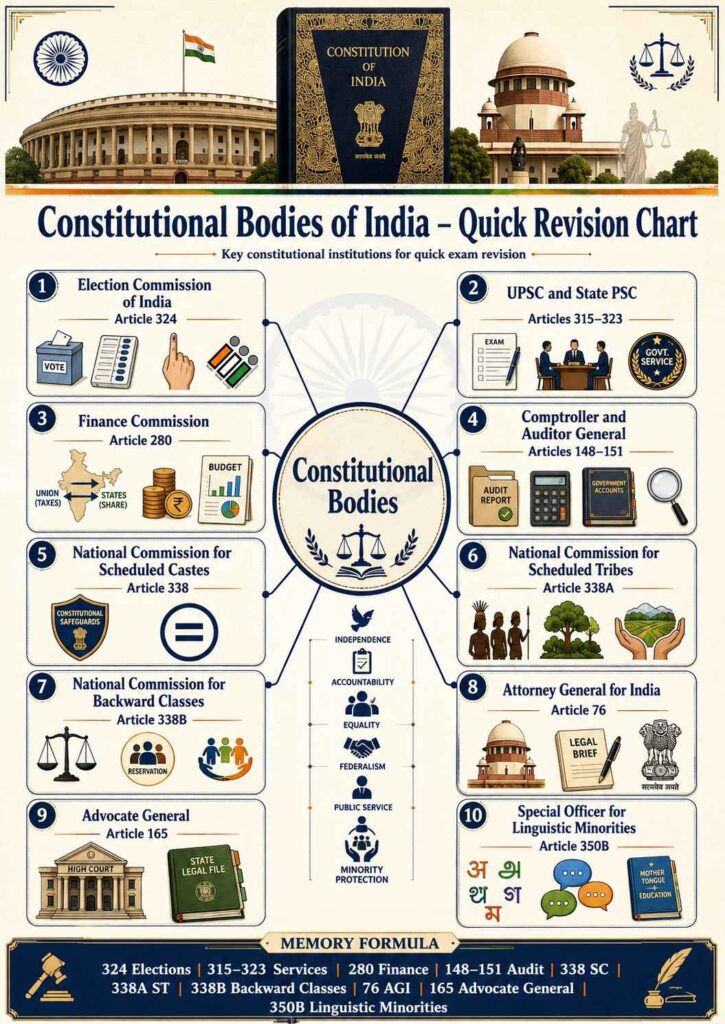
Meaning and Constitutional Scheme
- Constitutional bodies are institutions or offices created directly by the Constitution of India. Their existence, core composition, powers, duties, appointment process, reporting mechanism, or safeguards are found in the Constitution itself. Parliament may regulate details through legislation, but it cannot abolish or substantially alter their constitutional identity except through a constitutional amendment.
- Purpose: These bodies protect important constitutional values such as free elections, merit-based public employment, financial accountability, protection of vulnerable communities, linguistic diversity, and legally sound governance.
- Constitutional body versus statutory body: A constitutional body derives its authority from the Constitution itself. A statutory body, such as the National Human Rights Commission or Central Vigilance Commission, is created by an ordinary law made by Parliament. The Attorney General and Advocate General are constitutional offices, whereas the Election Commission, UPSC, CAG, Finance Commission, and National Commissions are constitutional institutions.
| Constitutional Institution / Office | Core Constitutional Provisions | Main Function |
|---|---|---|
| Election Commission of India | Articles 324–329 | Conduct and supervise elections |
| Union Public Service Commission | Articles 315–323 | Recruitment and service consultation for Union services |
| State Public Service Commission | Articles 315–323 | Recruitment and service consultation for State services |
| Finance Commission | Articles 280–281 | Recommend fiscal distribution between Union and States |
| Comptroller and Auditor-General | Articles 148–151 | Audit public money and public accounts |
| National Commission for Scheduled Castes | Article 338 | Monitor safeguards for Scheduled Castes |
| National Commission for Scheduled Tribes | Article 338A | Monitor safeguards for Scheduled Tribes |
| National Commission for Backward Classes | Article 338B | Monitor safeguards for socially and educationally backward classes |
| Attorney General for India | Articles 76 and 88 | Principal legal adviser to Union Government |
| Advocate General for a State | Articles 165 and 177 | Principal legal adviser to State Government |
| Special Officer for Linguistic Minorities | Article 350B | Investigate safeguards for linguistic minorities |
The Constitution expressly creates these institutions to ensure that democratic, financial, administrative and minority-rights functions are not left entirely to the discretion of the executive.
Election Commission of India
Constitutional Foundation and Nature
- Constitutional source: Article 324 creates the Election Commission of India. It vests the “superintendence, direction and control” of preparation of electoral rolls and conduct of elections to Parliament, State Legislatures, and the offices of President and Vice-President in the Election Commission.
- Coverage: The Election Commission conducts elections to:
- Lok Sabha
- Rajya Sabha
- State Legislative Assemblies
- State Legislative Councils
- President of India
- Vice-President of India
- Important distinction: Elections to Panchayats and Municipalities are conducted by the respective State Election Commissions under Articles 243K and 243ZA, not by the Election Commission of India.
- Composition: Article 324 provides for a Chief Election Commissioner and such number of other Election Commissioners as the President may determine. When other Election Commissioners are appointed, the Chief Election Commissioner acts as the Chairperson.
- Regional Commissioners: Before general elections and certain Legislative Council elections, the President may appoint Regional Commissioners after consulting the Election Commission.
Article 324 gives the Commission broad constitutional authority, but that authority must operate consistently with election laws enacted by Parliament, particularly the Representation of the People Acts, 1950 and 1951.
Appointment, Tenure and Removal
- Appointment: Article 324(2) states that the Chief Election Commissioner and other Election Commissioners are appointed by the President, subject to any law made by Parliament.
- Current statutory framework: The Chief Election Commissioner and Other Election Commissioners (Appointment, Conditions of Service and Term of Office) Act, 2023 governs appointment. It provides for:
- A Search Committee headed by the Union Minister of Law and Justice.
- A Selection Committee comprising the Prime Minister, the Leader of Opposition in the Lok Sabha, and a Union Cabinet Minister nominated by the Prime Minister.
- Appointment by the President on the recommendation of the Selection Committee.
- Eligibility generally restricted to persons holding or having held a post equivalent to Secretary to the Government of India and possessing integrity, knowledge and experience in election management and conduct.
- A term of six years or up to the age of sixty-five years, whichever is earlier, without reappointment.
- Security of tenure of CEC: The Chief Election Commissioner can be removed only in the same manner and on the same grounds as a Judge of the Supreme Court. Therefore, removal requires parliamentary impeachment on the ground of proved misbehaviour or incapacity.
- Protection of other Election Commissioners: Other Election Commissioners cannot be removed except on the recommendation of the Chief Election Commissioner. Their protection is therefore substantial, though not identical to that of the Chief Election Commissioner.
- Service conditions: The conditions of service of the Chief Election Commissioner cannot be altered to his disadvantage after appointment.
Powers and Functions of the Election Commission
- Electoral rolls: The Commission supervises the preparation, revision and correction of electoral rolls.
- Election schedule: It announces election dates, phases of polling, counting and declaration of results.
- Recognition and symbols: Under statutory powers, it recognises political parties and allocates election symbols.
- Model Code enforcement: It supervises political campaigning, monitors election expenditure, regulates campaign conduct and may issue directions to preserve free and fair elections.
- Election administration: It appoints observers, deploys election machinery, orders repolls where necessary and may postpone elections in exceptional circumstances.
- Advice on disqualification: Under Articles 103 and 192, the President or Governor decides questions of disqualification of legislators after obtaining the Election Commission’s opinion. In practice, that opinion has decisive constitutional importance.
Landmark Cases on the Election Commission
- N.P. Ponnuswami v. Returning Officer, Namakkal Constituency, AIR 1952 SC 64; 1952 SCR 218: The dispute concerned rejection of a nomination paper during an ongoing election. The issue was whether a constitutional court could intervene immediately under Article 226. The Supreme Court held that Article 329 bars judicial interference in an ongoing electoral process and that election disputes should ordinarily be raised only through an election petition after completion of the election. The case established the principle that the electoral process should not be interrupted at intermediate stages.
- Mohinder Singh Gill v. Chief Election Commissioner, (1978) 1 SCC 405; AIR 1978 SC 851: The Election Commission cancelled an election after serious disturbances and electoral malpractices. The issue was whether Article 324 gives the Commission broad power to act where statutory law is inadequate. The Supreme Court held that Article 324 is a reservoir of plenary power for conducting free and fair elections, enabling the Commission to act in areas where legislation is silent. However, this power cannot override an existing statutory provision.
- A.C. Jose v. Sivan Pillai, (1984) 2 SCC 656; AIR 1984 SC 921: The dispute involved the Election Commission’s direction regarding voting machines when statutory election rules did not permit their use in that manner. The Supreme Court held that Article 324 cannot be used to disobey or override the Representation of the People Act or rules validly made under it. The Commission may fill a legislative vacuum, but it cannot act contrary to a field already occupied by statute.
- T.N. Seshan v. Union of India, (1995) 4 SCC 611: The constitutional validity of the appointment of multiple Election Commissioners was challenged on the ground that it reduced the authority of the Chief Election Commissioner. The Supreme Court upheld the multi-member Election Commission. It held that the Chief Election Commissioner is the Chairperson but does not possess superior individual voting power over other Election Commissioners. The distinction in removal protection between the CEC and other Commissioners was held constitutionally valid because it protects the institutional independence of the Commission.
- Election Commission of India v. Ashok Kumar, (2000) 8 SCC 216: The Court considered the extent of judicial intervention during elections. It held that courts may intervene where their action helps the election process move forward, but they should not interrupt, stall or derail an election already in progress.
- Union of India v. Association for Democratic Reforms, (2002) 5 SCC 294: The issue was whether voters are entitled to know criminal antecedents, assets, liabilities and educational qualifications of candidates. The Supreme Court held that the voter’s right to know is part of freedom of speech and expression under Article 19(1)(a). The Election Commission was authorised to require candidates to disclose relevant information.
- People’s Union for Civil Liberties v. Union of India, (2003) 4 SCC 399: Parliament had attempted to restrict candidate disclosures through Section 33B of the Representation of the People Act, 1951. The Supreme Court struck down Section 33B because it unreasonably restricted the voter’s right to know. The case reinforced transparency as a requirement of meaningful electoral democracy.
- People’s Union for Civil Liberties v. Union of India, (2013) 10 SCC 1: The issue was whether a voter could reject all candidates while maintaining secrecy of the vote. The Supreme Court directed the Election Commission to provide the NOTA option. It held that the right to vote includes the right not to vote for any candidate and that secrecy of voting protects the voter’s freedom of expression.
- Anoop Baranwal v. Union of India, (2023) 6 SCC 161: The petition challenged the absence of a parliamentary law governing appointments of the Chief Election Commissioner and Election Commissioners. The Supreme Court held that an independent appointment process was necessary to protect electoral democracy and directed, as an interim arrangement until Parliament enacted a law, that appointments be made on the recommendation of a committee comprising the Prime Minister, Leader of Opposition and Chief Justice of India. Parliament subsequently enacted the 2023 Act, which now provides the statutory appointment process.
Quick Recall: Election Commission
- Keyword – Article 324: Election control.
- Keyword – Article 329: Election disputes after election through election petition.
- Keyword – Mohinder Singh Gill: Residual constitutional power.
- Keyword – A.C. Jose: Statute prevails over administrative direction.
- Keyword – PUCL: Informed voter and NOTA.
- Keyword – T.N. Seshan: Multi-member Commission is valid.
Union Public Service Commission and State Public Service Commissions
Constitutional Foundation
- Constitutional source: Articles 315 to 323 establish Public Service Commissions.
- Types of Commissions:
- Union Public Service Commission: Serves the Union.
- State Public Service Commission: One for each State.
- Joint State Public Service Commission: May serve two or more States when their legislatures pass resolutions and Parliament creates a Joint Commission by law.
- Purpose: Public Service Commissions ensure merit-based, impartial and transparent recruitment to civil services. They act as independent constitutional advisers in recruitment and service matters.
Articles 315 to 323 create a Union Commission, State Commissions and the possibility of Joint State Commissions.
Appointment and Composition
- UPSC: The Chairperson and members are appointed by the President.
- State PSC: The Chairperson and members are appointed by the Governor.
- Joint State PSC: The Chairperson and members are appointed by the President.
- Experience requirement: As nearly as possible, one-half of the members of every Public Service Commission must be persons who have held office for at least ten years under the Government of India or a State Government.
Tenure and Age Limit
- UPSC members: Six years or sixty-five years of age, whichever is earlier.
- State PSC members: Six years or sixty-two years of age, whichever is earlier.
- Resignation: A UPSC member resigns by writing to the President. A State PSC member resigns by writing to the Governor.
Removal and Suspension
- Removal by President: Even members of State Public Service Commissions are removed by the President, not by the Governor.
- Misbehaviour: A member may be removed for misbehaviour only after the Supreme Court conducts an inquiry under Article 317 and reports that removal is justified.
- Suspension: During such inquiry, the President may suspend the Chairperson or member.
- Direct removal without Supreme Court inquiry: The President may remove a member if the member:
- Is adjudged insolvent;
- Engages in paid employment outside official duties;
- Becomes unfit due to infirmity of mind or body.
Functions under Article 320
- Recruitment advice: The Commission conducts examinations for appointments to Union or State services.
- Recruitment methods: It advises on matters relating to recruitment methods and principles.
- Appointments and promotions: It is consulted on appointments, promotions and transfers from one service to another.
- Disciplinary matters: It is consulted in disciplinary proceedings affecting civil servants.
- Legal costs: It advises on claims for reimbursement of legal expenses incurred by civil servants defending proceedings arising from official acts.
- Injury pension: It advises on claims for pensions relating to injuries sustained in service.
- Additional functions: Parliament or a State Legislature may extend the functions of a Public Service Commission.
Advisory Nature of Consultation
- Non-binding advice: The advice of a Public Service Commission is ordinarily advisory. However, the executive cannot treat consultation as meaningless or depart from the Commission’s advice arbitrarily.
- Reporting safeguard: Where advice of a Commission is not accepted, the President or Governor must place before Parliament or the State Legislature a memorandum explaining cases in which advice was not accepted and reasons for non-acceptance.
- Financial independence: Expenses of UPSC are charged on the Consolidated Fund of India. Expenses of a State PSC are charged on the Consolidated Fund of the concerned State. These amounts are not ordinarily subject to legislative vote.
Post-Tenure Restrictions
- UPSC Chairperson: Cannot accept further employment under the Government of India or a State Government.
- State PSC Chairperson: May become Chairperson or member of UPSC or Chairperson of another State PSC, but cannot accept other government employment.
- UPSC member: May become Chairperson of UPSC or Chairperson of a State PSC, but cannot accept other government employment.
- State PSC member: May become Chairperson or member of UPSC, or Chairperson or member of another State PSC, but cannot accept other government employment.
Landmark Cases on Public Service Commissions
- State of Uttar Pradesh v. Manbodhan Lal Srivastava, AIR 1957 SC 912; 1958 SCR 533: A government employee challenged disciplinary action taken without consultation with the Public Service Commission. The Supreme Court held that Article 320(3)(c), which requires consultation in disciplinary matters, is directory rather than mandatory. Failure to consult does not automatically invalidate the disciplinary action or create an enforceable individual right, though constitutional authorities should ordinarily comply with the provision.
- Jatinder Kumar v. State of Punjab, (1985) 1 SCC 122: Candidates recommended by the Punjab Public Service Commission claimed appointment as a matter of right. The Supreme Court held that a recommendation by the Commission does not create an indefeasible right to appointment. However, the Government cannot reject recommendations arbitrarily and should act fairly, for valid reasons, and consistently with the constitutional purpose of consultation.
- Ashok Kumar Yadav v. State of Haryana, (1985) 4 SCC 417: The selection process was challenged because close relatives of members of the Public Service Commission were candidates. The Supreme Court held that selection must be free from actual or reasonable apprehension of bias. A member whose close relative is a candidate must withdraw from the selection process. The case emphasised impartiality, transparency and public confidence in Commission-based recruitment.
- In Re Dr. Ram Ashray Yadav, Chairman, Bihar Public Service Commission, (2000) 4 SCC 309: The matter arose from allegations of misconduct against the Chairman of the Bihar Public Service Commission. The Supreme Court stressed that the credibility of a Public Service Commission depends upon public confidence in its impartial functioning. It clarified that Article 317 proceedings concern proven misconduct and cannot rest on mere suspicion or general allegations.
Quick Recall: Public Service Commissions
- Keyword – Article 315: Establishment.
- Keyword – Article 316: Appointment and term.
- Keyword – Article 317: Removal by President after Supreme Court inquiry.
- Keyword – Article 320: Recruitment and service consultation.
- Keyword – Article 322: Expenses charged on Consolidated Fund.
- Keyword – Article 323: Annual report and reasons for non-acceptance of advice.
Finance Commission
Constitutional Foundation and Character
- Constitutional source: Article 280.
- Nature: The Finance Commission is a constitutional but periodic body. It is not a permanent daily functioning institution like UPSC or the Election Commission.
- Constitution: The President constitutes a Finance Commission within two years from commencement of the Constitution and thereafter every five years, or earlier if necessary.
- Composition: One Chairperson and four other members appointed by the President.
- Statutory law: The Finance Commission (Miscellaneous Provisions) Act, 1951 regulates qualifications, disqualifications and procedural matters. The Chairperson should have experience in public affairs. Other members may be selected from persons qualified to be High Court judges, experts in public finance and accounts, experienced administrators in financial matters, or economists.
Functions under Article 280
- Vertical devolution: The Commission recommends the distribution between the Union and States of net proceeds of taxes divisible between them.
- Horizontal devolution: It recommends the allocation among States of their respective shares of divisible tax proceeds.
- Grants-in-aid: It recommends principles governing grants-in-aid from the Consolidated Fund of India to States under Article 275.
- Panchayats: After the Seventy-third Amendment, it recommends measures to augment the Consolidated Fund of a State to supplement resources of Panchayats on the basis of State Finance Commission recommendations.
- Municipalities: After the Seventy-fourth Amendment, it recommends measures to augment the Consolidated Fund of a State to supplement resources of Municipalities on the basis of State Finance Commission recommendations.
- Additional reference: The President may refer any additional matter to the Commission in the interests of sound finance.
Finance Commission Recommendations
- Recommendatory role: The Finance Commission makes recommendations to the President. The Constitution does not state that every recommendation automatically becomes legally binding.
- Parliamentary accountability: Article 281 requires the President to lay every Finance Commission recommendation before both Houses of Parliament along with an explanatory memorandum regarding action taken.
- Federal significance: The Commission is a key instrument of cooperative federalism because it balances the revenue powers of the Union with the expenditure responsibilities of States.
Finance Commission and State Finance Commission: Difference
| Basis | Finance Commission | State Finance Commission |
|---|---|---|
| Constitutional provision | Article 280 | Articles 243I and 243Y |
| Constituted by | President | Governor |
| Main concern | Union–State fiscal relations | State–local body fiscal relations |
| Frequency | Every five years or earlier | Every five years |
| Recommends on | Tax sharing, grants, Union-State distribution | Panchayat and Municipal finances |
Quick Recall: Finance Commission
- Keyword – Article 280: Constitution of Commission.
- Keyword – Every five years: Periodic body.
- Keyword – Vertical devolution: Union share versus States’ share.
- Keyword – Horizontal devolution: Distribution among States.
- Keyword – Article 281: Recommendations and action taken memorandum before Parliament.
Comptroller and Auditor-General of India
Constitutional Position
- Constitutional source: Articles 148 to 151.
- Role: The Comptroller and Auditor-General of India, commonly called the CAG, is the supreme constitutional audit authority of India. The office ensures that public money is spent only for authorised purposes and that public authorities remain financially accountable.
- Appointment: The CAG is appointed by the President by warrant under his hand and seal.
- Removal: The CAG can be removed only in the same manner and on the same grounds as a Judge of the Supreme Court.
- Independence safeguards:
- Salary and service conditions cannot be altered to the CAG’s disadvantage after appointment.
- The CAG cannot hold any further office under the Government of India or any State Government after leaving office.
- Administrative expenses of the CAG’s office are charged on the Consolidated Fund of India.
- Statutory framework: The Comptroller and Auditor-General’s (Duties, Powers and Conditions of Service) Act, 1971 prescribes duties and powers.
Duties and Powers
- Audit of Union and State expenditure: The CAG audits expenditure from the Consolidated Fund of India, Consolidated Funds of States and Union Territories with legislatures.
- Appropriation audit: It verifies whether money was spent for the purpose for which Parliament or the State Legislature authorised it.
- Receipt audit: It examines whether revenue collection, tax assessment, grants, fees and other public receipts comply with law and procedure.
- Commercial audit: It audits Government companies and certain corporations as provided by law.
- Performance audit: It examines whether public schemes and expenditure were efficient, economical and effective.
- Access to records: The CAG can require documents, accounts and information necessary for audit.
- Accounts: Article 150 provides that the form of Union and State accounts is prescribed by the President on the advice of the CAG.
Audit Reports
- Union reports: CAG reports relating to Union accounts are submitted to the President, who causes them to be laid before both Houses of Parliament.
- State reports: CAG reports relating to State accounts are submitted to the Governor, who causes them to be laid before the State Legislature.
- Legislative scrutiny: Audit reports are usually examined by the Public Accounts Committee and, where relevant, the Committee on Public Undertakings. These committees scrutinise executive expenditure and seek explanations from departments.
Landmark Case on CAG Audit Power
- Association of Unified Telecom Service Providers of India v. Union of India, (2014) 6 SCC 110: Telecom service providers challenged the CAG’s power to audit their books and accounts. The issue was whether private entities could be audited by the CAG. The Supreme Court held that where private telecom operators deal with revenue payable to the Union under revenue-sharing arrangements, the CAG may examine relevant records to verify the Government’s revenue. The Court clarified that the audit was connected with accountability of public revenue, not an unrestricted audit of private business affairs.
Quick Recall: CAG
- Keyword – Article 148: Appointment and independence.
- Keyword – Article 149: Duties and powers.
- Keyword – Article 150: Form of accounts.
- Keyword – Article 151: Audit reports before Legislature.
- Keyword – PAC: Legislative scrutiny of audit reports.
- Keyword – No future government office: Post-tenure independence.
National Commission for Scheduled Castes
Constitutional Foundation
- Constitutional source: Article 338.
- Historical development: Originally, Article 338 provided for a Special Officer for Scheduled Castes and Scheduled Tribes. Later, a combined National Commission for Scheduled Castes and Scheduled Tribes was created. The Constitution (Eighty-ninth Amendment) Act, 2003 separated the combined institution into:
- National Commission for Scheduled Castes under Article 338.
- National Commission for Scheduled Tribes under Article 338A.
- Composition: Chairperson, Vice-Chairperson and three other members. They are appointed by the President by warrant under his hand and seal.
Functions of NCSC
- Safeguards monitoring: It investigates and monitors constitutional, legal and governmental safeguards available to Scheduled Castes.
- Complaint inquiry: It inquires into specific complaints concerning deprivation of rights and safeguards of Scheduled Castes.
- Development planning: It participates and advises in planning the socio-economic development of Scheduled Castes.
- Reports: It presents annual and special reports to the President.
- Recommendations: It recommends measures for effective implementation of safeguards and welfare measures.
- Consultation: The Union and every State Government must consult the Commission on major policy matters affecting Scheduled Castes.
- Civil court powers: While investigating or inquiring into complaints, it has powers of a civil court, including summoning witnesses, requiring documents, receiving affidavits and requisitioning public records.
- Anglo-Indian reference: Article 338 provides that references to Scheduled Castes in the Article include references to the Anglo-Indian community for the limited purpose stated in the constitutional provision.
National Commission for Scheduled Tribes
Constitutional Foundation
- Constitutional source: Article 338A.
- Reason for separate Commission: Scheduled Tribes face distinct constitutional concerns relating to tribal land, forest resources, displacement, self-governance, Scheduled Areas, Fifth Schedule protections and Sixth Schedule areas. A separate Commission was created to focus on those concerns.
Functions of NCST
- Monitoring safeguards: It monitors constitutional and legal safeguards for Scheduled Tribes.
- Complaint inquiry: It inquires into specific complaints relating to denial of rights and safeguards of Scheduled Tribes.
- Planning role: It advises on socio-economic development of Scheduled Tribes under the Union and States.
- Reports and recommendations: It submits annual and special reports to the President and recommends corrective measures.
- Consultation duty: Union and State Governments must consult the Commission on major policy matters affecting Scheduled Tribes.
- Civil court powers: Like the NCSC, it has civil court powers in investigations and complaint inquiries.
The constitutional duties, civil-court powers and consultation mechanisms for NCSC and NCST are broadly parallel, though each Commission focuses on the specific constitutional safeguards of the community it serves.
National Commission for Backward Classes
Constitutional Foundation and Evolution
- Constitutional source: Article 338B.
- Earlier statutory body: Before becoming a constitutional body, the National Commission for Backward Classes operated under the National Commission for Backward Classes Act, 1993.
- Constitutional status: The Constitution (One Hundred and Second Amendment) Act, 2018 inserted Article 338B and gave constitutional status to the National Commission for Backward Classes.
- Composition: Chairperson, Vice-Chairperson and three other members appointed by the President.
- Scope: The Commission deals with safeguards for socially and educationally backward classes, commonly referred to as SEBCs or Other Backward Classes in several legal contexts.
Functions of NCBC
- Safeguards monitoring: It investigates and monitors safeguards under the Constitution, laws and government orders.
- Complaint inquiry: It inquires into complaints concerning deprivation of rights and safeguards of socially and educationally backward classes.
- Development role: It advises on socio-economic development and evaluates progress under Union and State Governments.
- Reports: It submits annual and special reports to the President.
- Recommendations: It recommends remedial measures for effective protection of safeguards.
- Consultation: Union and State Governments must consult the Commission on major policy matters affecting socially and educationally backward classes.
- Civil court powers: It has civil-court powers while investigating matters and inquiring into complaints.
Article 342A and State Lists of Backward Classes
- Central List: Article 342A concerns identification of socially and educationally backward classes for the Central List.
- State List: The Constitution (One Hundred and Fifth Amendment) Act, 2021 clarified that every State or Union Territory may prepare and maintain its own list of socially and educationally backward classes for its own purposes. Such State List may differ from the Central List.
- Importance: A community may therefore be included in a State backward class list for State employment or educational measures, yet not necessarily be included in the Central List for Union purposes.
Article 338B was inserted by the One Hundred and Second Amendment, while the One Hundred and Fifth Amendment expressly restored the power of States and Union Territories to maintain separate lists for their own purposes.
Landmark Cases Connected with NCBC and Backward Classes
- Indra Sawhney v. Union of India, 1992 Supp (3) SCC 217: The case challenged the Central Government’s decision to reserve twenty-seven per cent posts for Other Backward Classes in public employment. The Supreme Court upheld reservation for socially and educationally backward classes under Article 16(4), subject to important limits. It recognised the creamy-layer principle, stated that reservations ordinarily should not exceed fifty per cent, and directed creation of a permanent body to examine inclusion and exclusion of backward classes. The statutory NCBC created in 1993 emerged from this constitutional development.
- Jaishri Laxmanrao Patil v. Chief Minister, (2021) 8 SCC 1: The constitutional validity of the Maharashtra law granting reservation to the Maratha community was challenged. One issue was whether, after the One Hundred and Second Amendment, States retained power to identify socially and educationally backward classes. The Court interpreted the amended constitutional scheme as limiting that power in the manner then applicable. Parliament subsequently enacted the One Hundred and Fifth Amendment, which expressly permits States and Union Territories to prepare and maintain their own backward-class lists for State purposes.
Quick Recall: National Commissions
- Keyword – Article 338: NCSC.
- Keyword – Article 338A: NCST.
- Keyword – Article 338B: NCBC.
- Keyword – Complaint inquiry: Individual deprivation of safeguards.
- Keyword – Civil court powers: Investigation and inquiry support.
- Keyword – Consultation: Major policy matters.
- Keyword – Article 342A: Central and State backward-class lists.
Attorney General for India
Constitutional Foundation
- Constitutional source: Article 76.
- Status: The Attorney General for India is the highest law officer of the Union Government.
- Appointment: The President appoints the Attorney General.
- Qualification: The person must be qualified to be appointed as a Judge of the Supreme Court. Therefore, the person must satisfy the eligibility requirements under Article 124(3).
- Tenure: The Attorney General holds office during the pleasure of the President. The Constitution prescribes no fixed term or age limit.
Functions and Rights
- Legal advice: The Attorney General advises the Government of India on legal matters referred by the President.
- Constitutional duties: The Attorney General performs legal duties assigned by the President and discharges functions conferred by the Constitution or any other law.
- Right of audience: The Attorney General has a right of audience in all courts within India.
- Parliamentary participation: Under Article 88, the Attorney General may participate in proceedings of both Houses of Parliament, joint sittings and parliamentary committees of which he may be named a member. However, he has no right to vote merely because of this constitutional participation.
- Distinction from Solicitor General: The Solicitor General and Additional Solicitors General are important Union law officers, but they are not constitutional offices. The Attorney General alone derives office directly from Article 76.
The Attorney General’s appointment, qualifications, advisory role, right of audience and tenure during the President’s pleasure are governed by Article 76; Article 88 confers the right to participate in parliamentary proceedings without a vote.
Quick Recall: Attorney General
- Keyword – Article 76: Attorney General.
- Keyword – Supreme Court Judge qualification: Eligibility.
- Keyword – President’s pleasure: No fixed tenure.
- Keyword – Right of audience: All courts in India.
- Keyword – Article 88: Can participate in Parliament but cannot vote.
Advocate General for the State
Constitutional Foundation
- Constitutional source: Article 165.
- Status: The Advocate General is the highest law officer of a State.
- Appointment: The Governor appoints the Advocate General.
- Qualification: The person must be qualified to be appointed as a Judge of a High Court.
- Tenure: The Advocate General holds office during the pleasure of the Governor and receives remuneration determined by the Governor.
Functions and Rights
- Legal advice: The Advocate General advises the State Government on legal matters referred by the Governor.
- Legal duties: The Advocate General performs legal duties assigned by the Governor and functions conferred by the Constitution or other laws.
- State Legislature participation: Under Article 177, the Advocate General may participate in proceedings of the State Legislature and its committees but has no right to vote merely by virtue of that office.
Attorney General and Advocate General: Comparison
| Basis | Attorney General | Advocate General |
|---|---|---|
| Constitutional provision | Article 76 | Article 165 |
| Appointed by | President | Governor |
| Advises | Union Government | State Government |
| Qualification | Eligible to be Supreme Court Judge | Eligible to be High Court Judge |
| Tenure | Pleasure of President | Pleasure of Governor |
| Legislative right | Article 88 | Article 177 |
| Right to vote | No | No |
Article 165 establishes the Advocate General’s office, while Article 177 grants participation rights in the State Legislature without voting rights.
Special Officer for Linguistic Minorities
Constitutional Foundation
- Constitutional source: Article 350B.
- Nature: The Constitution provides for a Special Officer for Linguistic Minorities, appointed by the President. Administratively, the office is commonly known as the Commissioner for Linguistic Minorities.
- Purpose: The office protects constitutional safeguards available to linguistic minorities and serves as a monitoring and reporting authority.
Functions
- Investigation: The Special Officer investigates matters relating to safeguards available to linguistic minorities under the Constitution.
- Reports: The Officer reports to the President at intervals directed by the President.
- Parliamentary accountability: The President must cause these reports to be laid before each House of Parliament.
- State communication: Reports must also be sent to the Governments of States concerned.
- Nature of authority: Unlike the National Commissions for SCs, STs and Backward Classes, Article 350B does not expressly confer civil-court powers on the Special Officer. The primary constitutional role is investigation, reporting and institutional monitoring.
Article 350B requires appointment by the President, investigation into safeguards for linguistic minorities, reporting to the President, laying reports before Parliament and forwarding them to concerned State Governments.
Related Constitutional Safeguards for Linguistic Minorities
- Article 29(1) – Conservation: Any section of citizens having a distinct language, script or culture has the right to conserve it.
- Article 29(2) – Admission: No citizen can be denied admission into a State-maintained or State-aided educational institution solely on grounds of religion, race, caste, language or any of them.
- Article 30(1) – Minority educational institutions: Religious and linguistic minorities have the right to establish and administer educational institutions of their choice.
- Article 347 – Language spoken by a section of population: The President may direct official recognition of a language spoken by a substantial proportion of a State’s population where appropriate.
- Article 350 – Representations for redress: Every person is entitled to submit a representation for redress of a grievance in any language used in the Union or State.
- Article 350A – Mother-tongue education: States must endeavour to provide adequate facilities for instruction in the mother tongue at the primary stage for children belonging to linguistic minority groups.
Landmark Case on Linguistic Minorities
- T.M.A. Pai Foundation v. State of Karnataka, (2002) 8 SCC 481: The case involved the scope of rights of religious and linguistic minorities to establish and administer educational institutions under Article 30. The Supreme Court held that the unit for determining whether a group is a linguistic or religious minority is ordinarily the State, because education is largely regulated at the State level. The Court also held that minority institutions have autonomy in administration, though reasonable regulatory measures may be imposed to maintain educational standards and prevent maladministration.
Quick Recall: Linguistic Minorities
- Keyword – Article 350B: Special Officer.
- Keyword – Article 350A: Mother-tongue instruction.
- Keyword – Article 29: Language, script and culture.
- Keyword – Article 30: Minority educational institutions.
- Keyword – T.M.A. Pai: Minority determined with reference to the State.
Consolidated Memory Aid
| Body / Office | Constitutional Keyword | Core Constitutional Function |
|---|---|---|
| Election Commission | Article 324 | Free and fair elections |
| UPSC / SPSC | Articles 315–323 | Merit-based public recruitment |
| Finance Commission | Article 280 | Fiscal federalism |
| CAG | Articles 148–151 | Audit and accountability |
| NCSC | Article 338 | SC safeguards |
| NCST | Article 338A | ST safeguards |
| NCBC | Article 338B | Backward-class safeguards |
| Attorney General | Article 76 | Union’s chief legal adviser |
| Advocate General | Article 165 | State’s chief legal adviser |
| Linguistic Minorities Officer | Article 350B | Linguistic safeguards |