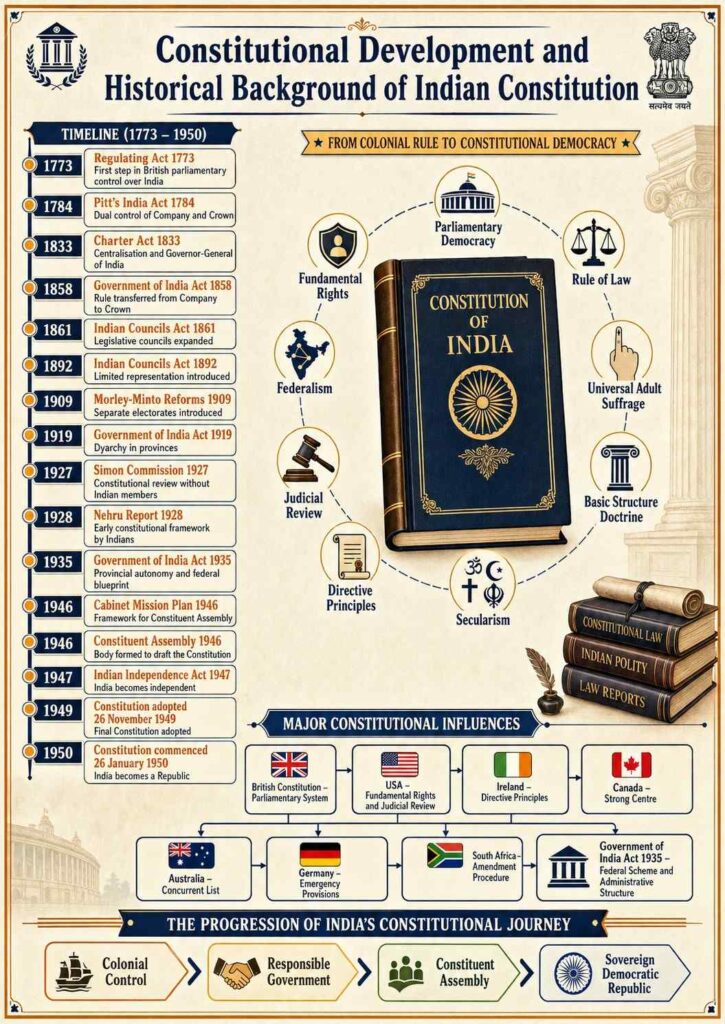
Meaning of Constitutional Development in India
➤ Constitutional development means the gradual historical evolution of the legal and political institutions through which India came to be governed. In India, constitutional development did not happen suddenly on 26 January 1950. It was the result of a long journey beginning with the East India Company’s commercial rule, continuing through British Crown rule, and finally ending in the making of a sovereign democratic Constitution by the people of India.
➤ Indian constitutional law developed through a continuous struggle between colonial control and Indian demand for self-government. The British introduced several laws such as the Regulating Act, 1773, Pitt’s India Act, 1784, Government of India Act, 1858, Indian Councils Acts, Government of India Acts of 1919 and 1935, and Indian Independence Act, 1947. These laws were colonial in purpose, but they gradually introduced ideas like central administration, legislative councils, federalism, responsible government, elections, public services, judiciary and provincial autonomy.
➤ Modern Constitution of India is not a copy of any single document. It is a carefully drafted legal instrument based on India’s own freedom struggle, constitutional experience under British laws, and useful features taken from other constitutions. The Constitution was adopted by the Constituent Assembly on 26 November 1949 and came into force on 26 January 1950.
Colonial Background of Indian Constitutional Law
➤ Company rule began after the East India Company gradually changed from a trading corporation into a political authority. The Battle of Plassey, 1757 and Battle of Buxar, 1764 strengthened Company power. After obtaining Diwani rights over Bengal, Bihar and Orissa in 1765, the Company started collecting revenue and administering territories. This created the need for parliamentary control over the Company.
➤ Regulating Act, 1773 was the first major step by the British Parliament to regulate the affairs of the East India Company in India. It made the Governor of Bengal the Governor-General of Bengal and subordinated the presidencies of Bombay and Madras to Bengal in important matters. Warren Hastings became the first Governor-General under this system. It also created the Supreme Court at Calcutta in 1774. This Act is important because it marked the beginning of centralised British parliamentary control over Indian administration.
➤ Pitt’s India Act, 1784 introduced a dual system of control. The Company continued to manage commercial matters, while political and military affairs came under greater supervision of the British Government through the Board of Control. This Act made it clear that Indian territories were no longer merely commercial possessions of a company but matters of British imperial governance.
➤ Charter Act, 1813 ended the Company’s trade monopoly in India except in tea and trade with China. It also recognised the responsibility of the British to promote education in India. The constitutional significance of this Act lies in the beginning of a more direct British concern with Indian society and governance.
➤ Charter Act, 1833 was a major step towards centralisation. It made the Governor-General of Bengal the Governor-General of India. Lord William Bentinck became the first Governor-General of India. The Act also deprived the Company of its remaining commercial functions and made it mainly an administrative body. It introduced the idea of legislative centralisation by giving law-making power to the Governor-General in Council for the whole of British India.
➤ Charter Act, 1853 separated legislative and executive functions of the Governor-General’s Council and introduced open competition for civil services. This was significant because it laid the foundation for a separate legislative structure and a merit-based civil service system.
Government of India Act, 1858 and Beginning of Crown Rule
➤ Government of India Act, 1858 was passed after the Revolt of 1857. It ended the rule of the East India Company and transferred Indian administration directly to the British Crown. The Governor-General of India also became the Viceroy, representing the British monarch in India.
➤ Secretary of State for India became the principal authority in Britain for Indian affairs. He was assisted by the Council of India. This created a highly centralised imperial structure where real authority remained in Britain.
➤ Queen Victoria’s Proclamation, 1858 promised non-interference in religious matters, equal protection of law, and respect for treaties with princely states. Though these promises were made within a colonial framework, they later became important in political arguments for equality, religious freedom and fair administration.
Indian Councils Acts and Growth of Legislative Institutions
➤ Indian Councils Act, 1861 introduced Indians into legislative councils by nomination. It also restored limited legislative powers to Bombay and Madras. The Act is important because it marked the beginning of Indian association with legislative work, although the system remained largely controlled by colonial authorities.
➤ Portfolio system was also recognised during this period. Under this system, members of the executive council were placed in charge of specific departments. This later helped in the development of ministerial responsibility.
➤ Indian Councils Act, 1892 enlarged legislative councils and allowed discussion of budgets, though members could not vote on them. It also introduced an indirect method of nomination through recommendations from local bodies and associations. This Act was a small but important step towards representative institutions.
➤ Indian Councils Act, 1909, also known as the Morley-Minto Reforms, increased the size of legislative councils and introduced separate electorates for Muslims. This was constitutionally significant but politically controversial. It introduced communal representation into the electoral system, which later deeply affected Indian politics.
Government of India Act, 1919: Dyarchy and Responsible Government
➤ Government of India Act, 1919, also known as the Montagu-Chelmsford Reforms, was based on the idea of the “progressive realisation of responsible government” in India. The Act introduced dyarchy in provinces and expanded legislative councils.
➤ Dyarchy means dual government. Provincial subjects were divided into two categories: reserved subjects and transferred subjects. Reserved subjects such as police, law and order, and finance remained under the control of the Governor and his executive councillors. Transferred subjects such as education, public health and local self-government were administered by Indian ministers responsible to the legislative council.
➤ Central legislature became bicameral under the 1919 Act. It consisted of the Council of State and the Legislative Assembly. However, the Governor-General retained overriding powers. Therefore, the Act introduced limited representative government but not real responsible government.
➤ Separate electorates were expanded. This increased political representation for some communities but also strengthened communal divisions in constitutional politics.
➤ Significance of the 1919 Act lies in the fact that it formally accepted responsible government as a goal, introduced dyarchy, expanded legislatures and widened Indian participation. However, it failed because real power remained with the British executive.
Simon Commission, Nehru Report and Round Table Conferences
➤ Simon Commission, 1927 was appointed to review the working of the Government of India Act, 1919. It had no Indian member, which led to widespread opposition under the slogan “Simon Go Back”. The boycott showed that Indians were no longer willing to accept constitutional reforms imposed without their participation.
➤ Nehru Report, 1928 was one of the first major Indian attempts to draft a constitutional framework. It recommended dominion status, fundamental rights, responsible government and a federal structure. Though not accepted by all political groups, it showed that Indians had begun thinking seriously in terms of a written constitution.
➤ Round Table Conferences were held in London between 1930 and 1932 to discuss constitutional reforms. They involved British officials, Indian political representatives, princely states and minority groups. These conferences eventually contributed to the Government of India Act, 1935.
Government of India Act, 1935: Foundation of Many Constitutional Features
➤ Government of India Act, 1935 was the most detailed constitutional law enacted by the British Parliament for India before independence. It proposed an All-India Federation, introduced provincial autonomy and created a division of powers between the Centre and provinces. The Act is often regarded as an important predecessor of the Constitution of India because many administrative and federal features were later adapted into the Constitution.
➤ All-India Federation was proposed to include British Indian provinces and princely states. However, the federation never came into operation because the required number of princely states did not join.
➤ Provincial autonomy replaced dyarchy in the provinces. Elected ministers became responsible to provincial legislatures in provincial matters. This gave Indians practical experience in running provincial governments after the 1937 elections.
➤ Dyarchy at Centre was proposed but never effectively implemented. The Centre remained under strong control of the Governor-General.
➤ Division of powers was introduced through three lists: Federal List, Provincial List and Concurrent List. This idea strongly influenced the Seventh Schedule of the Constitution of India.
➤ Federal Court was established in 1937. It became an important predecessor of the Supreme Court of India. The idea of constitutional adjudication and federal dispute resolution developed during this period.
➤ Emergency powers and Governor’s special powers under the 1935 Act showed the colonial tendency to preserve executive supremacy. The Indian Constitution later retained emergency provisions but placed them within a democratic constitutional framework.
➤ Importance of the 1935 Act lies in its influence on federalism, public services, judiciary, office of Governor, emergency provisions, administrative continuity and legislative lists. However, it was not democratic in the full sense because sovereignty remained with the British Parliament and the Governor-General had wide overriding powers. The Indian Independence Act, 1947 itself provided that the new dominions would initially be governed, as far as possible, according to the Government of India Act, 1935 until new constitutional arrangements were made.
Demand for Constituent Assembly
➤ Constituent Assembly means a body specially created to frame or draft a constitution. The idea was based on the principle that the Constitution of India should be made by Indians themselves and not imposed by the British Parliament.
➤ Indian demand for a Constituent Assembly became stronger during the freedom movement. The Indian National Congress rejected the Government of India Act, 1935 because it was imposed by the British Parliament and did not represent the sovereign will of the Indian people.
➤ August Offer, 1940 accepted, in principle, that Indians should frame their own constitution after the Second World War. This was an important step because the British Government recognised the idea of constitution-making by Indians.
➤ Cripps Mission, 1942 proposed that an elected body would frame a new constitution after the war. However, the proposal failed because it did not immediately transfer real power and also gave provinces the option not to join the future Indian Union.
Cabinet Mission Plan, 1946
➤ Cabinet Mission Plan was announced on 16 May 1946. The Cabinet Mission consisted of Lord Pethick-Lawrence, Sir Stafford Cripps and A.V. Alexander. It came to India to discuss the constitutional future of India and to create a framework for transfer of power.
➤ Main proposal of the Plan was the creation of a Constituent Assembly to frame the Constitution of India. It also proposed a Union of India dealing with foreign affairs, defence and communications, while provinces would enjoy autonomy.
➤ Composition of Constituent Assembly under the Plan was to be based on indirect election by members of provincial legislative assemblies. Seats were allotted broadly according to population and communities. Princely states were also to be represented.
➤ Grouping of provinces was proposed as a compromise between the Congress demand for a united India and the Muslim League’s demand for Pakistan. However, this grouping formula became controversial and ultimately failed to prevent Partition.
➤ Constitutional significance of the Cabinet Mission Plan lies in the fact that it provided the immediate legal and political basis for forming the Constituent Assembly. The Constitution of India was drafted by the Constituent Assembly created under this framework.
Constituent Assembly of India
➤ First meeting of the Constituent Assembly was held on 9 December 1946 in the Constitution Hall, now known as the Central Hall of Parliament House.
➤ Temporary President of the Assembly was Dr. Sachchidananda Sinha. Later, Dr. Rajendra Prasad was elected as the permanent President of the Constituent Assembly. B.N. Rau served as Constitutional Adviser, and Dr. B.R. Ambedkar became Chairman of the Drafting Committee.
➤ Initial strength of the Assembly was 389 members, but after Partition it was reduced to 299. The Assembly was indirectly elected and not elected on universal adult franchise, yet it contained leading lawyers, freedom fighters, administrators, social reformers and representatives of different communities and regions.
➤ Sovereign character after Independence developed after the Indian Independence Act, 1947. Before 15 August 1947, the Assembly functioned under the limitations of the Cabinet Mission Plan. After independence, it became a sovereign body for constitution-making and also functioned as the legislative body for the Dominion of India.
➤ Constituent Assembly debates were extensive and serious. The Assembly met over a period of nearly three years and held detailed discussions on fundamental rights, federalism, minorities, language, citizenship, judiciary, emergency powers, directive principles and the structure of government. The Constitution of India archive records 167 days of plenary debates between 9 December 1946 and 24 January 1950.
Objectives Resolution and Constitutional Philosophy
➤ Objectives Resolution was moved by Jawaharlal Nehru on 13 December 1946 and adopted by the Constituent Assembly on 22 January 1947. It laid down the philosophical foundation of the Constitution and later influenced the Preamble.
➤ Core principles of the Objectives Resolution included sovereignty of the people, democratic republic, justice, equality, freedom, safeguards for minorities and backward classes, and India’s contribution to world peace.
➤ Preamble connection is very important. The Preamble’s ideas of justice, liberty, equality and fraternity reflect the moral vision of the Objectives Resolution and the freedom struggle.
Drafting Process of the Constitution
➤ Committee system was used by the Constituent Assembly to make the drafting process systematic. Important committees included the Union Powers Committee, Union Constitution Committee, Provincial Constitution Committee, Advisory Committee on Fundamental Rights, Minorities and Tribal Areas, Drafting Committee and several procedural committees.
➤ Drafting Committee was appointed on 29 August 1947 with Dr. B.R. Ambedkar as Chairman. Other members included N. Gopalaswami Ayyangar, Alladi Krishnaswami Ayyar, K.M. Munshi, Mohammad Saadulla, B.L. Mitter and D.P. Khaitan. Later, N. Madhava Rau and T.T. Krishnamachari became members due to changes.
➤ B.N. Rau’s draft played an important role. As Constitutional Adviser, B.N. Rau prepared an initial draft after studying constitutional systems of different countries. The Drafting Committee then examined, revised and developed the draft.
➤ Public debate and amendments were significant. The Draft Constitution was published and discussed. Thousands of amendments were proposed in the Assembly. The final Constitution was not merely prepared by one person but was the result of collective discussion, legal drafting, political negotiation and national experience.
➤ Adoption and commencement happened in two stages. The Constitution was adopted on 26 November 1949. It came into force on 26 January 1950, chosen to honour the historic significance of 26 January 1930, the day associated with the Purna Swaraj declaration.
Indian Independence Act, 1947
➤ Indian Independence Act, 1947 was passed by the British Parliament and received Royal Assent on 18 July 1947. It created two independent Dominions: India and Pakistan.
➤ Partition and transfer of power were its immediate consequences. British paramountcy over princely states ended, and the new Dominions became legally independent from British control.
➤ Constituent Assembly’s authority increased after this Act. The Assembly was no longer merely a constitution-making body under British proposals; it became the sovereign constitution-making body of independent India.
➤ Continuity of administration was ensured because the Government of India Act, 1935 continued temporarily, with necessary modifications, until the Constitution came into force.
Major Constitutional Influences on the Indian Constitution
| Source | Important Features Borrowed or Inspired |
|---|---|
| Government of India Act, 1935 | Federal scheme, office of Governor, public service commissions, emergency provisions, administrative details, legislative lists |
| British Constitution | Parliamentary government, rule of law, cabinet system, legislative procedure, single citizenship in spirit |
| United States Constitution | Fundamental rights, judicial review, independence of judiciary, impeachment of President |
| Irish Constitution | Directive Principles of State Policy, nomination of members to Rajya Sabha |
| Canadian Constitution | Strong Centre, residuary powers with Centre, federal structure with unitary bias |
| Australian Constitution | Concurrent List, freedom of trade and commerce, joint sitting |
| Weimar Constitution of Germany | Emergency provisions |
| Soviet Constitution | Fundamental duties and ideals of social justice, later strengthened through constitutional amendments |
| South African Constitution | Procedure for constitutional amendment and election of members of Rajya Sabha |
| Japanese Constitution | Procedure established by law, reflected in Article 21 interpretation debates and Article 21 jurisprudence |
➤ Indian originality must not be ignored. Although several features were inspired by foreign constitutions, the Constitution of India was adapted to Indian realities such as social inequality, caste discrimination, linguistic diversity, religious plurality, poverty, Partition, princely states and the need for national unity.
Landmark Supreme Court Cases Connected with Constitutional Foundations
➤ Kesavananda Bharati v. State of Kerala, (1973) 4 SCC 225: The Supreme Court considered whether Parliament’s power to amend the Constitution under Article 368 was unlimited. The Court held by a 13-judge Bench that Parliament can amend the Constitution, but it cannot destroy its basic structure. The ratio is that constitutional supremacy, rule of law, judicial review, democracy, secularism and federalism are part of the basic structure. This case is directly connected with constitutional development because it protects the identity of the Constitution made by the Constituent Assembly.
➤ Minerva Mills Ltd. v. Union of India, (1980) 3 SCC 625: The issue was whether constitutional amendments could give unlimited power to Parliament and reduce judicial review. The Supreme Court held that limited amending power itself is part of the basic structure. It also held that harmony between Fundamental Rights and Directive Principles is essential. This case protects the balance created by the Constitution-makers.
➤ S.R. Bommai v. Union of India, (1994) 3 SCC 1: The Court examined misuse of Article 356 and President’s Rule. It held that federalism and secularism are basic features of the Constitution and that proclamations under Article 356 are subject to judicial review. This case is important because it clarifies the working of Indian federalism, which historically developed from the Government of India Act, 1935 but was transformed by the Constitution into democratic federalism.
➤ I.R. Coelho v. State of Tamil Nadu, (2007) 2 SCC 1: The issue was whether laws placed in the Ninth Schedule after the basic structure judgment could be completely immune from judicial review. The Supreme Court held that even Ninth Schedule laws inserted after 24 April 1973 are subject to basic structure review. This case strengthens constitutional supremacy and judicial review.
➤ NCT of Delhi v. Union of India, (2018) 8 SCC 501: The Court interpreted constitutional governance in the National Capital Territory of Delhi. It emphasised constitutional morality, collaborative federalism and representative democracy. The case is useful for understanding that the Constitution is not only a legal document but a living instrument requiring responsible constitutional behaviour.
Memory Aid: Chronology of Constitutional Development
| Year | Event | Constitutional Importance |
|---|---|---|
| 1773 | Regulating Act | First parliamentary control over Company rule |
| 1784 | Pitt’s India Act | Dual control and stronger British supervision |
| 1833 | Charter Act | Governor-General of India and centralised legislation |
| 1858 | Government of India Act | Crown rule began |
| 1861 | Indian Councils Act | Indians nominated to legislative councils |
| 1892 | Indian Councils Act | Wider councils and budget discussion |
| 1909 | Morley-Minto Reforms | Separate electorates introduced |
| 1919 | Montagu-Chelmsford Reforms | Dyarchy in provinces |
| 1935 | Government of India Act | Provincial autonomy and federal scheme |
| 1946 | Cabinet Mission Plan | Constituent Assembly proposed |
| 1947 | Indian Independence Act | India and Pakistan became independent Dominions |
| 1949 | Constitution adopted | 26 November became Constitution Day |
| 1950 | Constitution commenced | India became a Republic |
Overall Significance of Historical Development
➤ Centralisation to federalism is a major theme. British laws first centralised authority for imperial control, but later constitutional reforms created provinces, legislative lists and federal ideas. The Constitution transformed these ideas into democratic federalism.
➤ Colonial executive supremacy to constitutional supremacy is another major transition. Under British rule, Governors, Viceroys and the Secretary of State had overriding powers. Under the Constitution, all authorities are subject to the Constitution, judicial review and rule of law.
➤ Limited representation to universal democracy shows the democratic transformation. Colonial laws gave limited voting rights based on property, education, community and status. The Constitution adopted universal adult suffrage, making every adult citizen politically equal.
➤ Communal representation to constitutional equality marks a decisive break. British reforms often used separate electorates and communal categories. The Constitution rejected separate electorates for ordinary democratic representation and adopted equality, non-discrimination and protective provisions for historically disadvantaged groups.
➤ Foreign influence to Indian adaptation explains the character of the Constitution. The Constitution borrowed useful principles from many countries but adapted them to Indian needs. It created a parliamentary democracy with a strong Centre, independent judiciary, fundamental rights, directive principles, emergency provisions and social justice commitments.
Conclusion
➤ Constitutional development of India is the story of India’s movement from colonial subordination to constitutional self-rule. British statutes created administrative institutions, but they were designed to preserve imperial power. The Indian freedom movement transformed constitutional ideas into demands for liberty, democracy, equality and self-government.
➤ The Constituent Assembly converted the aspirations of the freedom struggle into a detailed constitutional document. It carefully balanced liberty with social reform, federalism with national unity, parliamentary government with judicial review, and rights with duties of the State.
➤ The Constitution of India is therefore both historical and revolutionary. It inherited certain institutions from colonial laws but changed their purpose completely. What was once a machinery of control became a framework of democratic governance, constitutional morality, fundamental rights and social justice.