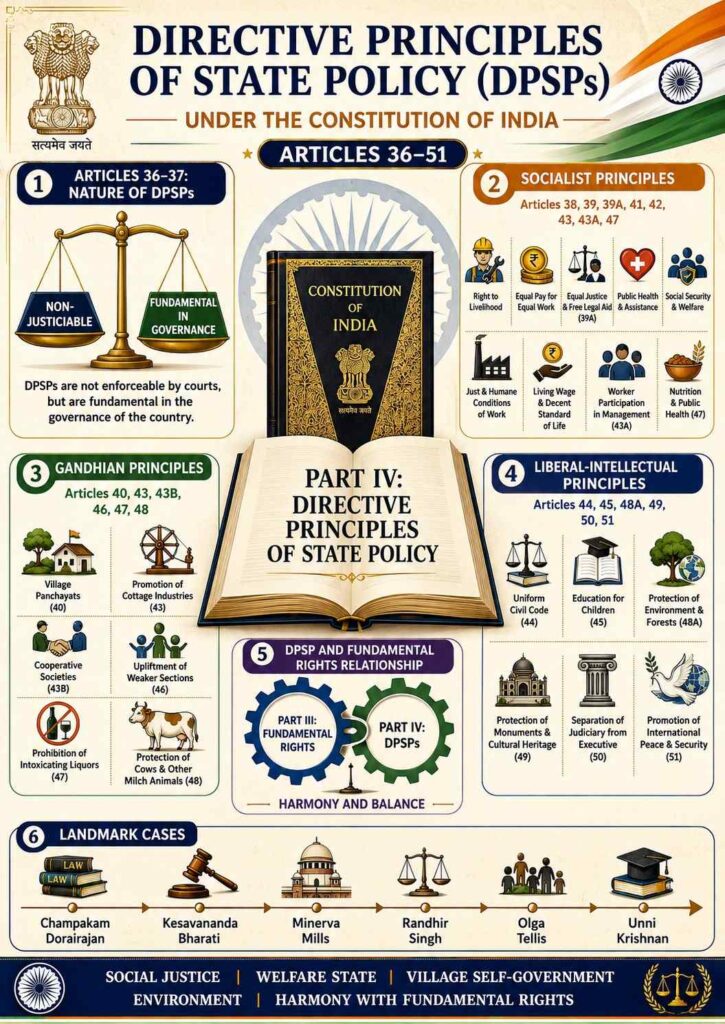
Meaning and Constitutional Importance of Directive Principles of State Policy
➤ Meaning of DPSPs: Directive Principles of State Policy, commonly called DPSPs, are constitutional directions given to the State for making laws and policies to establish a welfare-oriented, socially just, economically fair and morally progressive society. They are contained in Part IV of the Constitution of India, Articles 36 to 51. The official text of the Constitution places these provisions under the heading “Directive Principles of State Policy.”
➤ Core idea: Fundamental Rights mainly protect individual liberty, while DPSPs guide the State to create conditions where liberty becomes meaningful. For example, the right to life under Article 21 becomes more real when the State works for health, education, livelihood, nutrition, environment and justice, all of which are reflected in DPSPs.
➤ Constitutional philosophy: DPSPs represent the social and economic conscience of the Constitution. They show that India is not merely a political democracy where people vote, but also aims to be a social and economic democracy where poverty, inequality, exploitation and social backwardness are reduced.
➤ Source of inspiration: DPSPs were influenced by the Irish Constitution, but their Indian form reflects the freedom struggle, Gandhian ideas, social justice movements and the need to transform a poor and unequal society into a welfare State.
Article 36: Definition of State
➤ Meaning of State: Article 36 says that, unless the context otherwise requires, the word “State” in Part IV has the same meaning as in Part III. Therefore, it includes the Government and Parliament of India, the Government and Legislature of each State, local authorities and other authorities within India or under the control of the Government of India.
➤ Practical importance: DPSPs are addressed not only to the Union Government but also to State Governments, local bodies and other public authorities. Every organ of governance must keep DPSPs in mind while framing policies.
Article 37: Non-Justiciability and Fundamental Nature of DPSPs
➤ Non-justiciable nature: Article 37 clearly provides that DPSPs are not enforceable by any court. This means a citizen cannot directly file a case demanding enforcement of a DPSP in the same manner as a Fundamental Right.
➤ Fundamental in governance: Article 37 also says that these principles are fundamental in the governance of the country, and it is the duty of the State to apply them in making laws. Thus, DPSPs are not legally enforceable as direct rights, but they are constitutionally binding as goals of governance.
➤ Simple distinction: A court may not force the State to implement a DPSP immediately, but the State cannot ignore DPSPs while making law and policy. They are political, moral and constitutional obligations of the State.
Article 38: Social Order Based on Justice
➤ Justice-based social order: Article 38 directs the State to promote the welfare of the people by securing a social order in which justice—social, economic and political—shall inform all institutions of national life.
➤ Reduction of inequality: Article 38 also directs the State to minimise inequalities in income, status, facilities and opportunities among individuals and groups. This makes Article 38 the broad foundation of the welfare State.
➤ Example: Policies for poverty removal, affirmative action, social security, public health, rural development and access to basic services are connected with Article 38.
Article 39: Principles of Policy Relating to Livelihood, Resources and Economic Justice
➤ Adequate livelihood: Article 39(a) directs the State to ensure that citizens, men and women equally, have the right to an adequate means of livelihood.
➤ Material resources: Article 39(b) directs that ownership and control of material resources of the community should be distributed to subserve the common good. In Property Owners Association v. State of Maharashtra, 2024 INSC 835, a nine-judge Bench held that Article 31C, as upheld in Kesavananda Bharati, remains in force, and that not all private property is automatically a “material resource of the community” under Article 39(b); private property may qualify depending on context, nature of the resource, scarcity, public purpose and community need.
➤ Prevention of concentration of wealth: Article 39(c) directs that the economic system should not result in concentration of wealth and means of production to the common detriment.
➤ Equal pay for equal work: Article 39(d) directs equal pay for equal work for both men and women. In Randhir Singh v. Union of India, AIR 1982 SC 879, the petitioner, a driver in the Delhi Police Force, claimed parity with drivers in other departments performing similar duties. The Supreme Court held that although equal pay for equal work is not expressly declared as a Fundamental Right, it is a constitutional goal under Article 39(d) and can be read with Articles 14 and 16 to enforce equality where persons perform similar work under the same employer without rational classification.
➤ Protection of workers and children: Article 39(e) directs protection of the health and strength of workers, men and women, and the tender age of children from abuse. Article 39(f) directs that children should develop in a healthy manner with freedom, dignity and protection against exploitation and moral or material abandonment.
Article 39A: Equal Justice and Free Legal Aid
➤ Access to justice: Article 39A directs the State to ensure that the legal system promotes justice on the basis of equal opportunity and to provide free legal aid so that justice is not denied because of economic or other disabilities. Article 39A was inserted by the 42nd Constitutional Amendment Act, 1976.
➤ Constitutional importance: Article 39A converts justice from a theoretical idea into a practical necessity. A poor person must not lose a legal claim merely because they cannot afford a lawyer.
➤ Case law: In Hussainara Khatoon v. State of Bihar, AIR 1979 SC 1369, the Supreme Court dealt with the condition of undertrial prisoners who had remained in jail for long periods. The Court recognised speedy trial and legal aid as essential aspects of fair procedure under Article 21, read with the constitutional philosophy of Article 39A.
Article 40: Organisation of Village Panchayats
➤ Local self-government: Article 40 directs the State to organise village panchayats and endow them with powers and authority necessary to function as units of self-government.
➤ Implementation: This principle was strongly implemented through the 73rd Constitutional Amendment, which gave constitutional status to Panchayati Raj Institutions. Article 40 reflects democratic decentralisation and grassroots participation.
Article 41: Right to Work, Education and Public Assistance
➤ Conditional duty of State: Article 41 directs the State, within its economic capacity and development, to make effective provision for the right to work, education and public assistance in cases of unemployment, old age, sickness and disablement.
➤ Right to livelihood: In Olga Tellis v. Bombay Municipal Corporation, AIR 1986 SC 180; (1985) 3 SCC 545, pavement and slum dwellers challenged eviction because eviction would destroy their livelihood. The Supreme Court held that the right to life under Article 21 includes the right to livelihood, though eviction could be carried out according to fair procedure. The case shows how DPSP values like livelihood and social justice influenced interpretation of Fundamental Rights.
➤ Right to education: In Unni Krishnan J.P. v. State of Andhra Pradesh, AIR 1993 SC 2178; (1993) 1 SCC 645, the Supreme Court held that the right to education flows from Article 21 and that children have a fundamental right to free education up to 14 years. This judicial development later supported the insertion of Article 21A.
Article 42: Just and Humane Conditions of Work and Maternity Relief
➤ Labour welfare: Article 42 directs the State to make provision for just and humane conditions of work and maternity relief.
➤ Practical relevance: Laws relating to maternity benefits, factory safety, working hours, labour welfare, occupational health and humane workplace conditions derive constitutional support from Article 42.
Article 43: Living Wage and Decent Standard of Life
➤ Living wage: Article 43 directs the State to secure a living wage, decent standard of life, leisure, social and cultural opportunities for workers. It also encourages cottage industries on an individual or cooperative basis in rural areas.
➤ Difference between minimum wage and living wage: Minimum wage prevents exploitation at the lowest level, while living wage aims at a dignified life including basic needs, education, health, recreation and social security.
Article 43A: Participation of Workers in Management
➤ Industrial democracy: Article 43A directs the State to secure participation of workers in the management of industries. This provision was inserted by the 42nd Constitutional Amendment Act, 1976.
➤ Purpose: It recognises that workers are not merely instruments of production; they are stakeholders in industrial development.
Article 43B: Promotion of Cooperative Societies
➤ Cooperative principle: Article 43B directs the State to promote voluntary formation, autonomous functioning, democratic control and professional management of cooperative societies. It was inserted by the 97th Constitutional Amendment Act, 2011.
➤ Importance: This provision supports cooperative federalism at the economic level, especially in agriculture, credit, dairy, housing and rural development.
Article 44: Uniform Civil Code
➤ Common civil law: Article 44 directs the State to endeavour to secure a Uniform Civil Code for citizens throughout India.
➤ Meaning: A Uniform Civil Code means a common set of civil laws relating to matters such as marriage, divorce, succession, adoption and maintenance, irrespective of religion.
➤ Constitutional sensitivity: Article 44 must be understood with equality, gender justice, religious freedom and social harmony. It is a directive, not an immediately enforceable command.
Article 45: Early Childhood Care and Education
➤ Present text: Article 45 directs the State to provide early childhood care and education for all children until they complete the age of six years.
➤ Change after Article 21A: Originally, Article 45 directed free and compulsory education for children up to 14 years. After the 86th Constitutional Amendment, education for children between 6 and 14 years became a Fundamental Right under Article 21A, while Article 45 was reshaped to focus on early childhood care.
Article 46: Educational and Economic Interests of Weaker Sections
➤ Social justice: Article 46 directs the State to promote educational and economic interests of weaker sections, especially Scheduled Castes and Scheduled Tribes, and protect them from social injustice and exploitation.
➤ Practical importance: Reservations, scholarships, hostels, welfare schemes, protection against caste-based exploitation and targeted development measures are supported by Article 46.
Article 47: Nutrition, Standard of Living and Public Health
➤ Public health duty: Article 47 directs the State to raise the level of nutrition, standard of living and public health. It also directs the State to endeavour to prohibit intoxicating drinks and drugs injurious to health, except for medicinal purposes.
➤ Health jurisprudence: The Supreme Court has often connected public health with Article 21. Article 47 strengthens the view that health is not charity but a constitutional governance duty.
Article 48: Agriculture and Animal Husbandry
➤ Scientific agriculture: Article 48 directs the State to organise agriculture and animal husbandry on modern and scientific lines and to preserve and improve breeds. It also directs prohibition of slaughter of cows, calves and other milch and draught cattle.
➤ Balance required: This provision has to be understood with livelihood, agriculture, animal welfare, food practices and legislative competence.
Article 48A: Environment and Wildlife
➤ Environmental protection: Article 48A directs the State to protect and improve the environment and safeguard forests and wildlife. It was inserted by the 42nd Constitutional Amendment Act, 1976.
➤ Judicial development: Article 48A, along with Article 51A(g), has influenced environmental jurisprudence under Article 21. The right to life now includes the right to a clean and healthy environment.
Article 49: Protection of Monuments and Places of National Importance
➤ Cultural heritage: Article 49 directs the State to protect monuments, places and objects of artistic or historic interest declared by law to be of national importance.
➤ Purpose: A nation’s heritage is part of its constitutional identity. Protection of historical monuments preserves collective memory and culture.
Article 50: Separation of Judiciary from Executive
➤ Judicial independence: Article 50 directs the State to separate the judiciary from the executive in the public services of the State.
➤ Importance: Separation protects impartial justice. A judge should not be controlled by the executive authority whose actions may come before the court.
Article 51: International Peace and Security
➤ International constitutional morality: Article 51 directs the State to promote international peace and security, maintain just and honourable relations between nations, foster respect for international law and treaty obligations, and encourage settlement of international disputes by arbitration.
➤ Wider meaning: Article 51 shows that India’s Constitution is not inward-looking. It supports peaceful coexistence, international cooperation and rule-based global order.
Classification of DPSPs
Socialist Principles
➤ Meaning: Socialist DPSPs aim to reduce inequality, prevent exploitation and create social and economic justice.
➤ Main Articles: Articles 38, 39, 39A, 41, 42, 43, 43A and 47 are generally treated as socialist principles.
➤ Purpose: They deal with adequate livelihood, equal distribution of resources, equal pay, legal aid, work, education, public assistance, labour welfare, living wage, workers’ participation, nutrition and public health.
Gandhian Principles
➤ Meaning: Gandhian DPSPs reflect Mahatma Gandhi’s ideas of village self-rule, cottage industries, weaker section upliftment, prohibition and cow protection.
➤ Main Articles: Articles 40, 43, 43B, 46, 47 and 48 are generally considered Gandhian principles.
➤ Purpose: They promote village panchayats, rural industries, cooperative societies, protection of weaker sections, prohibition and scientific animal husbandry.
Liberal-Intellectual Principles
➤ Meaning: Liberal principles focus on legal reform, individual dignity, institutional separation, environment, heritage and international peace.
➤ Main Articles: Articles 44, 45, 48A, 49, 50 and 51 are usually classified as liberal-intellectual principles.
➤ Purpose: They support Uniform Civil Code, early childhood care, environmental protection, monument preservation, judicial independence and international peace.
Implementation of DPSPs
➤ Through constitutional amendments: Important DPSP-related changes include Article 39A, Article 43A and Article 48A through the 42nd Amendment; Article 21A and revised Article 45 through the 86th Amendment; and Article 43B through the 97th Amendment.
➤ Through legislation: DPSPs have inspired laws on land reforms, labour welfare, legal services, education, panchayats, environment, maternity benefits, food security, cooperative societies and social welfare.
➤ Through judicial interpretation: Courts have used DPSPs to expand the meaning of Fundamental Rights, especially Article 21. This is visible in cases on livelihood, education, health, environment, legal aid and dignity.
Relation Between DPSPs and Fundamental Rights
➤ Early view—Fundamental Rights prevail: In State of Madras v. Champakam Dorairajan, AIR 1951 SC 226, communal reservation in educational institutions was challenged. The Supreme Court held that DPSPs cannot override or abridge Fundamental Rights and must run subsidiary to Part III. This case led to the First Constitutional Amendment and showed the first major conflict between Part III and Part IV.
➤ Basic Structure and harmony: In Kesavananda Bharati v. State of Kerala, AIR 1973 SC 1461; (1973) 4 SCC 225, the Supreme Court upheld Parliament’s power to amend the Constitution but held that the basic structure cannot be destroyed. The case also dealt with Article 31C, which protected laws giving effect to Article 39(b) and 39(c), subject to constitutional limits.
➤ Balance between Parts III and IV: In Minerva Mills Ltd. v. Union of India, AIR 1980 SC 1789; (1980) 3 SCC 625, the Supreme Court struck down the attempt to give unlimited primacy to all DPSPs over Fundamental Rights. The Court held that the Constitution is founded on harmony and balance between Fundamental Rights and DPSPs, and destroying that balance damages the basic structure.
➤ Modern approach: The modern judicial approach is not to treat Fundamental Rights and DPSPs as enemies. Courts try to read them together. Fundamental Rights provide enforceable guarantees, while DPSPs provide the social and moral content needed to make those rights meaningful.
Difference Between Fundamental Rights and DPSPs
| Basis | Fundamental Rights | Directive Principles of State Policy |
|---|---|---|
| Location | Part III | Part IV |
| Nature | Mostly negative and positive obligations protecting individuals | Positive directions for welfare governance |
| Enforceability | Enforceable by courts | Not directly enforceable by courts |
| Purpose | Political democracy and individual liberty | Social and economic democracy |
| Remedy | Writs under Articles 32 and 226 | Implemented through laws, policies and interpretation |
| Constitutional value | Fundamental for individual rights | Fundamental in governance |
Memory Chart for Quick Revision
| Category | Articles | Key Idea |
|---|---|---|
| Definition and nature | 36–37 | State and non-justiciability |
| Social justice | 38–39A | Welfare, equality, resources, legal aid |
| Local democracy and labour welfare | 40–43B | Panchayats, work, maternity, living wage, cooperatives |
| Social reform and child welfare | 44–47 | UCC, early childhood care, weaker sections, health |
| Agriculture, environment and heritage | 48–49 | Animal husbandry, environment, monuments |
| Judiciary and international peace | 50–51 | Separation of judiciary and peaceful global relations |
Conclusion
➤ Final understanding: DPSPs are the constitutional roadmap for building a welfare State. They are not directly enforceable like Fundamental Rights, but they are fundamental in governance and deeply influence legislation, policy and judicial interpretation.
➤ Balanced Constitution: Indian constitutional law has moved from conflict between Fundamental Rights and DPSPs to harmony between them. Fundamental Rights protect liberty and dignity; DPSPs ensure that liberty and dignity are supported by social justice, economic fairness, education, health, livelihood, environment and equal opportunity.
➤ Best legal position: No absolute superiority can be given either to Fundamental Rights or DPSPs. The Constitution requires a careful balance where individual rights are protected and social transformation is pursued through constitutionally valid means.