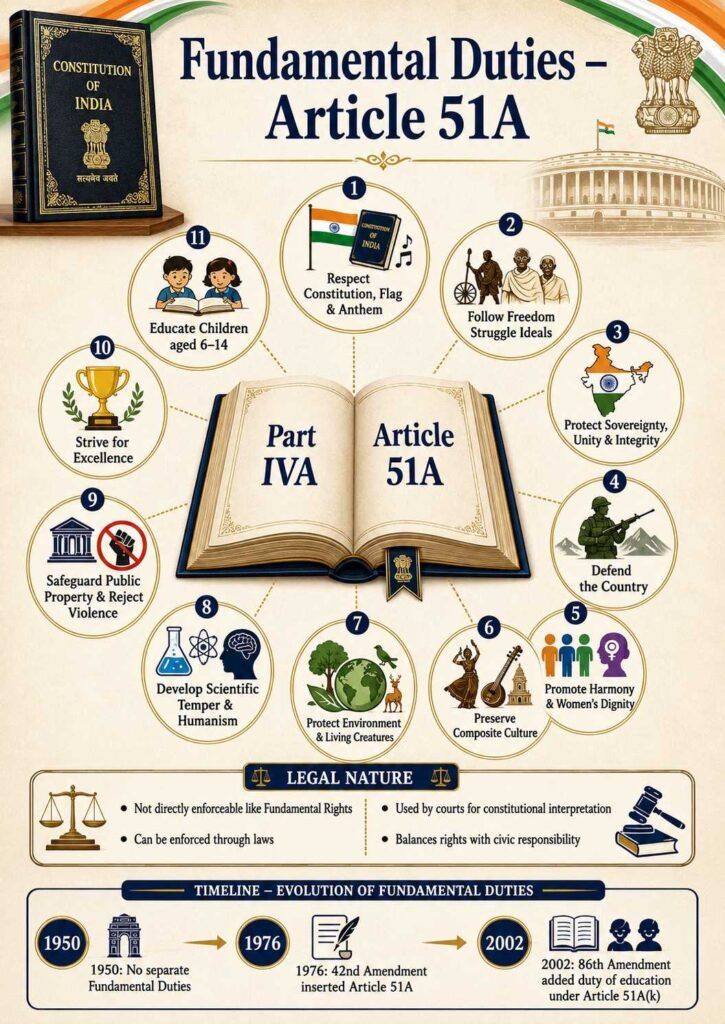
Meaning and Constitutional Position of Fundamental Duties
➤ Basic idea: Fundamental Duties are the constitutional obligations of citizens towards the Constitution, the nation, society, public property, environment, women, children, scientific temper and national unity. They are placed in Part IVA of the Constitution of India under Article 51A. Article 51A begins with the words: “It shall be the duty of every citizen of India—”, which shows that these duties are addressed specifically to citizens, unlike many Fundamental Rights which may be available to citizens as well as non-citizens depending on the Article. The current official text of the Constitution places Article 51A in Part IVA and lists eleven duties from clauses (a) to (k).
➤ Nature of duties: Fundamental Duties are not ordinary moral suggestions. They are constitutional duties, because they are expressly written in the Constitution. However, they are generally not directly enforceable by writ in the same manner as Fundamental Rights under Article 32 or Article 226. Their importance lies in guiding citizens, supporting constitutional morality, helping courts interpret laws, and allowing the State to make laws for giving effect to these duties.
➤ Rights and duties relationship: The Constitution cannot be understood only as a charter of rights. A democratic society requires both rights and responsibilities. Fundamental Rights protect individual liberty, Directive Principles guide the State in making welfare policies, and Fundamental Duties remind citizens that constitutional democracy can survive only when citizens behave responsibly. Therefore, Fundamental Duties complete the moral and civic structure of the Constitution.
Origin of Fundamental Duties through the 42nd Constitutional Amendment
➤ Original Constitution: The Constitution as adopted on 26 January 1950 did not contain a separate chapter on Fundamental Duties. The original Constitution contained Fundamental Rights in Part III and Directive Principles of State Policy in Part IV, but no separate list of duties for citizens.
➤ Swaran Singh Committee: During the 1970s, the need was felt to insert a chapter on citizens’ duties. The Swaran Singh Committee recommended the inclusion of Fundamental Duties in the Constitution. Acting on this constitutional reform idea, Parliament inserted Part IVA containing Article 51A through the Constitution (Forty-second Amendment) Act, 1976. The official Constitution text records that Part IVA was inserted by the 42nd Amendment Act, 1976.
➤ Initially ten duties: The 42nd Amendment inserted ten Fundamental Duties. These duties included respect for the Constitution, National Flag and National Anthem; following ideals of the freedom struggle; protecting sovereignty and unity; defending the country; promoting harmony; renouncing practices derogatory to women; preserving composite culture; protecting the environment; developing scientific temper; safeguarding public property; and striving for excellence.
➤ Source of inspiration: The concept of Fundamental Duties is generally understood to have been influenced by constitutions where duties of citizens were expressly recognised, especially the former Soviet constitutional model. However, the Indian form of Fundamental Duties is not a mechanical copy. Indian duties reflect the requirements of Indian constitutional culture: unity in diversity, constitutional respect, women’s dignity, environmental protection, scientific temper, and composite heritage.
Article 51A: Complete List and Explanation of Fundamental Duties
➤ Respect for Constitution, National Flag and National Anthem — Article 51A(a): Every citizen must abide by the Constitution and respect its ideals, institutions, the National Flag and the National Anthem. This duty is connected with constitutional loyalty. It means citizens must respect constitutional values such as democracy, secularism, equality, rule of law, liberty and justice. Respect for the National Flag and National Anthem is not merely emotional; it represents respect for the constitutional identity of India. The Prevention of Insults to National Honour Act, 1971 gives statutory effect to some aspects of this duty by penalising insults to the Constitution, National Flag and National Anthem.
➤ Freedom struggle ideals — Article 51A(b): Every citizen must cherish and follow the noble ideals that inspired India’s national struggle for freedom. These ideals include courage against injustice, sacrifice, non-violence, democratic participation, equality, dignity, unity, self-rule and social reform. This duty reminds citizens that independence was not only a political event but also a moral movement for justice and self-respect.
➤ Sovereignty, unity and integrity — Article 51A(c): Every citizen must uphold and protect the sovereignty, unity and integrity of India. Sovereignty means India’s independent authority; unity means national togetherness; and integrity means territorial and constitutional wholeness. This duty is relevant in matters involving secessionism, terrorism, threats to national unity, hate propaganda and activities weakening constitutional fraternity.
➤ Defence and national service — Article 51A(d): Every citizen must defend the country and render national service when called upon to do so. This duty does not mean every citizen is always under compulsory military service. It means that when lawfully required, citizens must support national defence and public service. The duty reflects the idea that national security is not only the work of the armed forces but also a constitutional responsibility of citizens.
➤ Harmony, brotherhood and dignity of women — Article 51A(e): Every citizen must promote harmony and the spirit of common brotherhood among all people of India, transcending religious, linguistic, regional and sectional diversities. Citizens must also renounce practices derogatory to the dignity of women. This duty directly supports the constitutional values of equality, secularism, fraternity and gender justice. Practices such as social exclusion, communal hatred, caste humiliation, honour-based violence, dowry harassment and gender-discriminatory customs are inconsistent with this duty.
➤ Composite culture — Article 51A(f): Every citizen must value and preserve the rich heritage of India’s composite culture. India’s culture is not single-dimensional; it is made of different languages, religions, traditions, art forms, philosophies, literatures and regional histories. This duty protects the idea of India as a plural and inclusive civilisation.
➤ Environment and compassion for living creatures — Article 51A(g): Every citizen must protect and improve the natural environment, including forests, lakes, rivers and wildlife, and must have compassion for living creatures. This duty is one of the most judicially relevant Fundamental Duties. It connects with Article 48A, which directs the State to protect and improve the environment, and Article 21, which has been interpreted to include the right to a healthy environment.
➤ Scientific temper, humanism and reform — Article 51A(h): Every citizen must develop scientific temper, humanism and the spirit of inquiry and reform. Scientific temper means rational thinking, questioning, evidence-based understanding and rejection of blind superstition. Humanism means respect for human dignity and compassion. Spirit of reform means willingness to improve social practices when they are unjust, irrational or oppressive.
➤ Public property and non-violence — Article 51A(i): Every citizen must safeguard public property and abjure violence. Public buses, trains, roads, government schools, hospitals, courts, public buildings and public resources are created through public money. Destroying public property during protests, riots or political agitation violates this constitutional duty. This clause also reminds citizens that democratic disagreement must remain peaceful.
➤ Excellence — Article 51A(j): Every citizen must strive towards excellence in all spheres of individual and collective activity, so that the nation constantly rises to higher levels of endeavour and achievement. This duty gives a positive direction to citizenship. It does not impose perfection, but it asks citizens to work with sincerity, discipline and commitment in education, profession, public life, research, governance, sports, art and social service.
➤ Education of children — Article 51A(k): A parent or guardian must provide opportunities for education to his child or ward between the age of six and fourteen years. This duty was added by the Constitution (Eighty-sixth Amendment) Act, 2002. The same amendment inserted Article 21A, making free and compulsory education for children aged six to fourteen a Fundamental Right, and substituted Article 45 regarding early childhood care and education.
Addition of Duty Regarding Education through the 86th Amendment
➤ Constitutional change: The 86th Constitutional Amendment, 2002 created an important constitutional triangle on education. First, Article 21A made education a Fundamental Right for children between six and fourteen years. Second, Article 45 was revised to require the State to endeavour to provide early childhood care and education to children below six years. Third, Article 51A(k) imposed a duty on parents and guardians to provide educational opportunities to children between six and fourteen years.
➤ Meaning of parental duty: Article 51A(k) does not punish poverty or inability. Its focus is on constitutional responsibility. Parents and guardians should not deliberately deny education to children. They must create opportunities for schooling and learning as far as reasonably possible. The duty supports the Right of Children to Free and Compulsory Education Act, 2009, which operationalises Article 21A.
➤ Balance between State and parents: The duty regarding education is important because children’s education cannot depend only on the State. The State must provide free and compulsory education, but parents and guardians must also ensure that children are not kept away from school due to negligence, child labour, social prejudice or lack of awareness.
Enforceability of Fundamental Duties
➤ Not directly enforceable like Fundamental Rights: Fundamental Duties are generally non-justiciable, meaning a citizen cannot ordinarily file a writ petition merely to compel another citizen to perform a Fundamental Duty. In AIIMS Students’ Union v. AIIMS, (2002) 1 SCC 428, the Supreme Court observed that Fundamental Duties under Article 51A are not made enforceable by writ like Fundamental Rights, but they cannot be overlooked because they are also described as “fundamental”.
➤ Enforceable through ordinary laws: Even though Article 51A itself does not provide direct punishment, Parliament and State Legislatures can make laws to enforce duties. For example, disrespect to the National Flag or National Anthem may be punished under the Prevention of Insults to National Honour Act, 1971. Similarly, environmental duties are supported by statutes such as the Environment (Protection) Act, 1986, the Water Act, 1974 and the Air Act, 1981. Therefore, Fundamental Duties become practically enforceable when converted into statutory obligations.
➤ Aid to constitutional interpretation: Courts use Fundamental Duties as interpretative guides. When a law is made to promote a Fundamental Duty, courts may consider that constitutional purpose while testing the reasonableness or validity of the law. For example, a law protecting forests, preventing cruelty to animals, prohibiting damage to public property, or promoting national honour may receive support from Article 51A.
➤ No excuse to violate Fundamental Rights: Fundamental Duties cannot be used casually to destroy Fundamental Rights. A citizen’s duty to respect the National Anthem does not mean the State may punish a person without legal authority or violate freedom of conscience. Duties and rights must be harmonised. The Constitution requires responsible liberty, not forced uniformity.
Judicial Relevance and Landmark Case Laws
➤ AIIMS Students’ Union v. AIIMS, (2002) 1 SCC 428: The facts involved reservation/preference in postgraduate medical admissions for students of AIIMS. The legal issue was whether such institutional preference was constitutionally permissible and how excellence in medical education should be understood. The Supreme Court emphasised Article 51A(j), which requires citizens to strive towards excellence in all spheres. The ratio was that Fundamental Duties, though not enforceable like Fundamental Rights, are constitutionally significant and may guide interpretation of constitutional and legal issues. The Court stressed that duties are also called “fundamental” and cannot be treated as meaningless.
➤ Bijoe Emmanuel v. State of Kerala, (1986) 3 SCC 615: In this case, three school children belonging to the Jehovah’s Witness faith stood respectfully during the National Anthem but did not sing it because of their religious belief. They were expelled from school. The issue was whether refusal to sing the National Anthem, while standing respectfully, amounted to disrespect and whether expulsion violated Fundamental Rights. The Supreme Court held that the children had not shown disrespect; they had stood respectfully and peacefully. The ratio was that genuine freedom of conscience under Article 25 and freedom of expression under Article 19 cannot be curtailed without lawful authority. This case shows that Article 51A(a) requires respect, but respect does not always mean compelled singing.
➤ Union of India v. Naveen Jindal, (2004) 2 SCC 510: The issue concerned the right of citizens to fly the National Flag. The Supreme Court held that flying the National Flag with respect and dignity is an expression protected under Article 19(1)(a), subject to reasonable restrictions. The case connects Article 51A(a) with constitutional patriotism: citizens may express respect for the Flag, but such expression must conform to dignity and statutory regulation. This case shows that Fundamental Duties may exist alongside Fundamental Rights and may help define the limits of respectful constitutional conduct.
➤ M.C. Mehta v. Union of India, AIR 1988 SC 1115 / Ganga Pollution cases: In the Ganga pollution litigation, industries and authorities were questioned for allowing pollution of the river Ganga. The legal issue was whether courts could issue directions to prevent environmental degradation affecting life, health and ecology. The Supreme Court relied on environmental constitutional values and treated environmental protection as a serious public duty. Article 51A(g) became important because it imposes a duty on citizens to protect and improve the environment, while Article 48A imposes a similar obligation on the State.
➤ M.C. Mehta v. Union of India, environmental education matter: In the environmental education litigation, the concern was that citizens cannot protect the environment unless they are made aware of environmental duties. The Supreme Court referred to Article 51A(g) and supported environmental education as a means of making citizens conscious of their constitutional responsibility. This case shows that Fundamental Duties are not only for courts and lawyers; they must be taught and internalised through education and public awareness.
➤ Hon’ble Shri Ranganath Mishra v. Union of India, (2003) 7 SCC 133: A letter by former Chief Justice Ranganath Mishra requesting steps to educate citizens about Fundamental Duties was treated as a writ petition. The issue was how Fundamental Duties could be made meaningful in public life. The Supreme Court referred to the recommendations of the Justice J.S. Verma Committee and the National Commission to Review the Working of the Constitution. The ratio was that the Government should consider appropriate steps for implementation and awareness of Fundamental Duties. This case is important because it treats duties as essential for balancing rights and responsibilities in a democratic society.
Relationship between Fundamental Duties, Fundamental Rights and Directive Principles
➤ With Fundamental Rights: Fundamental Rights give citizens enforceable claims against the State. Fundamental Duties impose obligations on citizens towards the nation and society. They are different in enforceability, but connected in purpose. For example, freedom of speech under Article 19 must be exercised consistently with public order, sovereignty, integrity and dignity of others. Article 51A(c), 51A(e) and 51A(i) provide civic values that support reasonable restrictions.
➤ With Directive Principles: Directive Principles guide the State, while Fundamental Duties guide citizens. Some duties and Directive Principles mirror each other. Article 48A directs the State to protect the environment, while Article 51A(g) asks citizens to protect and improve the environment. This creates a shared constitutional responsibility.
➤ Constitutional morality: Fundamental Duties promote constitutional morality by asking citizens to respect diversity, dignity, public property, national symbols, environment, scientific thinking and excellence. They help transform the Constitution from a legal document into a living civic culture.
Practical Importance of Fundamental Duties
➤ Civic discipline: Fundamental Duties teach that citizenship is not only about claiming benefits but also about contributing to public order, harmony and national progress.
➤ Social unity: Duties like promoting brotherhood, renouncing practices derogatory to women and preserving composite culture are especially important in a diverse society like India.
➤ Environmental responsibility: Article 51A(g) makes environmental protection a citizen’s duty. It is relevant in daily life, including waste management, water conservation, protection of animals, avoiding pollution and preserving public natural resources.
➤ Public property: Article 51A(i) is highly relevant during protests and public movements. Democracy allows dissent, but it does not justify violence or destruction of public assets.
➤ Education and children: Article 51A(k) reminds families that education is not charity; it is a constitutional responsibility towards children and society.
Memory Table: Article 51A at a Glance
| Clause | Keyword | Core Duty |
|---|---|---|
| 51A(a) | Respect | Constitution, National Flag, National Anthem |
| 51A(b) | Freedom struggle | Follow noble ideals of freedom movement |
| 51A(c) | Unity | Protect sovereignty, unity and integrity |
| 51A(d) | Defence | Defend country and render national service |
| 51A(e) | Harmony | Promote brotherhood and dignity of women |
| 51A(f) | Culture | Preserve composite cultural heritage |
| 51A(g) | Environment | Protect nature and show compassion to living creatures |
| 51A(h) | Scientific temper | Develop humanism, inquiry and reform |
| 51A(i) | Public property | Safeguard public property and reject violence |
| 51A(j) | Excellence | Strive for excellence individually and collectively |
| 51A(k) | Education | Parent/guardian to provide education opportunities to children aged 6–14 |
Conclusion
➤ Core essence: Fundamental Duties under Article 51A are the citizen’s side of the constitutional promise. They were inserted by the 42nd Amendment in 1976 and expanded by the 86th Amendment in 2002 through the addition of the duty regarding education. They are generally not directly enforceable like Fundamental Rights, but they are constitutionally important, judicially relevant and capable of statutory enforcement.
➤ Final understanding: Article 51A creates a model of responsible citizenship. It asks every citizen to respect the Constitution, protect national unity, promote harmony, preserve culture, protect the environment, develop scientific temper, safeguard public property, strive for excellence and support children’s education. The Supreme Court has repeatedly recognised that Fundamental Duties may guide interpretation, strengthen laws and balance rights with civic responsibility. In this way, Fundamental Duties convert constitutional citizenship from a passive status into an active responsibility.