Meaning and Nature of the Code of Civil Procedure, 1908
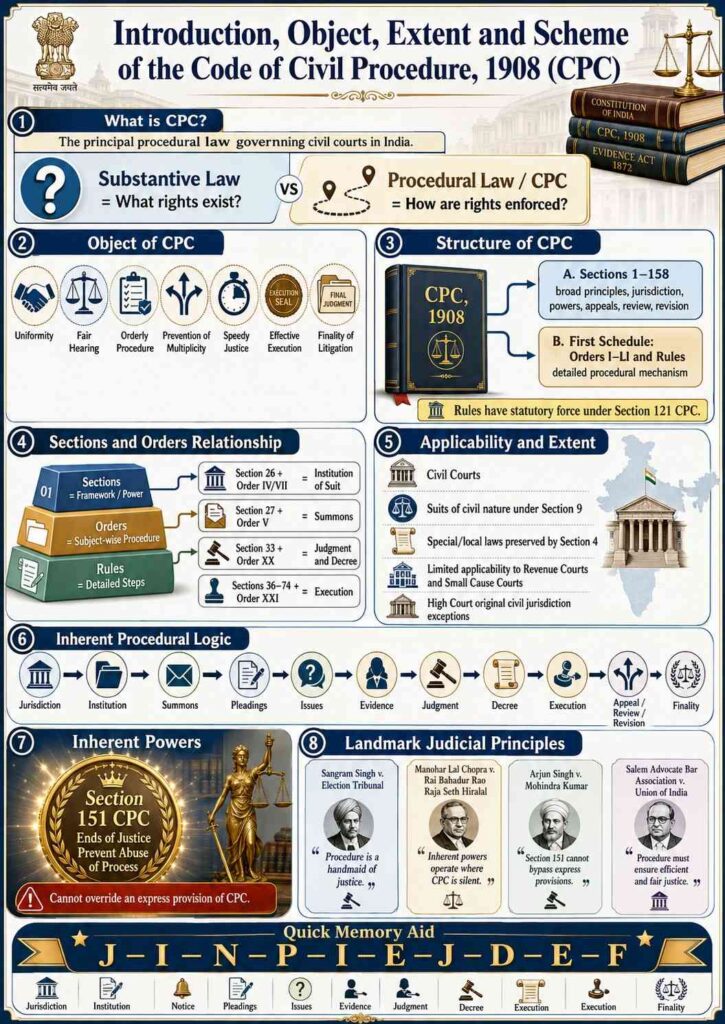
• Identity — The Code of Civil Procedure, 1908 (“CPC”) is Act No. 5 of 1908. It came into force on 1 January 1909. Its long title states that it is an Act “to consolidate and amend the laws relating to the procedure of the Courts of Civil Judicature.” Thus, it is the principal general statute regulating the manner in which civil courts entertain, conduct, decide and enforce civil proceedings in India.
• Procedural character — CPC is primarily a law of procedure, also called adjective law. It does not ordinarily create ownership rights, contractual rights, succession rights or property rights. Instead, it provides the legal machinery through which such rights are asserted, defended, adjudicated and enforced before a civil court.
• Simple distinction — A useful distinction is: substantive law answers “what is the right?” whereas procedural law answers “how is that right enforced?” For example, the Transfer of Property Act may determine whether a mortgage exists; CPC regulates the suit, parties, pleadings, evidence, judgment, appeal and execution through which the mortgage dispute is decided.
• Practical importance — A person may have a valid substantive right but fail to obtain relief because the action is filed before the wrong court, against an improper party, without a proper plaint, beyond the permissible stage, or through a barred proceeding. CPC therefore turns substantive rights into enforceable judicial remedies.
• Integrated code — Section 2(1) defines “Code” to include the rules. Therefore, the CPC is not confined to the numbered sections in its body; its First Schedule containing Orders and Rules is also legally integral to the Code.
Object and Purpose of the CPC
• Uniformity — The central object of CPC is to establish a reasonably uniform civil procedure for courts throughout India. A civil claim should not be decided through arbitrary or uncertain methods. The Code supplies a common procedural framework for ordinary civil litigation.
• Fair hearing — CPC protects the principles of natural justice by ensuring notice of proceedings, opportunity to file pleadings, production of evidence, hearing of parties, reasoned judgment and appellate remedies where the statute permits them.
• Orderly adjudication — The Code prevents disorder in litigation by laying down rules on jurisdiction, institution of suits, service of summons, pleadings, joinder of parties, framing of issues, proof, judgment, decree, execution, appeal, review and revision.
• Prevention of multiplicity — CPC aims to avoid repetitive litigation. Section 10 provides for stay of a subsequently instituted suit where the matter in issue is directly and substantially in issue in a previously instituted suit. Section 11 embodies res judicata, which bars re-litigation of matters already finally decided between the parties or their privies. These provisions protect judicial time and secure finality.
• Economy and efficiency — Several provisions are designed to identify the real dispute early and avoid unnecessary trial. Illustrations include admissions under Order XII, framing of issues under Order XIV, disposal of preliminary issues in limited situations under Order XIV Rule 2, and rejection of a plaint under Order VII Rule 11 where the statutory grounds are clearly made out.
• Effective enforcement — A decree is not merely a declaration of rights. CPC also contains an extensive execution mechanism. Sections 36 to 74 and Order XXI deal with enforcement of decrees, including attachment, sale, delivery of property, arrest in limited situations and transfer of decrees for execution.
• Balance — The Code seeks to balance two competing concerns: fair opportunity to litigants and timely, disciplined adjudication. Procedure cannot become so rigid that justice is defeated, but it cannot become so flexible that litigation is indefinitely delayed or manipulated.
Substantive Law and Procedural Law: Distinction
| Basis | Substantive Law | Procedural Law / CPC |
|---|---|---|
| Function | Creates, defines or regulates rights and liabilities | Regulates enforcement of rights before courts |
| Question answered | What right or obligation exists? | How, where and through what process is it enforced? |
| Examples | Contract Act, Transfer of Property Act, Hindu Succession Act | CPC, court rules, procedural provisions of special statutes |
| Effect | Determines legal entitlement | Determines the mode of adjudication and remedy |
| Typical subject | Ownership, contract, succession, tort, liability | Jurisdiction, pleadings, summons, trial, decree, appeal, execution |
• Non-rigid classification — The distinction is important but not mechanical. A procedural provision may have serious consequences. For example, non-compliance with a mandatory jurisdictional requirement, limitation period, statutory appeal condition or procedural bar may affect the maintainability of the proceeding itself.
• No automatic right of appeal — The right to institute a civil suit is generally recognised through Section 9 CPC, subject to express or implied statutory bars. However, an appeal is not an inherent right; it exists only where conferred by statute. CPC itself expressly provides appellate rights in specified situations, such as appeals from original decrees under Section 96 and appeals from certain orders under Section 104.
• Procedure serves justice — In Sangram Singh v. Election Tribunal, Kotah, Bhurey Lal Baya, AIR 1955 SC 425; (1955) 2 SCR 1, the Supreme Court considered procedural fairness in an election dispute where a party’s participation after an ex parte stage was in issue. The Court held that procedural law is intended to facilitate justice, not to trap parties through excessive technicality; however, fairness must be preserved for both sides. This remains a foundational statement of the philosophy of civil procedure.
• Procedure is not an excuse for indiscipline — The principle that procedure is a handmaid of justice does not mean that statutory rules may be ignored. Courts may adopt a justice-oriented interpretation where the statute permits flexibility, but they cannot dispense with an express mandatory requirement merely on equitable grounds.
Legislative Background and Development of CPC
• Consolidating statute — CPC, 1908 consolidated and amended the procedural law governing civil courts. The present statutory compilation records numerous amendments over time, showing that the Code has been continually adapted to improve efficiency, case management and access to justice.
• Major reform phases — Important reform phases include the Code of Civil Procedure (Amendment) Act, 1976, the Code of Civil Procedure (Amendment) Act, 1999 and the Code of Civil Procedure (Amendment) Act, 2002. These reforms addressed delay, written statements, costs, settlement mechanisms, evidence and judicial case management.
• Settlement orientation — Section 89 CPC, read with Order X Rules 1A to 1C, reflects the legislative effort to encourage settlement through arbitration, conciliation, judicial settlement including settlement through Lok Adalat, and mediation where appropriate.
• Modern interpretation — In Salem Advocate Bar Association, Tamil Nadu v. Union of India, (2005) 6 SCC 344, constitutional challenges to major CPC amendments were considered. The Supreme Court upheld the reform-oriented approach and emphasised that procedural amendments must be implemented in a manner that advances efficient and fair justice delivery, rather than becoming formal obstacles.
Structure and Scheme of the CPC
• Two-part structure — CPC has two principal components:
▸ The body of the Code: Sections 1 to 158, arranged in Parts.
▸ The First Schedule: Orders I to LI, containing detailed Rules governing particular stages of civil proceedings.
• Sections — The sections contain the broad legal framework, jurisdictional principles, powers of courts, appellate structure, review, revision, rule-making power and miscellaneous provisions.
• Orders and Rules — Orders divide the procedural field into specific subjects, while Rules prescribe the detailed manner in which that subject is to be handled. For example, Order VII concerns plaints, and its Rules prescribe matters such as particulars of plaint, return of plaint and rejection of plaint.
• Appendices — The First Schedule also contains appendices relating to pleadings, process, discovery, decrees, execution, supplemental proceedings and miscellaneous forms. These provide practical procedural formats.
| Part of CPC | Broad Subject |
|---|---|
| Preliminary: Sections 1–8 | Title, definitions, extent, savings, Revenue Courts and Small Cause Courts |
| Part I: Sections 9–35B | Suits in general, jurisdiction, res judicata, place of suing, institution, summons, pleadings, costs |
| Part II: Sections 36–74 | Execution of decrees and orders |
| Part III: Sections 75–78 | Commissions |
| Part IV: Sections 79–88 | Suits in particular cases, including suits by or against Government and interpleader suits |
| Part V: Sections 89–93 | Special proceedings, including settlement and public nuisance matters |
| Part VI: Sections 94–95 | Supplemental proceedings |
| Part VII: Sections 96–112 | Appeals |
| Part VIII: Sections 113–115 | Reference, review and revision |
| Part IX: Sections 116–120 | Special provisions relating to certain High Courts |
| Part X: Sections 121–131 | Rules and High Court rule-making powers |
| Part XI: Sections 132–158 | Miscellaneous provisions, including caveat, restitution, enlargement of time and inherent powers |
The arrangement of sections and the First Schedule demonstrates that CPC is designed as a complete procedural pathway—from filing of a suit to execution or appellate correction of the decree.
Relation Between Sections, Orders and Rules
• General principle — Sections lay down broad principles, powers and substantive procedural conditions. Orders and Rules provide operational detail. The two must be read together, not in isolation.
• Statutory force — Section 121 declares that the Rules in the First Schedule have effect “as if enacted in the body of this Code” until altered or annulled in accordance with Part X. Thus, Orders and Rules are not merely administrative instructions; they have statutory force.
• Illustration: institution of suit — Section 26 states that every suit shall be instituted by presentation of a plaint or in such other manner as may be prescribed. Order IV explains institution of suits, Order VI deals with pleadings, Order VII prescribes the contents and requirements of a plaint, and Order VIII regulates the written statement.
• Illustration: summons — Section 27 authorises the issue of summons to the defendant after institution of a suit. Order V then governs the detailed process of issue, service, substituted service and proof of service.
• Illustration: judgment and decree — Section 33 provides that after the case has been heard, the court shall pronounce judgment and a decree shall follow. Order XX gives detailed rules concerning pronouncement of judgment, drafting of decrees and their contents.
• Illustration: execution — Section 36 applies the provisions relating to execution of decrees to executable orders. Order XXI then supplies the detailed machinery for execution.
• Harmony — A court should interpret a section and its related Order or Rule harmoniously. The section provides the governing power or principle; the Rule ordinarily explains the procedure for its use.
• Local rules — Section 122 empowers High Courts to make rules regulating their own procedure and that of civil courts subject to their superintendence, including alteration or addition to Rules in the First Schedule. However, Section 128 makes it clear that such rules must not be inconsistent with the provisions in the body of the Code.
• Practical hierarchy — The First Schedule rules are statutory, but a High Court-made procedural rule cannot override an express provision in the body of CPC. Similarly, a court cannot use a general procedural provision to defeat a specific statutory command.
Applicability and Extent of CPC
• Territorial extent — Section 1(3) states that the Code extends to the whole of India except the State of Nagaland and the tribal areas, subject to the power of the concerned State Government to extend the Code or any part of it by notification with suitable modifications. The expression “tribal areas” carries the statutory meaning given in the Explanation to Section 1(3).
• Civil courts — CPC applies principally to courts of civil judicature dealing with civil suits and civil proceedings. Section 9 states that civil courts shall try all suits of a civil nature unless cognizance is expressly or impliedly barred.
• Civil nature — A dispute may be of civil nature even when it involves religious rites or ceremonies, provided that a right to property or office is contested. Section 9 expressly recognises this position.
• Special and local laws — Section 4 preserves special or local laws, special jurisdictions, special powers and special forms of procedure created by another law. Therefore, CPC is the general procedural law, but a special statute may provide a different procedure.
• Rule of priority — Where a special statute contains a complete or inconsistent procedural scheme, that special scheme ordinarily governs to the extent of inconsistency. CPC continues to apply only where the special statute is silent or expressly incorporates CPC.
• Revenue Courts — Section 5 deals with Revenue Courts. CPC may apply to such courts only in the manner permitted by the relevant special enactment, subject to governmental modification or exclusion.
• Small Cause Courts — Sections 7 and 8 exclude or modify the application of specified CPC provisions to Provincial and Presidency Small Cause Courts. This confirms that CPC is not applied mechanically; its application depends upon the character of the court and governing statute.
• High Courts — Section 117 generally applies CPC to High Courts, subject to Parts IX and X and applicable rules. Section 120 excludes Sections 16, 17 and 20 while certain High Courts exercise original civil jurisdiction.
Inherent Procedural Logic of CPC
• Sequential design — CPC operates through a logical sequence: jurisdiction → institution → notice → pleadings → issues → evidence → judgment → decree → execution → appeal/review/revision → finality.
• Jurisdiction first — Before merits are examined, the court must determine whether it has jurisdiction over the subject matter, pecuniary value and territorial cause of action. A court cannot confer jurisdiction upon itself merely because parties consent.
• Pleadings define the contest — Pleadings identify the case that each side must meet. The plaint states material facts and reliefs; the written statement answers those allegations and raises defences. Evidence generally cannot travel beyond pleadings.
• Issues narrow the dispute — Order XIV requires the court to identify propositions of fact or law affirmed by one party and denied by the other. This transforms a broad dispute into clear questions requiring adjudication.
• Evidence proves issues — Evidence is led not to narrate every grievance, but to prove the facts relevant to the framed issues. The procedural structure prevents surprise and ensures that both sides know the case they must answer.
• Judgment and decree separate reasoning from command — A judgment contains the court’s reasons; a decree formally expresses the conclusive adjudication of rights in the suit. CPC distinguishes both because enforcement ordinarily proceeds through the decree.
• Execution completes justice — A decree without execution is ineffective. Accordingly, CPC devotes a major part of its scheme to execution. The successful litigant is a decree-holder; the person against whom an executable decree is passed is a judgment-debtor.
• Finality protects the system — Appeals correct legal or factual errors within statutory limits. Review corrects limited errors by the same court. Revision corrects jurisdictional errors in cases where no appeal lies. Res judicata and execution rules prevent endless reopening of decided disputes.
Inherent Powers Under Section 151 CPC
• Saving provision — Section 151 preserves the inherent power of the court to make orders necessary for the ends of justice or to prevent abuse of the process of the court. It recognises that no procedural code can predict every possible factual situation.
• Residual power — Section 151 is a residual procedural power. It is used where the Code does not expressly provide a remedy but judicial intervention is necessary to prevent injustice, abuse, fraud, multiplicity or procedural deadlock.
• Not an appellate shortcut — Section 151 cannot be used as a substitute for appeal, review, revision or another remedy specifically provided by CPC.
• Express provision controls — In Manohar Lal Chopra v. Rai Bahadur Rao Raja Seth Hiralal, AIR 1962 SC 527; 1962 Supp (1) SCR 450, the Supreme Court examined the scope of inherent power in the context of interim relief. It held that CPC is not exhaustive of every possible situation, but where the Code expressly provides for a matter, the statutory provision must ordinarily be followed and inherent power cannot nullify it.
• No conflict with Code — In Arjun Singh v. Mohindra Kumar, AIR 1964 SC 993, the Supreme Court held that inherent power cannot override specific provisions of CPC. Where the Code expressly or by necessary implication exhausts the court’s power on a topic, Section 151 cannot be invoked to bypass that statutory scheme.
• Current position — The Supreme Court has reiterated that Section 151 cannot be invoked where CPC itself provides an alternative remedy, and it cannot be used to create remedies contrary to statutory prohibitions or to reopen settled matters outside recognised procedural routes.
Important Supreme Court Authorities on Procedural Philosophy
• Sangram Singh v. Election Tribunal, Kotah, Bhurey Lal Baya, AIR 1955 SC 425; (1955) 2 SCR 1 — In an election dispute involving the effect of a party’s absence and subsequent participation, the issue was whether procedural rules should be applied with excessive rigidity. The Supreme Court held that procedure is intended to facilitate justice, and courts must avoid technical interpretations that frustrate adjudication, while ensuring fairness to both sides.
• State of Punjab v. Shamlal Murari, (1976) 1 SCC 719 — In a dispute involving procedural compliance, the Court stressed that processual law is a servant of justice and not an obstruction to justice. The ratio is that procedural prescriptions should be applied to advance fair adjudication, not to defeat substantial rights through avoidable technicality.
• Kailash v. Nanhku, (2005) 4 SCC 480 — In an election petition, the respondent sought to file a written statement beyond the time indicated in Order VIII Rule 1 CPC. The Supreme Court held that, in ordinary civil procedure, the time limit was directory rather than automatically destructive of the defence; extension could be granted only for exceptional reasons and not as a routine practice. The ruling demonstrates that procedural timelines must promote expedition without causing disproportionate injustice.
• Rani Kusum v. Kanchan Devi, (2005) 6 SCC 705 — The dispute concerned delayed filing of a written statement and the nature of Order VIII Rule 1. The Supreme Court reaffirmed Kailash v. Nanhku and held that procedural provisions should ordinarily advance justice; however, courts must not treat procedural timelines as meaningless or permit delay as a matter of convenience.
• Salem Advocate Bar Association, Tamil Nadu v. Union of India, (2005) 6 SCC 344 — The case examined the validity and working of important CPC amendments. The Supreme Court upheld the reform process and clarified that procedural amendments should be interpreted to promote effective adjudication, settlement where appropriate and reduction of delay, without abandoning fairness or natural justice.
Quick Revision Memory Map
• CPC Formula — J–I–N–P–I–E–J–D–E–F
| Memory Letter | Stage |
|---|---|
| J | Jurisdiction |
| I | Institution of suit |
| N | Notice and summons |
| P | Pleadings |
| I | Issues |
| E | Evidence |
| J | Judgment |
| D | Decree |
| E | Execution |
| F | Finality through appeal, review, revision and res judicata |
• Core idea — CPC is not merely a collection of technical rules. It is the procedural architecture that ensures civil disputes are brought before the proper court, heard fairly, decided rationally, enforced effectively and brought to finality without needless repetition.