Introduction
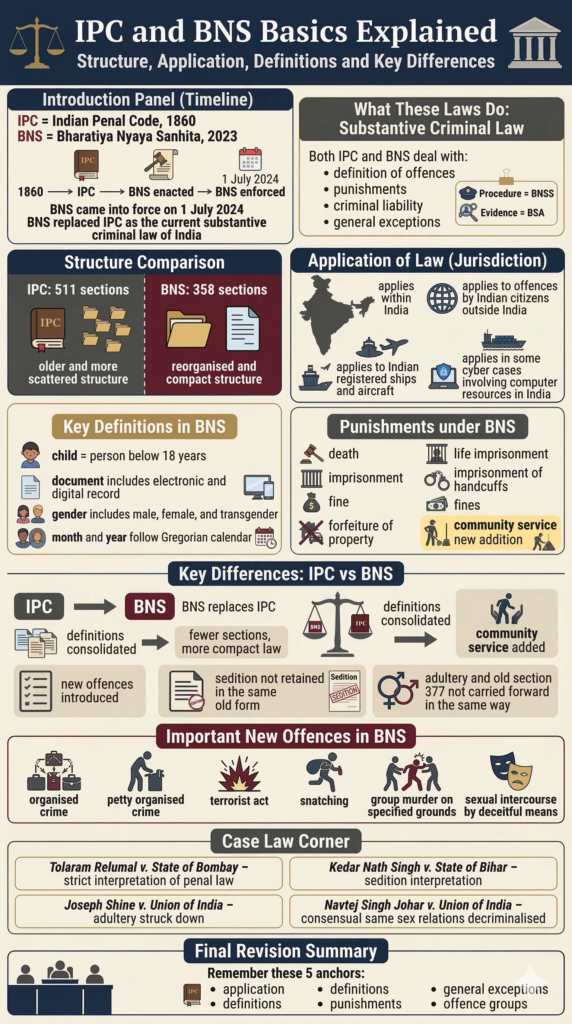
For a long time, the Indian Penal Code, 1860 (IPC) served as India’s principal substantive criminal law. It defined offences, fixed punishments, and supplied the general principles that courts use to decide criminal liability. That position has now changed. The Bharatiya Nyaya Sanhita, 2023 (BNS) came into force on 1 July 2024, and section 358 repealed the IPC, while also saving past actions, liabilities, and proceedings under the old law. One important exception is that the enforcement note to the official text records that section 106(2) BNS did not commence on 1 July 2024 along with the rest of the Act.
So, in simple words, IPC is the old penal code and BNS is the new penal code now in force in India. However, the IPC still matters for understanding older case law, older prosecutions, and the historical development of criminal law principles in India.
What IPC and BNS actually do
Both IPC and BNS are substantive criminal laws. They tell us:
- what conduct amounts to an offence
- what mental element may be required
- what exceptions excuse criminal liability
- what punishment can be imposed
They do not mainly deal with procedure of investigation and trial. Procedure now lies in the Bharatiya Nagarik Suraksha Sanhita, 2023 (BNSS), just as earlier procedure lay in the CrPC. Evidence is now governed by the Bharatiya Sakshya Adhiniyam, 2023 (BSA), earlier the Indian Evidence Act.
Basic purpose of the IPC
The IPC was enacted in 1860 as a general penal code for India. It organised criminal law into chapters dealing with offences against the State, the human body, property, public order, religion, reputation, and several other areas. Over time, Parliament amended it repeatedly, and courts interpreted it through a large body of precedent.
Basic purpose of the BNS
The BNS, enacted in 2023 and enforced from 1 July 2024, states that it is a law to consolidate and amend the provisions relating to offences and matters connected with them. In broad terms, it keeps much of the old IPC structure, but it also reorganises it, adds new offences, removes some outdated provisions, and changes some punishments and definitions.
Structure of IPC and BNS
IPC structure
The IPC contains 511 sections and is traditionally treated as having 23 chapters, though later insertions created additional chapter groupings through amendments. Its early chapters deal with introduction, general explanations, punishments, general exceptions, abetment, conspiracy, and then move into specific offences.
BNS structure
The BNS contains 358 sections in 20 chapters. It reorganises the old arrangement and brings scattered material together in a more compact form. Official and police training material comparing the two laws notes that the reduction in section numbers happened because several provisions were consolidated and definitions and punishments were placed more compactly.
Why the structural change matters
This structural change matters for students and practitioners because section numbers have changed across the board. A person who knows IPC section numbers cannot assume that the same number in BNS means the same thing. The safer method is to understand the topic and concept first, and only then map the corresponding section.
Application of IPC and BNS
Territorial application
Under the BNS, every person is liable for acts or omissions contrary to the Sanhita if committed within India. It also applies to certain offences committed beyond India, including offences by Indian citizens outside India, offences on Indian registered ships and aircraft, and offences committed outside India that target a computer resource located in India. These rules appear in section 1(3) to 1(5).
The IPC also had territorial and extra territorial reach through sections 2 to 4, but the BNS states these ideas in a more consolidated opening provision.
Saving of special laws
The BNS expressly says that it does not affect laws dealing with mutiny and desertion in the armed forces or the provisions of any special or local law. This continues an old legislative pattern that already existed in the IPC. Therefore, the BNS is the general penal law, but it coexists with special statutes such as the UAPA, NDPS Act, POCSO Act, Prevention of Corruption Act, and others.
Definitions and General Explanations
IPC method
In the IPC, definitions were spread across Chapter II, sections 6 to 52A. So, the student had to move through many separate sections to understand terms like gender, injury, good faith, judge, local law, special law, and so on.
BNS method
The BNS tries to simplify this by putting core definitions into section 2, followed by section 3 on general explanations. This is one of the most practical drafting changes in the new law.
Important BNS definitions to remember
Under section 2 BNS:
- “child” means a person below 18 years
- “document” includes electronic and digital record
- “gender” includes male, female, and transgender
- “month” and “year” are to be reckoned according to the Gregorian calendar
These are small looking changes, but they matter. They show a move toward clearer drafting and recognition of modern documentary forms and identity categories.
A useful comparison
The IPC said that “year” and “month” are to be understood according to the British calendar. The BNS replaces that with the Gregorian calendar. This is a symbolic but meaningful move away from colonial legislative language.
General exceptions
The BNS continues the familiar idea of general exceptions such as infancy, unsoundness of mind, intoxication in limited circumstances, mistake of fact, judicial acts, accident, necessity, consent, benefit, and private defence. Although some summaries outside the statute describe a shift to the phrase “mental illness,” the official BNS text available on India Code still carries section 22: act of a person of unsound mind. So the correct position should be taken from the enacted text itself.
Punishments under IPC and BNS
The IPC recognised punishments such as death, imprisonment for life, imprisonment, forfeiture of property, and fine. The BNS retains these and adds community service as a punishment under section 4. That is one of the clearest conceptual changes in the new penal law.
This addition shows that the BNS is not only punitive in a traditional sense. In minor cases, it also allows a more restorative and socially useful response.
Key differences between IPC and BNS
1. BNS replaces IPC and repeals it expressly
This is the most basic difference. The IPC is no longer the operative penal code for new cases after the commencement of BNS. Section 358 BNS expressly repeals the IPC, though old liabilities and proceedings are protected by the savings clause.
2. Fewer sections, tighter arrangement
IPC had 511 sections. BNS has 358 sections. This does not mean criminal law became small. It means the law has been rearranged and consolidated.
3. Definitions are more compact in BNS
IPC scattered definitions through many sections. BNS places a large set of foundational definitions inside section 2, which makes reading easier for a beginner.
4. Community service is a new punishment
BNS section 4(f) adds community service. IPC had no comparable general punishment clause of this kind.
5. New offences added in BNS
BNS introduces or expressly recognises several offences that the IPC either did not contain in this form or did not separately structure, including:
- organised crime under section 111
- petty organised crime under section 112
- terrorist act under section 113
- snatching under section 304
- group murder on specified grounds in section 103(2), often discussed as a mob lynching provision
- sexual intercourse by deceitful means under section 69
- abetment outside India for offence in India under section 48
6. Sedition under IPC is not reproduced in the same form
IPC section 124A punished sedition. BNS does not reproduce that section as such. Instead, section 152 BNS penalises acts endangering the sovereignty, unity and integrity of India, including secessionist and subversive activity. So the legal vocabulary has changed, though debates continue about how different the practical reach really is.
7. Some offences omitted because the constitutional position changed
The IPC contained section 497 (adultery) and section 377 (unnatural offences). The BNS does not carry these forward as penal offences in the old form. This aligns with major constitutional developments in the Supreme Court.
Important new BNS provisions in simple language
Organised crime
Section 111 BNS creates a detailed offence of organised crime. It covers continuing unlawful activity by crime syndicates and expressly includes conduct such as kidnapping, robbery, vehicle theft, extortion, contract killing, land grabbing, human trafficking, cybercrime, and economic offences. Where death results, punishment can extend to death or life imprisonment, with heavy minimum fines.
Petty organised crime
Section 112 BNS addresses gang based recurring lower level criminality such as theft, snatching, cheating, ticket black marketing, betting or gambling, and selling public examination question papers. This is significant because the law now separately recognises repeated gang based petty crime as a structural problem.
Terrorist act
Section 113 BNS defines terrorist act and also clarifies that an officer not below the rank of Superintendent of Police decides whether the case should be registered under BNS or under the UAPA. This shows that BNS overlaps with special anti terror law, but does not displace it.
Snatching
The IPC did not have a separate standalone offence of snatching. BNS section 304 now defines it as a form of theft where the offender suddenly, quickly, or forcibly seizes movable property from a person or from that person’s possession.
Foundational case law that still helps in understanding IPC and BNS
Tolaram Relumal v. State of Bombay, AIR 1954 SC 496
This is a classic rule of interpretation in penal law. The Supreme Court held that when a penal provision is genuinely ambiguous, courts should not stretch it harshly against the accused. This principle still matters under BNS because penal statutes continue to require strict construction.
Kedar Nath Singh v. State of Bihar, AIR 1962 SC 955
This Constitution Bench upheld IPC section 124A but limited its application to acts involving intention or tendency to create disorder or incitement to violence. The case remains important historically because any comparison between old sedition law and new BNS section 152 must begin here.
Joseph Shine v. Union of India, (2019) 3 SCC 39
The Supreme Court struck down section 497 IPC on constitutional grounds. This is one reason adultery no longer appears in the new penal code as a crime in the old form. The case shows how constitutional morality can reshape substantive criminal law.
Navtej Singh Johar v. Union of India, (2018) 10 SCC 1
The Supreme Court read down section 377 IPC to the extent it criminalised consensual sexual relations between adults. The BNS does not reproduce section 377 in that old form. This case therefore marks a major constitutional transition from colonial criminal morality to dignity, privacy, and equality.
Quick comparison table
| Point | IPC | BNS |
|---|---|---|
| Status | Old penal code | Current penal code in force |
| Year | 1860 | 2023 |
| In force | Historical relevance, saved for old matters | Enforced from 1 July 2024 |
| Sections | 511 | 358 |
| Chapters | About 23, with later insertions | 20 |
| Core definitions | Scattered in Chapter II | Consolidated mainly in section 2 |
| New punishment | No community service | Community service added |
| Sedition | Section 124A | Not retained in same form; section 152 used instead |
| New offences | No separate organised crime, terrorist act, snatching in this format | Separate provisions added |
| Adultery / old 377 form | Present in IPC text | Not carried forward in same form |
Conclusion
IPC gave India the classical framework of criminal law. BNS keeps much of that framework but updates the language, compresses the structure, introduces new offences, adds community service, removes some provisions that became constitutionally untenable, and shifts the penal code toward present day concerns such as organised crime, terrorism, digital evidence linked concepts, and modern forms of street crime.