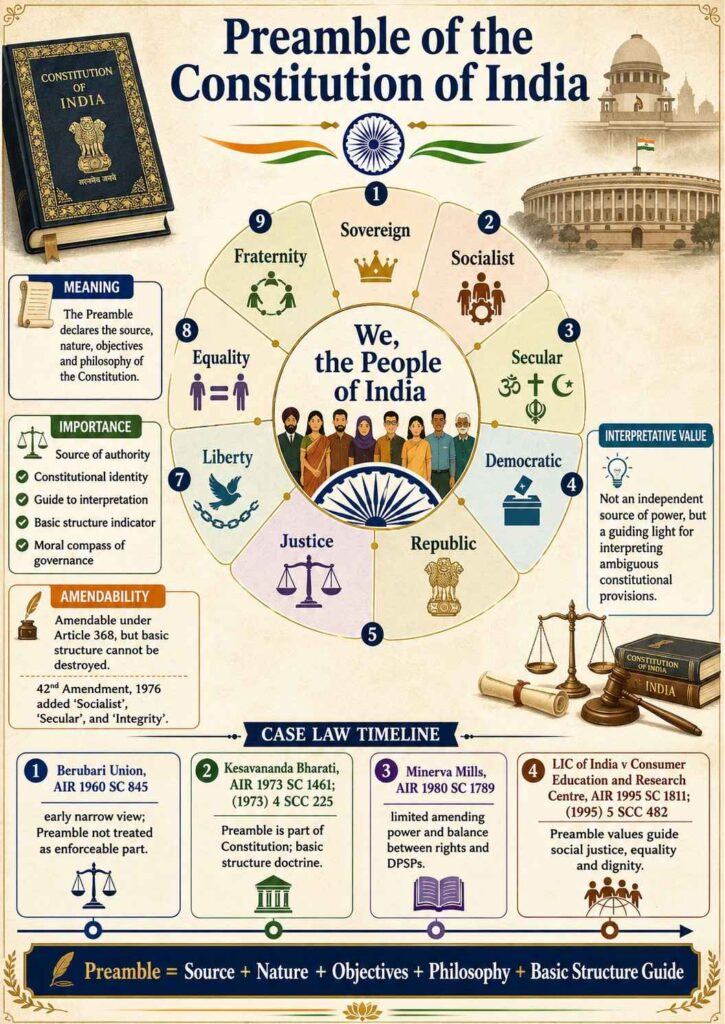
Introduction to the Preamble of the Constitution
➤ Meaning of Preamble: The Preamble is the introductory statement of the Constitution of India. It declares the source of the Constitution, the nature of the Indian State, the objectives of the Constitution, and the date of its adoption. It is like the “identity card” of the Constitution because it tells us what kind of political and legal system India wants to establish.
➤ Opening Words: The Preamble begins with the words “We, the People of India”. These words show that the Constitution derives its authority from the people of India, not from the British Crown, Parliament, King, President, or any external power. The people are the ultimate source of constitutional authority.
➤ Adoption Date: The Preamble states that the people of India adopted, enacted and gave to themselves the Constitution on 26 November 1949. The Constitution came into force on 26 January 1950, but the Preamble itself records the date of adoption as 26 November 1949.
➤ Philosophical Foundation: The Preamble expresses the constitutional philosophy of India. It reflects the basic values of the freedom struggle, such as justice, liberty, equality, fraternity, democracy, dignity of the individual and unity of the nation.
➤ Constitutional Summary: The Preamble is not a detailed legal code. It does not contain administrative rules or procedural provisions. Instead, it gives the broad ideals and guiding principles which help in understanding the spirit of the Constitution.
Textual Essence of the Preamble
➤ Core Declaration: The Preamble declares India to be a Sovereign Socialist Secular Democratic Republic and promises to secure to all citizens Justice, Liberty, Equality and Fraternity.
➤ Objectives: The major objectives of the Preamble are social, economic and political justice; liberty of thought, expression, belief, faith and worship; equality of status and opportunity; and fraternity assuring the dignity of the individual and the unity and integrity of the nation.
➤ Constitutional Vision: The Preamble shows that the Constitution is not merely a legal document but a social document aimed at transforming Indian society into a more just, equal and democratic society.
Importance of the Preamble
➤ Source of Authority: The Preamble makes it clear that the Constitution has been created by the people of India. This is important because it establishes popular sovereignty. The ultimate legal and political authority belongs to the people.
➤ Nature of Indian State: The Preamble tells us that India is sovereign, socialist, secular, democratic and republican. These words describe the constitutional character of the Indian State.
➤ Statement of Objectives: The Preamble states the goals which the Constitution seeks to achieve. These goals guide the legislature, executive and judiciary while performing their constitutional functions.
➤ Aid to Interpretation: When any constitutional provision is ambiguous or capable of more than one meaning, the Preamble helps courts understand the purpose behind the provision. It acts as a guiding light for constitutional interpretation.
➤ Basic Structure Indicator: After the decision in Kesavananda Bharati v. State of Kerala, the Preamble is treated as an important source for identifying the basic structure of the Constitution. The Supreme Court held that Parliament may amend the Constitution, but it cannot destroy or damage its basic structure. The official Supreme Court material describes the decision as placing limits on Parliament’s power to amend the Constitution through the basic structure doctrine.
➤ Moral Compass: The Preamble gives moral direction to constitutional governance. It reminds every organ of the State that power must be used to secure justice, liberty, equality and fraternity.
Keywords of the Preamble
Sovereign
➤ Meaning of Sovereign: The word Sovereign means that India is fully independent in its internal and external affairs. No outside authority can control India’s law-making power, foreign policy, constitutional system or governmental structure.
➤ Internal Sovereignty: Internally, India has the power to make laws for its territory through its constitutional organs. The Parliament and State Legislatures function according to the Constitution, and their authority flows from the Constitution.
➤ External Sovereignty: Externally, India is free to conduct relations with other countries, enter into treaties, participate in international organisations and decide its foreign policy.
➤ Constitutional Limitation: Sovereignty does not mean arbitrary power. In India, all organs of the State are subject to constitutional limitations, fundamental rights, judicial review and the rule of law.
Socialist
➤ Meaning of Socialist: The word Socialist was inserted into the Preamble by the 42nd Constitutional Amendment Act, 1976. In the Indian context, socialism does not mean complete State ownership of all property. It means commitment to social and economic justice, reduction of inequality, fair distribution of resources and protection of weaker sections.
➤ Indian Socialism: Indian socialism is democratic and constitutional. It permits private property and private enterprise, but the State has a duty to reduce poverty, exploitation and concentration of wealth.
➤ Connection with Directive Principles: The idea of socialism is closely connected with the Directive Principles of State Policy, especially provisions relating to equal distribution of material resources, prevention of concentration of wealth, living wages, education, public health and social welfare.
➤ Judicial Understanding: In several decisions, the Supreme Court has connected the idea of socialism with welfare State obligations. It has used constitutional values to expand the meaning of life, dignity and social justice.
Secular
➤ Meaning of Secular: The word Secular was also inserted by the 42nd Constitutional Amendment Act, 1976. Secularism means that the State has no official religion and treats all religions with equal respect.
➤ Indian Secularism: Indian secularism is not anti-religion. It allows freedom of religion but prevents the State from favouring or discriminating against any religion.
➤ Constitutional Basis: Articles 25 to 28 protect freedom of conscience, free profession, practice and propagation of religion, subject to public order, morality, health and other constitutional limitations.
➤ Equality Principle: Secularism is connected with equality because the State must treat persons of all religions equally. It also protects minorities and prevents religious domination in public law.
Democratic
➤ Meaning of Democratic: Democracy means government by the people, through elected representatives, under constitutional limitations.
➤ Political Democracy: India follows representative democracy. Citizens elect members of Parliament and State Legislatures through periodic elections.
➤ Constitutional Democracy: Indian democracy is not merely majority rule. It is controlled by constitutional morality, fundamental rights, judicial review, federalism and rule of law.
➤ Substantive Democracy: The Preamble connects democracy with justice, liberty and equality. Therefore, democracy in India is not only about elections; it also includes dignity, participation, fairness and protection of minorities.
Republic
➤ Meaning of Republic: A republic is a State where the head of the State is elected, directly or indirectly, and the office is not hereditary.
➤ Indian Republic: In India, the President is the constitutional head of the State and is elected indirectly. This shows that political power is not inherited by birth.
➤ Public Office: The republican principle also means that public offices are open to citizens according to constitutional requirements, not according to hereditary privilege.
Justice
➤ Meaning of Justice: The Preamble promises social, economic and political justice. This shows that the Constitution aims to create a just society in all major areas of life.
➤ Social Justice: Social justice means removal of social inequalities based on caste, gender, religion, birth, disability or social backwardness. It supports protective discrimination, reservation, abolition of untouchability and equality before law.
➤ Economic Justice: Economic justice means reducing economic inequality and ensuring fair opportunity for livelihood, work, health, education and basic human needs.
➤ Political Justice: Political justice means equal political rights, universal adult franchise, equal participation in democratic processes and non-discrimination in political representation.
Liberty
➤ Meaning of Liberty: Liberty means freedom of thought, expression, belief, faith and worship. It protects the individual’s inner freedom and external freedom.
➤ Constitutional Protection: Liberty is mainly protected through fundamental rights, especially Articles 19, 21, 25 and related provisions.
➤ Balanced Liberty: Liberty is not absolute. It is subject to reasonable restrictions in the interests of public order, morality, security of the State, decency and other constitutional grounds.
➤ Connection with Dignity: Liberty allows a person to think, speak, believe and live with dignity. Without liberty, democracy becomes merely formal.
Equality
➤ Meaning of Equality: Equality means equality of status and opportunity. It does not mean that everyone is identical; it means that the State must not unfairly discriminate and must create fair conditions for all.
➤ Formal Equality: Formal equality means equal treatment before law. Article 14 guarantees equality before law and equal protection of laws.
➤ Substantive Equality: Substantive equality allows special measures for disadvantaged groups. Articles 15 and 16 permit protective measures in favour of socially and educationally backward classes, Scheduled Castes, Scheduled Tribes and other disadvantaged groups.
➤ Equality of Opportunity: Equality of opportunity means that every person should get a fair chance to develop their abilities and participate in public life.
Fraternity
➤ Meaning of Fraternity: Fraternity means a feeling of brotherhood, mutual respect and common belonging among the people of India.
➤ Dignity of Individual: The Preamble connects fraternity with dignity. This means that every person must be treated as a human being with worth and respect.
➤ Unity and Integrity: Fraternity also assures the unity and integrity of the nation. The word integrity was inserted by the 42nd Constitutional Amendment Act, 1976.
➤ Social Harmony: Fraternity is essential in a diverse country like India because India has many religions, languages, castes, cultures and regions. Without fraternity, liberty and equality cannot survive in practice.
Is the Preamble a Part of the Constitution?
➤ Early View in Berubari: In In re Berubari Union, AIR 1960 SC 845, the Supreme Court gave an advisory opinion under Article 143 regarding the implementation of the Indo-Pakistan Agreement relating to Berubari Union and exchange of enclaves. The issue was whether Indian territory could be transferred to Pakistan under Article 3 or whether a constitutional amendment was necessary. The Court held that the agreement involved cession of Indian territory and required constitutional amendment. In this case, the Court observed that the Preamble was not a source of substantive power and was not treated as an enforceable part of the Constitution. The Indian Kanoon text records that the Court considered the agreement as involving cession or alienation of a part of India’s territory.
➤ Corrected View in Kesavananda Bharati: In Kesavananda Bharati v. State of Kerala, AIR 1973 SC 1461; (1973) 4 SCC 225, the Supreme Court changed the earlier understanding and held that the Preamble is a part of the Constitution. The case was decided by a 13-judge Bench on 24 April 1973, and the citation is recorded as AIR 1973 SC 1461 and (1973) 4 SCC 225.
➤ Present Legal Position: The Preamble is a part of the Constitution, but it is not a source of independent power. It cannot override express provisions of the Constitution. However, it can be used to interpret ambiguous provisions and to understand the basic philosophy of the Constitution.
Amendability of the Preamble
➤ Main Question: The question of amendability asks whether Parliament can amend the Preamble under Article 368 of the Constitution.
➤ Article 368 Power: Article 368 gives Parliament power to amend the Constitution. Since Kesavananda Bharati held that the Preamble is a part of the Constitution, the Preamble can also be amended.
➤ Basic Structure Limitation: The power to amend the Preamble is not unlimited. Parliament cannot amend the Preamble in a manner that destroys or damages the basic structure of the Constitution. The official Supreme Court page on the basic structure judgment explains that the decision upheld the doctrine and placed limits on Parliament’s amending power.
➤ 42nd Amendment: The Preamble was amended only once by the 42nd Constitutional Amendment Act, 1976. Three major changes were made: Socialist and Secular were added between “Sovereign” and “Democratic”; and Unity of the Nation was changed to Unity and Integrity of the Nation.
➤ Validity of Amendment: The amendment to the Preamble has been accepted as valid because it did not destroy the Constitution’s basic structure. Instead, it clarified and strengthened values already present in the Constitution.
➤ Non-Destructive Amendment: Parliament may add words or clarify constitutional ideals, but it cannot remove essential features such as democracy, republic, secularism, sovereignty, justice, liberty, equality, fraternity, dignity, unity, integrity and basic structure.
Interpretative Value of the Preamble
➤ Guiding Light: The Preamble helps courts understand the purpose and spirit of the Constitution. It is especially useful when a provision is unclear or capable of two interpretations.
➤ No Independent Power: The Preamble does not give power to Parliament, executive or judiciary by itself. Powers must come from specific constitutional provisions.
➤ No Override of Clear Text: If the language of a constitutional provision is clear, the Preamble cannot be used to contradict it. The Preamble assists interpretation; it does not rewrite the Constitution.
➤ Constitutional Morality: The Preamble helps in giving meaning to constitutional morality. It reminds courts and government that legal provisions must be interpreted in harmony with justice, liberty, equality and dignity.
➤ Expansion of Rights: The Preamble has helped courts adopt a broad and humane interpretation of fundamental rights, especially Article 21. Concepts like dignity, social justice and equality have influenced the development of constitutional rights.
Landmark Supreme Court Cases on the Preamble
In re Berubari Union
➤ Case Citation: In re Berubari Union, AIR 1960 SC 845.
➤ Brief Facts: After the partition of India, a boundary dispute arose regarding Berubari Union. The Nehru-Noon Agreement between India and Pakistan proposed division of Berubari and exchange of enclaves. The President of India referred questions to the Supreme Court under Article 143.
➤ Legal Issue: The main issue was whether the transfer of Indian territory to Pakistan could be done under Article 3 of the Constitution or whether a constitutional amendment under Article 368 was necessary.
➤ Ratio Decidendi: The Supreme Court held that the agreement involved cession of Indian territory and therefore required a constitutional amendment. It also took the view that the Preamble was not a source of power. The source material records that the Court treated the agreement as involving cession or alienation of part of India’s territory.
➤ Importance for Preamble: Berubari is important because it gave the early view that the Preamble was not a part of the Constitution in the enforceable sense. This view was later corrected in Kesavananda Bharati.
Kesavananda Bharati v. State of Kerala
➤ Case Citation: Kesavananda Bharati v. State of Kerala, AIR 1973 SC 1461; (1973) 4 SCC 225.
➤ Brief Facts: Sri Kesavananda Bharati, head of a religious mutt in Kerala, challenged land reform laws affecting the property of the mutt. The case also involved the validity of several constitutional amendments, including the 24th, 25th and 29th Amendments. The case was heard by the largest Constitution Bench of 13 judges and decided on 24 April 1973.
➤ Legal Issue: The main issue was whether Parliament’s power to amend the Constitution under Article 368 was unlimited, and whether Parliament could alter or destroy fundamental features of the Constitution.
➤ Ratio Decidendi: The Supreme Court held by majority that Parliament has wide power to amend the Constitution, including fundamental rights, but it cannot damage or destroy the basic structure of the Constitution. The official Supreme Court material explains that the judgment upheld the basic structure doctrine and placed limits on Parliament’s amending power.
➤ Importance for Preamble: The Court held that the Preamble is a part of the Constitution. It also treated the Preamble as an important guide for identifying the basic structure. Ideas such as sovereignty, democracy, republic, justice, liberty, equality and fraternity became crucial in understanding the Constitution’s identity.
➤ Exam-Relevant Principle: Parliament may amend the Constitution, but it cannot destroy the Constitution’s identity. The Preamble reflects that identity.
LIC of India v. Consumer Education and Research Centre
➤ Case Citation: LIC of India v. Consumer Education and Research Centre, AIR 1995 SC 1811; (1995) 5 SCC 482.
➤ Brief Facts: The case concerned the validity of restrictive conditions in an insurance policy of the Life Insurance Corporation of India. The policy was alleged to be discriminatory because it limited access to certain categories of persons. A summary of the case records the citation as 1995 AIR 1811 and (1995) 5 SCC 482.
➤ Legal Issue: The main issue was whether a public corporation like LIC could impose discriminatory conditions inconsistent with constitutional values of equality, fairness and social justice.
➤ Ratio Decidendi: The Supreme Court held that constitutional values apply to public bodies and that social justice, equality and dignity are central to constitutional governance. The Court interpreted State action in light of the Preamble and fundamental rights.
➤ Importance for Preamble: This case is important because it shows that the Preamble is not merely decorative. Its ideals of justice, equality and dignity influence interpretation of State action, welfare measures and rights of individuals.
Minerva Mills v. Union of India
➤ Case Citation: Minerva Mills Ltd. v. Union of India, AIR 1980 SC 1789; (1981) 1 SCR 206.
➤ Brief Facts: The case challenged provisions of the 42nd Constitutional Amendment, especially amendments that attempted to expand Parliament’s amending power and give primacy to certain Directive Principles over Fundamental Rights. The reported citation is AIR 1980 SC 1789 and 1981 SCR (1) 206.
➤ Legal Issue: The main issue was whether Parliament could enlarge its amending power so much that no constitutional amendment could be questioned in court.
➤ Ratio Decidendi: The Supreme Court held that limited amending power is itself a basic feature of the Constitution. Parliament cannot convert limited power into unlimited power.
➤ Importance for Preamble: Minerva Mills strengthened the idea that the Constitution is based on harmony and balance. The Preamble’s promise of justice, liberty and equality requires balance between Fundamental Rights and Directive Principles.
Important Legal Principles Related to the Preamble
➤ Preamble as Part of Constitution: The present position is that the Preamble is a part of the Constitution after Kesavananda Bharati.
➤ Preamble as Interpretative Tool: The Preamble may be used to interpret ambiguous constitutional provisions.
➤ Preamble Not Source of Power: It does not independently grant legislative, executive or judicial power.
➤ Preamble Cannot Override Text: It cannot override clear constitutional provisions.
➤ Preamble and Basic Structure: The Preamble is an important guide to identify the basic structure of the Constitution.
➤ Preamble is Amendable: It can be amended under Article 368, but the amendment must not destroy the basic structure.
➤ Preamble and Rights: The values of justice, liberty, equality and dignity help courts interpret fundamental rights broadly.
Memory Table on the Preamble
| Concept | Simple Meaning | Constitutional Importance |
|---|---|---|
| We, the People | People are the source of authority | Establishes popular sovereignty |
| Sovereign | India is fully independent | No external control over constitutional authority |
| Socialist | Social and economic justice | Supports welfare State and reduction of inequality |
| Secular | Equal respect for all religions | Prevents State religion and religious discrimination |
| Democratic | Government by elected representatives | Ensures political participation |
| Republic | Elected head of State | Rejects hereditary rule |
| Justice | Fairness in social, economic and political life | Guides welfare and equality-based interpretation |
| Liberty | Freedom of thought, belief and expression | Protects individual freedom |
| Equality | Equal status and opportunity | Supports Articles 14, 15 and 16 |
| Fraternity | Brotherhood and mutual respect | Protects dignity, unity and integrity |
Difference Between Berubari and Kesavananda Bharati
| Point | Berubari Union | Kesavananda Bharati |
|---|---|---|
| Year | 1960 | 1973 |
| Nature | Advisory opinion under Article 143 | Constitutional challenge before 13-judge Bench |
| View on Preamble | Preamble not treated as part of Constitution in enforceable sense | Preamble held to be part of Constitution |
| Main Issue | Transfer of territory to Pakistan | Scope of Parliament’s amending power |
| Importance | Early narrow view of Preamble | Modern authoritative view of Preamble |
| Doctrine | No basic structure doctrine | Basic structure doctrine established |
Conclusion
➤ Final Understanding: The Preamble is the soul, philosophy and guiding spirit of the Constitution of India. It explains who created the Constitution, what type of State India is, and what objectives the Constitution seeks to achieve.
➤ Legal Position: The Preamble is a part of the Constitution. It is amendable, but it cannot be amended in a way that destroys the basic structure. It is not an independent source of power, but it has great interpretative value.
➤ Constitutional Identity: The words sovereign, socialist, secular, democratic, republic, justice, liberty, equality and fraternity are not ornamental words. They describe the identity of Indian constitutionalism.
➤ Practical Importance: The Preamble helps courts, lawmakers, administrators and citizens understand the Constitution as a living document committed to human dignity, social transformation, equality and democratic governance.
➤ Core Principle: The Preamble teaches that the Constitution of India is not merely a machinery of government; it is a promise to build a just, free, equal and united society.