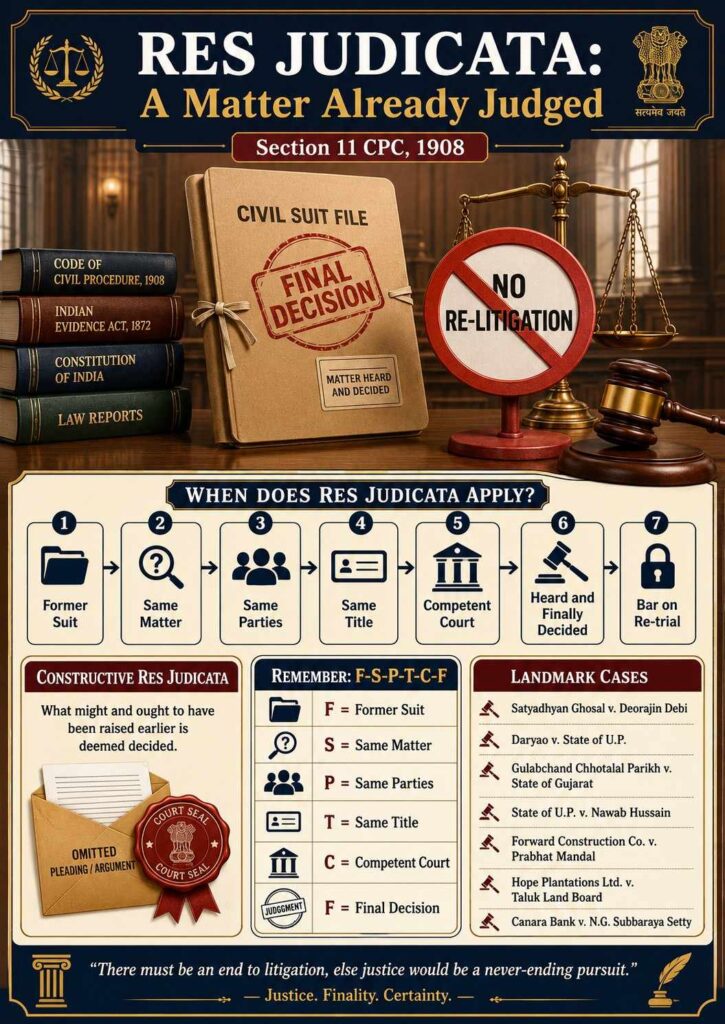
Meaning and Core Idea of Res Judicata
➤ Meaning: The expression “res judicata” means “a matter already judged.” It is a rule that once a competent court has finally decided a matter between parties, the same parties cannot re-open the same matter again in another suit or proceeding.
➤ Simple explanation: If A sues B claiming ownership of a house and the competent court finally decides that B is the owner, A cannot file another suit against B again claiming the same ownership on the same grounds. The law treats the earlier final decision as conclusive between them.
➤ Purpose: The doctrine protects three important interests: finality of litigation, public confidence in courts, and protection of parties from repeated harassment. The Supreme Court in Satyadhyan Ghosal v. Deorajin Debi, AIR 1960 SC 941 explained that res judicata is based on the need to give finality to judicial decisions; once a matter is finally decided between parties, it should not be adjudged again in future litigation.
➤ Legal maxim: The principle is supported by two well-known maxims: nemo debet bis vexari pro una et eadem causa meaning no person should be vexed twice for the same cause, and interest reipublicae ut sit finis litium meaning it is in the interest of the State that litigation must come to an end.
➤ Nature: Res judicata is not merely a technical rule of procedure. It is a rule of public policy, justice, and judicial discipline. In Hope Plantations Ltd. v. Taluk Land Board, (1999) 5 SCC 590, the Supreme Court treated res judicata and estoppel as principles founded on public policy and justice, intended to prevent parties from re-agitating settled matters.
Statutory Provision: Section 11 CPC, 1908
➤ Section 11 CPC: Section 11 of the Code of Civil Procedure, 1908 provides that no court shall try any suit or issue in which the matter directly and substantially in issue has been directly and substantially in issue in a former suit between the same parties, or between parties under whom they or any of them claim, litigating under the same title, where such matter has been heard and finally decided by a court competent to try the former suit or the subsequent suit.
➤ Key idea of Section 11: The bar is not against filing every later suit. The bar applies only when the later suit or issue seeks to re-open a matter which was directly and substantially in issue and was heard and finally decided earlier by a competent court.
➤ Important distinction: Section 11 uses the phrase “suit or issue.” Therefore, res judicata may bar the whole subsequent suit, or it may bar only a particular issue inside the later suit. For example, a later suit for different relief may still proceed, but an earlier decided issue of title may not be re-opened.
Essential Conditions of Res Judicata under Section 11 CPC
➤ Condition 1 — Former suit: There must be a former suit. The expression does not necessarily mean a suit filed earlier in time; it means a suit which has been decided before the later suit is taken up for decision.
➤ Condition 2 — Matter directly and substantially in issue: The matter in the later suit must have been directly and substantially in issue in the former suit. A matter is directly and substantially in issue when the court was required to decide it as a necessary and important question for granting or refusing relief.
➤ Condition 3 — Same parties or parties claiming under them: The former and later proceedings must be between the same parties, or between persons claiming through them, such as legal representatives, transferees, successors, heirs, assignees, or persons litigating under the same legal interest.
➤ Condition 4 — Same title: The parties must have litigated under the same title. This means the legal character in which the party litigates must be the same. For example, a person suing as an individual is not necessarily the same as the same person suing as trustee, guardian, manager, or legal representative.
➤ Condition 5 — Competent court: The earlier decision must have been given by a court of competent jurisdiction. Competence means the court must have had jurisdiction over the subject matter, parties, and relief in the manner required by law.
➤ Condition 6 — Heard and finally decided: The matter must have been heard and finally decided. A decision is final when it conclusively determines the issue between parties. A dismissal on merits may operate as res judicata, but a dismissal for default, want of jurisdiction, technical defect, or non-joinder may not ordinarily decide the matter on merits.
➤ Condition 7 — Finality despite appeal rules: In Canara Bank v. N.G. Subbaraya Setty, (2018) 16 SCC 228, the Supreme Court explained the doctrine in detail and emphasized that res judicata belongs to procedural law, though it is based on high public policy. The Court also discussed that when an appeal is filed within limitation, the matter may remain sub judice rather than becoming finally res judicata.
“Directly and Substantially in Issue” vs “Collaterally or Incidentally in Issue”
➤ Direct issue: A matter is directly and substantially in issue when the court must decide it to grant the main relief. Example: In a title suit, the question “Who owns the land?” is directly and substantially in issue.
➤ Incidental issue: A matter is collaterally or incidentally in issue when it is only a background or supporting matter, not the main dispute. Such incidental findings do not always operate as res judicata.
➤ Practical illustration: If in a rent suit, the court incidentally observes something about ownership only to decide rent liability, that observation may not necessarily bar a later full title suit, unless ownership was itself directly and substantially in issue and was finally decided.
➤ Reason: Res judicata applies only to real, necessary, and material determinations, not to casual remarks, unnecessary observations, or findings not essential to the decree.
Constructive Res Judicata under Explanation IV to Section 11 CPC
➤ Meaning: Constructive res judicata means that a party cannot raise in a later proceeding a ground, claim, defence, or attack which the party might and ought to have raised in the earlier proceeding. Explanation IV to Section 11 CPC expressly states that any matter which might and ought to have been made a ground of defence or attack in the former suit shall be deemed to have been directly and substantially in issue.
➤ Simple explanation: A party cannot keep one argument hidden, lose the first case, and then file a second case using that hidden argument. Law expects parties to bring their whole case at the proper time.
➤ Example: A tenant is sued for eviction. He could have pleaded that the notice was invalid and that rent was already paid, but he raises only the rent-payment plea and loses. Later, he cannot file a fresh proceeding on the invalid-notice ground if that ground might and ought to have been raised earlier.
➤ Purpose: Constructive res judicata prevents piecemeal litigation, splitting of claims, strategic silence, and abuse of process.
➤ State of U.P. v. Nawab Hussain, AIR 1977 SC 1680: In this case, a dismissed police sub-inspector first challenged his dismissal on certain grounds but did not raise the ground that he was dismissed by an authority subordinate to the appointing authority. After failure in the earlier proceeding, he raised that ground in a later suit. The Supreme Court held that the later plea was barred by constructive res judicata because it could and ought to have been raised earlier.
➤ Forward Construction Co. v. Prabhat Mandal, (1986) 1 SCC 100: AIR 1986 SC 391: The Supreme Court applied constructive res judicata in the context of public interest litigation and held that grounds which could have been raised earlier cannot be permitted to be raised later to re-open the same dispute.
Difference between Direct Res Judicata and Constructive Res Judicata
| Basis | Direct Res Judicata | Constructive Res Judicata |
|---|---|---|
| Meaning | Matter was actually raised and decided earlier. | Matter was not raised, but could and ought to have been raised earlier. |
| Legal basis | Main part of Section 11 CPC. | Explanation IV to Section 11 CPC. |
| Focus | Actual adjudication. | Deemed adjudication. |
| Example | Title decided in first suit cannot be re-opened. | A defence not raised in first suit cannot be used later if it should have been raised. |
| Purpose | Finality of decided issues. | Preventing splitting of claims and defences. |
Explanations to Section 11 CPC: Simplified Notes
➤ Explanation I — Former suit: A former suit means a suit decided before the suit in question, whether or not it was instituted before it.
➤ Explanation II — Competence: The competence of the court is determined irrespective of any right of appeal from the decision of that court.
➤ Explanation III — Matter alleged and denied: The matter must have been alleged by one party and either denied or admitted by the other.
➤ Explanation IV — Constructive res judicata: A matter which might and ought to have been made a ground of attack or defence is deemed to have been directly and substantially in issue.
➤ Explanation V — Relief not granted: Any relief claimed in the plaint but not expressly granted by the decree is deemed to have been refused.
➤ Explanation VI — Representative litigation: Where persons litigate bona fide in respect of a public right or a private right claimed in common, all persons interested in such right are deemed to claim under the litigating persons.
➤ Explanation VII — Execution proceedings: Section 11 applies to execution proceedings also. Therefore, issues finally decided in execution cannot be re-opened again in later execution stages.
➤ Explanation VIII — Limited jurisdiction courts: An issue heard and finally decided by a court of limited jurisdiction may operate as res judicata in a subsequent suit, even if such court was not competent to try the later suit as a whole.
Res Judicata and Writ Proceedings
➤ General principle: Though Section 11 CPC directly applies to suits, the general principle of res judicata applies beyond ordinary civil suits, including writ proceedings, because the doctrine is based on public policy.
➤ Daryao v. State of U.P., AIR 1961 SC 1457: The Supreme Court held that when a writ petition under Article 226 is dismissed on merits by a High Court, a later petition under Article 32 before the Supreme Court on the same facts and grounds may be barred by res judicata. The case recognized that finality of judicial decisions is important even in constitutional remedies, though dismissal in limine or dismissal on technical grounds may stand on a different footing.
➤ Gulabchand Chhotalal Parikh v. State of Gujarat, AIR 1965 SC 1153: The Supreme Court held that a decision on merits in a writ petition under Article 226 can operate as res judicata in a subsequent regular civil suit between the same parties on the same matter. This shows that Section 11 is not exhaustive of the whole doctrine, and courts may apply the general principle of res judicata where justice and public policy require it.
➤ Important caution: Res judicata in writs is applied with care. If the earlier writ was dismissed for delay, alternative remedy, technical defect, lack of jurisdiction, or without decision on merits, the bar may not apply in the same way.
Res Judicata between Co-defendants and Co-plaintiffs
➤ Between co-defendants: A finding may operate as res judicata between co-defendants if three conditions are satisfied: there was a conflict of interest between them, it was necessary to decide that conflict to give relief to the plaintiff, and the court actually decided that conflict.
➤ Between co-plaintiffs: Similar logic applies between co-plaintiffs. If their inter se rights were directly in conflict, necessary for decision, and finally decided, the finding may bind them in later proceedings.
➤ Reason: Section 11 is not limited only to plaintiff versus defendant disputes. It may also apply where the real issue was between parties on the same side, provided the conditions of final adjudication are satisfied.
Res Judicata and Execution Proceedings
➤ Execution relevance: Section 11 applies to execution proceedings through Explanation VII. This means that if an executing court finally decides a matter between parties, the same issue cannot be repeatedly raised in later execution applications.
➤ Example: If a judgment-debtor objects that the decree is not executable and that objection is finally rejected, he cannot repeatedly raise the same objection in later execution stages.
➤ Policy: Execution is meant to enforce decrees, not to create endless rounds of objections. Res judicata prevents judgment-debtors from frustrating decrees by repetitive objections.
Res Judicata and Issue Estoppel
➤ Res judicata: It usually bars the trial of a suit or issue already finally decided.
➤ Issue estoppel: It prevents a party from re-opening a specific issue of fact or law already decided between the same parties in earlier proceedings.
➤ Difference: Res judicata is broader and often statutory under Section 11 CPC; issue estoppel is a principle of finality applied to specific issues.
➤ Overlap: Indian courts sometimes use these principles together, especially where strict Section 11 may not apply but the general principle of finality applies.
Res Judicata and Estoppel: Difference
| Basis | Res Judicata | Estoppel |
|---|---|---|
| Source | Decision of a court. | Conduct, representation, or statement of a party. |
| Nature | Rule of procedure and public policy. | Rule of evidence and equity. |
| Effect | Bars re-litigation of decided matter. | Prevents a party from denying what was represented or accepted. |
| Parties | Requires prior adjudication. | May arise without prior adjudication. |
| Main focus | Finality of judicial decision. | Fairness based on representation and reliance. |
➤ Hope Plantations principle: The Supreme Court recognized that res judicata and estoppel are related to public policy and justice, but they are not identical. Res judicata arises from adjudication; estoppel arises mainly from conduct or representation.
Exceptions and Situations Where Res Judicata May Not Apply
➤ No final decision: If the earlier matter was not finally decided, res judicata does not apply.
➤ Lack of jurisdiction: A decision by a court lacking jurisdiction generally cannot create res judicata on the merits.
➤ Fraud: A judgment obtained by fraud does not operate as res judicata because fraud vitiates judicial proceedings.
➤ Pure question of law affecting jurisdiction: If the earlier decision was on a pure question of law relating to jurisdiction or statutory prohibition, courts may be cautious in applying res judicata.
➤ Changed circumstances: If material facts or legal circumstances have substantially changed after the earlier decision, a fresh cause may arise.
➤ Different cause of action: If the later suit is based on a distinct cause of action, res judicata may not apply, although issue estoppel or constructive res judicata may still become relevant.
➤ Dismissal on technical grounds: Dismissal for default, non-prosecution, limitation at threshold, non-joinder, misjoinder, or alternative remedy may not always amount to final decision on merits.
➤ Habeas corpus: The doctrine is applied differently in habeas corpus matters because personal liberty is involved and recurring detention legality may be examined afresh depending on circumstances.
Landmark Supreme Court Cases on Res Judicata
➤ Satyadhyan Ghosal v. Deorajin Debi, AIR 1960 SC 941: The dispute arose in the context of landlord-tenant proceedings and the effect of earlier orders. The issue was whether a party could re-agitate a matter already decided at an earlier stage. The Supreme Court held that res judicata is based on the need to give finality to judicial decisions and applies not only between separate proceedings but also at later stages of the same proceeding. The ratio is that once a matter of fact or law has been decided between parties and has attained finality, courts should proceed on the basis that the earlier decision is correct.
➤ Daryao v. State of U.P., AIR 1961 SC 1457: The petitioners earlier approached the High Court under Article 226 and later approached the Supreme Court under Article 32. The issue was whether a decision in writ proceedings could bar a later constitutional petition. The Supreme Court held that the general principle of res judicata applies to writ petitions when the earlier petition was decided on merits. The ratio is that constitutional remedies are fundamental, but a party cannot repeatedly litigate the same matter after a competent court has finally decided it.
➤ Gulabchand Chhotalal Parikh v. State of Gujarat, AIR 1965 SC 1153: The issue was whether a decision in a writ petition could operate as res judicata in a later civil suit. The Supreme Court held that a final decision on merits in a writ petition under Article 226 may operate as res judicata in a subsequent regular suit involving the same parties and matter. The ratio is that Section 11 CPC is not exhaustive of the general doctrine of res judicata.
➤ State of U.P. v. Nawab Hussain, AIR 1977 SC 1680: The respondent challenged dismissal from service but failed to raise one available ground in the earlier proceeding. He later tried to rely on that ground. The Supreme Court held that the later challenge was barred by constructive res judicata. The ratio is that a party must raise all grounds of attack or defence that might and ought to be raised in the first proceeding.
➤ Forward Construction Co. v. Prabhat Mandal, (1986) 1 SCC 100: AIR 1986 SC 391: The dispute concerned a public interest challenge relating to development and land use. The issue was whether grounds not raised earlier could be raised later in another proceeding. The Supreme Court held that constructive res judicata applies even in public interest litigation in appropriate cases. The ratio is that public interest cannot be used as a device to repeatedly re-open issues which could have been raised earlier.
➤ Hope Plantations Ltd. v. Taluk Land Board, (1999) 5 SCC 590: The dispute arose under land ceiling proceedings. The issue was whether previously settled questions could be reopened. The Supreme Court reaffirmed that res judicata is founded on public policy, justice, and finality. The ratio is that parties cannot be permitted to re-agitate issues already settled by competent adjudication.
➤ Canara Bank v. N.G. Subbaraya Setty, (2018) 16 SCC 228: The dispute involved assignment of trademark-related rights and successive suits. The Supreme Court examined res judicata in detail and clarified that though Section 11 is procedural, the doctrine rests on public policy. The Court also discussed the relationship between finality and appeal. The ratio is that once a competent court finally decides a matter, the same matter cannot be reopened, but where an appeal keeps the matter alive, finality must be assessed carefully.
Practical Illustrations for Easy Understanding
➤ Illustration 1 — Bar applies: A sues B for declaration that A owns land X. The court decides that B owns land X. A cannot later sue B again for declaration of ownership of land X on the same basis.
➤ Illustration 2 — Constructive bar applies: A sues B for possession. B could have pleaded adverse possession but did not. If B loses and later files another suit based on adverse possession existing at that time, the later claim may be barred because B might and ought to have raised it earlier.
➤ Illustration 3 — Bar may not apply: A suit is dismissed because the plaint was not properly valued. Since title was not heard and finally decided, a properly filed later suit may not be barred.
➤ Illustration 4 — Different title: A sues as owner and loses. Later A sues as trustee for a trust property, where the trust has an independent legal claim. The bar will depend on whether the title and legal capacity are truly the same.
Memory Chart: Ingredients of Res Judicata
| Memory Keyword | Requirement |
|---|---|
| Former | There must be an earlier decided suit or proceeding. |
| Same Matter | The matter must be directly and substantially in issue. |
| Same Parties | Parties or their privies must be the same. |
| Same Title | Parties must litigate under the same legal capacity. |
| Competence | Earlier court must be competent. |
| Finality | Matter must be heard and finally decided. |
| No Splitting | Grounds that might and ought to have been raised are also barred. |
Conclusion
➤ Final understanding: Res judicata under Section 11 CPC is a doctrine of finality. It ensures that litigation does not become endless and that parties do not suffer repeated proceedings over the same matter. It balances private justice and public interest by protecting successful parties from harassment and preserving the authority of judicial decisions.
➤ Core rule: A matter once directly and substantially decided by a competent court between the same parties litigating under the same title cannot be tried again.
➤ Broader rule: Even matters not actually raised may be barred if they might and ought to have been raised earlier. This is constructive res judicata.
➤ Essence: Res judicata is not a mere procedural technicality. It is a principle of justice, convenience, finality, and public policy. Section 11 CPC codifies it for civil suits, but Indian courts also apply its general principle to writs, execution proceedings, representative litigation, and other adjudicatory contexts where fairness and finality demand closure.