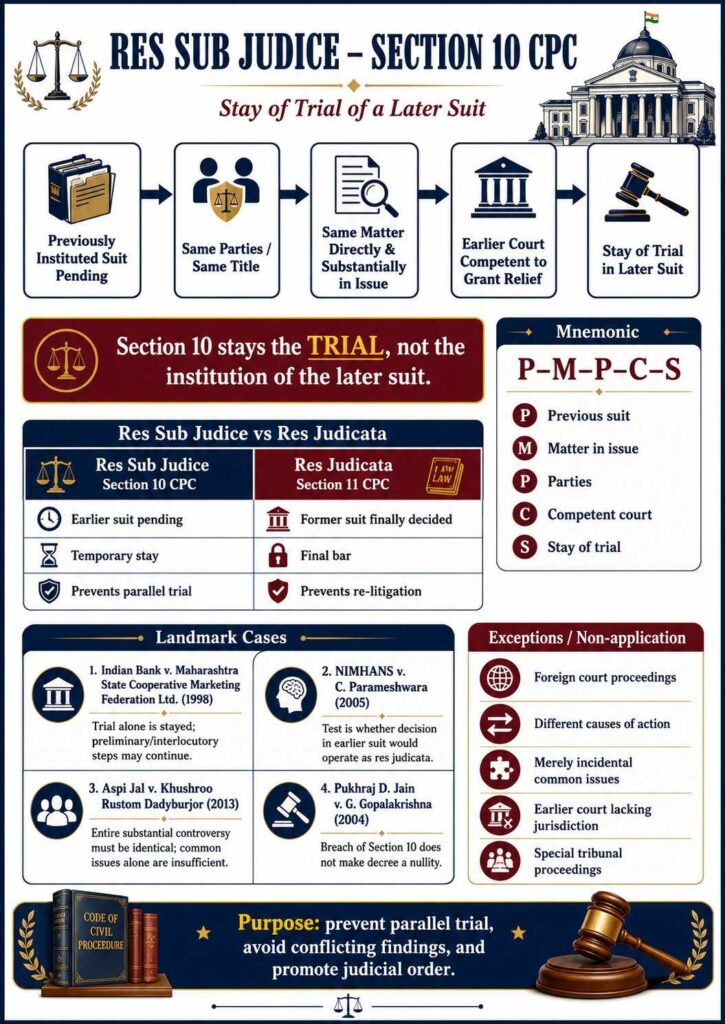
Meaning and Concept of Res Sub Judice
➤ Meaning: Res sub judice literally means “a matter under judicial consideration.” In civil procedure, it refers to a situation where an earlier suit concerning substantially the same dispute is already pending before a competent court, and a later suit concerning that same dispute is filed.
➤ Statutory Basis: The doctrine is embodied in Section 10 of the Code of Civil Procedure, 1908. It is commonly described as the rule of stay of suit. It does not prohibit filing of the later suit; it prohibits the court from proceeding with its trial when the statutory requirements are fulfilled.
➤ Central Idea: The law does not permit two courts of concurrent jurisdiction to simultaneously conduct parallel trials over the same substantial controversy between the same parties. This prevents conflicting findings, inconsistent decrees, duplicated evidence, unnecessary costs, and harassment of parties.
➤ Nature: Section 10 is a procedural provision. It regulates the manner in which a court proceeds with a later suit. It does not take away the court’s jurisdiction to receive, entertain, or register that suit, and it does not create a substantive right in either party.
Statutory Provision: Section 10 CPC
Section 10 CPC provides:
“No Court shall proceed with the trial of any suit in which the matter in issue is also directly and substantially in issue in a previously instituted suit between the same parties, or between parties under whom they or any of them claim litigating under the same title where such suit is pending in the same or any other Court in India having jurisdiction to grant the relief claimed, or in any Court beyond the limits of India established or continued by the Central Government and having like jurisdiction, or before the Supreme Court.”
The Explanation states that the pendency of a suit in a foreign court does not prevent an Indian court from trying a suit founded on the same cause of action.
➤ Mandatory language: The words “No Court shall proceed” make Section 10 mandatory once every statutory condition is satisfied. The court has no discretion to continue the trial of the later suit merely because it considers simultaneous proceedings convenient.
➤ Limited operation: The provision stays only the trial of the later suit. It does not destroy the plaint, dismiss the suit, or render the subsequent suit non-maintainable.
Object of Section 10 CPC
➤ Avoidance of conflicting decisions: If two courts simultaneously decide identical substantial issues, there is a risk of contradictory judgments. Section 10 prevents this procedural inconsistency.
➤ Protection against multiplicity: It prevents a plaintiff from repeatedly litigating the same dispute in separate courts and protects the defendant from repeated defence of substantially identical claims.
➤ Judicial economy: It avoids duplicate recording of evidence, repeated examination of witnesses, and waste of judicial time.
➤ Harmony with res judicata: The underlying test is whether the final decision in the earlier suit would operate as res judicata in the later suit. If it would, the later trial should ordinarily be stayed under Section 10.
Essential Conditions for Application of Section 10 CPC
For Section 10 to apply, all the following conditions must coexist.
Previously Instituted Suit Must Be Pending
➤ Earlier institution: The earlier suit must have been instituted before the later suit. The question is one of chronology: which suit was filed first.
➤ Pendency: The earlier suit must still be pending. Once it is finally decided, Section 10 ordinarily ceases to apply; the question thereafter may be one of res judicata under Section 11 CPC.
➤ Competent civil proceeding: The earlier proceeding must be a suit pending before a court of competent jurisdiction. A proceeding before a tribunal, labour court, administrative authority, or other forum under a special statute is not automatically treated as a “previously instituted suit” for Section 10.
➤ Illustration: A files a title suit against B in Delhi in January. B later files another title suit against A in Jaipur in March involving the same title dispute. The Delhi suit is the previously instituted suit.
Matter in Issue Must Be Directly and Substantially the Same
➤ Core requirement: The matter in issue in the later suit must also be directly and substantially in issue in the earlier suit.
➤ Directly and substantially: An issue is directly and substantially in issue when its determination is necessary for granting or refusing the principal relief claimed. It must form the real controversy, not merely an incidental background fact.
➤ Not collateral or incidental: A common factual circumstance, common property, common contract, or common legal question is insufficient by itself. The issue must be central to both suits.
➤ Whole controversy test: The Supreme Court has emphasised that Section 10 does not apply merely because a few questions are common. The entire substantial matter in controversy must be identical in both suits.
➤ Res judicata test: Ask: Would the final decision in the earlier suit operate as res judicata in the later suit? If the answer is yes, Section 10 is likely attracted. If the answer is no, the later suit should not be stayed.
➤ Same relief not always decisive: Difference in relief alone may not prevent Section 10 if the actual matter in controversy remains identical. Conversely, even where both suits seek a similar relief, Section 10 will not apply if they arise from distinct causes of action or different factual periods.
Same Parties or Parties Claiming Under Them
➤ Identity of parties: The earlier and later suits must be between the same parties.
➤ Representative or derivative parties: Exact personal identity is not always necessary. Section 10 also applies where parties claim under the same predecessors, such as legal representatives, transferees, heirs, assignees, or persons deriving title from a common party.
➤ Same title: The parties must be litigating under the same legal character or title. For example, a person suing as owner in one suit and as trustee in another may not necessarily be litigating under the same title.
➤ Capacity matters: The court examines the legal capacity in which parties litigate. Mere similarity of names or relationship between parties does not satisfy the condition.
Earlier Court Must Have Jurisdiction to Grant Relief
➤ Competence: The court where the earlier suit is pending must have jurisdiction to grant the relief claimed in the later suit.
➤ Jurisdictional requirement: The earlier court must be competent regarding subject matter, territorial jurisdiction, pecuniary jurisdiction, and the nature of relief involved.
➤ No stay where earlier court is incompetent: If the earlier court lacks jurisdiction to grant the relevant relief, Section 10 cannot be invoked merely because an earlier proceeding exists.
➤ Supreme Court clarification: In Mayar (H.K.) Ltd. v. Owners & Parties, Vessel M.V. Fortune Express, (2006) 3 SCC 100, the Supreme Court noted that Section 10 could not be used where there was no previously instituted suit pending before a competent court between the parties involving directly and substantially identical issues.
Earlier Suit Must Be Pending in a Recognised Court
➤ Indian courts: The previous suit may be pending in the same court or another court in India having jurisdiction to grant the relief.
➤ Supreme Court: A suit pending before the Supreme Court satisfies the statutory requirement.
➤ Court outside India established by Central Government: The section also recognises a court beyond India which has been established or continued by the Central Government and has like jurisdiction.
➤ Foreign court exception: An ordinary foreign court does not trigger Section 10. The Explanation expressly permits Indian courts to try a suit even when a suit founded on the same cause of action is pending in a foreign court.
Effect of Stay under Section 10 CPC
➤ Stay of trial, not stay of suit: The later suit remains on the file of the court. The court cannot proceed with its substantive trial until the earlier suit is decided.
➤ Institution remains valid: Filing of the later suit is not barred. This is important because limitation may expire if the plaintiff waits until the earlier suit is concluded.
➤ Interlocutory powers remain available: The court may still entertain applications for temporary injunction, appointment of receiver, attachment before judgment, consolidation of suits, or similar interlocutory reliefs. Section 10 does not paralyse every procedural action in the later suit.
➤ No nullity of decree: A decree passed despite Section 10 is not automatically void or a nullity. Since Section 10 is procedural, its breach may amount to an irregularity, but it does not inherently destroy the court’s jurisdiction.
➤ Application should be raised promptly: A party should place the earlier plaint, pleadings, and relevant orders before the court and demonstrate the identity of issues, parties, title, and jurisdiction. However, merely filing an application under Section 10 does not itself stop the court from dealing with the case.
Scope of “Trial” under Section 10 CPC
➤ Ordinary suits: In an ordinary civil suit, the court must not proceed with the substantive adjudicatory stage once Section 10 is attracted.
➤ Summary suits under Order XXXVII CPC: In Indian Bank v. Maharashtra State Cooperative Marketing Federation Ltd., (1998) 5 SCC 69; AIR 1998 SC 1952, the Supreme Court considered whether Section 10 applies to an Order XXXVII summary suit. The Bank had instituted a summary money suit while an earlier ordinary suit involving the dispute was pending. The Court held that Section 10 is procedural and does not prevent all action in the summary suit. In a summary suit, the “trial” begins only after leave to defend is granted. Therefore, the court may proceed up to the stage of considering leave to defend and may pass judgment where the defendant fails to obtain or comply with leave to defend; Section 10 restrains the trial only after the stage at which trial truly begins.
➤ Pure legal issues: In Pukhraj D. Jain v. G. Gopalakrishna, (2004) 7 SCC 251; AIR 2004 SC 3504, the Supreme Court dealt with a later specific-performance suit in which an application under Section 10 was pending because of an earlier eviction suit. The trial court dismissed the later suit on limitation and maintainability without first deciding the Section 10 application. The Supreme Court upheld that approach, holding that a mere Section 10 application does not create an embargo on examining merits. Where the later suit can be disposed of on a pure legal issue without recording evidence, the court may decide that issue rather than keep an untenable suit pending.
Situations Where Section 10 CPC Does Not Apply
➤ Different causes of action: Section 10 does not apply where the suits arise from separate causes of action, even if the property, parties, or broad relief appear similar.
➤ Different factual periods: A subsequent cause of action arising from fresh facts is not automatically barred by an earlier suit based on an earlier period.
➤ Few common questions: Commonality of one or more issues is insufficient. The entire substantial controversy must be identical.
➤ Different forums under special laws: Section 10 ordinarily does not apply where one proceeding is before a civil court and the other is before a labour court, tribunal, or statutory authority functioning under a distinct legal framework.
➤ Foreign court proceedings: A pending suit before a foreign court does not prevent trial of a suit in India under the Explanation to Section 10.
➤ Earlier suit not pending: Once the earlier suit is finally decided, the question becomes one of res judicata, not res sub judice.
Landmark Supreme Court Decisions on Section 10 CPC
National Institute of Mental Health & Neuro Sciences v. C. Parameshwara
Citation: (2005) 2 SCC 256; AIR 2005 SC 242.
➤ Facts and issue: NIMHANS filed a civil recovery suit against an employee for alleged pecuniary loss due to misappropriation of drugs. Separately, proceedings concerning the employee’s dismissal and reinstatement were pending through labour adjudication and a writ petition. The employee sought stay of the civil recovery suit under Section 10 CPC.
➤ Ratio decidendi: The Supreme Court held that Section 10 did not apply because the civil recovery suit and the labour/writ proceedings operated in distinct fields, arose from different causes of action, and did not involve the same subject matter. The Court laid down the fundamental test: whether the final decision in the earlier proceeding would operate as res judicata in the later suit. It also clarified that Section 10 refers to parallel civil suits before courts of concurrent jurisdiction and does not generally extend to proceedings under other statutes.
Aspi Jal v. Khushroo Rustom Dadyburjor
Citation: (2013) 4 SCC 333.
➤ Facts and issue: A landlord had earlier filed eviction suits based on non-user of premises during an earlier period. A later eviction suit was filed on the ground of non-user for a fresh six-month period immediately preceding the later suit. The tenant sought stay of the later suit under Section 10.
➤ Ratio decidendi: The Supreme Court held that the later suit should not be stayed. Although the parties, premises, and broad ground of eviction were similar, the relevant period of non-user and the cause of action were different. The Court held that Section 10 applies only where the whole substantial matter in controversy is identical, not where only a few matters are common. The Court suggested a practical question: if the earlier suit is dismissed, can the plaintiff still obtain relief in the later suit? If yes because the later suit rests on a distinct cause of action, Section 10 does not apply.
Indian Bank v. Maharashtra State Cooperative Marketing Federation Ltd.
Citation: (1998) 5 SCC 69; AIR 1998 SC 1952.
➤ Facts and issue: A summary suit under Order XXXVII CPC was filed while an earlier ordinary suit involving substantially similar issues was pending. The issue was whether Section 10 prevents all proceedings in a summary suit.
➤ Ratio decidendi: The Supreme Court held that Section 10 does not bar institution of the later suit and does not prohibit interlocutory or preliminary steps. In an Order XXXVII suit, trial begins only after leave to defend is granted. The court may therefore decide the leave-to-defend stage and may even pass judgment where no leave is obtained or conditions are not complied with.
Pukhraj D. Jain v. G. Gopalakrishna
Citation: (2004) 7 SCC 251; AIR 2004 SC 3504.
➤ Facts and issue: The plaintiff instituted a specific-performance suit and sought stay of that suit under Section 10 because an earlier eviction suit regarding the same property was pending. The later suit was dismissed on limitation and maintainability without first deciding the stay application.
➤ Ratio decidendi: The Supreme Court held that Section 10 is only a procedural rule and a pending application under Section 10 does not compel the court to suspend all consideration of the case. Where a later suit can be dismissed on a clear legal ground without trial, the court may do so. The Court further held that a decree passed contrary to Section 10 is not a nullity.
Manohar Lal Chopra v. Rai Bahadur Rao Raja Seth Hiralal
Citation: AIR 1962 SC 527; 1962 Supp (1) SCR 450.
➤ Principle: The Supreme Court explained the relationship between Section 10 and inherent powers under Section 151 CPC. Where Section 10 expressly governs the situation of parallel suits, a court cannot use Section 151 in a manner that defeats or bypasses the mandatory statutory scheme. Inherent powers may be exercised only where they do not conflict with the Code or legislative intent.
Distinction Between Res Sub Judice and Res Judicata
| Basis | Res Sub Judice | Res Judicata |
|---|---|---|
| Statutory provision | Section 10 CPC | Section 11 CPC |
| Stage of earlier litigation | Earlier suit is pending | Former suit has been heard and finally decided |
| Object | Avoid parallel trials and conflicting findings | Give finality to adjudication and prevent re-litigation |
| Effect | Stays trial of the later suit | Bars trial of the subsequent suit or issue |
| Nature | Temporary and preventive | Final and conclusive |
| Earlier decision needed? | No final decision required | Final adjudication by a competent court is essential |
| Main test | Earlier decision would operate as res judicata if rendered | Matter was directly and substantially in issue and finally decided |
| Consequences | Later suit remains pending but trial stops | Later suit or issue cannot be tried again |
➤ Key distinction: Section 10 operates before the earlier suit is finally decided. Section 11 operates after the earlier suit has been finally decided. Section 10 prevents duplication of trial; Section 11 prevents duplication of adjudication. Section 11 expressly bars re-trial of matters directly and substantially in issue that were heard and finally decided in a competent former suit.
Quick Revision Formula
➤ Remember: P-M-P-C-S
- P – Previous suit: Was an earlier suit instituted first and still pending?
- M – Matter in issue: Is the substantial controversy identical?
- P – Parties: Are the parties the same, or claiming under the same title?
- C – Competent court: Can the earlier court grant the relevant relief?
- S – Stay of trial: If all answers are yes, the later suit’s trial must be stayed.
➤ Final rule: Section 10 CPC is attracted only when the earlier pending civil suit and the later suit involve the same substantial dispute, between the same litigating parties or persons claiming under them, before a court competent to grant relief. It stays the later trial but does not extinguish the later suit.