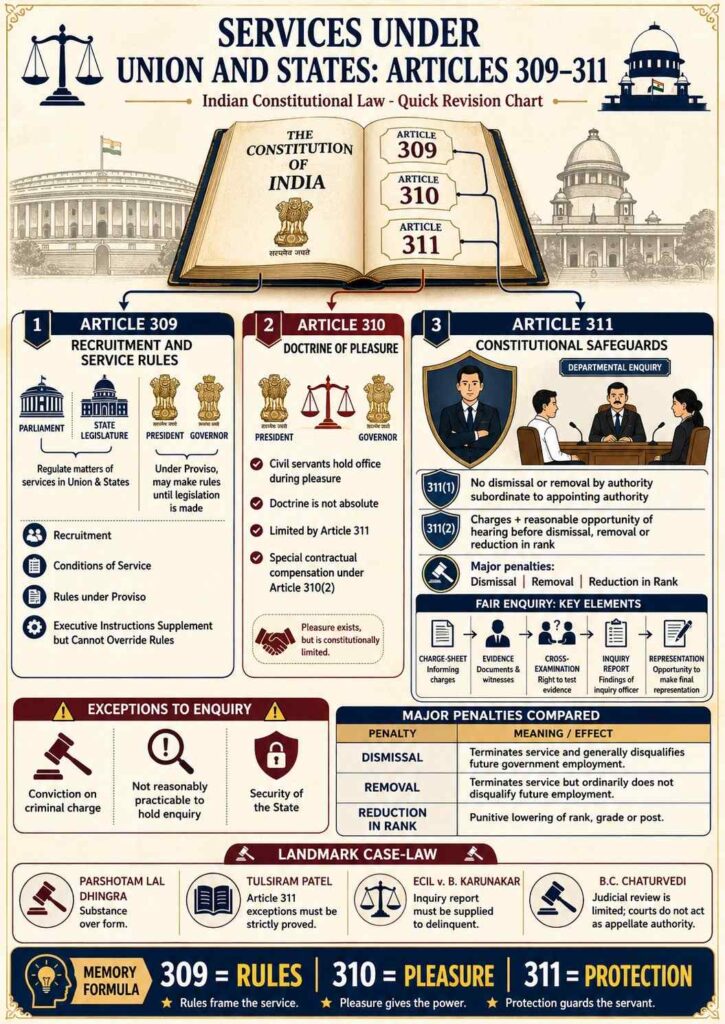
Constitutional Scheme of Public Services
• Three-part framework: Articles 309, 310 and 311 together regulate public employment under the Union and the States. Article 309 deals with recruitment and service conditions; Article 310 establishes tenure during the pleasure of the President or Governor; and Article 311 protects civil servants against arbitrary dismissal, removal and reduction in rank.
| Provision | Core function | Memory aid |
|---|---|---|
| Article 309 | Recruitment and conditions of service | Rules |
| Article 310 | Tenure during pleasure of President/Governor | Pleasure |
| Article 311 | Safeguards before major punishments | Protection |
• Status, not ordinary contract: Government service begins with appointment, but after appointment the relationship is principally governed by constitutional provisions, statutes and service rules. A government servant therefore holds a legal status, not merely a private contractual job. Service conditions may be altered through valid law or rules, subject to constitutional limits.
• Balance of interests: The Constitution protects honest civil servants from arbitrary action, but does not make public employment immune from disciplinary control. The object is to secure both fairness to the employee and efficiency, integrity and accountability in public administration.
Article 309: Recruitment and Conditions of Service
Legislative Power Under Article 309
• Legislative authority: Article 309 authorises Parliament and State Legislatures to regulate recruitment and conditions of service of persons appointed to public services and posts connected with Union or State affairs. “Conditions of service” broadly include pay, pension, leave, seniority, promotion, disciplinary control, suspension, retirement and other incidents of service.
• Presidential and gubernatorial rules: Until the appropriate Legislature makes an Act, the President, or a person authorised by the President, may make rules for Union services. Similarly, the Governor, or a person authorised by the Governor, may make rules for State services. These rules remain effective subject to a later Act made by the appropriate Legislature.
• Hierarchy: Rules made under the proviso to Article 309 have statutory force, but they cannot conflict with the Constitution or with a governing statute. A service rule inconsistent with Articles 14, 16, 310 or 311 is vulnerable to judicial review.
• Executive instructions: In Sant Ram Sharma v. State of Rajasthan, AIR 1967 SC 1910 : (1968) 1 SCR 111, promotion-related service rules did not address every procedural detail. The Supreme Court held that executive instructions may supplement statutory rules where the rules are silent, but they cannot amend, supersede or contradict statutory rules. Thus, administrative circulars may fill a gap but cannot override a valid rule framed under Article 309.
• Service-status principle: In Roshan Lal Tandon v. Union of India, (1968) 1 SCR 185, a railway employee challenged an alteration in promotion conditions after entering service. The Supreme Court held that, although appointment originates in contract, a government servant thereafter acquires a status governed by statute and rules. Hence, a servant has no immutable contractual right to the continuance of every existing service condition.
Article 310: Doctrine of Pleasure
Meaning of the Doctrine of Pleasure
• Constitutional rule: Article 310(1) provides that members of Union civil services, All India Services, defence services and holders of civil or defence posts under the Union hold office during the pleasure of the President. Members of State civil services and holders of civil posts under a State hold office during the pleasure of the Governor.
• Nature: The doctrine means that public service tenure is not absolutely guaranteed. Subject to constitutional safeguards, the State may terminate service in the public interest. The doctrine is founded on public policy and not on a personal or arbitrary prerogative of the President or Governor.
• Constitutional limitation: The doctrine is not absolute in India. Article 311 operates as a major restriction upon Article 310 in relation to civil servants. Therefore, where dismissal, removal or reduction in rank falls within Article 311, the pleasure doctrine must be exercised consistently with Article 311 safeguards.
• Aid and advice: The President and Governor are constitutional heads. In service matters, their formal powers are ordinarily exercised through the constitutional machinery of aid and advice and the applicable Rules of Business.
• Special constitutional offices: Certain constitutional authorities have special security of tenure under separate provisions, for example Supreme Court and High Court judges, the Comptroller and Auditor-General, the Chief Election Commissioner and members of Election Commissions. Their removal is regulated by the specific constitutional provisions applicable to them, rather than by ordinary civil-service rules.
Compensation Under Article 310(2)
• Special qualification contract: Article 310(2) permits a contract for compensation where a person with special qualifications is appointed to a civil post for an agreed period and, before that period ends, the post is abolished or the person is asked to vacate it for reasons unrelated to misconduct. This protection does not apply to members of defence services, All India Services, Union civil services or State civil services.
Article 311: Constitutional Safeguards for Civil Servants
Persons Protected by Article 311
• Covered employees: Article 311 protects a person who is a member of a civil service of the Union, an All India Service, a civil service of a State, or who holds a civil post under the Union or a State.
• Civil capacity: Article 311 applies to persons employed in a civil capacity. It does not extend to members of defence services merely because Article 310 covers them.
• Temporary and probationary employees: A temporary employee or probationer may also invoke Article 311 where termination is, in substance, punitive. The State cannot avoid constitutional protection simply by using neutral words such as “termination” if the real foundation of the order is misconduct.
• Substance over form: In Parshotam Lal Dhingra v. Union of India, 1958 SCR 828 : AIR 1958 SC 36, the Supreme Court examined termination and reversion orders affecting government servants. It held that the court must look at the substance of the order. If the employee had a right to the post or rank, or if the order imposes evil consequences founded upon misconduct, negligence, inefficiency or other disqualification, the action is punitive and Article 311 safeguards are attracted.
• Non-punitive termination: A probationer may be discharged for unsatisfactory overall performance under the applicable rules, without a full Article 311 inquiry, where the order is genuinely non-stigmatic and is not founded upon proved misconduct. In Pavanendra Narayan Verma v. Sanjay Gandhi PGI of Medical Sciences, (2002) 1 SCC 520, the Supreme Court explained that a termination becomes punitive where stigma, an inquiry into misconduct and findings of guilt combine to form its foundation.
Article 311(1): Protection Regarding Authority
• Rule: No civil servant covered by Article 311 may be dismissed or removed by an authority subordinate to the authority by which that person was appointed. The protection in clause (1) expressly concerns dismissal and removal, not reduction in rank.
• Recall formula: Appointing authority or higher authority may dismiss or remove; a lower authority may not.
• Initiation of proceedings: Article 311(1) does not itself require that the appointing authority must personally initiate or conduct the departmental enquiry. The requirement is that the final dismissal or removal order must not be passed by an authority subordinate to the appointing authority. A service rule may, however, provide greater protection.
• Case law: In P.V. Srinivasa Sastry v. Comptroller and Auditor-General, (1993) 1 SCC 419, departmental proceedings against auditors were initiated by a subordinate authority and culminated in reduction in rank. The Supreme Court held that Article 311(1) does not require disciplinary proceedings to be initiated only by the appointing authority unless the applicable service rules impose such a restriction. The Court also held that reduction in rank cannot ordinarily push an employee into a lower cadre or post that the employee had never held.
Article 311(2): Protection of Departmental Enquiry
• Rule: No protected civil servant may be dismissed, removed or reduced in rank except after an inquiry in which the person is informed of the charges and given a reasonable opportunity of being heard in respect of those charges.
• Major penalties: Article 311(2) applies only to dismissal, removal and reduction in rank. Other disciplinary penalties are primarily regulated by applicable service rules, though they must still satisfy Articles 14 and 16 and the relevant principles of natural justice.
| Punishment | Effect |
|---|---|
| Dismissal | Terminates service; under Central and All India Service rules, it ordinarily disqualifies future government employment. |
| Removal | Terminates service but ordinarily does not disqualify future government employment. |
| Reduction in rank | Punitive lowering of rank, grade or post. |
The above dismissal-removal distinction is drawn from service rules and is not expressly defined by Article 311 itself.
Departmental Enquiry and Reasonable Opportunity
Essential Stages of a Fair Departmental Enquiry
• Charges: The employee must receive clear and specific charges. Vague allegations make an effective defence impossible. The charge-sheet should ordinarily disclose the imputation, relevant documents and list of witnesses as required by the applicable service rules.
• Defence opportunity: The employee must receive reasonable time to submit a written statement of defence and must be given a real opportunity to deny the allegations.
• Evidence: The department must establish the charge through material placed on record in the inquiry. A departmental inquiry is not a criminal trial, and the strict rules of the Evidence Act do not apply; nevertheless, findings cannot rest on suspicion, unproved documents or material never put to the employee.
• Cross-examination and defence evidence: Where oral evidence is relied upon, the employee should have a fair opportunity to cross-examine departmental witnesses and to produce defence evidence, subject to lawful procedural restrictions.
• Impartial inquiry officer: The inquiry officer acts as a quasi-judicial authority. The officer must remain unbiased and cannot act as a representative of the department.
• Case law: In Roop Singh Negi v. Punjab National Bank, (2009) 2 SCC 570, dismissal of a bank employee was based substantially on unproved documents and allegations relating to the disappearance of bank drafts. The Supreme Court held that departmental proceedings are quasi-judicial; documents cannot automatically become evidence merely because they are produced, and the inquiry officer must base findings on material legally brought on record.
• No-evidence rule: In Union of India v. H.C. Goel, (1964) 4 SCR 718 : AIR 1964 SC 364, a disciplinary finding was challenged as unsupported by evidence. The Supreme Court held that a writ court does not reassess adequacy or reliability of evidence as an appellate authority; however, it may interfere where the finding is perverse, suffers from patent error or is based on no evidence at all.
Inquiry Report and Disciplinary Authority
• Inquiry report: Where the inquiry officer and disciplinary authority are different persons, the employee must ordinarily receive the inquiry report before the disciplinary authority finally decides guilt.
• Representation on findings: The employee must have an opportunity to represent against adverse findings in the inquiry report before the disciplinary authority reaches its conclusion on guilt.
• Disagreement by disciplinary authority: When the inquiry officer exonerates the employee or records a favourable finding, and the disciplinary authority proposes to disagree, it must communicate its tentative reasons for disagreement and provide an opportunity to respond before recording guilt.
• Case law: In Managing Director, ECIL v. B. Karunakar, (1993) 4 SCC 727, the inquiry officer’s report had not been supplied before the disciplinary authority acted. The Constitution Bench held that supply of the report is part of reasonable opportunity because the employee must be allowed to answer the inquiry officer’s findings before guilt is finally determined. Failure may require the matter to be restored from the stage at which the report should have been supplied, subject to the effect of the denial on fairness.
• Case law: In Punjab National Bank v. Kunj Behari Misra, (1998) 7 SCC 84, bank officers faced disciplinary proceedings after a financial shortage, while the inquiry officer did not fully sustain the charges. The disciplinary authority differed from the inquiry findings without first hearing them. The Supreme Court held that the employee must receive the disciplinary authority’s tentative reasons for disagreement and a chance to respond before an adverse conclusion is reached.
Effect of the Forty-Second Amendment
• Earlier position: Before the Forty-Second Amendment, Article 311 jurisprudence recognised two stages of protection: defence during the inquiry and a further opportunity to make representation against the proposed penalty.
• Present position: The Forty-Second Amendment, effective from 3 January 1977, removed the constitutional requirement of a second show-cause notice against the proposed penalty. The disciplinary authority may impose the penalty on the evidence recorded during inquiry without separately asking the employee to explain why a particular penalty should not be imposed.
• Important distinction: The Amendment removed the right to represent specifically against the proposed punishment; it did not remove the right to receive the inquiry report and represent against the findings of guilt before the disciplinary authority decides the charges.
Exceptions to Departmental Enquiry Under Article 311(2)
Conviction on a Criminal Charge
• Article 311(2)(a): Inquiry may be dispensed with where dismissal, removal or reduction in rank is based on conduct that has led to conviction on a criminal charge.
• Conduct, not automatic punishment: Conviction does not mechanically require dismissal. The disciplinary authority must examine the conduct leading to conviction and determine the appropriate penalty under the service rules.
Impracticability of Holding Inquiry
• Article 311(2)(b): Inquiry may be dispensed with where the authority empowered to dismiss, remove or reduce in rank is satisfied that it is not reasonably practicable to hold the inquiry.
• Recorded reasons: Reasons must be recorded in writing. Mere inconvenience, administrative urgency, hostility toward the employee or a desire for speed cannot justify dispensing with inquiry.
• Judicial review: Article 311(3) declares the authority’s decision final on the question of practicability, but this does not exclude judicial review for mala fides, irrelevant considerations, absence of material or arbitrary exercise of power.
Security of the State
• Article 311(2)(c): Inquiry may be dispensed with where the President or Governor is satisfied that, in the interest of the security of the State, it is not expedient to hold the inquiry.
• Exceptional power: This is an extraordinary constitutional exception. It is concerned with security of the State and cannot be invoked merely because the alleged conduct is undesirable or because a regular inquiry may be inconvenient.
Leading Authority on Exceptions
• Constitution Bench: In Union of India v. Tulsiram Patel, (1985) 3 SCC 398, the Supreme Court considered the constitutional validity and operation of the three exceptions to Article 311(2). The Court upheld the exceptions, explaining that they operate in exceptional situations where a regular inquiry is constitutionally unnecessary. It also clarified that Article 311 is an express limitation on the doctrine of pleasure, while Article 309 rules must conform to Articles 310 and 311.
Dismissal, Removal, Reduction in Rank and Compulsory Retirement
• Dismissal and removal: Both end the employment relationship. The constitutional procedure under Article 311 must be followed unless an exception under the second proviso applies.
• Reduction in rank: Reduction is a major penalty where it operates as punishment. Reversion from an officiating or temporary higher post to a substantive lower post may not amount to reduction in rank if it is a normal consequence of service rules and carries no stigma or punitive consequences.
• Compulsory retirement: Compulsory retirement in public interest under applicable rules is generally not treated as dismissal, removal or reduction in rank if it is non-stigmatic and is not imposed as punishment.
• Case law: In Baikuntha Nath Das v. Chief District Medical Officer, Baripada, (1992) 2 SCC 299, compulsory retirement was challenged as punitive. The Supreme Court held that compulsory retirement in public interest is ordinarily not a punishment, carries no stigma and does not attract Article 311(2), provided the decision is bona fide and based on the employee’s service record under the governing rules.
Judicial Review of Disciplinary Action
• Review, not appeal: Courts do not ordinarily reappreciate evidence or replace the disciplinary authority’s conclusion with their own view.
• Grounds of interference: Judicial review is available where there is lack of jurisdiction, breach of Article 311, violation of statutory rules, denial of natural justice, bias, mala fides, reliance on irrelevant material, perversity, no evidence, or a punishment that is shockingly disproportionate.
• Proportionality: In B.C. Chaturvedi v. Union of India, (1995) 6 SCC 749, the Supreme Court held that judicial review examines the decision-making process, not the merits of the disciplinary authority’s view. Interference with punishment is exceptional and normally arises only where the penalty shocks the conscience of the court; ordinarily, the matter should then be remitted to the competent authority for reconsideration.
Quick Revision Matrix
• Article 309: Who makes service rules? Parliament, State Legislature, President or Governor under the proviso.
• Article 310: Who holds office during pleasure? Union servants during the President’s pleasure; State servants during the Governor’s pleasure.
• Article 311(1): What is protected? Dismissal or removal by an authority lower than the appointing authority.
• Article 311(2): What is protected? Dismissal, removal or reduction in rank without charges and a fair opportunity of hearing.
• Article 311 exceptions: Conviction – Impracticability – Security of State.
• Core principle: Article 309 regulates service; Article 310 permits tenure at pleasure; Article 311 prevents arbitrary major punishment.