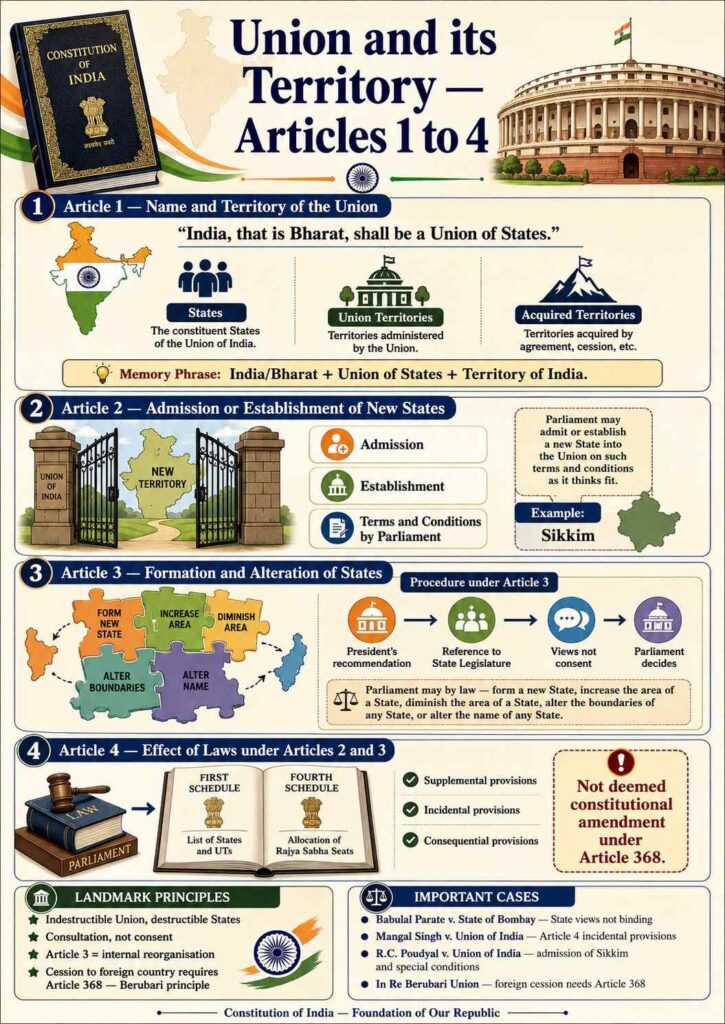
Meaning and Constitutional Scheme of “Union and its Territory”
➤ Core idea: Part I of the Constitution of India is titled “The Union and its Territory” and contains Articles 1 to 4. These provisions explain the constitutional identity of India, the territory of India, admission or establishment of new States, formation of new States, alteration of boundaries, alteration of names, and the legal effect of laws made for such territorial changes.
➤ Simple meaning: These Articles answer four basic questions:
What is India constitutionally called? What territory forms India? How can new States be admitted or created? How can existing States be reorganised?
➤ Present constitutional position: India is a federal polity with a strong Union. The Constitution presently recognises India as a Union of States, and the territory of India consists of the territories of the States, the Union territories specified in the First Schedule, and any other territories that may be acquired. Article 1 uses the expression “India, that is Bharat, shall be a Union of States.”
➤ Important distinction: The expression “Union of States” is significant. India is not described as a mere federation formed by an agreement among sovereign States. The Indian Union is indestructible, though the States may be reorganised, divided, merged, renamed, or have their boundaries altered by Parliament under the Constitution.
Article 1: Name and Territory of the Union
➤ Textual essence: Article 1 declares three things:
India, that is Bharat, shall be a Union of States; the States and their territories shall be as specified in the First Schedule; and the territory of India shall comprise the territories of the States, Union territories, and such other territories as may be acquired.
➤ Keyword — India/Bharat: The Constitution uses both names: India and Bharat. These are constitutional names of the same sovereign entity. The provision does not create two different legal personalities; it recognises one constitutional polity.
➤ Keyword — Union of States: The expression Union shows that the unity of India is not dependent upon the consent of individual States. States do not have a right to secede from India. Parliament may change their boundaries or names under Article 3, subject to the procedure prescribed.
➤ Keyword — First Schedule: The First Schedule is important because it lists the States and Union territories and describes their territories. Whenever a State is created, divided, merged, renamed, or territorially altered, the First Schedule is amended accordingly.
➤ Keyword — Territory of India: The phrase “territory of India” is wider than merely “territories of States.” It includes:
• territories of States;
• Union territories; and
• other territories acquired by India.
➤ Illustration: If India acquires a territory by treaty, conquest, cession, or agreement recognised in international law, such territory may become part of the territory of India. But its internal constitutional placement may require parliamentary action depending on the nature of the acquisition and its proposed administration.
Difference Between “Union of India” and “Territory of India”
➤ Keyword — Union of India: The expression Union of India generally refers to the federal political entity consisting of the Union and the States under the constitutional structure.
➤ Keyword — Territory of India: The expression territory of India is geographical and territorial in nature. It includes States, Union territories, and acquired territories.
➤ Practical effect: A territory may form part of India’s territory, but Parliament may still have to decide how that territory will be governed, whether it will be admitted as a State, established as a new State, merged with an existing State, or administered as a Union territory.
Article 2: Admission or Establishment of New States
➤ Textual essence: Article 2 empowers Parliament to admit into the Union or establish new States on such terms and conditions as it thinks fit.
➤ Keyword — Admission: Admission means bringing into the Indian Union a political entity or territory which was not previously a part of India as a State. This provision is suitable where an outside territory or political unit becomes part of India and is admitted as a State.
➤ Keyword — Establishment: Establishment means creating a new State in circumstances where Parliament sets up a State under constitutional authority. Article 2 is wide and gives Parliament flexibility to determine the terms and conditions of such admission or establishment.
➤ Scope of Parliament’s power: Parliament may impose conditions regarding representation, administration, transitional arrangements, special safeguards, or other matters connected with the new State.
➤ Sikkim example: Sikkim’s integration into India illustrates the use of constitutional power to admit a new State into the Union. In R.C. Poudyal v. Union of India, AIR 1993 SC 1804; 1994 Supp (1) SCC 324, the Supreme Court considered the constitutional validity of special provisions relating to Sikkim. The Court observed that the power under Article 2 is wide because admission of a new State may involve complex historical and political circumstances, though such power is not completely beyond judicial scrutiny.
➤ Case law — R.C. Poudyal v. Union of India: In this case, the challenge concerned special representation arrangements in the Sikkim Legislative Assembly after Sikkim became part of India. The issue was whether such special provisions violated democratic equality and constitutional principles. The Supreme Court upheld the provisions in view of Sikkim’s special historical and political background. The ratio is that constitutional accommodation may be valid where it is connected with the special circumstances of admission of a new State and does not destroy the basic constitutional framework.
Difference Between Article 2 and Article 3
| Basis | Article 2 | Article 3 |
|---|---|---|
| Main purpose | Admission or establishment of new States | Formation of new States and alteration of existing States |
| Territorial focus | Generally concerns territories or political units not already organised as Indian States | Concerns existing States and Union territories within India |
| State Legislature’s role | No mandatory reference procedure like Article 3 | President must refer the Bill to the concerned State Legislature for views |
| Nature of power | Wide political-constitutional power | Specific reorganisation power subject to constitutional procedure |
➤ Simple memory point: Article 2 brings a new State into the Union; Article 3 reshapes what is already within the Union.
Article 3: Formation of New States and Alteration of Areas, Boundaries or Names
➤ Textual essence: Article 3 empowers Parliament by law to:
• form a new State by separation of territory from any State;
• unite two or more States or parts of States;
• unite any territory to a part of any State;
• increase the area of any State;
• diminish the area of any State;
• alter the boundaries of any State; and
• alter the name of any State.
➤ Keyword — Formation of new States: Parliament may create a new State out of the territory of an existing State. For example, Telangana was formed from the existing State of Andhra Pradesh under the Andhra Pradesh Reorganisation Act, 2014, which came into force on 2 June 2014. Section 3 of that Act provided for the formation of the State of Telangana.
➤ Keyword — Alteration of boundaries: Parliament may transfer territory from one State to another, redraw boundaries, or make territorial adjustments. Such changes are internal constitutional adjustments within India.
➤ Keyword — Alteration of name: Parliament may change the name of a State. For instance, constitutional and statutory changes have historically renamed States such as Madras to Tamil Nadu, Mysore to Karnataka, Orissa to Odisha, and Uttaranchal to Uttarakhand.
➤ Keyword — Union territories included: Explanation I to Article 3 provides that, in clauses dealing with formation, increase, diminution, alteration of boundaries and names, “State” includes a Union territory; however, in the proviso, “State” does not include a Union territory. Explanation II clarifies that Parliament’s power includes the power to form a new State or Union territory by uniting part of any State or Union territory with another State or Union territory.
Procedure Under Article 3
➤ Keyword — Bill only on President’s recommendation: A Bill under Article 3 can be introduced in either House of Parliament only on the recommendation of the President.
➤ Keyword — Reference to State Legislature: If the Bill affects the area, boundaries, or name of any State, the President must refer the Bill to the Legislature of that State for expressing its views within the period specified by the President.
➤ Keyword — Views, not consent: The State Legislature’s role is consultative, not decisive. Parliament is not bound by the views of the State Legislature. Even if the State Legislature rejects the proposal, does not respond, or suggests modifications, Parliament may still pass the law.
➤ Keyword — Democratic consultation: The purpose of referring the Bill to the State Legislature is to ensure that the affected State gets an opportunity to express its opinion. However, the Constitution gives the final authority to Parliament because territorial integrity and reorganisation are matters of national constitutional policy.
Landmark Case: Babulal Parate v. State of Bombay
➤ Case law — Babulal Parate v. State of Bombay, AIR 1960 SC 51; 1960 SCR (1) 605: In this case, the petitioner challenged the constitutional process relating to the reorganisation of Bombay. The legal issue was whether Parliament was bound by the views of the State Legislature and whether fresh reference was necessary if changes were made in the Bill after the State Legislature had expressed its views. The Supreme Court held that Article 3 requires the State Legislature to be given an opportunity to express its views, but its consent is not necessary and its views are not binding on Parliament. The ratio is that Parliament has dominant constitutional power in matters of State reorganisation, subject only to the procedure expressly prescribed in Article 3.
➤ Important principle: Article 3 does not create a veto power in favour of States. It creates a mechanism of consultation. This is why India is often described as an indestructible Union of destructible States.
Landmark Case: Pradeep Chaudhary v. Union of India
➤ Case law — Pradeep Chaudhary v. Union of India, decided on 5 May 2009: The Supreme Court reaffirmed the principle that Parliament has wide authority under Article 3 in relation to State reorganisation and that the views of the State Legislature are not binding. The Court relied on the earlier constitutional position explained in Babulal Parate. The ratio is that State reorganisation is primarily a parliamentary function, and judicial review is limited to examining whether constitutional procedure has been followed.
Landmark Case: Mangal Singh v. Union of India
➤ Case law — Mangal Singh v. Union of India, AIR 1967 SC 944; 1967 SCR (2) 109: This case arose after the Punjab Reorganisation Act, 1966, which reorganised the old State of Punjab and created Haryana, transferred certain areas, and dealt with Chandigarh and Himachal Pradesh. The issue included whether Parliament could make provisions affecting legislative representation and whether such provisions violated constitutional requirements. The Supreme Court upheld the reorganisation law and explained that Article 4 permits Parliament to include supplemental, incidental, and consequential provisions necessary to make reorganisation effective.
➤ Important principle: When Parliament reorganises a State, it may need to adjust representation in Parliament, State Legislatures, services, courts, assets, liabilities, and administrative arrangements. Article 4 allows such connected provisions.
Article 4: Legal Effect of Laws Made Under Articles 2 and 3
➤ Textual essence: Article 4 provides that any law made under Article 2 or Article 3 shall contain provisions for amending the First Schedule and Fourth Schedule as necessary, and may also contain supplemental, incidental, and consequential provisions. Most importantly, Article 4 states that no such law shall be deemed to be an amendment of the Constitution for the purposes of Article 368.
➤ Keyword — First Schedule amendment: Since the First Schedule lists States and Union territories with their territories, any law creating or altering a State must amend the First Schedule.
➤ Keyword — Fourth Schedule amendment: The Fourth Schedule deals with allocation of seats in the Council of States, that is, the Rajya Sabha. When a new State is formed or territories are reorganised, Rajya Sabha representation may need adjustment.
➤ Keyword — Supplemental provisions: These are additional provisions necessary to make the reorganisation workable. They may relate to administration, courts, services, public assets, liabilities, laws in force, adaptation of laws, representation, and transitional arrangements.
➤ Keyword — Incidental provisions: These are provisions naturally connected with the main reorganisation. For example, if a district is transferred from one State to another, the law may provide how pending legal proceedings, government employees, local authorities, and records will be handled.
➤ Keyword — Consequential provisions: These are provisions that follow as a necessary consequence of territorial change. For example, if a new State is created, the law may provide for a Governor, Legislature, High Court arrangements, representation in Parliament, and division of assets and liabilities.
Article 4 and Article 368: Why Reorganisation Laws Are Not Constitutional Amendments
➤ Core rule: A law made under Article 2 or Article 3 may amend the First Schedule and Fourth Schedule, but Article 4 expressly says that such a law is not treated as a constitutional amendment under Article 368. This means the special procedure of Article 368 is not required for ordinary internal reorganisation of States.
➤ Simple explanation: Normally, changing the text or schedules of the Constitution may require a constitutional amendment. But Article 4 creates a special constitutional shortcut for territorial reorganisation. Since Articles 2 and 3 themselves contemplate such changes, Parliament can make necessary schedule amendments by ordinary law.
➤ Legal effect: Such laws are passed like ordinary parliamentary legislation, but they have constitutional consequences because they alter the First Schedule and Fourth Schedule.
➤ Important limitation: Article 4 does not mean that Parliament can use Article 3 to do everything involving territory. Internal reorganisation is different from cession of Indian territory to a foreign country.
Cession of Territory to a Foreign Country: Berubari Principle
➤ Case law — In Re: Berubari Union and Exchange of Enclaves, AIR 1960 SC 845; 1960 3 SCR 250: This was a Presidential Reference under Article 143 concerning implementation of the Indo-Pakistan Agreement relating to Berubari Union. The main issue was whether India could transfer part of its territory to Pakistan under Article 3 or whether a constitutional amendment under Article 368 was necessary. The Supreme Court held that Article 3 deals with internal adjustment of territories among States within India and does not authorise cession of Indian territory to a foreign State. Therefore, cession of Indian territory requires constitutional amendment under Article 368.
➤ Important principle: Article 3 = internal reorganisation. Article 368 = cession of Indian territory to a foreign country.
➤ Case law — Ram Kishore Sen v. Union of India, AIR 1966 SC 644; 1966 SCR (1) 430: This case concerned implementation of the Ninth Constitutional Amendment relating to transfer of certain territories following the Indo-Pakistan arrangements. The issue was whether the constitutional process adopted for transfer was valid. The Supreme Court upheld the constitutional mechanism and followed the Berubari principle that cession of Indian territory to a foreign State cannot be done merely under Article 3.
➤ Modern example — 100th Constitutional Amendment: The Constitution (One Hundredth Amendment) Act, 2015 was enacted to give effect to the India-Bangladesh Land Boundary Agreement involving acquisition and transfer of territories between India and Bangladesh. This reflects the Berubari principle that transfer of territory to a foreign country is dealt with through constitutional amendment, not merely Article 3.
State Reorganisation and Indian Federalism
➤ Keyword — Strong Union: Articles 1 to 4 show that Indian federalism is not identical to American federalism. In the United States, States have a different historical origin as pre-existing units. In India, the Constitution creates a Union where Parliament has power to reorganise States.
➤ Case law — State of West Bengal v. Union of India, AIR 1963 SC 1241; 1964 SCR (1) 371: The State of West Bengal challenged parliamentary power relating to acquisition of State property. Although the case was not only about Article 3, the Supreme Court explained the nature of Indian federalism and rejected the idea that Indian States possess sovereignty independent of the Union in the same way as classical federations. The ratio relevant here is that the Indian Constitution establishes a federal structure with a strong Union, and States are not sovereign entities capable of overriding the constitutional authority of Parliament.
➤ Important principle: Indian States are constitutionally important, but they are not indestructible. Parliament may reorganise them under Article 3, while the Union of India remains constitutionally permanent.
Practical Examples of Article 3 Reorganisation
➤ Keyword — Telangana: The Andhra Pradesh Reorganisation Act, 2014 created Telangana from the existing State of Andhra Pradesh. It provided not only for territorial formation but also for capital arrangements, representation, High Court arrangements, public employment, assets, liabilities, water, education, and other transitional matters.
➤ Keyword — Jammu and Kashmir Reorganisation: The Jammu and Kashmir Reorganisation Act, 2019 reorganised the former State of Jammu and Kashmir into the Union Territory of Jammu and Kashmir and the Union Territory of Ladakh. The Act contains provisions on formation of Union territories, representation, administration, laws, courts, services, assets, and liabilities.
➤ Keyword — Punjab Reorganisation: The Punjab Reorganisation Act, 1966 reorganised Punjab and led to the creation of Haryana and arrangements relating to Chandigarh and Himachal Pradesh. Its validity and connected provisions were considered in Mangal Singh v. Union of India.
Legal Effect of Reorganisation Laws
➤ Effect on territory: The territories of the affected States or Union territories stand changed from the appointed day mentioned in the reorganisation law.
➤ Effect on First Schedule: The First Schedule is amended to reflect the new names, territories, or status of the concerned States or Union territories.
➤ Effect on Fourth Schedule: Rajya Sabha seat allocation may be changed where necessary.
➤ Effect on laws in force: Existing laws may continue until altered, repealed, or adapted by the competent Legislature or authority. This avoids legal vacuum.
➤ Effect on courts: High Court jurisdiction, pending cases, subordinate courts, and judicial administration may be reorganised.
➤ Effect on services: Government employees may be allocated between successor States or Union territories.
➤ Effect on assets and liabilities: Public debt, property, contracts, corporations, boards, and government undertakings may be divided.
➤ Effect on representation: Lok Sabha, Rajya Sabha, and State Legislative Assembly representation may be adjusted.
➤ Effect on administration: New executive authorities, Governors, Lieutenant Governors, capitals, departments, and local administrative units may be created or reorganised.
Constitutional Safeguards and Limits on Parliament’s Power
➤ Procedural safeguard: A Bill under Article 3 affecting a State’s area, boundary, or name must be referred by the President to the concerned State Legislature for its views.
➤ Substantive parliamentary control: Parliament has final authority and is not bound by the State Legislature’s opinion.
➤ Judicial review: Courts can examine whether mandatory constitutional procedure was followed. However, courts generally do not sit in appeal over the political wisdom of State reorganisation.
➤ Foreign territory limitation: Parliament cannot cede Indian territory to a foreign country merely by using Article 3. Such cession requires Article 368 constitutional amendment as held in Berubari.
➤ Basic structure limitation: Although Article 4 says reorganisation laws are not Article 368 amendments, Parliament’s exercise of constitutional power cannot destroy the basic structure of the Constitution. This acts as a broad constitutional limitation.
Memory Table: Articles 1 to 4 at a Glance
| Article | Subject | Main legal point |
|---|---|---|
| Article 1 | Name and territory of the Union | India/Bharat is a Union of States; territory includes States, Union territories, and acquired territories |
| Article 2 | Admission or establishment of new States | Parliament may admit or establish new States on terms and conditions |
| Article 3 | Formation and alteration of States | Parliament may form, merge, divide, rename, or alter boundaries/areas of States |
| Article 4 | Effect of Articles 2 and 3 laws | Such laws may amend First and Fourth Schedules and include incidental provisions; not deemed Article 368 amendments |
Key Doctrines and Principles
➤ Indestructible Union, destructible States: India as a Union cannot be broken by States, but States may be territorially reorganised by Parliament.
➤ Consultation, not consent: The affected State Legislature must be allowed to express its views under Article 3, but its approval is not mandatory.
➤ Internal adjustment doctrine: Article 3 applies to internal territorial changes within India.
➤ Cession limitation doctrine: Transfer of Indian territory to a foreign State requires constitutional amendment under Article 368.
➤ Incidental powers doctrine: Article 4 gives Parliament power to make necessary supplemental, incidental, and consequential provisions for effective reorganisation.
Conclusion
➤ Final essence: Articles 1 to 4 create the constitutional foundation of India’s territorial structure. Article 1 declares India as Bharat and as a Union of States. Article 2 enables admission or establishment of new States. Article 3 gives Parliament wide power to reorganise existing States by forming new States, merging territories, changing boundaries, altering areas, or changing names. Article 4 makes such reorganisation practically effective by allowing amendment of the First and Fourth Schedules and by permitting supplemental, incidental, and consequential provisions without following Article 368.
➤ Central understanding: The Indian Constitution balances federalism with national unity. States are important constitutional units, but they do not possess a veto over territorial reorganisation. Parliament, after following the required procedure, has the power to reshape the internal map of India. However, where Indian territory is to be ceded to a foreign country, Article 3 is insufficient and Article 368 becomes necessary.