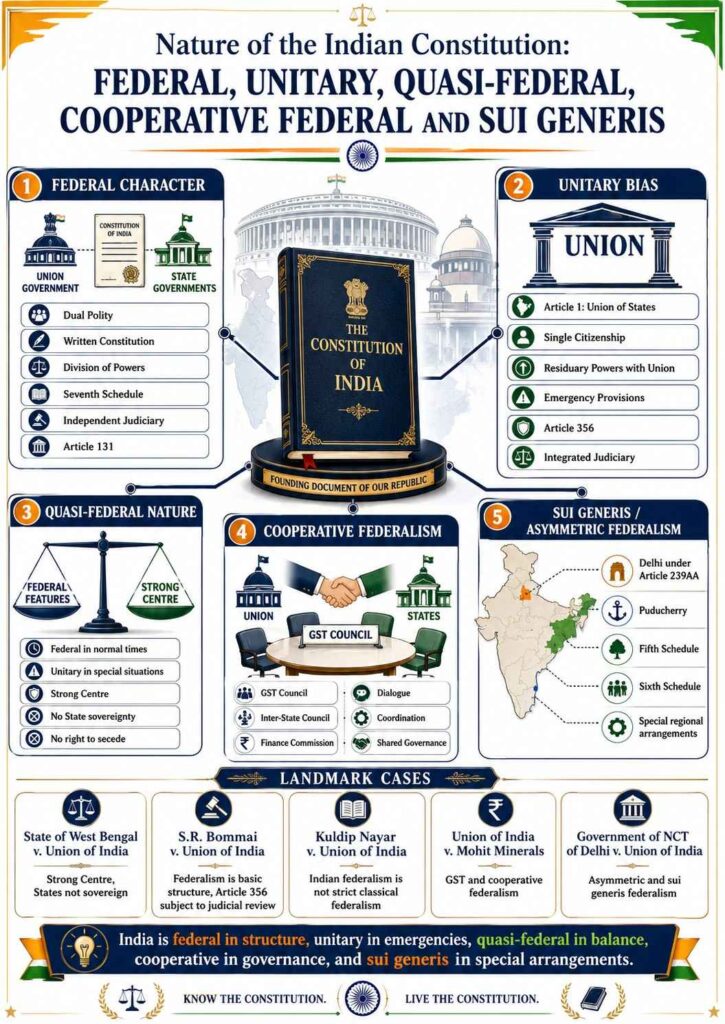
Meaning of the Nature of the Indian Constitution
Constitutional Nature: Why the Debate Exists
➤ Core Idea: The Indian Constitution cannot be described by one simple label because it combines a federal distribution of powers with a strong Union-oriented structure.
➤ Federal Aspect: India has two levels of constitutional government: the Union and the States. Both derive their authority directly from the Constitution, not from each other. The Union Parliament and State Legislatures have separate law-making fields under Articles 245 to 254 and the Seventh Schedule. Article 245 allows Parliament to make laws for India and State Legislatures to make laws for their States, while Article 246 distributes legislative subjects between Union, State and Concurrent Lists.
➤ Unitary Aspect: At the same time, India is not a loose federation of sovereign States. Article 1 describes India as a “Union of States”, not as a federation formed by an agreement among States. States have no constitutional right to secede from India. The Supreme Court has repeatedly recognised that Indian federalism is structured with a strong Centre.
➤ Best Description: The most accurate description is that India is a federal Constitution with a strong unitary bias, commonly called quasi-federal, and in modern cases also explained as cooperative, asymmetric, and in some contexts sui generis.
Federal Character of the Indian Constitution
Federalism: Essential Meaning
➤ Federal Principle: Federalism means division of governmental powers between two levels of government, where each level is constitutionally supreme in its own sphere.
➤ Constitutional Supremacy: In India, neither Parliament nor State Legislatures are legally supreme over the Constitution. Both are limited by the Constitution, and their laws can be tested by courts.
➤ Dual Polity: India has a Union Government and State Governments. Both have elected institutions, executive authorities, legislatures and separate constitutional responsibilities.
➤ Division of Legislative Powers: The Seventh Schedule divides subjects into the Union List, State List and Concurrent List. Defence, foreign affairs, railways and currency are Union subjects. Police, public order, public health and agriculture are primarily State subjects. Criminal law, marriage, education and forests are examples of Concurrent List subjects.
➤ Written Constitution: India has a detailed written Constitution. A written Constitution is important in a federation because the powers of each government must be clearly defined.
➤ Rigid Amendment Procedure: Certain constitutional amendments affecting federal provisions require ratification by at least one-half of the State Legislatures under Article 368. This protects the States from unilateral alteration of core federal arrangements.
➤ Independent Judiciary: The Supreme Court and High Courts protect the constitutional distribution of powers. Article 131 gives the Supreme Court original jurisdiction in certain Centre-State and inter-State disputes.
➤ Bicameral Parliament: The Rajya Sabha represents States at the Union level, although India does not follow equal State representation like the United States. Representation in the Rajya Sabha is largely population-based.
Unitary Character of the Indian Constitution
Strong Centre: Main Unitary Features
➤ Union of States: Article 1 calls India a Union of States. This expression was deliberately preferred because the Indian Union is indestructible. States are not sovereign units that came together by compact.
➤ No Right to Secede: A State cannot separate from India. The Supreme Court has observed that a State is a creature of the Constitution and has no right to claim sovereignty or secession.
➤ Single Constitution: Except the earlier special constitutional position of Jammu and Kashmir before the 2019 constitutional changes, India generally functions under one Constitution for both Union and States. In In Re: Article 370 of the Constitution, 2023 INSC 1058, the Supreme Court upheld the constitutional process relating to abrogation of Article 370 and noted the integration of Jammu and Kashmir into the constitutional framework.
➤ Single Citizenship: India follows single citizenship. A person is a citizen of India, not separately a citizen of a State. This promotes national unity and distinguishes India from classical federations like the United States.
➤ Residuary Powers with Union: Under Article 248 and Entry 97 of the Union List, residuary legislative power belongs to Parliament. This is a strong unitary feature because in some classical federations residuary powers belong to States.
➤ Parliament’s Power over State List in Special Situations: Parliament can legislate on State List matters in certain circumstances, such as national interest under Article 249, emergency under Article 250, consent of two or more States under Article 252, and implementation of treaties under Article 253.
➤ Concurrent List Supremacy: Under Article 254, when a State law conflicts with a Union law on a Concurrent List subject, Union law generally prevails unless the State law has received Presidential assent and is not overridden later by Parliament.
➤ Emergency Provisions: During a national emergency, the federal structure becomes more unitary. Parliament can legislate more widely, and executive power of the Union expands.
➤ President’s Rule: Article 356 allows the Union to assume State governmental functions if constitutional machinery fails in a State. This is one of the strongest unitary features, though it is controlled by judicial review after S.R. Bommai v. Union of India, (1994) 3 SCC 1.
➤ Integrated Judiciary: India does not have separate federal and State court systems. The Supreme Court stands at the top of an integrated judicial hierarchy.
➤ All India Services: Services like IAS and IPS are recruited nationally but serve both Union and States. This creates administrative unity.
➤ Governor’s Role: The Governor is appointed by the President and may reserve certain State Bills for Presidential consideration. This gives the Union an indirect constitutional presence in State governance.
Quasi-Federal Character of the Indian Constitution
Quasi-Federal: Meaning and Application
➤ Concept: “Quasi-federal” means a system that is federal in normal times but becomes unitary or Centre-dominant in certain situations.
➤ Indian Position: India is federal because powers are constitutionally divided, but it is not a classical federation because the Union has stronger constitutional powers than the States.
➤ Strong Centre Bias: In State of West Bengal v. Union of India, AIR 1963 SC 1241; (1964) 1 SCR 371, West Bengal challenged Parliament’s power to acquire coal-bearing lands belonging to the State. The Supreme Court held that India’s Constitution adopted a federal structure with a strong bias towards the Centre, and States are autonomous only within the fields allotted to them. The case rejected the idea that Indian States possess independent sovereignty against the Union.
➤ Quasi-Federal Judicial Recognition: In Kuldip Nayar v. Union of India, (2006) 7 SCC 1, the Supreme Court held that federalism is a basic feature, but Indian federalism leans in favour of a strong Centre and does not follow strict or classical federalism. The challenge related to removal of domicile requirement and introduction of open ballot for Rajya Sabha elections; the Court upheld the amendments and clarified that Rajya Sabha representation need not follow a rigid federal model.
➤ Modern Formulation: Recent Supreme Court reasoning has also described the State as federal in its constitutional sphere but quasi-federal in relation to the Union, because States have no sovereign right to secede and are bound by the constitutional structure.
Cooperative Federalism in India
Cooperative Federalism: Meaning
➤ Core Idea: Cooperative federalism means Union and States must work together, especially in areas where powers overlap or governance requires coordination.
➤ Practical Need: Modern governance cannot be run through isolated compartments. Subjects like environment, taxation, public health, disaster management, education, digital governance and economic planning require joint effort.
➤ Constitutional Examples: The Inter-State Council under Article 263, GST Council under Article 279A, Finance Commission under Article 280, Zonal Councils, NITI Aayog, and centrally sponsored schemes reflect cooperative mechanisms.
➤ GST and Federal Dialogue: In Union of India v. Mohit Minerals Pvt. Ltd., 2022 SCC OnLine SC 657, the Supreme Court held that GST Council recommendations have persuasive value and are not binding in a manner that destroys legislative power of Parliament and State Legislatures. The Court emphasised that GST federalism requires dialogue, cooperation and balance between Union and States.
➤ Delhi Federalism: In Government of NCT of Delhi v. Union of India, 2023 INSC 433, the Supreme Court described Delhi’s constitutional arrangement under Article 239AA as an asymmetric federal model and stressed that the Union must operate within constitutional boundaries in the spirit of cooperative federalism.
Sui Generis and Asymmetric Federalism
Sui Generis: Special Constitutional Arrangements
➤ Meaning: “Sui generis” means unique or of its own kind. In Indian federalism, some territories have special arrangements that do not fit neatly into ordinary State or Union Territory categories.
➤ Delhi as Sui Generis: The National Capital Territory of Delhi has an elected legislature and council of ministers, but it is not a full State. Under Article 239AA, Delhi’s legislative powers exclude public order, police and land. The Supreme Court has recognised Delhi as having a special constitutional status, different from ordinary Union Territories.
➤ Asymmetric Federalism: India does not treat all units identically. Different States and territories may have special provisions depending on history, geography, tribal autonomy, border concerns or national capital needs.
➤ Examples: Special arrangements exist under provisions relating to the North-Eastern States, tribal areas under the Fifth and Sixth Schedules, and Union Territories with legislatures such as Delhi and Puducherry.
Landmark Case Laws on Nature of Indian Constitution
State of West Bengal v. Union of India
➤ Case: State of West Bengal v. Union of India, AIR 1963 SC 1241; (1964) 1 SCR 371
➤ Facts: West Bengal challenged the Union’s power to acquire coal-bearing lands vested in the State under a Parliamentary law.
➤ Issue: Whether States possess sovereign immunity against Union legislation and whether Parliament could acquire State property.
➤ Ratio: The Supreme Court held that India is not a compact of sovereign States. The Constitution creates a federal structure with a strong Centre. States are autonomous within assigned fields but do not possess independent sovereignty against the Union.
➤ Importance: This case is a foundation for describing India as federal but Centre-leaning.
State of Rajasthan v. Union of India
➤ Case: State of Rajasthan v. Union of India, AIR 1977 SC 1361; (1977) 3 SCC 592
➤ Facts: After political change at the Union level, certain State Governments challenged threatened Union action under Article 356.
➤ Issue: Whether courts could interfere with Union action concerning President’s Rule at the preliminary stage.
➤ Ratio: The Supreme Court showed restraint and held that political questions do not automatically become non-justiciable, but interference requires serious constitutional grounds.
➤ Importance: The case showed the wide nature of Union power under Article 356, though later controlled by S.R. Bommai.
S.R. Bommai v. Union of India
➤ Case: S.R. Bommai v. Union of India, (1994) 3 SCC 1; AIR 1994 SC 1918
➤ Facts: Several State Governments were dismissed under Article 356, and the validity of Presidential Proclamations was challenged.
➤ Issue: Whether President’s Rule is subject to judicial review and whether federalism is part of the basic structure.
➤ Ratio: The Supreme Court held that federalism is part of the basic structure of the Constitution. A proclamation under Article 356 is subject to judicial review. The majority in the Assembly must ordinarily be tested on the floor of the House. Article 356 is an exceptional power, not a weapon for political control.
➤ Importance: This is the most important case protecting Indian federalism against arbitrary Union interference.
Kuldip Nayar v. Union of India
➤ Case: Kuldip Nayar v. Union of India, (2006) 7 SCC 1
➤ Facts: Amendments to Rajya Sabha election law removed domicile requirement and introduced open ballot.
➤ Issue: Whether these changes violated federalism and free and fair elections.
➤ Ratio: The Supreme Court upheld the amendments and held that Indian federalism is not strict federalism. Federalism is a basic feature, but India has a strong Centre and Rajya Sabha representation need not require domicile in the represented State.
➤ Importance: The case clarifies that India’s federalism is flexible, not mechanically copied from other federations.
Government of NCT of Delhi v. Union of India
➤ Case: Government of NCT of Delhi v. Union of India, 2023 INSC 433
➤ Facts: The dispute concerned control over “services” in the National Capital Territory of Delhi.
➤ Issue: Whether the elected Delhi Government or the Union/Lieutenant Governor had control over services, except excluded subjects.
➤ Ratio: The Supreme Court held that Delhi has a constitutionally recognised democratic and representative structure under Article 239AA. The Union and Delhi share a unique federal relationship, and cooperative federalism requires each authority to remain within constitutional boundaries.
➤ Importance: The case is important for asymmetric and sui generis federalism.
Union of India v. Mohit Minerals Pvt. Ltd.
➤ Case: Union of India v. Mohit Minerals Pvt. Ltd., 2022 SCC OnLine SC 657
➤ Facts: The dispute involved levy of IGST on ocean freight and the legal effect of GST Council recommendations.
➤ Issue: Whether recommendations of the GST Council are binding on Parliament and State Legislatures.
➤ Ratio: The Supreme Court held that GST Council recommendations are not binding in a manner that overrides legislative power. The GST framework rests on cooperative federalism and dialogue.
➤ Importance: The case explains modern fiscal cooperative federalism.
Comparative Table: Federal, Unitary, Quasi-Federal, Cooperative and Sui Generis
| Character | Meaning | Indian Example |
|---|---|---|
| Federal | Powers divided between Union and States | Articles 245–246, Seventh Schedule |
| Unitary | Strong central control in certain areas | Articles 249, 250, 253, 356 |
| Quasi-Federal | Federal in normal times, unitary in special situations | Strong Centre, emergency powers, residuary powers |
| Cooperative Federal | Union and States work jointly | GST Council, Inter-State Council, Finance Commission |
| Asymmetric/Sui Generis | Special constitutional treatment for certain units | Delhi under Article 239AA, tribal areas, special regional provisions |
Final Legal Position
➤ Most Accurate Conclusion: The Indian Constitution is not purely federal and not purely unitary. It is a federal Constitution with a strong unitary bias.
➤ Classical Answer: India is commonly called quasi-federal because federal features operate in normal times, but the Union has dominant powers in emergencies, residuary matters, treaty implementation, inter-State coordination and constitutional breakdown.
➤ Modern Answer: India is also a model of cooperative federalism, especially after GST and modern Centre-State governance, where Union and States must consult, coordinate and respect each other’s constitutional spaces.
➤ Special Answer: India also contains asymmetric and sui generis federal arrangements because different units, such as Delhi, Puducherry, tribal areas and certain regions, have special constitutional treatment.
➤ Basic Structure Point: Federalism is part of the basic structure of the Constitution. Parliament cannot use constitutional amendment power to destroy the federal identity of the Constitution, although the Indian model permits a strong Centre.
➤ One-Line Memory Aid: India is federal in structure, unitary in emergencies, quasi-federal in balance, cooperative in governance, and sui generis in special constitutional arrangements.