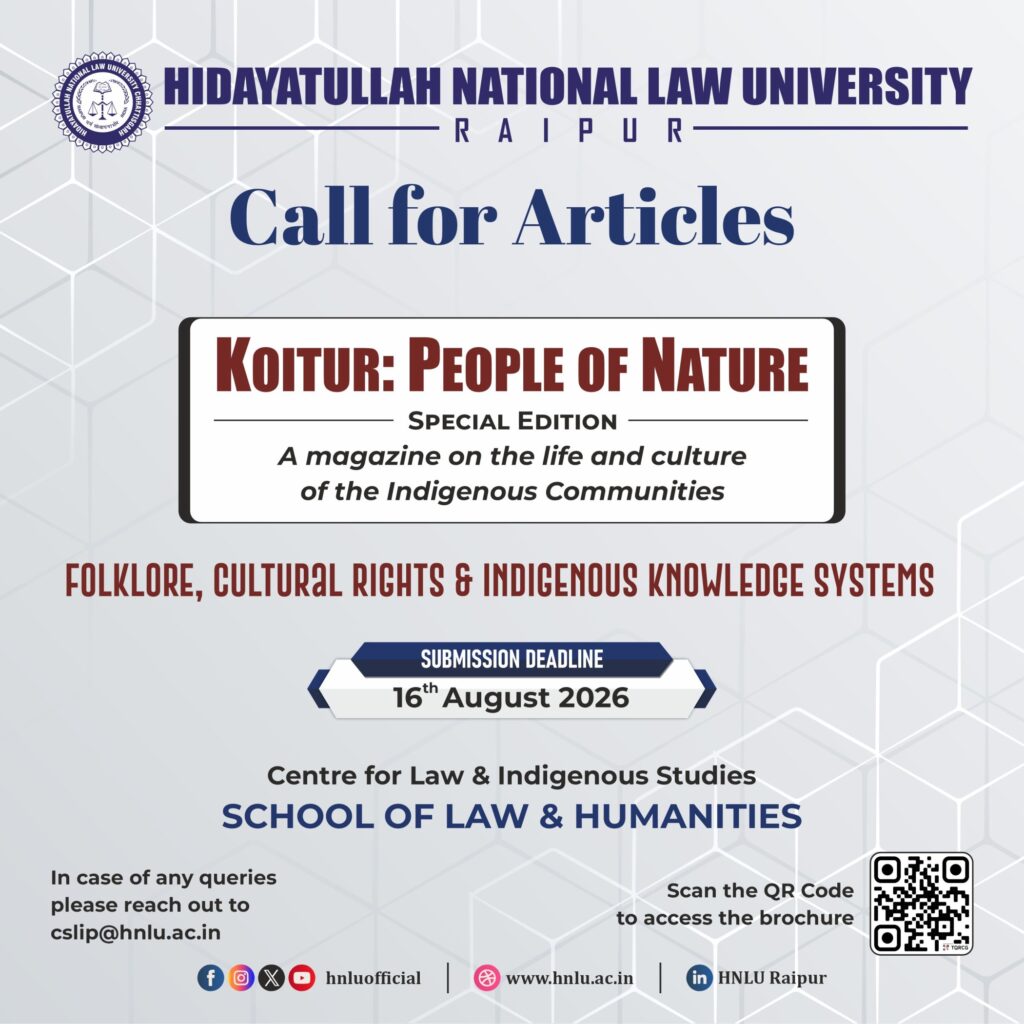
Folklore, Cultural Rights, and Indigenous Knowledge Systems
KOITUR Magazine invites original and unpublished articles, essays, commentaries, case studies, book reviews, and interdisciplinary reflections for its forthcoming Special Edition on “Folklore, Cultural Rights, and Indigenous Knowledge Systems.” This special issue seeks to critically examine the relationship between folklore, indigenous traditions, customary knowledge, and contemporary legal and policy frameworks.
Folklore is not merely a collection of stories and oral traditions; it represents the living memory, identity, ecological wisdom, and normative consciousness of communities. Across tribal and indigenous societies, folklore continues to influence governance, dispute resolution, environmental ethics, social relations, and cultural continuity. However, rapid commercialization, digital reproduction, cultural appropriation, and technological interventions have raised serious concerns regarding ownership, protection, and representation of indigenous cultural expressions.
This special edition aims to provide an interdisciplinary platform for academicians, researchers, practitioners, policymakers, activists, and students to engage with emerging conversations surrounding folklore, law, cultural rights, intellectual property, and indigenous knowledge systems from both national and international perspectives.
Suggested Themes
The following themes are indicative and not exhaustive:
- Folklore and Jurisprudence
- Indigenous Knowledge Systems and Legal Pluralism
- Tribal Oral Traditions and Community Governance
- Folklore, Gender, and Social Justice
- Sacred Ecology and Environmental Traditions
- Intellectual Property Rights and Traditional Cultural Expressions
- UNESCO, WIPO, and International Protection of Folklore
- Cultural Appropriation and Community Consent
- Folklore in the Digital Age: AI, Media, and Streaming Platforms
- Indigenous Languages, Storytelling, and Cultural Preservation
- Constitutional Protection of Tribal and Cultural Rights
- Folk Narratives and Human Rights Discourse
- Comparative Perspectives on Indigenous Communities across Africa, Latin America, Australia, Canada, New Zealand, and South-East Asia
- Folklore, Decoloniality, and Resistance
- Customary Laws and Contemporary Governance
- Community Ownership and Benefit-Sharing Mechanisms
- Folk Art, Music, Performance, and Cultural Heritage Protection
Submission Guidelines for Articles
- The word limit for submissions shall be 1000–1200 words, and all manuscripts must be submitted in MS Word format (.doc/.docx).
- The manuscript must be typed in Times New Roman, Font Size 12, with 1.5 line spacing, on A4 size paper with 1-inch margins on all sides.
- Each submission must be accompanied by a brief author profile containing:
- Name of the Author(s)
- Institutional Affiliation
- Designation
- Official Address
- Email Address
- Contact Number
- The manuscript must be original and unpublished and should not exceed a 10% similarity index and 10% AI-generated content under any recognised plagiarism and AI-detection software. Submissions failing to comply with these standards may not be considered for publication
- Authors are required to follow the Bluebook: A Uniform System of Citation (20th Edition) for citations and references.
- The last date for submission of articles is 16th August 2026. At cslip@hnlu.ac.in
Note: The suggested themes and sub-themes are illustrative and not exhaustive. Submissions addressing allied or interdisciplinary issues relevant to the theme of the special edition may also be considered for publication
Guidelines for Photo Submissions
- Technical Requirements
- Photographs must be submitted in digital format only.
- Images should be of high resolution (minimum 300 DPI) and saved in JPEG/JPG format.
- The recommended dimensions for images are 8.5 × 11 inches or smaller.
Quality Standards
- Photographs should demonstrate strong composition, clarity, lighting, and overall visual quality.
- Images must be properly focused and free from technical distortions such as excessive noise or blur.
- Minimal editing or post-processing is encouraged in order to preserve the authenticity of the subject matter.
Caption and Metadata Requirements
- Each photograph must be accompanied by:
- A caption (not exceeding 100 words) describing the subject, location, and context of the image.
- Relevant metadata including:
- Name of the Photographer
- Date of Capture
- Location
- Any additional contextual information relevant to the image
- Ethical and Legal Requirements
By submitting photographs, contributors affirm that
- They hold the necessary copyright over the submitted work; and
- Appropriate consent or permissions have been obtained wherever identifiable individuals or private property appear in the photographs.
- Submission Process
- Photographs, along with captions and author details, must be submitted via email to cslip@hnlu.ac.in
- The deadline for photo submissions is 16th August, 2026.
- Contributors are requested to include a brief bio and complete contact information with their submission.
Publication Rights
By submitting photographs, contributors grant the magazine non-exclusive publication rights to use the images in the magazine and related promotional materials.
Acknowledgement
- All selected contributors will receive appropriate credit through:
- By-lines and photo credits in the magazine;
- Recognition through the magazine’s website, social media platforms, and related academic or promotional initiatives.
We warmly invite Faculty, Scholars, Researchers, Photographers, Artists, and Cultural practitioners to contribute to this special edition and become part of an important dialogue on indigenous cultures, folklore, and community knowledge systems.