Introduction to Fundamental Rights and General Principles
➤ Core idea: Fundamental Rights are constitutional guarantees contained in Part III of the Constitution of India. They protect individuals from arbitrary power, preserve human dignity, and ensure that the State acts according to constitutional limits.
➤ Articles 12 and 13 as foundation: Articles 12 and 13 are placed at the beginning of Part III because they answer two basic questions: against whom Fundamental Rights are generally enforceable and what happens when a law violates Fundamental Rights.
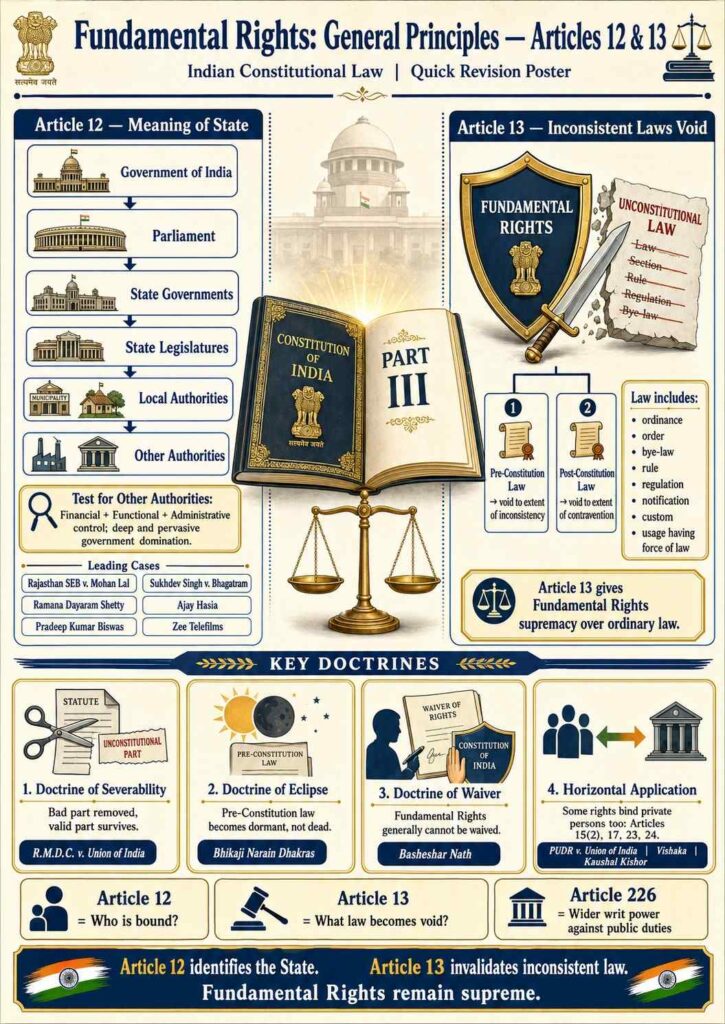
➤ Article 12 — meaning of “State”: Article 12 defines “State” for Part III. It includes the Government and Parliament of India, the Government and Legislature of each State, and all local or other authorities within India or under the control of the Government of India.
➤ Article 13 — invalidity of inconsistent laws: Article 13 declares that pre-Constitution laws inconsistent with Fundamental Rights are void to the extent of inconsistency, and the State cannot make any future law which takes away or abridges Fundamental Rights.
➤ Practical importance: Without Article 12, it would be unclear which bodies are bound by Fundamental Rights. Without Article 13, there would be no direct constitutional rule invalidating laws inconsistent with Part III.
Article 12 of the Constitution of India: Definition of State
➤ Textual meaning: Article 12 says that, unless the context otherwise requires, “the State” includes four broad categories: Government and Parliament of India, Government and Legislature of each State, local authorities, and other authorities within India or under the control of the Government of India.
➤ Inclusive definition: The word “includes” shows that Article 12 is not exhaustive. It gives a broad constitutional meaning so that bodies exercising public power do not escape Fundamental Rights merely because they are not traditional government departments.
➤ Purpose of Article 12: Fundamental Rights are mainly enforceable against the State because constitutional rights are designed to control public power. Therefore, whenever a body is found to be “State” under Article 12, its actions must satisfy constitutional standards such as equality, fairness, non-arbitrariness and reasonableness.
Government and Parliament of India
➤ Union executive and legislature: The Central Government, Union Ministries, departments, statutory offices under Union control, and Parliament are clearly “State”. Any executive order, administrative action, legislation, rule, regulation or notification made by them can be tested against Fundamental Rights.
➤ Example: A Central Government rule excluding a class of eligible persons from public employment can be challenged under Articles 14 and 16 if the classification is arbitrary or discriminatory.
Government and Legislature of States
➤ State executive and legislature: State Governments, State departments, State legislatures, and authorities functioning under State control are also covered by Article 12.
➤ Example: A State law restricting freedom of trade, speech, religion or equality can be challenged if it violates any provision of Part III.
Local Authorities under Article 12
➤ Meaning of local authority: Local authorities include bodies such as municipalities, panchayats, district boards, improvement trusts and other local self-government institutions that exercise statutory powers in a defined local area.
➤ Legal basis: A local authority generally has legal existence, power to administer local affairs, power to raise funds or taxes, and public duties towards residents of that area.
➤ Constitutional consequence: Since local authorities are “State”, their actions must be fair, non-arbitrary and consistent with Fundamental Rights.
Other Authorities under Article 12
➤ Most important expression: The phrase “other authorities” has created the richest constitutional jurisprudence under Article 12. It covers bodies which may not be government departments but are so connected with governmental power, public functions, public funding or governmental control that they should be treated as State.
➤ Early approach — statutory power test: In Rajasthan State Electricity Board v. Mohan Lal, AIR 1967 SC 1857, the Supreme Court held that the Rajasthan State Electricity Board was “State” under Article 12. The important principle was that an authority created by statute and having power to make binding rules or regulations could fall within “other authorities”.
➤ Expansion of State agencies: In Sukhdev Singh v. Bhagatram, (1975) 1 SCC 421, statutory corporations such as ONGC, LIC and IFC were treated as “State”. The Supreme Court recognised that modern governance often works through corporations and statutory bodies, and such bodies cannot avoid constitutional obligations when they exercise public power.
➤ Instrumentality or agency test: In Ramana Dayaram Shetty v. International Airport Authority of India, (1979) 3 SCC 489, the Supreme Court held that a government-created airport authority was an instrumentality of the State. The Court emphasised that even in contractual matters, State agencies must act fairly and cannot arbitrarily choose favoured persons.
➤ Ajay Hasia test: In Ajay Hasia v. Khalid Mujib Sehravardi, (1981) 1 SCC 722, the Supreme Court held that a society registered under the Societies Registration Act may also be “State” if it is in reality an instrumentality or agency of the Government. The Court gave indicators such as government funding, deep control, public importance of functions, transfer of government department to the body, and monopoly status.
➤ Pradeep Kumar Biswas clarification: In Pradeep Kumar Biswas v. Indian Institute of Chemical Biology, (2002) 5 SCC 111, a seven-Judge Bench clarified that the Ajay Hasia factors are not a rigid formula. The real test is whether the body is financially, functionally and administratively dominated by or under the control of the Government, and such control must be particular and pervasive, not merely regulatory.
➤ Mere regulation is not enough: A private body does not become State merely because it is regulated by law. For Article 12, there must be deep governmental domination or the body must be an instrumentality or agency of government.
➤ Zee Telefilms and BCCI: In Zee Telefilms Ltd. v. Union of India, (2005) 4 SCC 649, the Supreme Court by majority held that BCCI was not “State” under Article 12. The Court noted that BCCI was not created by statute, did not receive substantial government financial assistance, and was not under deep and pervasive government control.
➤ Public function distinction: Even if a body is not “State” under Article 12, it may still be subject to writ jurisdiction under Article 226 if it performs a public duty. This distinction is important because Article 12 is mainly relevant for Article 32 and Part III enforcement, while Article 226 is wider.
Article 12 and Writs against Private Bodies
➤ Article 32 position: Article 32 is normally used for enforcement of Fundamental Rights against the State. Therefore, whether the respondent is “State” under Article 12 becomes crucial.
➤ Article 226 is wider: High Courts under Article 226 can issue writs not only for Fundamental Rights but also “for any other purpose”. Therefore, writs may be issued against private bodies if they discharge public duties.
➤ Andi Mukta principle: In Andi Mukta Sadguru Shree Muktajee Vandas Swami Suvarna Jayanti Mahotsav Smarak Trust v. V.R. Rudani, (1989) 2 SCC 691, the Supreme Court held that the words “any person or authority” under Article 226 must receive a liberal meaning, and a writ can lie against a private body performing a public duty.
➤ Practical distinction: A private unaided school, private university, bank selection body, sports association or hospital may not always be “State” under Article 12. But if it performs public duties or is under statutory/public obligations, High Courts may examine its actions under Article 226.
Article 13 of the Constitution: Laws Inconsistent with Fundamental Rights
➤ Basic rule of constitutional supremacy: Article 13 ensures that Fundamental Rights prevail over ordinary laws. If a law is inconsistent with Part III, the inconsistent part becomes void.
➤ Article 13(1): It applies to laws in force before the commencement of the Constitution. Such laws become void to the extent of inconsistency with Fundamental Rights.
➤ Article 13(2): It prohibits the State from making any law which takes away or abridges Fundamental Rights. Any law made in contravention is void to the extent of contravention.
➤ Article 13(3)(a): “Law” includes Ordinance, order, bye-law, rule, regulation, notification, custom or usage having the force of law. This is very wide and ensures that executive and subordinate legal instruments are also tested against Fundamental Rights.
➤ Article 13(3)(b): “Laws in force” includes pre-Constitution laws passed or made by competent authorities, even if they were not operating in all areas at the commencement of the Constitution.
➤ Article 13(4): It says that Article 13 does not apply to constitutional amendments made under Article 368. This clause was inserted by the Constitution (Twenty-fourth Amendment) Act, 1971, but constitutional amendments are still subject to the basic structure doctrine after Kesavananda Bharati.
Doctrine of Severability under Article 13
➤ Meaning: The Doctrine of Severability means that when only a part of a law violates Fundamental Rights, only that offending part is void, and the remaining valid part can survive if it is independent and workable.
➤ Constitutional basis: Article 13 uses the words “to the extent of such inconsistency” and “to the extent of the contravention”, which clearly support severability.
➤ Simple example: If a statute has ten sections and only two sections violate Article 14, the Court may strike down only those two sections while allowing the remaining eight sections to operate.
➤ A.K. Gopalan principle: In A.K. Gopalan v. State of Madras, AIR 1950 SC 27, parts of preventive detention law were examined for constitutional validity. The case is important because the Court applied the idea that invalid portions of a law may be separated if the remaining law can function independently.
➤ R.M.D.C. test: In R.M.D. Chamarbaugwalla v. Union of India, AIR 1957 SC 628, the Supreme Court explained that the valid part of a law can survive if it is distinct and separable from the invalid part, and if the legislature would have enacted the valid part even without the invalid part.
➤ When severability fails: If the valid and invalid parts are so mixed that they cannot be separated, or if the remaining law becomes meaningless or contrary to legislative intention, the whole law may be struck down.
➤ Key memory point: Severability saves the valid portion of law; it does not save the unconstitutional portion.
Doctrine of Eclipse under Article 13
➤ Meaning: The Doctrine of Eclipse means that a pre-Constitution law inconsistent with Fundamental Rights is not dead for all purposes. It becomes dormant, overshadowed or eclipsed as against citizens while the inconsistency continues.
➤ Why it applies mainly to pre-Constitution laws: Article 13(1) deals with existing laws. Such laws were valid when made, but became unenforceable after the Constitution to the extent they conflicted with Fundamental Rights.
➤ Bhikaji Narain Dhakras case: In Bhikaji Narain Dhakras v. State of Madhya Pradesh, AIR 1955 SC 781, a pre-Constitution motor transport law became inconsistent with Article 19(1)(g). After the Constitution was amended to permit State monopoly in such business, the law revived. The Supreme Court applied the Doctrine of Eclipse and held that the law was not dead but only eclipsed.
➤ Effect of constitutional amendment: If the constitutional shadow is removed by a valid constitutional amendment, the eclipsed law may again become operative without fresh enactment, provided the law was pre-Constitutional and otherwise valid.
➤ Deep Chand limitation: In Deep Chand v. State of Uttar Pradesh, AIR 1959 SC 648, the Supreme Court indicated that post-Constitution laws violating Fundamental Rights are stillborn or void from inception under Article 13(2), so eclipse generally does not apply to them in the same way.
➤ Mahendra Lal Jaini clarification: In Mahendra Lal Jaini v. State of Uttar Pradesh, AIR 1963 SC 1019, the Court maintained the distinction between pre-Constitution laws under Article 13(1) and post-Constitution laws under Article 13(2).
➤ Key memory point: Eclipse means “temporarily hidden, not destroyed”; severability means “cut the bad part and keep the good part.”
Doctrine of Waiver of Fundamental Rights
➤ Meaning of waiver: Waiver means voluntary abandonment of a legal right. In ordinary private law, a person may waive certain rights. But Fundamental Rights are not ordinary private rights.
➤ Indian position: Fundamental Rights cannot generally be waived. A citizen cannot authorise the State to violate the Constitution.
➤ Basheshar Nath case: In Basheshar Nath v. Commissioner of Income Tax, AIR 1959 SC 149, the Supreme Court held that there can be no waiver of Fundamental Rights. Article 13(2) is a constitutional command to the State, and no citizen can relieve the State from obeying that command.
➤ Reasoning: Fundamental Rights are not merely individual benefits; they also protect public policy, constitutional morality and the rule of law. If waiver were freely allowed, the State could obtain consent from vulnerable citizens and bypass constitutional restrictions.
➤ Example: A person cannot validly agree that the State may discriminate against him in violation of Article 14, or punish him without authority of law in violation of Article 21.
➤ Key memory point: Fundamental Rights protect both the individual and the constitutional order; therefore, waiver cannot be used to validate unconstitutional State action.
Horizontal Application of Fundamental Rights
➤ Vertical application: Traditionally, Fundamental Rights operate vertically, meaning they are enforced by individuals against the State.
➤ Horizontal application: Horizontal application means enforcement of Fundamental Rights against private persons or private bodies.
➤ Indian Constitution has mixed design: Many Fundamental Rights are directed against the State, but some provisions expressly or effectively apply against private individuals also.
➤ Article 15(2): Article 15(2) prohibits denial of access to shops, public restaurants, hotels, places of public entertainment, wells, tanks, roads and places of public resort on specified grounds. Its wording is not limited only to State action and therefore has a direct horizontal character in public access contexts.
➤ Article 17: Abolition of untouchability applies against society at large. A private person practising untouchability cannot say that Fundamental Rights bind only the State.
➤ Article 23: Prohibition of trafficking, begar and forced labour applies against both State and private persons. In People’s Union for Democratic Rights v. Union of India, AIR 1982 SC 1473, the Supreme Court held that Article 23 is enforceable even against private individuals, and the State has a duty to prevent forced labour.
➤ Article 24: Prohibition of employment of children in factories, mines and hazardous employment also affects private employers.
➤ Vishaka and workplace dignity: In Vishaka v. State of Rajasthan, (1997) 6 SCC 241, the Supreme Court framed guidelines against sexual harassment at workplace until legislation was enacted. The case used Articles 14, 15, 19(1)(g) and 21 to protect dignity and equality in both public and private workplaces.
➤ Kaushal Kishor development: In Kaushal Kishor v. State of Uttar Pradesh, (2023) 4 SCC 1, the Supreme Court discussed horizontal application of Articles 19 and 21. The majority took a wider view that Fundamental Rights under Articles 19 and 21 may operate even against persons other than the State in appropriate situations, though practical enforcement will depend on the nature of remedy and facts.
➤ Caution: Horizontal application does not mean every private dispute automatically becomes a Fundamental Rights case. Courts examine the nature of the right, the nature of the duty, availability of statutory/common law remedies, and whether public law intervention is appropriate.
Enforceability against Private Bodies where Applicable
➤ Private body as State: A private or non-government body may be treated as “State” under Article 12 if it is financially, functionally and administratively dominated by the Government with deep and pervasive control.
➤ Private body under Article 226: Even if not State under Article 12, a private body performing public duty may be subject to writ jurisdiction under Article 226.
➤ Private body under horizontal rights: Certain Fundamental Rights directly or indirectly bind private persons, such as Articles 15(2), 17, 23 and 24.
➤ Statutory enforcement: Many constitutional values are enforced against private bodies through statutes, such as labour laws, anti-discrimination provisions, child labour laws, environmental laws, consumer protection law and sexual harassment law.
➤ Public function test: If a private body performs functions having public importance, statutory flavour, public duty, or monopoly-like control over essential opportunities, courts may examine its actions more closely.
➤ Illustration: A private restaurant refusing entry on the ground of caste may violate Article 15(2). A private contractor extracting forced labour may violate Article 23. A private body conducting public recruitment for public sector institutions may be examined under Article 226 if public duty is established.
Article 13 and Constitutional Amendments
➤ Early controversy: The question arose whether a constitutional amendment is “law” under Article 13 and whether it can be struck down for violating Fundamental Rights.
➤ Shankari Prasad: In Shankari Prasad v. Union of India, AIR 1951 SC 458, the Supreme Court held that constitutional amendments under Article 368 were not ordinary “law” under Article 13.
➤ Golak Nath: In I.C. Golak Nath v. State of Punjab, AIR 1967 SC 1643, the Supreme Court took a different view and held that Parliament could not amend Fundamental Rights.
➤ Twenty-fourth Amendment: Parliament inserted Article 13(4), stating that Article 13 does not apply to constitutional amendments made under Article 368.
➤ Kesavananda Bharati: In Kesavananda Bharati v. State of Kerala, (1973) 4 SCC 225, the Supreme Court held that Parliament may amend any part of the Constitution, including Fundamental Rights, but cannot destroy the basic structure of the Constitution.
➤ Present position: Constitutional amendments are not struck down merely under Article 13, but they can be invalidated if they damage or destroy the basic structure, such as rule of law, judicial review, equality, constitutional supremacy, secularism, federalism or democracy.
Difference between Article 12 and Article 13
| Basis | Article 12 | Article 13 |
|---|---|---|
| Main function | Defines “State” for Part III | Invalidates laws inconsistent with Fundamental Rights |
| Main question | Against whom can Fundamental Rights be enforced? | What happens to unconstitutional laws? |
| Focus | Identity of authority/body | Validity of law/action |
| Key expression | State, local authority, other authority | Law, laws in force, void |
| Important doctrines | Instrumentality test, public function distinction | Severability, eclipse, waiver, judicial review |
| Practical use | Determines maintainability against a body | Determines whether law survives constitutional scrutiny |
Important Memory Chart
| Doctrine | Simple meaning | Main use | Leading case |
|---|---|---|---|
| Severability | Remove unconstitutional part and save valid part | Article 13 invalidity | R.M.D.C. v. Union of India, AIR 1957 SC 628 |
| Eclipse | Law is dormant, not dead | Pre-Constitution inconsistent law | Bhikaji Narain Dhakras, AIR 1955 SC 781 |
| Waiver | Giving up a right | Generally not allowed for Fundamental Rights | Basheshar Nath, AIR 1959 SC 149 |
| Instrumentality test | Body is really government agency | Article 12 “other authorities” | Ajay Hasia, (1981) 1 SCC 722 |
| Deep and pervasive control | Government domination must be real | Article 12 bodies | Pradeep Kumar Biswas, (2002) 5 SCC 111 |
Conclusion
➤ Article 12 gives reach: Article 12 ensures that Fundamental Rights bind not only traditional government departments but also authorities and instrumentalities through which the State acts.
➤ Article 13 gives force: Article 13 gives Fundamental Rights legal supremacy by making inconsistent laws void to the extent of inconsistency.
➤ Judicial review is the connecting principle: Courts use Articles 12 and 13 to examine whether a body is constitutionally accountable and whether a law or action violates Part III.
➤ Modern constitutional trend: Indian law has moved from a narrow State-action model to a more realistic approach. Public corporations, statutory bodies, government-controlled societies, and private bodies performing public duties may be constitutionally scrutinised depending on the facts.
➤ Final essence: Article 12 identifies the constitutional wrongdoer; Article 13 invalidates the unconstitutional law. Together, they make Fundamental Rights meaningful, enforceable and capable of controlling both old and new forms of power.