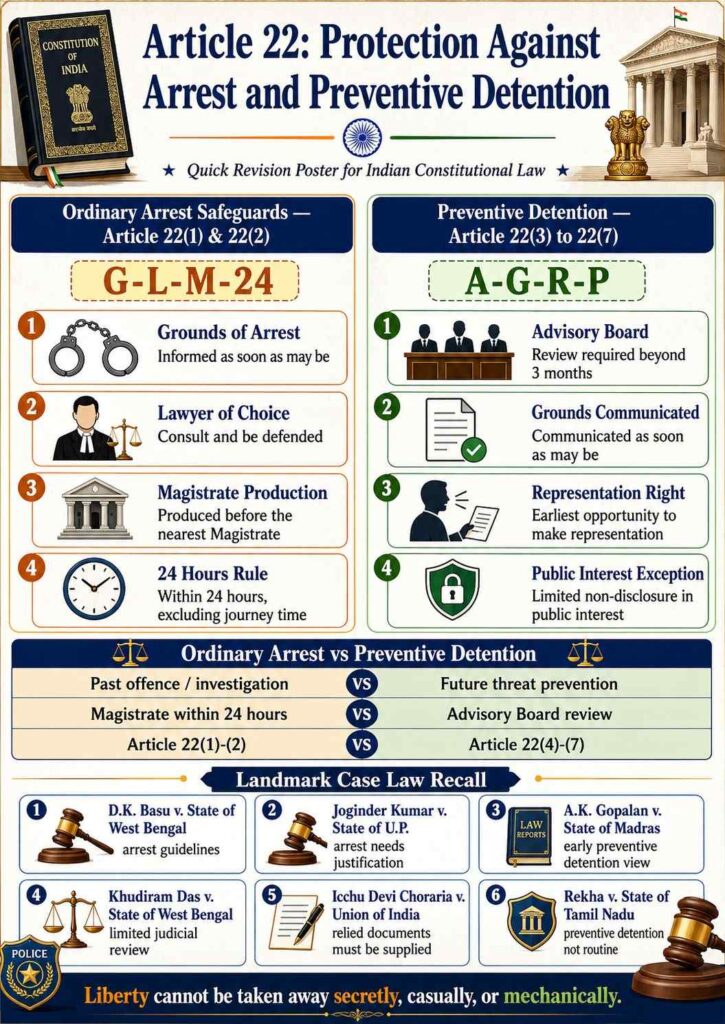
Meaning and Constitutional Purpose of Article 22
● Core idea: Article 22 of the Constitution of India protects personal liberty by placing constitutional limits on the power of the State to arrest and detain a person. It deals with two different situations: ordinary arrest in criminal law and preventive detention under special detention laws. Article 22(1) and Article 22(2) mainly deal with ordinary arrest, while Article 22(4) to Article 22(7) deal with preventive detention. Article 22(3) creates exceptions for enemy aliens and persons detained under preventive detention laws.
● Personal liberty connection: Article 22 must be read with Article 21, which says that no person shall be deprived of life or personal liberty except according to procedure established by law. After Maneka Gandhi v. Union of India, (1978) 1 SCC 248, “procedure established by law” must be fair, just, and reasonable; therefore, arrest and detention cannot be mechanical, arbitrary, or unfair.
● Two-fold structure: Article 22 is both protective and exceptional. It gives strong safeguards in ordinary arrest, but it also constitutionally permits preventive detention, where a person may be detained not for what he has already been convicted of, but to prevent anticipated harmful acts. This makes preventive detention an extraordinary power requiring strict constitutional control.
Ordinary Arrest Safeguards under Article 22(1) and 22(2)
● Right to know grounds of arrest: Article 22(1) provides that no arrested person shall be detained in custody without being informed, “as soon as may be,” of the grounds of arrest. This means the arrested person must know the real reasons for arrest, not merely the name of the offence. The purpose is to enable the person to challenge the arrest, seek bail, consult a lawyer, and prepare a defence.
● Right to consult and be defended by a lawyer: Article 22(1) also gives the arrested person the right to consult and be defended by a legal practitioner of his choice. This is a constitutional recognition that liberty cannot be protected unless the arrested person has access to legal assistance.
● Production before Magistrate within 24 hours: Article 22(2) requires that every arrested and detained person must be produced before the nearest Magistrate within 24 hours of arrest, excluding the time necessary for journey from the place of arrest to the Magistrate’s court. Detention beyond 24 hours is illegal unless authorised by a Magistrate.
● Judicial check on police custody: The 24-hour rule prevents secret detention and police custody without judicial supervision. The Magistrate is not a rubber stamp; he must examine whether arrest, custody, and remand are legally justified.
● BNSS statutory support: The Bharatiya Nagarik Suraksha Sanhita, 2023 strengthens these constitutional safeguards. Section 47 BNSS requires communication of full particulars of the offence or grounds of arrest, and Section 48 BNSS requires information about arrest and place of detention to be given to a relative, friend, or nominated person. Sections 57 and 58 relate to taking the arrested person before the Magistrate or officer-in-charge and the 24-hour limit.
Important Case Laws on Ordinary Arrest
● Joginder Kumar v. State of U.P., (1994) 4 SCC 260: The Supreme Court held that arrest should not be made merely because it is lawful to arrest. The police officer must justify the necessity of arrest. The case arose when the petitioner, a young advocate, was taken by police and his whereabouts were not properly disclosed. The issue was whether police power of arrest can be exercised routinely. The Court held that arrest affects reputation and liberty, and therefore there must be reasonable justification. This case developed the principle that power to arrest is different from justification for arrest.
● D.K. Basu v. State of West Bengal, (1997) 1 SCC 416: The Supreme Court issued binding guidelines to prevent custodial violence and illegal detention. The facts involved public interest litigation on custodial deaths. The issue was how to protect arrested persons from abuse of police power. The Court held that arrest memo, identification of arresting officers, information to relatives, medical examination, diary entries, and production before Magistrate are necessary safeguards. The ratio is that custodial power must be transparent, accountable, and consistent with Articles 21 and 22.
● Pankaj Bansal v. Union of India, 2023 INSC 866: The Supreme Court held in the PMLA context that written grounds of arrest must be supplied to the arrested person. The Court reasoned that merely reading out grounds may defeat Article 22(1), especially when grounds are detailed or disputed. The ratio is that meaningful communication of grounds of arrest is necessary to make the constitutional right effective.
● Prabir Purkayastha v. State (NCT of Delhi), 2024 INSC 414: The Supreme Court applied the requirement of written communication of grounds of arrest in a UAPA arrest. The Court treated Article 22(1) as a real safeguard, not an empty formality. The ratio is that non-supply of proper grounds of arrest may vitiate arrest and remand.
● Vihaan Kumar v. State of Haryana, 2025 INSC 162: The Supreme Court reiterated that communication of grounds of arrest under Article 22(1) is a sacrosanct constitutional requirement. The Court held that failure to communicate grounds can render custody illegal. This case is important because it confirms that Article 22(1) applies beyond special statutes and remains a general constitutional command for arrest.
Exceptions under Article 22(3)
● Enemy alien exception: Article 22(3)(a) says Article 22(1) and Article 22(2) do not apply to an enemy alien. An enemy alien is generally a national of a country at war with India. This is a national security exception.
● Preventive detention exception: Article 22(3)(b) says Article 22(1) and Article 22(2) do not apply to a person arrested or detained under a preventive detention law. This does not mean such a person has no rights. It means ordinary arrest safeguards are replaced by special safeguards under Article 22(4) to Article 22(7).
Meaning of Preventive Detention
● Preventive, not punitive: Preventive detention means detention to prevent a person from doing something harmful in the future. It is not punishment for a completed offence. In ordinary criminal law, a person is punished after trial and conviction. In preventive detention, the executive detains a person on subjective satisfaction that detention is necessary to prevent prejudicial activity.
● Extraordinary nature: Preventive detention is constitutionally allowed, but it is an exception to normal liberty. Because there is no regular criminal trial at the stage of detention, courts insist on strict compliance with constitutional and statutory safeguards.
● Examples of preventive detention laws: Laws like the National Security Act, 1980, COFEPOSA, PIT NDPS Act, and State preventive detention laws operate within the constitutional framework of Article 22.
Article 22(4): Advisory Board Safeguard
● Three-month constitutional limit: Article 22(4) provides that no preventive detention law shall authorise detention for more than three months unless an Advisory Board reports, before expiry of three months, that there is sufficient cause for detention. The Advisory Board must consist of persons who are, have been, or are qualified to be appointed as Judges of a High Court.
● Function of Advisory Board: The Advisory Board acts as a constitutional check on executive detention. It examines whether there is sufficient cause for continued detention. It is not a regular criminal court, but it provides an independent review mechanism.
● Effect of adverse opinion: If the Advisory Board finds no sufficient cause, continued detention becomes unconstitutional and the detenu must be released, unless held under some other valid law.
● Maximum period: Even if the Advisory Board supports detention, the detenu cannot be detained beyond the maximum period prescribed by law made by Parliament under Article 22(7)(b). Article 22(4) itself states that Advisory Board approval does not authorise detention beyond the statutory maximum.
Article 22(5): Communication of Grounds and Right to Representation
● Two essential rights: Article 22(5) gives two valuable rights to a preventive detenu: first, the authority must communicate the grounds of detention “as soon as may be”; second, the detenu must be given the earliest opportunity to make a representation against the detention order.
● Effective communication: Communication of grounds must be real and understandable. The detenu must receive enough basic facts, particulars, and relied-upon material to make an effective representation. A vague, incomplete, or unintelligible communication defeats Article 22(5).
● Language requirement: If the detenu does not understand the language of the grounds or documents, merely serving papers may not amount to proper communication. The grounds must be communicated in a language or manner the detenu can understand.
● Documents relied upon: If the detention order is based on documents, statements, or other material, copies of such material must ordinarily be supplied, unless protected by a valid public interest claim under Article 22(6). Without relied-upon documents, the right to representation becomes ineffective.
● Earliest opportunity: The right to representation is not decorative. The government must consider the representation promptly and independently. Delay in consideration may invalidate continued detention.
Article 22(6): Public Interest Non-disclosure
● Limited secrecy exception: Article 22(6) says the detaining authority is not required to disclose facts which it considers against public interest to disclose. This protects sensitive information such as confidential sources or security intelligence.
● Not a blanket power: Article 22(6) cannot be used to hide all material or make the detenu helpless. The authority must still disclose sufficient grounds to enable representation. If everything material is withheld, the constitutional safeguard under Article 22(5) is destroyed.
Article 22(7): Parliament’s Power
● Legislative control: Article 22(7) empowers Parliament to prescribe three things: circumstances and classes of cases where detention may exceed three months without Advisory Board opinion, the maximum period of detention, and the procedure to be followed by the Advisory Board.
● Constitutional balance: Article 22(7) shows that preventive detention is not left entirely to executive discretion. Parliament must define limits, periods, and procedure. However, any such law must also satisfy broader constitutional principles under Articles 14, 21, and 22.
Important Case Laws on Preventive Detention
● A.K. Gopalan v. State of Madras, AIR 1950 SC 27: The petitioner was detained under the Preventive Detention Act, 1950 and challenged the law as violating fundamental rights. The issue was whether preventive detention law had to satisfy Articles 19, 21, and 22 together. The early majority view treated fundamental rights more separately and upheld preventive detention subject to Article 22 safeguards, though parts of the law were struck down. The later constitutional approach after Maneka Gandhi is broader, requiring fairness, reasonableness, and non-arbitrariness in laws affecting liberty.
● Haradhan Saha v. State of West Bengal, (1975) 3 SCC 198: The petitioners were detained under preventive detention law for activities affecting essential supplies. The issue was whether preventive detention and criminal prosecution can exist simultaneously. The Supreme Court held that preventive detention is different from punitive prosecution: prosecution punishes past acts, while preventive detention prevents future harm. The ratio is that pendency of prosecution does not automatically bar preventive detention, but the detention must satisfy constitutional safeguards.
● Khudiram Das v. State of West Bengal, (1975) 2 SCC 81: The detenu was detained under MISA on grounds relating to disruption of essential supplies. The issue was whether subjective satisfaction of the detaining authority is completely immune from judicial review. The Supreme Court held that subjective satisfaction can be examined on limited grounds such as mala fides, irrelevant material, non-application of mind, or absence of relevant material. The ratio is that preventive detention power is preventive, but not arbitrary or beyond constitutional scrutiny.
● Icchu Devi Choraria v. Union of India, (1980) 4 SCC 531: The detention was based on several documents, and the detenu sought copies to make an effective representation. The issue was whether non-supply of relied-upon documents violates Article 22(5). The Supreme Court held that documents and material relied upon must be supplied with reasonable expedition, because representation is meaningless without access to the basis of detention. The ratio is that Article 22(5) requires effective, not merely formal, opportunity of representation.
● Shalini Soni v. Union of India, (1980) 4 SCC 544: The Supreme Court explained that “grounds” means not only bare conclusions but also basic facts on which detention is founded. The issue was whether vague grounds satisfy Article 22(5). The Court held that grounds must be sufficiently clear and complete to enable representation. The ratio is that vague grounds make detention unconstitutional because they disable the detenu from answering the case.
● Rekha v. State of Tamil Nadu, (2011) 5 SCC 244: The detenu was detained under a State preventive detention law despite ordinary criminal law being available. The issue was whether preventive detention can be used casually when normal law can deal with the situation. The Supreme Court held that preventive detention is repugnant to democratic ideas of liberty and must be used only when strictly necessary. The ratio is that preventive detention cannot become a substitute for ordinary criminal prosecution.
Constitutional Limits on Preventive Detention
● Strict construction: Preventive detention laws are strictly construed because they permit detention without trial. Any procedural violation generally benefits the detenu.
● Live and proximate link: There must be a live and proximate connection between past conduct and the need for detention. If the detention order is based on stale incidents, the link may snap, making detention invalid.
● No mechanical detention: The detaining authority must apply its own mind. Copy-paste orders, non-consideration of bail status, irrelevant material, or failure to consider vital facts may show non-application of mind.
● Not substitute for criminal law: If ordinary criminal law is sufficient and there is no special preventive necessity, preventive detention may be unconstitutional. The State must show why detention without trial is necessary.
● Judicial review remains available: Courts do not sit as appellate authorities over subjective satisfaction, but they can examine legality, relevance of material, procedural compliance, mala fides, delay, vagueness, non-supply of documents, and violation of Article 22(5).
Difference between Ordinary Arrest and Preventive Detention
| Basis | Ordinary Arrest | Preventive Detention |
|---|---|---|
| Purpose | Investigation, trial, or securing presence of accused | Preventing future prejudicial acts |
| Nature | Connected with alleged offence | Based on anticipated danger |
| Article 22 safeguards | Article 22(1) and 22(2) apply | Article 22(4) to 22(7) apply |
| Lawyer right | Express right under Article 22(1) | Not expressly guaranteed in same form under Article 22(5) |
| Magistrate within 24 hours | Mandatory under Article 22(2) | Not applicable due to Article 22(3)(b) |
| Review mechanism | Magistrate and criminal courts | Advisory Board and constitutional courts |
| Core remedy | Bail, quashing of arrest/remand, habeas corpus | Representation, Advisory Board review, habeas corpus |
Memory Aid for Article 22
● Ordinary arrest — “G-L-M-24”: Grounds, Lawyer, Magistrate, 24 hours.
● Preventive detention — “A-G-R-P”: Advisory Board, Grounds, Representation, Public interest exception.
Conclusion
● Balanced understanding: Article 22 is a constitutional shield against arbitrary arrest and detention, but it also recognises preventive detention as an exceptional State power. In ordinary arrest, the Constitution insists on immediate knowledge of grounds, access to legal defence, and production before a Magistrate within 24 hours. In preventive detention, where ordinary safeguards are excluded, Article 22 creates special protections through Advisory Board review, communication of grounds, and earliest opportunity of representation.
● Central principle: The strongest idea behind Article 22 is that personal liberty cannot be taken away secretly, casually, or mechanically. Whether the case concerns police arrest or preventive detention, the State must act under law, disclose legally sufficient reasons, follow procedure strictly, and respect the person’s right to challenge the loss of liberty.