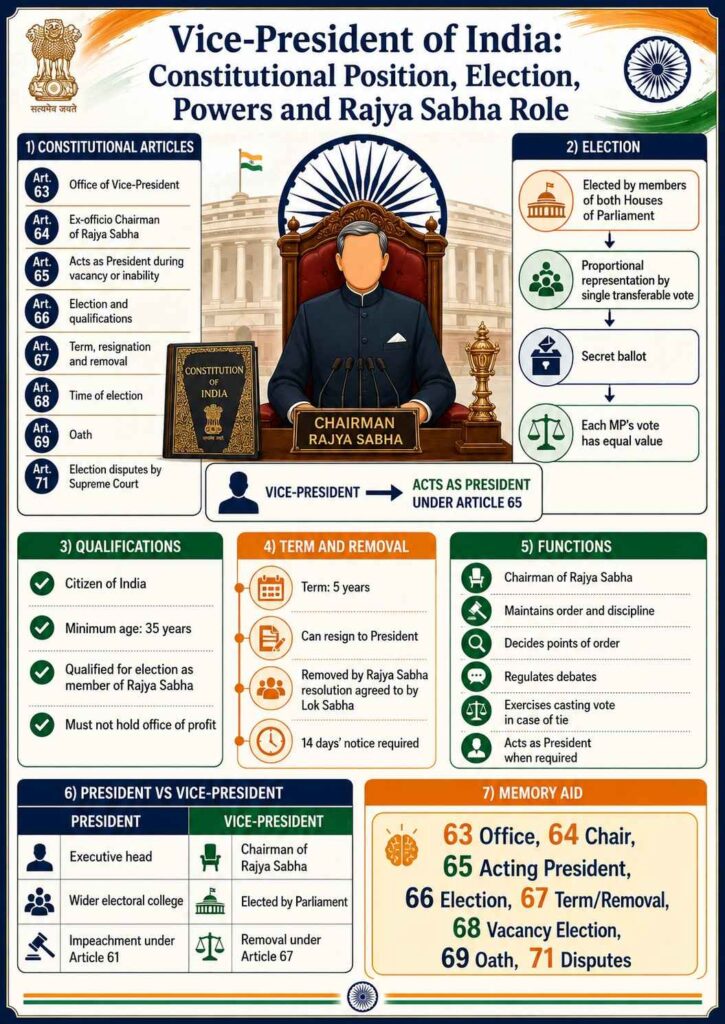
Meaning and Constitutional Position of Vice-President of India
➤ Constitutional office: The Vice-President of India is a high constitutional authority created under Article 63 of the Constitution of India. The office is important because it connects two major parts of the Constitution: the Union Executive and the Parliament. The Vice-President is not the ordinary “deputy” of the President in day-to-day executive administration, but he becomes constitutionally important when the office of the President becomes vacant or when the President is unable to discharge functions.
➤ Present office-holder: As of the current available official parliamentary position, Shri C. P. Radhakrishnan is shown as the Chairman of Rajya Sabha, which office is held ex officio by the Vice-President of India. The Rajya Sabha website states that the Vice-President of India is the ex-officio Chairman of Rajya Sabha and displays Shri C. P. Radhakrishnan as Chairman.
➤ Basic constitutional idea: The Vice-President is placed immediately after the President in constitutional order. However, unlike the President, the Vice-President does not normally exercise executive powers of the Union. His regular constitutional role is mainly parliamentary, because he presides over the Rajya Sabha as its Chairman under Article 64.
Constitutional Provisions Related to Vice-President of India
➤ Article 63 — Vice-President of India: This Article provides that there shall be a Vice-President of India. The word “shall” makes the office mandatory and permanent in the constitutional scheme.
➤ Article 64 — Ex-officio Chairman of Rajya Sabha: The Vice-President is the ex-officio Chairman of the Council of States, that is, Rajya Sabha. “Ex-officio” means by virtue of holding another office. Therefore, the Vice-President automatically becomes Chairman of Rajya Sabha without a separate election by the House.
➤ Article 65 — Acting as President: When the office of President becomes vacant due to death, resignation, removal or otherwise, the Vice-President acts as President until a new President enters office. If the President is temporarily unable to discharge functions due to absence, illness or any other cause, the Vice-President discharges those functions until the President resumes office.
➤ Article 66 — Election and qualifications: This Article deals with the election method, electoral college, secret ballot, proportional representation, qualifications and disqualifications for the office of Vice-President. Article 66 provides that the Vice-President is elected by members of both Houses of Parliament through proportional representation by means of the single transferable vote, and voting is by secret ballot.
➤ Article 67 — Term, resignation and removal: This Article provides that the Vice-President holds office for five years from the date on which he enters office. It also provides the method of resignation and removal.
➤ Article 68 — Time of election to fill vacancy: This Article ensures timely election to the office. If the vacancy is caused by expiry of term, the election must be completed before the term expires. If the vacancy occurs due to death, resignation, removal or otherwise, election must be held as soon as possible.
➤ Article 69 — Oath or affirmation: Before entering office, the Vice-President must make and subscribe an oath or affirmation before the President or a person appointed by the President.
➤ Article 70 — Discharge of President’s functions in other contingencies: Parliament may make provision for discharge of President’s functions in contingencies not expressly covered in the Constitution.
➤ Article 71 — Election disputes: All doubts and disputes connected with the election of the President or Vice-President are decided by the Supreme Court of India, and its decision is final. The Constitution also protects acts done by the President or Vice-President before the Supreme Court declares an election void.
Election of Vice-President of India
➤ Electoral college: The Vice-President is elected by an electoral college consisting of members of both Houses of Parliament. This includes members of Lok Sabha and Rajya Sabha. Unlike the President’s election, members of State Legislative Assemblies do not participate in the Vice-President’s election. The Election Commission’s official material also explains that the Vice-President is elected by members of Lok Sabha and Rajya Sabha, including elected and nominated members.
➤ Difference from President’s electoral college: The President is elected by elected members of both Houses of Parliament and elected members of State Legislative Assemblies, including relevant elected members of Union Territory legislatures as constitutionally provided. But the Vice-President is elected only by Parliament members. This difference exists because the Vice-President’s ordinary function is to preside over Rajya Sabha, not to represent the Union and States in the same wider manner as the President.
➤ Method of election: The election is held according to the system of proportional representation by means of the single transferable vote, and the voting is by secret ballot. Article 66 expressly states these requirements.
➤ Single transferable vote explained simply: Each elector marks preferences, such as first preference, second preference and so on. The purpose is to ensure that the elected candidate has the required quota of support. Since only one office is to be filled, the system allows votes to be transferred according to preferences if required.
➤ Value of vote: In Vice-Presidential election, the value of each Member of Parliament’s vote is the same. For example, the PIB note for the 2025 Vice-Presidential Election stated that because all electors were members of both Houses of Parliament, the value of vote of each MP was one.
➤ Superintendence by Election Commission: The conduct of election to the office of Vice-President is under the superintendence, direction and control of the Election Commission of India under Article 324 read with the Presidential and Vice-Presidential Elections Act, 1952 and the Presidential and Vice-Presidential Elections Rules, 1974. The PIB note for the 2025 election specifically records this legal position.
➤ No joint sitting now: Earlier, the constitutional text referred to members of both Houses assembled at a joint meeting. After the Eleventh Constitutional Amendment, 1961, the requirement of a joint meeting was removed. Now the electoral college consists of members of both Houses, but they do not need to assemble in a joint sitting.
Qualifications for Vice-President of India
➤ Citizenship: The candidate must be a citizen of India. This is a basic requirement because the office is part of the sovereign constitutional structure of India.
➤ Minimum age: The candidate must have completed 35 years of age. The age requirement is the same as that for the President.
➤ Rajya Sabha qualification: The candidate must be qualified for election as a member of the Council of States, that is, Rajya Sabha. Article 66(3) expressly provides that a person is eligible for election as Vice-President only if he is a citizen of India, has completed 35 years of age, and is qualified for election as a member of the Council of States.
➤ Office of profit disqualification: A person is not eligible if he holds any office of profit under the Government of India, a State Government, or any local or other authority subject to the control of government. However, the Constitution clarifies that a person is not disqualified merely because he is the President, Vice-President, Governor of any State, or a Minister of the Union or a State.
➤ Not member of Legislature after election: The Vice-President cannot be a member of either House of Parliament or of a State Legislature. If such a member is elected as Vice-President, he is deemed to have vacated his legislative seat on the date on which he enters office as Vice-President.
Nomination and Election Process
➤ Nomination requirement: A candidate must be properly nominated according to the Presidential and Vice-Presidential Elections Act, 1952 and related rules. The nomination is not a mere formality; it is a legal requirement that confirms seriousness, eligibility and support.
➤ Proposers and seconders: For Vice-Presidential elections, the nomination paper must be subscribed by the required number of electors as proposers and seconders under the statutory framework. This requirement prevents non-serious candidatures and ensures that only candidates with some parliamentary support enter the contest.
➤ Security deposit: The candidate is also required to make the prescribed security deposit. The purpose of a security deposit is to discourage frivolous nominations.
➤ Scrutiny and withdrawal: After nominations, the Returning Officer scrutinises nomination papers. Invalid nominations may be rejected. Candidates may also withdraw within the prescribed time. If more than one validly nominated candidate remains, a poll is held.
➤ Secret ballot and party whip: Voting in Vice-Presidential election is by secret ballot. Therefore, an elector is expected to vote according to constitutional and electoral rules, not under an ordinary party whip in the same manner as a legislative vote inside the House.
Term of Office of Vice-President
➤ Five-year term: Under Article 67, the Vice-President holds office for a term of five years from the date on which he enters office. The PIB note for the 2025 Vice-Presidential election also refers to this five-year constitutional term under Article 67.
➤ Continuation until successor enters office: Even after expiry of the five-year term, the Vice-President continues to hold office until his successor enters office. This avoids a constitutional vacuum.
➤ Eligibility for re-election: The Constitution does not prohibit re-election of the Vice-President. Therefore, a person may be elected again if he satisfies the required qualifications and wins the election.
➤ Full term after casual vacancy: Where vacancy occurs due to death, resignation, removal or otherwise, the person elected to fill that vacancy is entitled to hold office for a full term of five years from the date on which he enters office, subject to Article 67. The Election Commission/PIB explanation of the 2025 vacancy also records this position under Article 68(2).
Resignation of Vice-President
➤ Mode of resignation: The Vice-President may resign by writing under his hand addressed to the President of India. The resignation becomes constitutionally effective according to the applicable process once communicated.
➤ Reason for addressing President: Since the Vice-President is a constitutional authority immediately connected with the President’s office, the resignation is addressed to the President, not to Parliament or the Prime Minister.
Removal of Vice-President
➤ Removal mechanism: The Vice-President can be removed by a resolution of the Rajya Sabha passed by a majority of all the then members of the Rajya Sabha and agreed to by the Lok Sabha. This is different from impeachment of the President.
➤ Notice requirement: A resolution for removal cannot be moved unless at least 14 days’ notice has been given of the intention to move the resolution. This gives seriousness and procedural fairness to the removal process.
➤ No specific grounds mentioned: The Constitution does not expressly mention grounds such as “violation of Constitution” for removal of the Vice-President. This is different from the President, who may be impeached for violation of the Constitution.
➤ Rajya Sabha’s central role: Since the Vice-President’s regular function is to act as Chairman of Rajya Sabha, the Rajya Sabha has the primary role in initiating removal. Lok Sabha’s agreement is also necessary, ensuring parliamentary control by both Houses.
➤ Comparison with President’s impeachment: The President’s removal is by impeachment under Article 61 and requires a more elaborate process. The Vice-President’s removal is simpler in form but still constitutionally serious because it requires special majority in Rajya Sabha and agreement of Lok Sabha.
Oath or Affirmation of Vice-President
➤ Oath before entering office: Under Article 69, the Vice-President must make an oath or affirmation before the President or a person appointed by the President.
➤ Substance of oath: The oath requires the Vice-President to bear true faith and allegiance to the Constitution of India and to faithfully discharge the duty of the office. This oath reflects constitutional loyalty, not loyalty to any party or government.
Functions and Powers of Vice-President of India
➤ Chairman of Rajya Sabha: The most regular and visible function of the Vice-President is to act as the Chairman of Rajya Sabha. The official Rajya Sabha website states that the Vice-President is the ex-officio Chairman of Rajya Sabha and that the Deputy Chairman presides in the absence of the Chairman.
➤ Acting President: The Vice-President acts as President when the office of President becomes vacant due to death, resignation, removal or otherwise. He continues in that role until a new President is elected and enters office.
➤ Discharging President’s functions temporarily: When the President is unable to discharge functions because of absence, illness or any other cause, the Vice-President discharges the President’s functions until the President resumes office.
➤ No ordinary executive authority: The Vice-President does not normally exercise the executive power of the Union. The executive power is vested in the President under Article 53, exercised according to the Constitution with the aid and advice of the Council of Ministers under Article 74.
➤ No membership of Rajya Sabha: Although the Vice-President presides over Rajya Sabha, he is not a member of Rajya Sabha. This gives him a neutral presiding position.
➤ Casting vote: As Chairman of Rajya Sabha, the Vice-President does not vote in the first instance because he is not a member of the House. However, in case of equality of votes, he may exercise a casting vote.
Role as Chairman of Rajya Sabha
➤ Presiding over sittings: The Chairman conducts the proceedings of Rajya Sabha. He ensures that debates are held according to constitutional provisions, parliamentary rules, conventions and standards of decorum.
➤ Maintaining order: The Chairman maintains discipline in the House. He may call members to order, regulate speeches, decide who may speak, and ensure that members follow parliamentary procedure.
➤ Deciding points of order: Members may raise points of order when they believe that the rules of procedure or constitutional requirements are being violated. The Chairman decides such points, and his decision carries great procedural importance.
➤ Regulating debates: The Chairman ensures that debate remains relevant to the matter before the House. This function is important because parliamentary time is limited and the House must function efficiently.
➤ Protecting dignity of the House: Rajya Sabha is the Upper House of Parliament. The Chairman has a duty to protect its dignity, independence and deliberative character. This role is not merely mechanical; it requires impartiality, patience and constitutional understanding.
➤ Administrative responsibilities: The Chairman also has administrative responsibilities connected with Rajya Sabha Secretariat and functioning of parliamentary committees where rules so provide.
➤ Suspension and discipline: The Chairman may apply the Rules of Procedure of Rajya Sabha in relation to disorderly conduct. His role is to balance freedom of speech in Parliament with the need for orderly functioning.
➤ Impartiality as constitutional expectation: Even if a Vice-President had a political background before election, once he becomes Chairman of Rajya Sabha, he is expected to function with fairness and neutrality. The moral authority of the office depends upon impartial conduct.
Vice-President as Acting President
➤ Vacancy in President’s office: If the President dies, resigns, is removed, or the office otherwise becomes vacant, the Vice-President acts as President. During this period, he has the powers, privileges and immunities of the President.
➤ Temporary inability of President: If the President is unable to act because of illness, absence or any other cause, the Vice-President discharges presidential functions. This is temporary and ends when the President resumes duties.
➤ Effect on Rajya Sabha chairmanship: When the Vice-President acts as President or discharges President’s functions, he does not perform the duties of Chairman of Rajya Sabha during that period. The Deputy Chairman or other authorised person presides according to Rajya Sabha rules and constitutional provisions.
➤ Constitutional continuity: This arrangement protects continuity of the Union Executive. The Constitution does not allow the highest executive office to remain functionally vacant.
Important Case Laws Related to President and Vice-President Elections
➤ Shri Baburao Patel v. Dr. Zakir Husain, AIR 1968 SC 904: In this case, the election of Dr. Zakir Husain as President was challenged. The issues included whether a candidate was required to take oath as a member of Parliament before being qualified and whether certain campaign activities amounted to undue influence. The Supreme Court rejected the challenge and clarified important principles relating to eligibility and corrupt practices under the Presidential and Vice-Presidential Elections Act, 1952. Though the case concerned a Presidential election, its reasoning is relevant because the same election law also governs Vice-Presidential elections.
➤ Charan Lal Sahu v. Giani Zail Singh, AIR 1984 SC 309; 1984 (1) SCC 390: The election of Giani Zail Singh as President was challenged before the Supreme Court. The Court dealt with the maintainability of election petitions and the grounds on which such high constitutional elections may be questioned. The ratio is important because election to the offices of President and Vice-President cannot be challenged on vague, political or suitability-based allegations; the challenge must satisfy the statutory grounds under the Presidential and Vice-Presidential Elections Act, 1952.
➤ In re Presidential Poll, AIR 1974 SC 1682: This advisory opinion concerned timing of Presidential election and constitutional vacancies. The Supreme Court emphasised that constitutional timelines for filling high offices must be respected and that elections should be held in the manner required by the Constitution. The decision is relevant by analogy for understanding Articles 68 and 65, because the Constitution similarly seeks continuity in the offices of President and Vice-President.
Comparison Between President and Vice-President of India
| Basis | President of India | Vice-President of India |
|---|---|---|
| Constitutional provision | Article 52 creates the office of President | Article 63 creates the office of Vice-President |
| Constitutional position | Head of the Union and formal executive head | Second-highest constitutional office; regular role is Chairman of Rajya Sabha |
| Election body | Elected by elected MPs and elected MLAs as constitutionally provided | Elected by members of both Houses of Parliament |
| State role in election | States participate through elected MLAs | States do not directly participate |
| Voting system | Proportional representation by single transferable vote | Proportional representation by single transferable vote |
| Minimum age | 35 years | 35 years |
| Qualification link | Qualified for election as member of Lok Sabha | Qualified for election as member of Rajya Sabha |
| Term | Five years | Five years |
| Removal | Impeachment for violation of Constitution under Article 61 | Removal by Rajya Sabha resolution agreed to by Lok Sabha under Article 67 |
| Ordinary functions | Executive functions of Union are exercised in President’s name | Presides over Rajya Sabha as Chairman |
| Legislative role | Summons Parliament, gives assent to Bills, addresses Parliament | Conducts Rajya Sabha proceedings |
| Emergency powers | Constitutional emergency powers are proclaimed by President | No independent emergency powers |
| Succession role | Highest constitutional office | Acts as President when vacancy or inability occurs |
Key Differences in Simple Language
➤ President represents the Union: The President symbolises the Republic and performs constitutional executive functions. The President is part of Parliament under Article 79, but he is not a member of either House.
➤ Vice-President represents parliamentary neutrality in Rajya Sabha: The Vice-President’s regular function is not executive but parliamentary. He ensures that Rajya Sabha functions according to rules.
➤ President has wider electoral base: The President’s election includes elected representatives from States because the President represents the Union as a whole. The Vice-President’s election is limited to Parliament because his main regular work is connected with Rajya Sabha.
➤ President’s removal is more difficult: Presidential impeachment is a very serious constitutional process. Vice-President’s removal is comparatively simpler but still requires a special parliamentary procedure.
➤ Vice-President is constitutional substitute, not administrative deputy: The Vice-President does not assist the President in daily executive work. He becomes important in presidential vacancy or temporary inability.
Memory Aid for Quick Revision
| Keyword | Meaning |
|---|---|
| 63 | Office of Vice-President |
| 64 | Ex-officio Chairman of Rajya Sabha |
| 65 | Acts as President during vacancy |
| 66 | Election and qualifications |
| 67 | Term, resignation and removal |
| 68 | Time of election to fill vacancy |
| 69 | Oath or affirmation |
| 71 | Election disputes decided by Supreme Court |
Conclusion
➤ Constitutional balance: The Vice-President of India is a carefully designed constitutional office. It is not a mere ceremonial post, because the Vice-President performs two vital functions: first, he acts as the Chairman of Rajya Sabha, and second, he ensures continuity by acting as President when necessary.
➤ Parliamentary importance: As Chairman of Rajya Sabha, the Vice-President protects the dignity, order and procedural discipline of the Upper House. His impartiality is essential for healthy parliamentary democracy.
➤ Executive continuity: As acting President in specified situations, the Vice-President prevents a constitutional vacuum in the highest office of the Union.
➤ Distinct from President: The President is the formal executive head of India, while the Vice-President is mainly a parliamentary presiding authority with a conditional executive role. This distinction is the key to understanding the office.