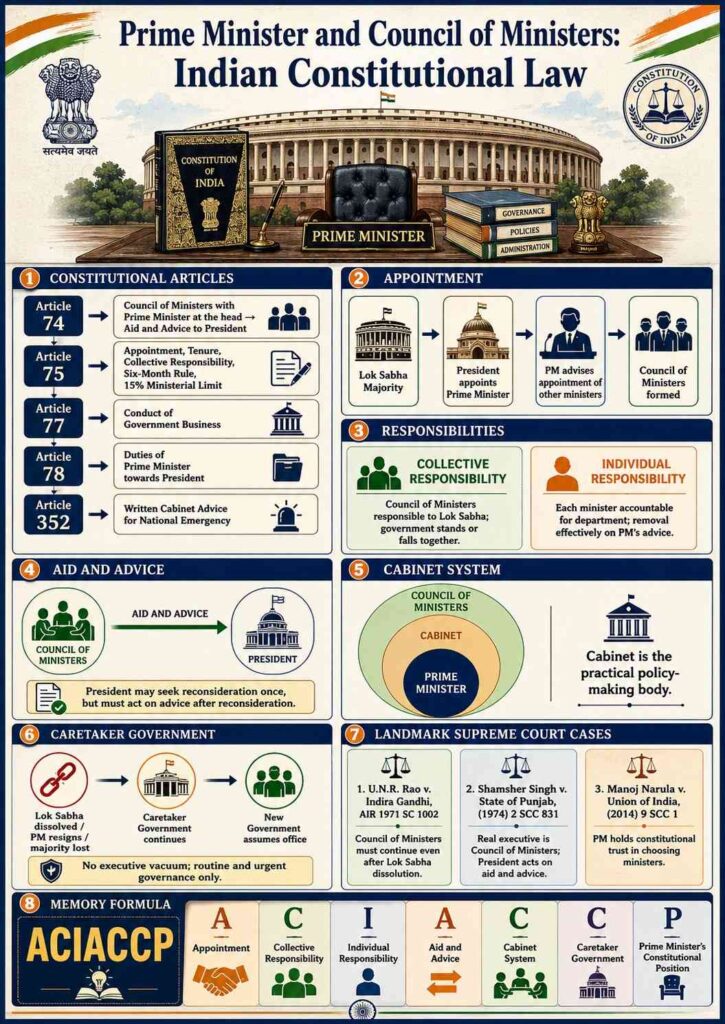
Prime Minister and Council of Ministers: Constitutional Foundation
➤ Core Concept: India follows a parliamentary form of government, where the President is the constitutional head and the Prime Minister with the Council of Ministers is the real executive authority. Article 74 provides that there shall be a Council of Ministers with the Prime Minister at the head to aid and advise the President, and Article 75 deals with appointment, tenure, responsibility, membership, oath, and salaries of ministers.
➤ Real Executive: The Constitution vests executive power formally in the President, but in actual working, this power is exercised on the aid and advice of the Council of Ministers headed by the Prime Minister. Therefore, the Prime Minister is not merely another minister; he is the constitutional centre of the Union executive.
➤ Important Distinction: These notes are confined to the Prime Minister and Council of Ministers, and not to the President as a separate institution. The President’s role is discussed only where it is necessary to understand appointment, aid and advice, and ministerial responsibility.
Constitutional Articles Related to Prime Minister and Council of Ministers
| Article | Subject | Simple Explanation |
|---|---|---|
| Article 74 | Council of Ministers to aid and advise President | Creates the Council of Ministers with the Prime Minister as head; President acts according to such advice after the 42nd and 44th Amendments. |
| Article 75 | Other provisions as to Ministers | Appointment, pleasure doctrine, collective responsibility, oath, six-month rule, salary, 15% limit, anti-defection-related bar. |
| Article 77 | Conduct of Government business | Executive action is taken in the name of the President; business is allocated among ministers through rules. |
| Article 78 | Duties of Prime Minister towards President | PM must communicate Council decisions, furnish information, and place certain ministerial decisions before the Council if President requires. |
| Article 352 | National Emergency | Emergency proclamation requires written advice of the Cabinet, not merely individual advice of the Prime Minister. |
Appointment of the Prime Minister
➤ Constitutional Provision: Under Article 75(1), “The Prime Minister shall be appointed by the President,” and the other ministers are appointed by the President on the advice of the Prime Minister.
➤ No Direct Election: The Prime Minister is not directly elected by the people as Prime Minister. Citizens elect members of the Lok Sabha, and the leader who can command the confidence of the Lok Sabha is appointed as Prime Minister.
➤ Normal Situation: When a single party has a clear majority in the Lok Sabha, the President appoints the leader of that majority party as Prime Minister. This is a constitutional convention based on parliamentary democracy.
➤ Coalition Situation: When no party gets a clear majority, the President appoints the person who appears most likely to secure majority support in the Lok Sabha. Such support may come through a pre-poll alliance, post-poll coalition, or outside support.
➤ Floor Test Principle: In doubtful majority situations, the real test of majority is not private correspondence or political claim but a floor test in the House. Though this principle is usually discussed in the context of Governors and State governments, it reflects the broader parliamentary rule that the legislature is the proper forum to determine majority.
➤ Prime Minister from Rajya Sabha: The Constitution does not require that the Prime Minister must be a member of the Lok Sabha only. A Prime Minister may be a member of either House of Parliament. However, because the Council of Ministers is collectively responsible to the Lok Sabha under Article 75(3), the Prime Minister must politically enjoy the confidence of the Lok Sabha.
➤ Six-Month Rule: Under Article 75(5), a minister who is not a member of either House of Parliament for six consecutive months ceases to be a minister at the end of that period. This applies to the Prime Minister also because the Prime Minister is a minister within the meaning of Article 75.
Important Case Law on Appointment and Continuance
➤ U.N.R. Rao v. Indira Gandhi, AIR 1971 SC 1002; (1971) 2 SCC 63: The petitioner challenged the continuance of Prime Minister Indira Gandhi and her Council of Ministers after dissolution of the Lok Sabha. The issue was whether Article 75(3), which makes the Council collectively responsible to the Lok Sabha, means that the Council must cease to exist when the Lok Sabha is dissolved. The Supreme Court held that Article 74(1) is mandatory and there must always be a Council of Ministers with the Prime Minister at the head to aid and advise the President. The Court rejected the argument that “shall” in Article 74 should be read as “may”, because that would change the parliamentary character of the Constitution and create an executive vacuum.
Appointment of Other Ministers
➤ Prime Minister’s Advice: Under Article 75(1), other ministers are appointed by the President on the advice of the Prime Minister. This means that constitutionally, the Prime Minister decides who should be included in the Council of Ministers, and the President acts on that advice.
➤ Political and Constitutional Discretion: The Prime Minister’s choice of ministers is political, but it is not morally uncontrolled. The Prime Minister is expected to uphold constitutional morality, integrity of government, and public trust.
➤ Limit on Size of Council: Article 75(1A), inserted by the 91st Constitutional Amendment Act, 2003, provides that the total number of ministers, including the Prime Minister, shall not exceed 15% of the total number of members of the Lok Sabha.
➤ Anti-Defection Bar: Article 75(1B) provides that a member of either House of Parliament who is disqualified under the Tenth Schedule on the ground of defection is also disqualified from being appointed as a minister for the prescribed period.
Important Case Law on Selection of Ministers
➤ Manoj Narula v. Union of India, (2014) 9 SCC 1: The issue was whether a person with criminal background or charges involving serious offences could be constitutionally barred from being appointed as minister. The Supreme Court held that courts cannot add a new disqualification to Article 75 beyond what the Constitution and law already provide. However, the Court recognised that the Prime Minister and Chief Ministers are holders of constitutional trust and are expected not to choose persons against whom charges have been framed for heinous or serious offences or corruption. The ratio is that appointment of ministers is primarily the constitutional prerogative of the Prime Minister, but it must be exercised consistently with constitutional morality and public trust.
Collective Responsibility of the Council of Ministers
➤ Constitutional Provision: Article 75(3) states that the Council of Ministers shall be collectively responsible to the House of the People, meaning the Lok Sabha.
➤ Meaning: Collective responsibility means that the Council of Ministers functions as one political unit. The government stands or falls together. If the Lok Sabha passes a no-confidence motion against the Council of Ministers, the entire Council, including the Prime Minister, must resign.
➤ Cabinet Solidarity: Ministers may disagree internally during Cabinet discussions, but once a decision is taken, every minister must publicly support it. A minister who cannot support the decision is expected to resign.
➤ Responsibility to Lok Sabha Only: The Council of Ministers is collectively responsible to the Lok Sabha, not to the Rajya Sabha. Rajya Sabha may discuss, criticise, or delay some legislative proposals, but it cannot remove the Council of Ministers through a no-confidence motion.
➤ Effect of Losing Majority: If the Prime Minister loses the confidence of the Lok Sabha, the Council of Ministers cannot continue as a regular government. It must resign or advise dissolution, depending on circumstances and constitutional propriety.
➤ Responsible Government: Collective responsibility ensures that real executive power remains answerable to the elected House. It prevents the executive from becoming independent of Parliament.
Case Law on Collective Responsibility
➤ Shamsher Singh v. State of Punjab, (1974) 2 SCC 831: The Supreme Court held that India has adopted a parliamentary system where the President and Governors act on the aid and advice of their respective Councils of Ministers, except in limited situations where the Constitution permits discretion. The Court explained that Article 74(1) is mandatory and that Article 75(3) creates responsible government, meaning the Council of Ministers must enjoy the confidence of the Lok Sabha. The ratio is that the real executive is the Council of Ministers headed by the Prime Minister, not the formal constitutional head.
Individual Responsibility of Ministers
➤ Constitutional Basis: Article 75(2) states that ministers hold office during the pleasure of the President. In parliamentary practice, this “pleasure” is exercised on the advice of the Prime Minister.
➤ Meaning: Individual responsibility means that each minister is responsible for the proper functioning of his or her department. A minister may be removed or asked to resign even if the entire Council of Ministers continues in office.
➤ Prime Minister’s Control: Since other ministers are appointed on the advice of the Prime Minister and continue politically because of the Prime Minister’s confidence, the Prime Minister may advise the President to remove a minister.
➤ Departmental Accountability: A minister must answer questions in Parliament relating to the ministry, defend government policy, explain administrative failures, and take responsibility for departmental actions.
➤ Difference from Collective Responsibility: Collective responsibility concerns the survival of the entire government before the Lok Sabha. Individual responsibility concerns the accountability, resignation, or removal of a particular minister.
| Basis | Collective Responsibility | Individual Responsibility |
|---|---|---|
| Article | Article 75(3) | Article 75(2), read with parliamentary convention |
| Responsible To | Lok Sabha | Prime Minister and Parliament |
| Effect of Breach | Entire Council resigns | Individual minister resigns or is removed |
| Core Idea | Government acts as one unit | Each minister is accountable for own department |
Aid and Advice of the Council of Ministers
➤ Article 74(1): There shall be a Council of Ministers with the Prime Minister at the head to aid and advise the President, and the President shall act in accordance with such advice. The President may require reconsideration, but after reconsideration, the President must act according to the advice tendered.
➤ 42nd Amendment: The 42nd Constitutional Amendment made it explicit that the President shall act in accordance with ministerial advice. This strengthened the textual position of parliamentary government.
➤ 44th Amendment: The 44th Constitutional Amendment added the power of the President to require reconsideration of advice. However, once the Council of Ministers gives advice again after reconsideration, the President is bound by it.
➤ Confidentiality of Advice: Article 74(2) provides that the question whether any, and if so what, advice was tendered by ministers to the President shall not be inquired into in any court. This protects the confidentiality of constitutional advice.
➤ Judicial Review Not Fully Excluded: Article 74(2) bars inquiry into the advice itself, but it does not necessarily bar judicial review of the legality of the final executive action, especially where constitutional limits are violated.
➤ Prime Minister as Head: The aid and advice is not the personal advice of each minister separately. It is the advice of the Council of Ministers headed by the Prime Minister, reflecting Cabinet responsibility.
Case Law on Aid and Advice
➤ Shamsher Singh v. State of Punjab, (1974) 2 SCC 831: The Supreme Court held that the President cannot exercise executive powers without the aid and advice of the Council of Ministers. The expression “satisfaction” of the President generally means the satisfaction of the President acting on ministerial advice. This case is the leading authority for the proposition that India’s President is a constitutional head and the Council of Ministers is the real executive.
➤ U.N.R. Rao v. Indira Gandhi, AIR 1971 SC 1002; (1971) 2 SCC 63: The Court held that Article 74 is mandatory and that the Council of Ministers must continue even after dissolution of the Lok Sabha until a new Council takes office, because the President must always have constitutional aid and advice.
Cabinet System in India
➤ Council of Ministers and Cabinet: The Constitution uses the expression Council of Ministers, while the Cabinet is a smaller and more powerful body within it. The Cabinet consists of senior ministers who take major policy decisions.
➤ Cabinet as the Real Decision-Making Body: In practice, the entire Council of Ministers is large, so day-to-day and high-level decisions are taken by the Cabinet. The Council of Ministers is collectively responsible, but the Cabinet is the practical steering body of government.
➤ Cabinet Committees: For administrative efficiency, several Cabinet committees deal with specific areas such as security, economic affairs, parliamentary affairs, appointments, and political affairs.
➤ Cabinet Secrecy: Cabinet discussions are confidential because ministers must be able to discuss policy freely. Once a decision is taken, collective responsibility requires public unity.
➤ Cabinet and Article 352: The word Cabinet is expressly important in Article 352. A proclamation of National Emergency cannot be issued unless the decision of the Union Cabinet is communicated to the President in writing. This safeguard was introduced after the Emergency experience to prevent emergency power from being triggered merely on informal or individual advice.
➤ Cabinet Government, Not Prime Ministerial Autocracy: Although the Prime Minister is the head, the system is constitutionally based on Cabinet responsibility. A strong Prime Minister may dominate the Cabinet politically, but constitutionally the Council of Ministers remains collectively responsible to the Lok Sabha.
Duties of the Prime Minister under Article 78
➤ Communication Duty: Under Article 78(a), the Prime Minister must communicate to the President all decisions of the Council of Ministers relating to administration of Union affairs and proposals for legislation.
➤ Information Duty: Under Article 78(b), the Prime Minister must furnish such information relating to Union administration and legislative proposals as the President may call for.
➤ Cabinet Consideration Duty: Under Article 78(c), if the President requires, the Prime Minister must submit for consideration of the Council of Ministers any matter on which a minister has taken a decision but which has not been considered by the Council.
➤ Constitutional Link: Article 78 makes the Prime Minister the formal constitutional channel between the President and the Council of Ministers. The President receives information through the Prime Minister, and the Prime Minister ensures that individual ministerial decisions can be brought before the collective body.
Prime Minister’s Constitutional Position
➤ Head of Council of Ministers: Article 74 itself recognises the Prime Minister as the head of the Council of Ministers. Without a Prime Minister, there cannot be a valid Council of Ministers at the Union level.
➤ Leader of Government: The Prime Minister determines broad policy direction, coordinates ministries, presides over Cabinet meetings, and represents the government in Parliament and before the nation.
➤ Link Between President and Cabinet: Article 78 gives the Prime Minister the duty to communicate decisions and information to the President. This makes the Prime Minister the constitutional bridge between the formal head of State and the real executive.
➤ Leader of Lok Sabha Majority: In ordinary circumstances, the Prime Minister is the leader of the majority in the Lok Sabha. Even when the Prime Minister is a member of Rajya Sabha, the government must enjoy Lok Sabha confidence.
➤ Architect of Ministry Formation: Other ministers are appointed on the Prime Minister’s advice, and the Prime Minister controls allocation, reshuffling, and removal of ministers through constitutional advice to the President.
➤ Guardian of Collective Responsibility: The Prime Minister ensures that all ministers follow Cabinet decisions. If a minister publicly disagrees with government policy, the Prime Minister may ask for resignation or advise removal.
➤ Constitutional Trust: In Manoj Narula v. Union of India, (2014) 9 SCC 1, the Supreme Court stressed that the Prime Minister occupies a position of constitutional trust while advising appointment of ministers. The Court did not create new legal disqualifications, but it emphasised that constitutional morality requires responsible choices.
Caretaker Government
➤ Meaning: A caretaker government is a government that continues temporarily after resignation, loss of majority, dissolution of the Lok Sabha, or completion of tenure, until a new government assumes office.
➤ Constitutional Necessity: The Constitution does not use the expression “caretaker government” in Article 74 or Article 75, but the idea flows from the need for continuity. The Union cannot be left without a Council of Ministers because Article 74 requires a Council of Ministers to aid and advise the President.
➤ Legal Basis: In U.N.R. Rao v. Indira Gandhi, the Supreme Court held that the Council of Ministers does not automatically disappear merely because the Lok Sabha is dissolved. Article 74 is mandatory, and the President must have a Council of Ministers to aid and advise him.
➤ Limited Role: A caretaker government should normally avoid major policy decisions, long-term commitments, controversial appointments, and decisions that bind the incoming government, unless urgent public interest requires action.
➤ Reason for Restraint: Since the caretaker government may not have a freshly tested mandate of the Lok Sabha, it should act with constitutional propriety and democratic restraint.
➤ Continuity of Administration: Routine administration, national security, urgent financial matters, disaster response, and essential governance continue during the caretaker period.
Memory Aid: PM–COM Formula
| Keyword | Meaning |
|---|---|
| A | Appointment by President; other ministers on PM’s advice |
| C | Collective responsibility to Lok Sabha |
| I | Individual responsibility through PM’s control and President’s pleasure |
| A | Aid and advice binding on President after reconsideration |
| C | Cabinet system as practical decision-making core |
| C | Caretaker government ensures no executive vacuum |
| P | PM’s position as head, coordinator, link, leader, and trustee |
Conclusion
➤ Final Understanding: The Prime Minister and Council of Ministers form the heart of India’s parliamentary executive. Article 74 establishes the Council of Ministers with the Prime Minister as its head, while Article 75 gives the rules for appointment, tenure, responsibility, membership, and ministerial limits. The Prime Minister is appointed by the President, but the real constitutional test is the ability to command Lok Sabha confidence.
➤ Democratic Accountability: Collective responsibility makes the entire Council answerable to the Lok Sabha, while individual responsibility makes each minister accountable for departmental conduct and dependent on the Prime Minister’s confidence.
➤ Aid and Advice Principle: The President acts on the aid and advice of the Council of Ministers, and after reconsideration, such advice is binding. This is the foundation of India’s parliamentary system.
➤ Cabinet and Caretaker Role: The Cabinet is the effective policy-making centre, while the caretaker government principle ensures continuity of governance without creating an executive vacuum.
➤ Constitutional Position of PM: The Prime Minister is the head of the Council of Ministers, leader of government, coordinator of administration, link between President and Cabinet, guardian of collective responsibility, and holder of constitutional trust.