1. Constitutional Position of Speaker and Deputy Speaker
● Institutional importance: The Speaker and Deputy Speaker are constitutional offices created to ensure orderly, fair and authoritative functioning of the House of the People, that is, the Lok Sabha. The Speaker is not merely a presiding officer; the Speaker is the constitutional guardian of the dignity, procedure, discipline and privileges of the House.
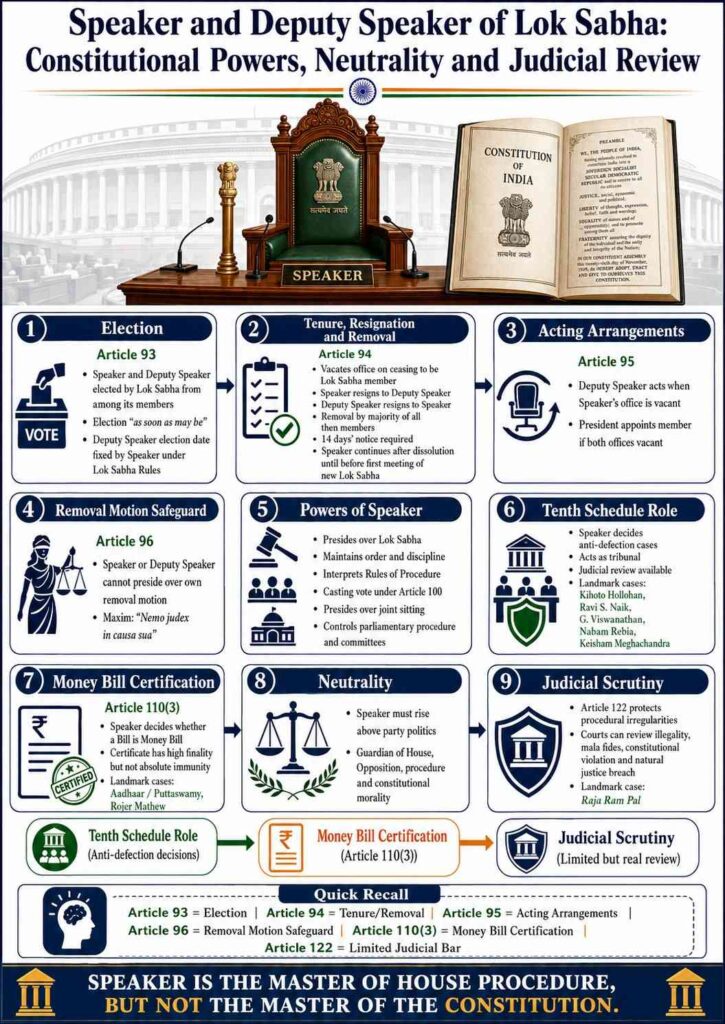
● Article 93 – Election of Speaker and Deputy Speaker: Article 93 provides that the Lok Sabha shall, “as soon as may be”, choose two of its members to be respectively the Speaker and Deputy Speaker, and whenever either office becomes vacant, the House shall choose another member to fill the vacancy. This means both offices are elected by the Lok Sabha from among its own members.
● Meaning of “as soon as may be”: The Constitution does not prescribe an exact number of days for election of the Speaker or Deputy Speaker. However, the phrase shows constitutional urgency. The offices are not optional or ceremonial; they are necessary for the working of parliamentary democracy. Long vacancy of the Deputy Speaker’s office raises serious constitutional concerns because Article 93 contemplates the existence of both offices.
● Article 94 – Vacation, resignation and removal: Article 94 states that a Speaker or Deputy Speaker vacates office if he or she ceases to be a member of the Lok Sabha. The Speaker may resign by writing addressed to the Deputy Speaker, and the Deputy Speaker may resign by writing addressed to the Speaker. Either may be removed by a resolution of the Lok Sabha passed by a majority of all the then members of the House, provided at least fourteen days’ notice is given. The Speaker continues even after dissolution of Lok Sabha until immediately before the first meeting of the new Lok Sabha.
● Article 95 – Acting arrangements: Article 95 provides continuity. When the office of Speaker is vacant, the Deputy Speaker performs the duties of Speaker. When both offices are vacant, such member of the House as the President may appoint performs those duties. During absence from a sitting, the Deputy Speaker or another person determined by rules presides.
● Article 96 – Removal motion and neutrality: Article 96 provides that when a resolution for removal of the Speaker is under consideration, the Speaker shall not preside. Similarly, when a resolution for removal of the Deputy Speaker is under consideration, the Deputy Speaker shall not preside. This rule protects fairness because no one should act as judge in his or her own cause.
● Article 100 – Voting and casting vote: The Speaker or person acting as Speaker does not vote in the first instance but has a casting vote in case of equality of votes. The Lok Sabha’s own FAQ states that the Speaker has a casting vote in the event of a tie and that it is customarily exercised to maintain the status quo.
2. Election of Speaker and Deputy Speaker
● Election from among members: Only a sitting member of Lok Sabha can be elected as Speaker or Deputy Speaker. If that person later ceases to be a member, the constitutional office also comes to an end under Article 94(a).
● Election of Speaker: After a general election, the President appoints a pro tem Speaker to administer oath and conduct the election of the Speaker. The Speaker is elected by the House through a motion. Conventionally, the ruling party or ruling coalition proposes the candidate because the Speaker must command the confidence of the House.
● Election of Deputy Speaker: The Deputy Speaker is elected after the Speaker. Rule 8 of the Rules of Procedure and Conduct of Business in Lok Sabha provides that the election of Deputy Speaker is held on such date as the Speaker may fix. There is no constitutional rule that the Deputy Speaker must belong to the Opposition, though in many periods of parliamentary practice the office has been given to the Opposition to promote institutional balance.
● Simple practical distinction: The Speaker’s election date is connected with the first sitting and constitutional necessity of forming the House’s presiding authority. The Deputy Speaker’s election date is fixed by the Speaker under the Lok Sabha Rules. Therefore, the Deputy Speaker’s office depends on constitutional mandate plus procedural scheduling.
● No express time limit but constitutional obligation: The absence of a fixed deadline does not mean the election may be indefinitely avoided. Article 93 uses mandatory language: the House “shall” choose. Therefore, the better constitutional interpretation is that the election must occur within a reasonable time.
3. Tenure, Resignation and Removal
● Tenure linked with membership: The Speaker and Deputy Speaker normally hold office during the life of the Lok Sabha, but they may vacate earlier by resignation, removal or loss of Lok Sabha membership.
● Special continuity of Speaker: A very important constitutional point is that the Speaker does not vacate office immediately on dissolution of Lok Sabha. Under the second proviso to Article 94, the Speaker continues until immediately before the first meeting of the new Lok Sabha. This ensures that there is institutional continuity even between two Lok Sabhas.
● Removal majority: Removal requires a resolution passed by a majority of all the then members of the Lok Sabha. This is not merely a majority of members present and voting. For example, if the House has 543 existing members, at least 272 votes are required, assuming there are no vacancies affecting the number of “then members”.
● Fourteen days’ notice: A removal resolution cannot be suddenly moved. Article 94 requires at least fourteen days’ notice. This protects the dignity and stability of the office.
● Speaker not to preside over own removal: Under Article 96, when a removal motion against the Speaker is under consideration, the Speaker cannot preside. This principle reflects natural justice: nemo judex in causa sua, meaning no person should be a judge in his or her own cause.
4. Powers and Functions of Speaker
● Presiding power: The Speaker presides over sittings of the Lok Sabha, maintains order, regulates debate, decides who may speak, and ensures that proceedings are conducted according to the Constitution, Rules of Procedure and parliamentary conventions.
● Disciplinary power: The Speaker maintains discipline in the House. The Speaker may direct a member to withdraw from the House, name a member for disorderly conduct, and take procedural action under the Rules.
● Interpretation of rules: The Speaker interprets and applies the Rules of Procedure of Lok Sabha. The Speaker’s rulings on procedure are generally treated as final inside the House because parliamentary proceedings require immediate and authoritative decisions.
● Casting vote: The Speaker does not vote in the first instance but may exercise a casting vote in case of equality of votes. This power is not meant to advance party interest. Parliamentary convention expects the Speaker to use the casting vote to maintain the existing position unless the House clearly decides otherwise.
● Certification of Money Bill: Under Article 110(3), if any question arises whether a Bill is a Money Bill, the decision of the Speaker of Lok Sabha is final. This power is extremely significant because a Money Bill can be passed with limited role of Rajya Sabha.
● Joint sitting: Under Article 118(4), the Speaker presides over a joint sitting of both Houses of Parliament. The Lok Sabha FAQ also records that the Speaker presides over joint sittings.
● Committee-related role: The Speaker constitutes and supervises several parliamentary committees, nominates chairpersons or members where rules so provide, and plays a key role in the committee system of parliamentary accountability.
● Privilege and dignity of House: The Speaker acts as custodian of the House’s privileges, records and dignity. However, this power is not absolute and remains subject to constitutional limitations.
5. Powers and Role of Deputy Speaker
● Constitutional substitute: The Deputy Speaker is not a subordinate private assistant of the Speaker. The Deputy Speaker is an independent constitutional authority chosen by the House.
● When Speaker is absent: The Deputy Speaker presides over the House when the Speaker is absent. While presiding, the Deputy Speaker has the same authority as the Speaker for conducting proceedings.
● When office of Speaker is vacant: Under Article 95, the Deputy Speaker performs the duties of Speaker when the office of Speaker is vacant. This shows why the Deputy Speaker’s office is constitutionally important.
● Impartial presiding role: Once in the Chair, the Deputy Speaker is expected to act with the same neutrality as the Speaker. His or her rulings are not appealable inside the House in the ordinary sense.
● Removal of Deputy Speaker: The Deputy Speaker may be removed in the same manner as the Speaker: by resolution passed by a majority of all the then members of the House after fourteen days’ notice under Article 94.
6. Speaker under the Tenth Schedule: Anti-Defection Law
● Basic purpose of Tenth Schedule: The Tenth Schedule was inserted by the Constitution (Fifty-second Amendment) Act, 1985 to curb political defections. It provides disqualification on grounds such as voluntarily giving up membership of a political party or voting/abstaining contrary to party whip without permission.
● Speaker as adjudicating authority: Paragraph 6 of the Tenth Schedule says that questions of disqualification on the ground of defection are decided by the Speaker or Chairman of the concerned House. In Lok Sabha, the Speaker decides such questions.
● Speaker acts as tribunal: In Kihoto Hollohan v. Zachillhu, 1992 Supp (2) SCC 651, the Supreme Court upheld the constitutional validity of the Tenth Schedule but held that while deciding disqualification petitions, the Speaker acts as a tribunal and the decision is subject to judicial review. The Court rejected the argument that the Speaker’s decision is completely immune from courts. However, courts usually interfere after the Speaker has made a decision, except in cases of exceptional illegality, mala fides or violation of constitutional mandates.
● Paragraph 7 struck down: In Kihoto Hollohan, the Supreme Court held that Paragraph 7, which excluded court jurisdiction, required ratification by States because it affected the jurisdiction of the Supreme Court and High Courts. Since such ratification was absent, Paragraph 7 was unconstitutional. This preserved judicial review under Articles 32, 136, 226 and 227.
● Voluntarily giving up membership: In Ravi S. Naik v. Union of India, 1994 Supp (2) SCC 641, the Supreme Court held that “voluntarily giving up membership” is wider than formal resignation. A member may be treated as having given up party membership by conduct, speeches, alliances or actions showing abandonment of the party.
● Expelled member and original party: In G. Viswanathan v. Speaker, Tamil Nadu Legislative Assembly, (1996) 2 SCC 353, the Supreme Court held that even if a member is expelled by the political party, for the purpose of the Tenth Schedule he continues to be treated as belonging to the party on whose ticket he was elected. Therefore, joining another party after expulsion may still attract disqualification.
● Speaker’s delay and judicial concern: Delay by Speakers in deciding defection petitions has become a major constitutional problem. In Keisham Meghachandra Singh v. Hon’ble Speaker, Manipur Legislative Assembly, (2020) 2 SCC 617, the Supreme Court observed that disqualification petitions should ordinarily be decided within a reasonable period, generally three months, unless exceptional circumstances exist. The Court also suggested that Parliament may consider replacing the Speaker with an independent tribunal for anti-defection adjudication.
● Resignation and defection: In Shrimanth Balasaheb Patil v. Karnataka Legislative Assembly, (2020) 2 SCC 595, the Supreme Court held that resignation does not automatically defeat pending disqualification proceedings. The Speaker may examine whether a resignation is voluntary and genuine, but the Speaker cannot impose a punishment beyond constitutional limits, such as barring members from contesting elections for the entire term unless the Constitution or law permits it.
● Speaker facing removal motion: In Nabam Rebia v. Deputy Speaker, Arunachal Pradesh Legislative Assembly, (2016) 8 SCC 1, the Supreme Court held that a Speaker should not decide disqualification petitions when a motion for the Speaker’s own removal is pending. The reasoning was based on institutional impartiality and the principle that a Speaker whose continuance is under challenge should not decide matters that may affect majority in the House.
● Later reconsideration of Nabam Rebia: In Subhash Desai v. Principal Secretary, Governor of Maharashtra, 2023 SCC OnLine SC 607, the Supreme Court considered the effect of Nabam Rebia in the Maharashtra political crisis and referred the correctness of the Nabam principle to a larger Bench. Therefore, the present position is that Nabam Rebia continues to be relevant, but its correctness on this point is under reconsideration.
7. Money Bill Certification by Speaker
● Article 110 – Money Bill: A Money Bill is a Bill that contains only matters listed in Article 110(1), such as taxation, borrowing of money, custody of Consolidated Fund of India, appropriation of money, expenditure charged on Consolidated Fund, receipt or custody of public money, audit of accounts, or matters incidental to these.
● Speaker’s final certificate: Article 110(3) provides that if any question arises whether a Bill is a Money Bill, the decision of the Speaker of Lok Sabha is final. Article 110(4) requires the Speaker’s certificate when the Bill is transmitted to Rajya Sabha and presented to the President.
● Why certification matters: In an ordinary Bill, both Lok Sabha and Rajya Sabha have substantial legislative roles. But in a Money Bill, Rajya Sabha can only make recommendations within fourteen days, and Lok Sabha may accept or reject them. Therefore, wrongful certification of an ordinary Bill as a Money Bill can weaken bicameralism.
● Aadhaar case: In Justice K.S. Puttaswamy (Retd.) v. Union of India, (2019) 1 SCC 1, the majority upheld the Aadhaar Act as a valid Money Bill. However, Justice D.Y. Chandrachud dissented and held that passing the Aadhaar Act as a Money Bill was unconstitutional because it bypassed Rajya Sabha. The case is important because it triggered deeper debate on whether the Speaker’s Money Bill certificate can be judicially reviewed.
● Rojer Mathew case: In Rojer Mathew v. South Indian Bank Ltd., (2020) 6 SCC 1, the Supreme Court held that the Speaker’s certification of a Money Bill is not completely immune from judicial review. The Court doubted the correctness of the Aadhaar majority’s interpretation of Money Bill and referred the larger issue to a larger Bench. The Court also clarified that earlier cases suggesting near-total immunity, such as Mohd. Saeed Siddiqui v. State of U.P., (2014) 11 SCC 415, and Yogendra Kumar Jaiswal v. State of Bihar, (2016) 3 SCC 183, did not state the correct law on immunity from judicial review.
● Present legal position: The Speaker’s certificate under Article 110 is given high constitutional respect, but it is not beyond judicial review. Courts may examine whether the certification is a blatant constitutional violation or colourable exercise of power.
8. Neutrality of Speaker
● Need for neutrality: The Speaker belongs to a political party before election as Speaker, but after election to the Chair, the Speaker is expected to act above party interest. Neutrality is essential because the Speaker controls debate, discipline, recognition of members, committee matters, anti-defection adjudication and Money Bill certification.
● Indian challenge: Unlike the British convention where the Speaker resigns from party politics and is normally re-elected unopposed, India has not fully developed such a strict convention. Indian Speakers often continue to be seen as members of the ruling political arrangement. This creates concern especially in Tenth Schedule cases and Money Bill certification.
● Neutrality as constitutional morality: The Constitution may not expressly say that the Speaker must resign from party membership, but constitutional morality requires impartial conduct. The Speaker must protect the House, not the government alone; the Opposition, not obstruction alone; and procedure, not political convenience.
● Practical areas where neutrality matters: Neutrality is tested when the Speaker decides disqualification petitions, allows or disallows motions, expunges remarks, certifies Money Bills, recognises party whips or leaders, and decides whether to permit division of votes.
9. Judicial Scrutiny of Speaker’s Actions
● General rule of non-interference during proceedings: Courts usually avoid interfering with internal parliamentary procedure because the Constitution gives each House autonomy to regulate its own proceedings.
● Article 122 protection: Article 122 says that the validity of parliamentary proceedings cannot be questioned on the ground of alleged irregularity of procedure. However, this protection does not cover substantive illegality or constitutional violation.
● Raja Ram Pal principle: In Raja Ram Pal v. Hon’ble Speaker, Lok Sabha, (2007) 3 SCC 184, the Supreme Court held that parliamentary proceedings are subject to judicial review where there is illegality, unconstitutionality, gross illegality or violation of fundamental constitutional limitations. Courts will not interfere for mere procedural irregularity, but constitutional violations are reviewable.
● Tenth Schedule review: After Kihoto Hollohan, the Speaker’s decision under the Tenth Schedule is reviewable because the Speaker acts as a tribunal. Judicial review may examine mala fides, perversity, violation of natural justice, constitutional error, or failure to decide within a reasonable time.
● Money Bill review: After Rojer Mathew, the Speaker’s Money Bill certification is also not absolutely immune. Judicial review is narrow but available where the certification appears to defeat Article 110 and bicameralism.
● Removal-related review: In matters involving removal of the Speaker or Deputy Speaker, courts may examine constitutional compliance, such as notice, majority requirement and whether the concerned presiding officer improperly presided over his or her own removal motion.
10. Speaker and Deputy Speaker: Comparative Memory Table
| Point | Speaker | Deputy Speaker |
|---|---|---|
| Constitutional basis | Article 93 | Article 93 |
| Elected by | Lok Sabha | Lok Sabha |
| Election timing | As soon as may be after constitution of House | After Speaker; date fixed by Speaker under Lok Sabha Rules |
| Resignation addressed to | Deputy Speaker | Speaker |
| Removal | Majority of all the then members + 14 days’ notice | Same |
| Presiding role | Ordinary presiding authority | Presides when Speaker absent |
| When Speaker office vacant | Not applicable | Performs duties of Speaker under Article 95 |
| Neutrality requirement | Very high | Same while presiding |
| Tenth Schedule role | Decides defection cases in Lok Sabha | May act if performing Speaker’s duties, depending on circumstances |
| Money Bill certification | Speaker of Lok Sabha certifies | Deputy Speaker does not ordinarily certify unless acting as Speaker |
11. Important Case Law Summary
● Kihoto Hollohan v. Zachillhu, 1992 Supp (2) SCC 651: The Supreme Court upheld the Tenth Schedule but held that the Speaker acts as a tribunal while deciding defection cases. The decision is subject to judicial review. Paragraph 7 excluding court jurisdiction was struck down for lack of State ratification. This case is the foundation of judicial scrutiny over Speaker’s anti-defection decisions.
● Ravi S. Naik v. Union of India, 1994 Supp (2) SCC 641: The Court held that “voluntarily giving up membership” is wider than resignation. Conduct may show abandonment of party membership. This widened the Speaker’s inquiry under the Tenth Schedule.
● G. Viswanathan v. Speaker, Tamil Nadu Legislative Assembly, (1996) 2 SCC 353: The Court held that an expelled member continues to be treated as belonging to the original political party for Tenth Schedule purposes. This prevents expelled members from avoiding anti-defection consequences by relying on expulsion.
● Rajendra Singh Rana v. Swami Prasad Maurya, (2007) 4 SCC 270: The Supreme Court interfered where the Speaker failed to properly decide disqualification issues and where constitutional requirements were not followed. The case shows that judicial review is meaningful, not merely theoretical.
● Raja Ram Pal v. Hon’ble Speaker, Lok Sabha, (2007) 3 SCC 184: The Court held that parliamentary actions are reviewable for illegality and unconstitutionality, although courts will not interfere with mere procedural irregularities. This case is important for understanding Article 122.
● Nabam Rebia v. Deputy Speaker, (2016) 8 SCC 1: The Court held that a Speaker facing a pending removal motion should not decide disqualification petitions. The case links neutrality, majority politics and Tenth Schedule adjudication. Its correctness on this point has been referred to a larger Bench in Subhash Desai.
● Justice K.S. Puttaswamy (Aadhaar) v. Union of India, (2019) 1 SCC 1: The majority upheld Aadhaar as a Money Bill; the dissent strongly objected to bypassing Rajya Sabha. This case made Money Bill certification a major constitutional issue.
● Rojer Mathew v. South Indian Bank Ltd., (2020) 6 SCC 1: The Court held that Speaker’s Money Bill certification is not immune from judicial review and referred the larger Article 110 issue for reconsideration. This is the leading case on judicial scrutiny of Money Bill certification.
● Keisham Meghachandra Singh v. Hon’ble Speaker, Manipur Legislative Assembly, (2020) 2 SCC 617: The Court criticised delay in deciding defection petitions and stated that such petitions should ordinarily be decided within three months unless exceptional circumstances exist. It also suggested an independent tribunal mechanism.
● Shrimanth Balasaheb Patil v. Karnataka Legislative Assembly, (2020) 2 SCC 595: The Court held that resignation does not automatically end disqualification proceedings. The Speaker can examine genuineness of resignation but cannot impose penalties beyond constitutional authority.
12. Core Constitutional Principles
● Parliamentary democracy: The Speaker and Deputy Speaker ensure that the elected House functions through rules rather than disorder.
● Bicameralism: Money Bill certification directly affects Rajya Sabha’s role; therefore, the Speaker must use Article 110 carefully.
● Constitutional morality: The Speaker’s authority is trusted because it is expected to be neutral, principled and transparent.
● Judicial review: Finality clauses do not completely exclude courts. Whether under the Tenth Schedule or Article 110, the Speaker’s decisions remain subject to limited but real judicial scrutiny.
● Natural justice: A Speaker facing removal should not decide matters affecting his or her own survival in office. Similarly, members facing disqualification must receive fair hearing.
● Reasonable time: Constitutional authorities cannot defeat constitutional remedies by inaction. Delay in deciding defection petitions may itself damage democracy.
13. Conclusion
● Final understanding: The Speaker and Deputy Speaker are central to India’s parliamentary constitutional structure. Their offices are created by Article 93, protected by Article 94, supported by Article 95, and regulated during removal by Article 96. The Speaker’s powers are wide, but they are not absolute.
● Balanced position: The Speaker is the master of procedure inside the House, but not the master of the Constitution. In ordinary procedural matters, courts show restraint. In matters involving defection, Money Bill certification, mala fides, constitutional violation or denial of natural justice, judicial review is available.
● Democratic significance: The Speaker’s neutrality is the moral foundation of the office. Without neutrality, powers under the Tenth Schedule and Article 110 may become tools of political advantage. With neutrality, the Speaker becomes the guardian of parliamentary democracy.