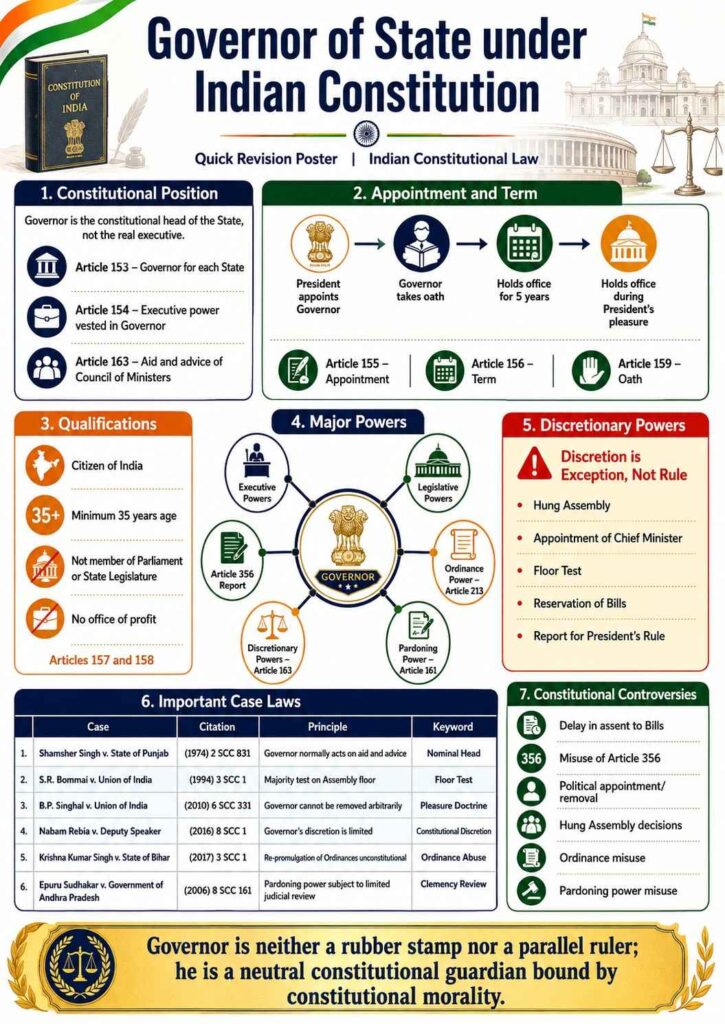
Meaning and Constitutional Position of Governor
◉ Constitutional head of the State: The Governor is the constitutional head of a State. Under Article 153, there shall be a Governor for each State, though the same person may be appointed as Governor for two or more States. Under Article 154, the executive power of the State is vested in the Governor, but in a parliamentary system this power is normally exercised through the elected Council of Ministers headed by the Chief Minister.
◉ Nominal executive, not real executive: The Governor is not meant to run the State government personally. The real executive authority belongs to the Council of Ministers, because they are responsible to the Legislative Assembly. The Governor is therefore similar to the President at the Union level, but with some constitutionally recognised discretionary areas under Article 163.
◉ Link between Union and State: The Governor performs a dual role. He is the constitutional head of the State and is also appointed by the President, which often makes the office politically sensitive. This dual position is the root of many controversies, especially where the State government and Union government belong to different political parties.
◉ Part of State Legislature: Under Article 168, the Governor is a component of the State Legislature along with the Legislative Assembly and, where applicable, Legislative Council. This does not mean that the Governor is an elected legislator; it means that certain legislative processes, such as assent to Bills and summoning the House, cannot be completed without the Governor’s constitutional role.
Appointment of Governor
◉ Appointment by President: Under Article 155, the Governor of a State is appointed by the President by warrant under his hand and seal. In practical terms, the appointment is made by the Union executive, because the President acts on the aid and advice of the Union Council of Ministers.
◉ No election of Governor: The Governor is not elected directly by the people of the State and is not elected by the State Legislature. The framers adopted the appointment model to avoid a rival elected authority in the State. An elected Governor could have created conflict with the elected Chief Minister.
◉ No consultation requirement in text: The Constitution does not expressly require consultation with the Chief Minister before appointment of a Governor. However, constitutional commissions such as the Sarkaria Commission and Punchhi Commission have recommended that Governors should be impartial persons and should not be active party politicians immediately before appointment.
◉ Oath of office: Under Article 159, the Governor takes an oath before the Chief Justice of the High Court of the State, or in his absence, the senior-most judge available. The Governor swears to preserve, protect and defend the Constitution and the law, and to devote himself to the service and well-being of the people of the State.
Qualifications for Appointment as Governor
◉ Citizen of India: Under Article 157, a person must be a citizen of India to be appointed as Governor.
◉ Minimum age: The person must have completed 35 years of age under Article 157.
◉ No legislative membership: Under Article 158, the Governor cannot be a member of either House of Parliament or of a House of the Legislature of any State. If such a person is appointed as Governor, he is deemed to have vacated his legislative seat on entering office.
◉ No office of profit: The Governor must not hold any other office of profit. This requirement protects the independence and dignity of the office.
◉ Official residence and emoluments: Under Article 158, the Governor is entitled to use the official residence without rent and is entitled to such emoluments, allowances and privileges as determined by Parliament.
Term of Office and Removal of Governor
◉ Five-year term: Under Article 156(3), the Governor holds office for a term of five years from the date on which he enters office.
◉ Pleasure of President: Under Article 156(1), the Governor holds office during the pleasure of the President. This means the Governor may be removed before completion of five years. Since the President acts on Union ministerial advice, the Union government has practical control over removal.
◉ Continuance after expiry of term: Under Article 156(3), the Governor continues to hold office until his successor enters office. Therefore, expiry of five years does not automatically create a vacancy if a successor has not yet assumed office.
◉ Resignation: Under Article 156(2), the Governor may resign by writing addressed to the President.
◉ B.P. Singhal v. Union of India, (2010) 6 SCC 331: In this landmark case, several Governors were removed after a change in the Union government. The issue was whether Governors can be removed arbitrarily under the pleasure doctrine. The Supreme Court held that although the Governor holds office during the pleasure of the President, the power cannot be exercised in an arbitrary, capricious, unreasonable or mala fide manner. The Governor cannot be removed merely because he is out of sync with the policies of the Union government. However, the Court also held that reasons need not be disclosed in every case unless judicial review is invoked. This case is important because it limits political misuse of the pleasure doctrine while preserving constitutional flexibility.
Executive Powers of Governor
◉ Executive power of State: Under Article 154, the executive power of the State is vested in the Governor. This power extends to matters on which the State Legislature has law-making power.
◉ Exercise through officers: The Governor may exercise executive power directly or through officers subordinate to him, but this does not make him the real executive. In actual constitutional practice, executive decisions are taken by the Council of Ministers.
◉ Appointment of Chief Minister: Under Article 164, the Chief Minister is appointed by the Governor. In a normal situation, the Governor appoints the leader of the majority party or coalition in the Legislative Assembly.
◉ Appointment of other Ministers: Other Ministers are appointed by the Governor on the advice of the Chief Minister. The Council of Ministers is collectively responsible to the Legislative Assembly.
◉ Allocation of business: Under Article 166, all executive action of the State is expressed to be taken in the name of the Governor. Rules are made for convenient transaction of government business.
◉ Appointment powers: The Governor appoints several constitutional authorities, including the Advocate General of the State under Article 165, and participates in appointments where the Constitution provides a role. However, many such powers are exercised on ministerial advice.
◉ Shamsher Singh v. State of Punjab, (1974) 2 SCC 831: In this seven-judge Constitution Bench decision, probationary judicial officers challenged termination orders issued in the name of the Governor. The main constitutional issue was whether the Governor acts personally or on ministerial advice. The Supreme Court held that the President and Governor are constitutional or formal heads and ordinarily act on the aid and advice of the Council of Ministers. The ratio is that “satisfaction” of the Governor normally means satisfaction of the Council of Ministers, except where the Constitution expressly or by necessary implication permits discretion. This is the leading authority on the nominal position of the Governor in India’s parliamentary system.
Legislative Powers of Governor
◉ Summoning, proroguing and dissolving House: Under Article 174, the Governor summons and prorogues the State Legislature and may dissolve the Legislative Assembly. Normally, this is done on the aid and advice of the Council of Ministers. However, discretion may arise during a constitutional crisis, such as when the Chief Minister has lost majority support.
◉ Address to Legislature: Under Article 176, the Governor addresses the first session after each general election and the first session of each year, informing the Legislature of the government’s policy agenda.
◉ Message to House: Under Article 175, the Governor may send messages to the House or Houses of the State Legislature.
◉ Assent to Bills: Under Article 200, when a Bill is passed by the State Legislature, it is presented to the Governor. The Governor may assent to the Bill, withhold assent, return the Bill for reconsideration if it is not a Money Bill, or reserve the Bill for consideration of the President.
◉ Reservation for President: The Governor must reserve a Bill for the President if, in his opinion, the Bill would derogate from the powers of the High Court so as to endanger the position designed for that Court by the Constitution. The Governor may also reserve certain Bills where constitutional provisions require or justify reservation.
◉ Money Bills: A Money Bill cannot be introduced in the Legislative Assembly except on the recommendation of the Governor. However, this is also normally based on the advice of the Council of Ministers.
Ordinance-Making Power of Governor under Article 213
◉ Temporary law-making power: Under Article 213, the Governor may promulgate an Ordinance when the Legislature is not in session and when circumstances exist requiring immediate action. An Ordinance has the same force and effect as an Act of the State Legislature, but it is temporary.
◉ Conditions for Ordinance: Three main conditions must exist: the State Legislature must not be in session; the Governor must be satisfied that immediate action is necessary; and the subject must be within the legislative competence of the State Legislature.
◉ Aid and advice: The Governor’s satisfaction under Article 213 is generally the satisfaction of the Council of Ministers. The Governor is not expected to act as a personal law-maker.
◉ Limitations: The Governor cannot promulgate an Ordinance if the same law would have required previous instructions from the President or reservation for the President had it been introduced as a Bill. This protects Union control in constitutionally sensitive matters.
◉ Duration of Ordinance: An Ordinance must be laid before the State Legislature and ceases to operate at the expiration of six weeks from the reassembly of the Legislature, unless disapproved earlier or replaced by an Act.
◉ Krishna Kumar Singh v. State of Bihar, (2017) 3 SCC 1: In this case, Bihar repeatedly re-promulgated Ordinances without placing them properly before the Legislature. The issue was whether re-promulgation of Ordinances is constitutionally valid. The Supreme Court held that re-promulgation of Ordinances is a fraud on the Constitution if it bypasses legislative scrutiny. The ratio is that Ordinance-making is an emergency legislative power, not a parallel source of permanent legislation. The Court also held that the satisfaction behind Ordinance-making is subject to judicial review on limited grounds.
Pardoning Power of Governor under Article 161
◉ Scope of Article 161: Under Article 161, the Governor may grant pardons, reprieves, respites or remissions of punishment, or suspend, remit or commute the sentence of any person convicted of an offence against a law relating to a matter to which the executive power of the State extends.
◉ Meaning of pardon: A pardon completely removes the punishment and its legal consequences. It is the highest form of mercy power.
◉ Reprieve: A reprieve temporarily postpones execution of a sentence, especially in death sentence matters.
◉ Respite: A respite means awarding a lesser punishment because of special circumstances such as pregnancy, age, disability or serious illness.
◉ Remission: Remission reduces the period of sentence without changing the character of the sentence. For example, a sentence of ten years may be reduced to six years.
◉ Commutation: Commutation substitutes one form of punishment with a lighter form. For example, death sentence may be commuted to life imprisonment.
◉ Difference between Article 72 and Article 161: The President’s pardoning power under Article 72 extends to death sentences, court-martial cases and Union law offences. The Governor’s power under Article 161 extends to offences relating to State executive power. A Governor cannot pardon a death sentence in the same full sense as the President, but he may suspend, remit or commute sentences where State law is involved, subject to constitutional limits.
◉ Maru Ram v. Union of India, (1981) 1 SCC 107: The Supreme Court held that the President and Governor exercise clemency powers on the aid and advice of the appropriate government. The issue concerned remission and constitutional mercy powers. The ratio is that Articles 72 and 161 are constitutional powers, but they are not personal powers of the President or Governor.
◉ Kehar Singh v. Union of India, (1989) 1 SCC 204: Though mainly concerning the President under Article 72, this case is relevant by analogy to Article 161. The Supreme Court held that the constitutional authority may examine the merits of the case while considering mercy, but the Court cannot sit as an appellate authority over the mercy decision.
◉ Epuru Sudhakar v. Government of Andhra Pradesh, (2006) 8 SCC 161: In this case, remission granted by the Governor was challenged on the ground of political influence and irrelevant considerations. The issue was whether exercise of pardoning power under Article 161 is subject to judicial review. The Supreme Court held that clemency power is wide but not absolute. Judicial review is available where the order is mala fide, arbitrary, passed without application of mind, based on irrelevant considerations, or excludes relevant material. This case is a leading authority for controlling misuse of pardoning power.
Discretionary Powers of Governor
◉ Meaning of discretion: Discretion means an area where the Governor may act without being bound by ministerial advice. However, this discretion is not personal political freedom. It must be constitutional, limited and based on objective circumstances.
◉ Article 163: Under Article 163, there shall be a Council of Ministers with the Chief Minister at the head to aid and advise the Governor, except in matters where the Governor is required by or under the Constitution to act in his discretion. This makes discretion an exception, not the rule.
◉ Appointment of Chief Minister in hung Assembly: If no party has a clear majority, the Governor may exercise discretion in inviting a person to form government. The guiding principle is not personal preference but likelihood of commanding majority support in the Assembly.
◉ Dismissal of Ministry: If a Chief Minister loses majority and refuses to resign or face the Assembly, the Governor may act to protect responsible government. But the proper test of majority is normally the floor of the House, not the Governor’s subjective opinion.
◉ Dissolution of Assembly: The Governor may face discretion where a Chief Minister who has lost majority advises dissolution, or where an alternative government is possible. The Governor must act to preserve democratic majority rule.
◉ Reservation of Bills: The Governor may reserve certain Bills for the President under Article 200, especially where constitutional issues arise. However, this power has become controversial when used to delay State legislation.
◉ Report under Article 356: The Governor may send a report to the President stating that the government of the State cannot be carried on in accordance with the Constitution. This may lead to President’s Rule. Because this power can affect an elected State government, it is highly sensitive.
◉ Special responsibilities: In certain States and special constitutional provisions, the Governor has specific discretionary or special responsibility functions, such as under some clauses of Article 371 and related provisions.
Supreme Court on Governor’s Discretion
◉ S.R. Bommai v. Union of India, (1994) 3 SCC 1: This landmark case dealt with misuse of Article 356. The issue was whether President’s Rule imposed on the basis of Governor’s report is subject to judicial review. The Supreme Court held that Article 356 proclamations are judicially reviewable and majority should ordinarily be tested on the floor of the House. The ratio protects federalism and prevents arbitrary dismissal of State governments.
◉ Rameshwar Prasad v. Union of India, (2006) 2 SCC 1: In this case, the Bihar Assembly was dissolved before it could even meet, based on the Governor’s report alleging possible horse-trading. The issue was whether such dissolution was constitutionally valid. The Supreme Court held the dissolution unconstitutional, observing that the Governor’s report cannot be based on mere suspicion or political assumptions. The ratio is that the Governor must act on relevant, objective and constitutional material.
◉ Nabam Rebia and Bamang Felix v. Deputy Speaker, Arunachal Pradesh Legislative Assembly, (2016) 8 SCC 1: In Arunachal Pradesh, the Governor advanced the Assembly session and fixed the agenda during political conflict. The issue was whether the Governor could summon or advance a session and set legislative agenda without aid and advice. The Supreme Court held that the Governor cannot interfere with the functioning of the Legislature or act as an all-purpose political authority. The ratio is that gubernatorial discretion is limited to areas expressly or necessarily provided by the Constitution.
◉ Shivraj Singh Chouhan v. Speaker, Madhya Pradesh Legislative Assembly, (2020) 17 SCC 1: The Supreme Court directed a floor test during a political crisis in Madhya Pradesh. The issue was whether a floor test could be ordered to determine majority. The Court held that when there is doubt about majority, the floor of the House is the proper democratic forum. This principle limits arbitrary gubernatorial conclusions about majority.
Ordinance Power and Constitutional Morality
◉ Emergency nature: Ordinance power exists to deal with urgent situations when the Legislature is not in session. It is not meant to avoid debate, opposition, committee scrutiny or voting.
◉ Legislative accountability: Every Ordinance must face the Legislature. If the executive repeatedly promulgates Ordinances instead of placing them before the House, it damages representative democracy.
◉ Judicial control: Courts may review whether the constitutional conditions for Ordinance-making have been abused. The Court does not normally question policy wisdom but may strike down colourable or mala fide use.
Assent to Bills and Constitutional Controversies
◉ Nature of Article 200 controversy: In recent years, disputes have arisen where Governors allegedly delayed assent to Bills passed by State Legislatures, withheld assent without returning Bills, or reserved Bills for the President after long delay. This has created tension between elected State governments and Raj Bhavans.
◉ No pocket veto principle: The Constitution does not expressly provide a fixed time-limit in Article 200, but the Governor is not expected to keep Bills pending indefinitely. Constitutional power must be exercised within the spirit of responsible government and federalism.
◉ State of Tamil Nadu v. Governor of Tamil Nadu, 2025: In the 2025 Tamil Nadu Governor litigation, the Supreme Court examined the Governor’s role under Article 200 and whether delay in dealing with Bills was constitutionally permissible. The Court considered whether the Governor may withhold assent, reserve Bills for the President, or delay action. The judgment held that the Governor cannot exercise a pocket veto and that gubernatorial action under Article 200 is subject to judicial review. It also treated parts of the earlier understanding in B.K. Pavitra on Governor’s discretion under Article 200 as per incuriam to the extent noted in the judgment.
◉ Special Reference on assent to Bills, 2025: Later, a Constitution Bench in the 2025 Presidential Reference considered the question of whether strict timelines can be judicially fixed for Governors and the President while dealing with Bills. Reports of the decision state that the larger Bench held that fixed timelines cannot be imposed where the Constitution does not prescribe them, while also recognising that indefinite inaction or unconstitutional conduct may still be open to constitutional scrutiny.
◉ Practical effect: The current legal position may be understood in a balanced way: the Governor should not sit over Bills indefinitely, but courts must also be cautious in creating rigid timelines not found in the constitutional text. The deeper principle is that constitutional offices must act with reason, responsibility and respect for elected legislatures.
Pardoning Power and Constitutional Controversies
◉ Political influence concern: Mercy power is meant for justice, equity and humanitarian correction. It is not meant to reward political loyalty or favour influential convicts.
◉ Delay in mercy decisions: Delay in deciding remission or clemency petitions can raise Article 21 concerns, especially in death penalty matters. Although Governor’s power is wide, it must be exercised fairly and with application of mind.
◉ Judicial review: Courts do not replace the Governor’s mercy decision with their own opinion. They only examine whether the decision-making process is constitutionally valid. Grounds include mala fides, arbitrariness, irrelevant material, non-application of mind and exclusion of relevant material.
Governor and Article 356 Controversy
◉ Misuse of President’s Rule: Historically, Governors’ reports have sometimes been used to dismiss State governments ruled by parties opposed to the Union government. This created serious federalism concerns.
◉ Floor test rule: The Supreme Court has repeatedly emphasised that majority must ordinarily be tested in the Assembly. Raj Bhavan cannot become the place where majority is finally decided.
◉ Speaking report requirement: A Governor’s report recommending Article 356 should be based on clear, relevant and objective constitutional material. Mere political instability, party rivalry or speculative horse-trading is not enough.
Governor’s Relationship with Chief Minister and Council of Ministers
◉ Information power: Under Article 167, the Chief Minister has a duty to communicate to the Governor all decisions of the Council of Ministers relating to administration and legislation, furnish information when called for, and submit matters for Council consideration if required by the Governor.
◉ Right to warn and advise: The Governor may advise, warn and encourage the Council of Ministers. This is a constitutional influence function, not a power to overrule the elected government.
◉ No parallel administration: The Governor cannot run departments, directly command civil servants in ordinary matters, or substitute his policy view for that of the elected ministry.
◉ Constitutional dignity: The Governor and Chief Minister must maintain institutional respect. The Governor should not behave as an opposition authority, and the State government should not treat the Governor’s constitutional functions as meaningless.
Important Memory Table on Governor’s Powers
| Area | Article | Nature of Power | Normal Rule | Key Limitation |
|---|---|---|---|---|
| Executive power | 154 | State executive authority | Aid and advice | Cannot act as real executive |
| Appointment of Governor | 155 | President appoints | Union advice | No State election |
| Term | 156 | Five years, pleasure of President | May continue until successor | Removal cannot be arbitrary |
| Qualifications | 157 | Citizen, 35 years | Mandatory | No relaxation |
| Conditions | 158 | No legislative seat or office of profit | Mandatory | Must vacate seat |
| Pardon | 161 | Clemency | Aid and advice | Judicial review on limited grounds |
| Aid and advice | 163 | Council of Ministers | Binding normally | Discretion is exception |
| Chief Minister | 164 | Appointment | Majority leader | Hung Assembly discretion |
| Summon/dissolve | 174 | Legislative control | Aid and advice | Floor test principle |
| Assent to Bills | 200 | Assent/withhold/return/reserve | Must act constitutionally | No indefinite pocket veto |
| Ordinance | 213 | Temporary law | Aid and advice | No re-promulgation abuse |
| President’s Rule report | 356 | Constitutional report | Objective material | Judicial review possible |
Key Doctrines Related to Governor
◉ Aid and advice doctrine: The Governor normally acts on the aid and advice of the Council of Ministers. This is the foundation of parliamentary government.
◉ Discretion as exception doctrine: Discretion is not general. It exists only where the Constitution expressly or by necessary implication permits it.
◉ Floor test doctrine: Majority must be tested on the floor of the Legislative Assembly, not through the Governor’s private assessment.
◉ No pocket veto doctrine: The Governor should not keep Bills pending indefinitely, because such inaction can defeat the will of the elected Legislature.
◉ Limited judicial review doctrine: Although the Governor enjoys constitutional immunity under Article 361 from being answerable in court personally, the actions or decisions taken on the basis of gubernatorial powers can be judicially reviewed in appropriate cases.
◉ Constitutional morality doctrine: The Governor must act as a neutral constitutional authority, not as an agent of a political party or a parallel centre of power.
Constitutional Controversies around Governor
◉ Appointment controversy: Since Governors are appointed by the Union, critics argue that the office may be filled with politically loyal persons. This creates suspicion when the Governor deals with an opposition-ruled State.
◉ Removal controversy: The pleasure doctrine may be misused after a change in Union government. B.P. Singhal reduces this risk by holding that removal cannot be arbitrary or mala fide.
◉ Hung Assembly controversy: Governors have sometimes been criticised for inviting parties or coalitions in a manner that appears politically favourable. The proper constitutional approach is to invite the person most likely to prove majority and then require an early floor test.
◉ Assent delay controversy: Delays in assent to Bills have become a major federal issue. State governments argue that delays frustrate the legislative mandate. Governors argue that they must examine constitutional validity. Courts have attempted to balance these concerns through judicial review and constitutional discipline.
◉ Ordinance misuse controversy: Ordinances may be used to bypass the Legislature. Krishna Kumar Singh strongly disapproves repeated re-promulgation because it damages legislative supremacy.
◉ Pardoning power controversy: Clemency may be misused for political reasons. Epuru Sudhakar makes it clear that mercy decisions are not beyond constitutional control.
◉ Article 356 controversy: Governor’s reports have historically contributed to dismissal of State governments. S.R. Bommai and Rameshwar Prasad restrict this misuse by requiring objective material and allowing judicial review.
Conclusion
◉ Core principle: The Governor is a constitutional head, not a political supervisor of the elected State government. The office is designed to preserve constitutional governance, not to weaken responsible government.
◉ Balanced role: The Governor must act on ministerial advice in ordinary matters, use discretion only in exceptional constitutional situations, and maintain neutrality in political conflicts.
◉ Modern importance: The office of Governor remains one of the most debated institutions in Indian federalism because it stands at the meeting point of Union authority, State autonomy, parliamentary democracy and constitutional morality.
◉ Final understanding: A Governor is neither a rubber stamp nor an elected ruler. The correct constitutional position is that the Governor is a dignified constitutional guardian who must act within the Constitution, respect the elected government, protect democratic majority, and avoid becoming an instrument of partisan politics.