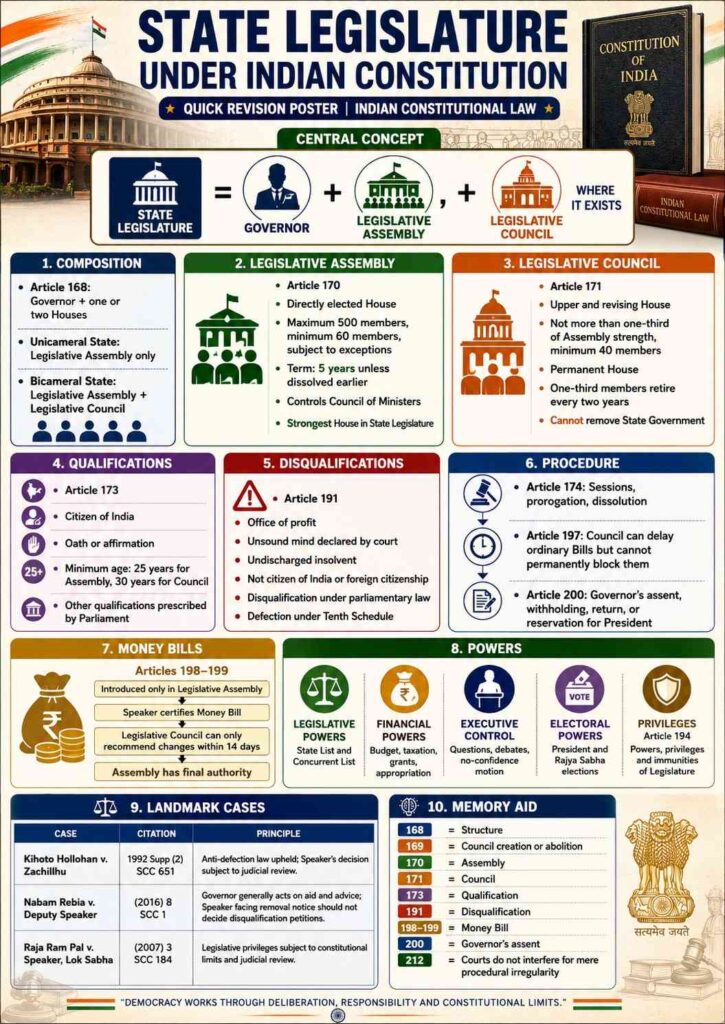
Meaning and Constitutional Scheme of State Legislature
• Basic meaning: The State Legislature is the law-making organ of a State. It debates public issues, makes laws for the State, controls the State Government, authorises public expenditure, and represents the people at the State level.
• Constitutional foundation: The provisions relating to the State Legislature are mainly contained in Part VI, Chapter III of the Constitution of India, Articles 168 to 212. Article 168 provides that every State shall have a Legislature consisting of the Governor and one or two Houses. Where there are two Houses, they are called the Legislative Assembly and the Legislative Council; where there is only one House, it is called the Legislative Assembly.
• Governor as part of State Legislature: The Governor is not a member of the House, but is constitutionally part of the State Legislature. This is because the Governor summons and prorogues the House, may dissolve the Legislative Assembly, addresses the Legislature, and gives assent to Bills.
• Unicameral and bicameral Legislature: A State having only a Legislative Assembly has a unicameral Legislature. A State having both Legislative Assembly and Legislative Council has a bicameral Legislature. The Legislative Assembly is the directly elected and politically stronger House. The Legislative Council is the upper, revising and partly indirectly elected House.
Composition of State Legislature under Article 168
• Article 168 rule: The Legislature of every State consists of the Governor and either one House or two Houses. In a bicameral State, the two Houses are the Legislative Assembly and Legislative Council. In a unicameral State, there is only the Legislative Assembly.
• Nature of bicameralism: Bicameralism means law-making through two Houses. It allows a second chamber to review, revise and discuss Bills with more depth. However, at the State level, the Legislative Council is not equal to the Legislative Assembly.
• Reason for Assembly superiority: The Legislative Assembly is directly elected by the people. Therefore, it carries the primary democratic mandate. The Council of Ministers is collectively responsible only to the Legislative Assembly and not to the Legislative Council.
• Practical importance: The State Legislature is the central institution through which State policies are converted into binding law. It performs legislative, financial, deliberative, electoral and controlling functions.
Creation and Abolition of Legislative Council under Article 169
• Special procedure: Article 169 provides that Parliament may create a Legislative Council in a State where there is none, or abolish an existing Legislative Council, if the Legislative Assembly of that State first passes a special resolution.
• Special majority in Assembly: The resolution must be passed by a majority of the total membership of the Legislative Assembly and by a majority of not less than two-thirds of the members present and voting.
• Parliament’s final role: After the State Assembly passes the required resolution, Parliament may enact a law for creation or abolition of the Legislative Council. The State Assembly initiates the process, but Parliament gives it legal effect.
• Not Article 368 amendment: A law made by Parliament under Article 169 may contain necessary constitutional amendments, but such a law is not treated as a constitutional amendment under Article 368. This makes Article 169 a special and flexible provision.
• Purpose of Article 169: The provision recognises that the need for a Legislative Council may vary from State to State. Some States may prefer a second revising chamber, while others may prefer a simpler unicameral structure.
Legislative Assembly: Composition, Election and Duration
• Direct election: Article 170 provides that the Legislative Assembly of a State consists of members chosen by direct election from territorial constituencies in the State. This makes it the main representative House of the people.
• Number of members: Generally, the Legislative Assembly shall have not more than 500 and not less than 60 members. However, the Constitution contains special provisions for some smaller States.
• Territorial constituencies: Each State is divided into territorial constituencies. Each constituency elects one representative to the Legislative Assembly.
• Population principle: The Constitution seeks broad equality of representation by requiring, as far as practicable, that the ratio between the population of each constituency and the number of seats allotted should be similar throughout the State.
• Duration under Article 172: The normal term of a Legislative Assembly is five years from the date appointed for its first meeting, unless it is dissolved earlier. During a national emergency, Parliament may extend this period by law for one year at a time, but the extension cannot continue beyond six months after the emergency has ceased.
• Dissolution: Dissolution ends the life of the Legislative Assembly. After dissolution, fresh elections are required. The Legislative Council, if present, is not dissolved because it is a permanent body.
• Political importance: The Legislative Assembly determines who forms the State Government. The Chief Minister and Council of Ministers must enjoy the confidence of the Legislative Assembly.
Legislative Council: Composition, Election and Duration
• Upper House of State Legislature: The Legislative Council is the upper House in a bicameral State Legislature. It is mainly a revising chamber. Its function is to reconsider, discuss and suggest improvements in proposed laws.
• Strength under Article 171: Article 171 provides that the total number of members in the Legislative Council shall not exceed one-third of the total number of members of the Legislative Assembly of that State, and in no case shall it be less than 40.
• Mixed composition: The Legislative Council is composed through a mixed system of election and nomination. Its members are not all directly elected by the people.
• Sources of membership: Broadly, members of the Legislative Council are elected by local authorities, graduates, teachers, members of the Legislative Assembly, and some members are nominated by the Governor from persons having special knowledge or practical experience in fields such as literature, science, art, cooperative movement and social service.
• Permanent House: The Legislative Council is a continuing body and is not subject to dissolution. One-third of its members retire every two years.
• Term of members: A member of the Legislative Council generally has a term of six years, with one-third retiring every second year.
• Limited authority: The Legislative Council cannot remove the Council of Ministers, cannot finally reject a Money Bill, and cannot permanently block an ordinary Bill. Therefore, it is weaker than the Legislative Assembly.
Difference between Legislative Assembly and Legislative Council
| Basis | Legislative Assembly | Legislative Council |
|---|---|---|
| Nature | Lower House | Upper House |
| Election | Directly elected by people | Mostly indirectly elected; partly nominated |
| Democratic mandate | Stronger | Weaker |
| Duration | Five years unless dissolved earlier | Permanent body |
| Retirement | Entire House may dissolve | One-third members retire every two years |
| Minimum age | 25 years | 30 years |
| Money Bill | Can introduce and finally pass | Cannot introduce; can only recommend |
| Control over Ministry | Ministry responsible to Assembly | No power to remove Ministry |
| Ordinary Bill | Has final superiority | Can delay and suggest changes |
| Constitutional role | Main law-making and financial House | Revising and deliberative House |
Qualifications for Membership of State Legislature
• Article 173 rule: Article 173 lays down the qualifications for membership of the State Legislature. A person must be a citizen of India, must make and subscribe the constitutional oath or affirmation, must satisfy the prescribed age requirement, and must possess such other qualifications as Parliament may prescribe by law.
• Age for Legislative Assembly: A person must be at least 25 years old to become a member of the Legislative Assembly.
• Age for Legislative Council: A person must be at least 30 years old to become a member of the Legislative Council.
• Citizenship requirement: Only a citizen of India can become a member of the State Legislature. A person who voluntarily acquires foreign citizenship becomes disqualified.
• Oath under Article 188: Before taking a seat in the House, every member must make and subscribe an oath or affirmation according to the form given in the Third Schedule.
• Statutory qualifications: Parliament may prescribe additional qualifications through law. The Representation of the People Act, 1951 is important for election-related qualifications and disqualifications.
Disqualifications for Membership of State Legislature
• Article 191 grounds: Article 191 provides that a person is disqualified from being chosen as, and from being, a member of the Legislative Assembly or Legislative Council if he holds an office of profit under the Government of India or a State Government, is of unsound mind and so declared by a competent court, is an undischarged insolvent, is not a citizen of India, has voluntarily acquired foreign citizenship, or is disqualified under any law made by Parliament.
• Office of profit: The object of the office of profit rule is to ensure legislative independence. A legislator should not be financially dependent on the executive in a manner that may affect independent judgment.
• Unsound mind: A person is disqualified only when declared to be of unsound mind by a competent court. Mere allegation or medical suspicion is not enough.
• Undischarged insolvent: Insolvency shows inability to pay debts. An undischarged insolvent is treated as disqualified because financial dependence may affect public responsibility.
• Foreign citizenship: A person who is not a citizen of India or who voluntarily acquires citizenship of another country cannot be a member of the State Legislature.
• Disqualification by parliamentary law: Parliament may create disqualifications through law, especially through election laws. Conviction for certain offences may disqualify a person under the Representation of the People Act, 1951.
• Decision under Article 192: If a question arises whether a sitting member has become disqualified, the decision is made by the Governor. However, the Governor must obtain the opinion of the Election Commission and act according to that opinion.
Anti-Defection Disqualification under the Tenth Schedule
• Meaning of defection: Defection means changing political loyalty after being elected, especially by leaving the party on whose ticket the member was elected or by voting against party directions in the House.
• Tenth Schedule: The Tenth Schedule was inserted by the Constitution Fifty-Second Amendment Act, 1985 to deal with political defections. It applies to Parliament and State Legislatures.
• Main grounds: A member may be disqualified if he voluntarily gives up membership of the political party, votes or abstains from voting contrary to the party whip without permission, or commits other acts covered by the Tenth Schedule.
• Decision by Speaker or Chairman: In the State Legislature, questions of disqualification under the Tenth Schedule are decided by the Speaker of the Legislative Assembly or the Chairman of the Legislative Council, as the case may be.
• Kihoto Hollohan v. Zachillhu, 1992 Supp (2) SCC 651: In this landmark case, the Supreme Court upheld the constitutional validity of the Tenth Schedule. The issue was whether the anti-defection law and the Speaker’s power to decide disqualification violated constitutional principles. The Court held that the anti-defection law was intended to curb political defections and maintain democratic stability. It also held that the Speaker’s decision is subject to judicial review, although courts normally do not interfere before the Speaker decides.
• Nabam Rebia and Bamang Felix v. Deputy Speaker, Arunachal Pradesh Legislative Assembly, (2016) 8 SCC 1: The case arose from a political crisis in Arunachal Pradesh. One important issue was whether the Governor could advance the Assembly session and fix legislative agenda without ministerial advice, and whether a Speaker facing a removal notice could decide disqualification petitions. The Supreme Court held that the Governor ordinarily acts on the aid and advice of the Council of Ministers in matters of summoning, proroguing and dissolving the Assembly, and that a Speaker facing a notice of removal should not decide disqualification petitions during that period.
Presiding Officers of State Legislature
• Speaker and Deputy Speaker: Articles 178 to 181 deal with the Speaker and Deputy Speaker of the Legislative Assembly. The Assembly chooses both from among its members.
• Role of Speaker: The Speaker maintains order, conducts proceedings, interprets rules of procedure, allows debates, decides points of order, and certifies whether a Bill is a Money Bill.
• Chairman and Deputy Chairman: Articles 182 to 185 deal with the Chairman and Deputy Chairman of the Legislative Council. They are chosen by the Council from among its members.
• Casting vote: Under Article 189, decisions in the House are generally made by majority of members present and voting. The presiding officer does not vote in the first instance but may cast a deciding vote in case of equality.
• Removal: The Speaker, Deputy Speaker, Chairman or Deputy Chairman may be removed by a resolution of the concerned House, subject to the constitutional procedure.
Sessions, Summoning, Prorogation and Dissolution
• Summoning under Article 174: The Governor summons the House or Houses of the State Legislature. The Constitution requires that six months shall not intervene between the last sitting of one session and the first sitting of the next session.
• Prorogation: Prorogation ends a session of the Legislature. It does not dissolve the Legislative Assembly.
• Dissolution: Dissolution applies only to the Legislative Assembly. It ends the life of the Assembly and fresh elections must be held.
• Governor’s role limited by parliamentary system: Though Article 174 uses the expression that the Governor summons, prorogues and dissolves, the power is generally exercised on the aid and advice of the Council of Ministers. The Nabam Rebia judgment confirmed that the Governor cannot ordinarily act independently in legislative scheduling when the Constitution does not expressly give discretion.
Legislative Procedure for Ordinary Bills
• Introduction of ordinary Bill: An ordinary Bill may be introduced in the Legislative Assembly. In a bicameral State, it may generally be introduced in either House, except where the Constitution provides otherwise.
• Stages of a Bill: A Bill usually passes through introduction, general discussion, detailed consideration, clause-by-clause voting, and final passing. The exact details are regulated by the rules of procedure of the House.
• Ordinary Bill in bicameral State: Article 197 deals with restriction on the powers of the Legislative Council regarding ordinary Bills. If the Assembly passes a Bill and the Council rejects it, delays it, or passes it with amendments not accepted by the Assembly, the Assembly may pass the Bill again.
• No joint sitting: There is no joint sitting mechanism in the State Legislature to resolve disagreement between the Legislative Assembly and Legislative Council. Instead, the Constitution gives the Assembly final superiority.
• Council’s delaying power: The Legislative Council can delay an ordinary Bill, but it cannot permanently block it. This maintains democratic priority of the directly elected Assembly.
• Assent of Governor: After a Bill is passed by the House or Houses, it is presented to the Governor under Article 200. The Governor may give assent, withhold assent, return a non-Money Bill for reconsideration, or reserve the Bill for the consideration of the President.
• President’s consideration: Under Article 201, when a Bill is reserved for the President, the President may assent or withhold assent. In case of a non-Money Bill, the President may direct the Governor to return the Bill to the Legislature for reconsideration.
Money Bills in State Legislature
• Definition under Article 199: A Bill is a Money Bill if it contains only provisions dealing with matters such as taxation, borrowing of money by the State, custody of the Consolidated Fund or Contingency Fund of the State, appropriation of money from the Consolidated Fund, declaration of charged expenditure, receipt or custody of public money, or matters incidental to these subjects.
• Only specified matters: A Bill is not a Money Bill merely because it involves expenditure or affects revenue in some indirect way. It must deal only with the matters listed in Article 199.
• Introduction only in Legislative Assembly: Article 198 provides that a Money Bill shall not be introduced in the Legislative Council. It can be introduced only in the Legislative Assembly.
• Speaker’s certificate: The decision of the Speaker of the Legislative Assembly that a Bill is a Money Bill is constitutionally important. When a Money Bill is transmitted to the Council and presented to the Governor, it carries the Speaker’s certificate.
• Council’s limited role: After the Legislative Assembly passes a Money Bill, it is transmitted to the Legislative Council for recommendations. The Council must return it within 14 days.
• Assembly’s final authority: The Legislative Assembly may accept or reject all or any recommendations of the Legislative Council. If the Council does not return the Bill within 14 days, the Bill is deemed to have been passed by both Houses in the form passed by the Assembly.
• Reason for special rule: Money Bills concern taxation and public expenditure. Since the Legislative Assembly is directly elected by the people, financial control is placed primarily in its hands.
Financial Procedure and Budgetary Powers
• Annual Financial Statement: Article 202 requires the Governor to cause the Annual Financial Statement, commonly known as the State Budget, to be laid before the House or Houses of the State Legislature.
• Demand for grants: Article 203 provides that demands for grants are submitted to the Legislative Assembly. The Legislative Council does not vote on demands for grants.
• Appropriation Bill: Article 204 provides for Appropriation Bills. Money cannot be withdrawn from the Consolidated Fund of the State except under appropriation made by law.
• Supplementary grants: Article 205 allows supplementary, additional or excess grants where the amount authorised is insufficient or where expenditure was not contemplated earlier.
• Vote on account and vote of credit: Article 206 allows temporary financial authorisation when the full budget process cannot be completed immediately or when urgent expenditure is needed.
• Financial Bills: Article 207 contains special provisions regarding Financial Bills. Certain financial proposals require the Governor’s recommendation.
Powers of State Legislature
Legislative Powers
• State List: The State Legislature has power to make laws on subjects in the State List, such as police, public order, public health, agriculture, local government, land and markets, subject to constitutional limitations.
• Concurrent List: The State Legislature can also make laws on Concurrent List subjects. However, in case of conflict between a State law and a Parliamentary law on a Concurrent List subject, Article 254 generally gives supremacy to the Union law, unless the State law has received Presidential assent in the manner constitutionally required.
• Territorial limitation: A State law generally operates within the territory of that State. The State Legislature cannot ordinarily make laws with extra-territorial operation.
Financial Powers
• Control over State finances: The State Legislature controls taxation, expenditure, grants and appropriation. No tax can be imposed and no money can be withdrawn from the Consolidated Fund of the State except according to law.
• Assembly’s financial dominance: The Legislative Assembly is supreme in financial matters. The Legislative Council has no effective power to reject Money Bills or demands for grants.
Executive Control Powers
• Collective responsibility: The Council of Ministers is collectively responsible to the Legislative Assembly. This means the Ministry must retain the confidence of the Assembly.
• No-confidence motion: The Legislative Assembly can remove the government by passing a no-confidence motion. The Legislative Council cannot remove the government.
• Questions and debates: Members control the executive through questions, discussions, motions, resolutions, calling attention, committee reports and debates on government policies.
Electoral Powers
• Election of President: Elected members of State Legislative Assemblies form part of the electoral college for the election of the President of India.
• Election of Rajya Sabha members: Elected members of the Legislative Assembly elect representatives of the State to the Rajya Sabha.
• Election to Legislative Council: In States having a Legislative Council, members of the Legislative Assembly elect a portion of the Council’s members.
Constituent Powers
• Ratification of constitutional amendments: Some constitutional amendments affecting federal provisions require ratification by at least one-half of the State Legislatures under Article 368. This gives States a role in preserving the federal structure.
• No independent amendment power: A State Legislature cannot amend the Constitution independently. It can only ratify certain amendments when required.
Privileges and Immunities
• Article 194 privileges: Members of the State Legislature enjoy freedom of speech in the Legislature, subject to the Constitution and rules of procedure. They are not liable in court for anything said or any vote given in the Legislature or its committees.
• Purpose of privileges: Legislative privileges protect the independence, dignity and effective functioning of the Legislature. They are not personal benefits for individual members.
• Raja Ram Pal v. Hon’ble Speaker, Lok Sabha, (2007) 3 SCC 184: Though the case concerned Parliament, its principles are relevant because Article 105 and Article 194 are similar. The Supreme Court held that legislative privileges are subject to constitutional limitations and judicial review. Courts may examine illegality or unconstitutionality, though they do not interfere with mere procedural irregularities.
Limitations on Powers of State Legislature
• Constitutional supremacy: The State Legislature is subject to the Constitution. A State law violating fundamental rights, legislative competence or constitutional limitations may be struck down by courts.
• Federal distribution of powers: The State Legislature cannot legislate beyond its constitutional field. Legislative competence is determined mainly by the Seventh Schedule.
• Union power in special situations: Parliament may legislate on State List subjects in special circumstances, such as national interest under Article 249, national emergency under Article 250, State consent under Article 252, and international obligations under Article 253.
• Governor and President’s assent: Certain Bills may require the Governor’s recommendation, reservation for Presidential consideration, or Presidential assent.
• Judicial review: Article 212 protects legislative proceedings from being questioned in court on the ground of mere procedural irregularity. However, unconstitutional or illegal acts may still be judicially reviewed.
Important Articles at a Glance
| Article | Subject |
|---|---|
| Article 168 | Constitution of State Legislature |
| Article 169 | Abolition or creation of Legislative Council |
| Article 170 | Composition of Legislative Assembly |
| Article 171 | Composition of Legislative Council |
| Article 172 | Duration of State Legislature |
| Article 173 | Qualification for membership |
| Article 174 | Sessions, prorogation and dissolution |
| Article 178 | Speaker and Deputy Speaker |
| Article 182 | Chairman and Deputy Chairman |
| Article 191 | Disqualifications |
| Article 194 | Powers, privileges and immunities |
| Article 197 | Restriction on Council’s power over ordinary Bills |
| Article 198 | Special procedure for Money Bills |
| Article 199 | Definition of Money Bill |
| Article 200 | Assent to Bills |
| Article 202 | Annual Financial Statement |
| Article 212 | Courts not to question proceedings for procedural irregularity |
Memory Aid for Quick Understanding
| Keyword | Meaning |
|---|---|
| 168 = Structure | Governor plus one or two Houses |
| 169 = Council Change | Creation or abolition of Legislative Council |
| 170 = Assembly | Directly elected House |
| 171 = Council | Mixed elected and nominated House |
| 172 = Duration | Assembly five years; Council permanent |
| 173 = Qualification | Citizenship, oath, age and legal qualifications |
| 191 = Disqualification | Office of profit, unsound mind, insolvency, foreign citizenship, law and defection |
| 198–199 = Money Bill | Assembly dominance in financial legislation |
| 200 = Governor’s assent | Assent, return, withholding or reservation |
| 212 = Autonomy | Courts avoid mere procedural irregularities |
Final Summary
• Central concept: The State Legislature is the constitutional law-making body of a State. It represents the people, makes laws, controls the executive and authorises expenditure.
• Composition: Under Article 168, the State Legislature consists of the Governor and one or two Houses. The Legislative Assembly exists in every State. The Legislative Council exists only in States where it has been constitutionally created.
• Assembly dominance: The Legislative Assembly is the more powerful House because it is directly elected, controls the Council of Ministers, votes on grants and has final authority in Money Bills.
• Council’s function: The Legislative Council is a revising chamber. It improves deliberation but cannot permanently defeat the will of the Assembly.
• Money Bills: A Money Bill can be introduced only in the Legislative Assembly. The Legislative Council can only make recommendations within 14 days.
• Constitutional balance: The State Legislature has wide powers, but those powers are limited by the Constitution, federal distribution of legislative subjects, judicial review, and special roles of the Governor and President in certain situations.