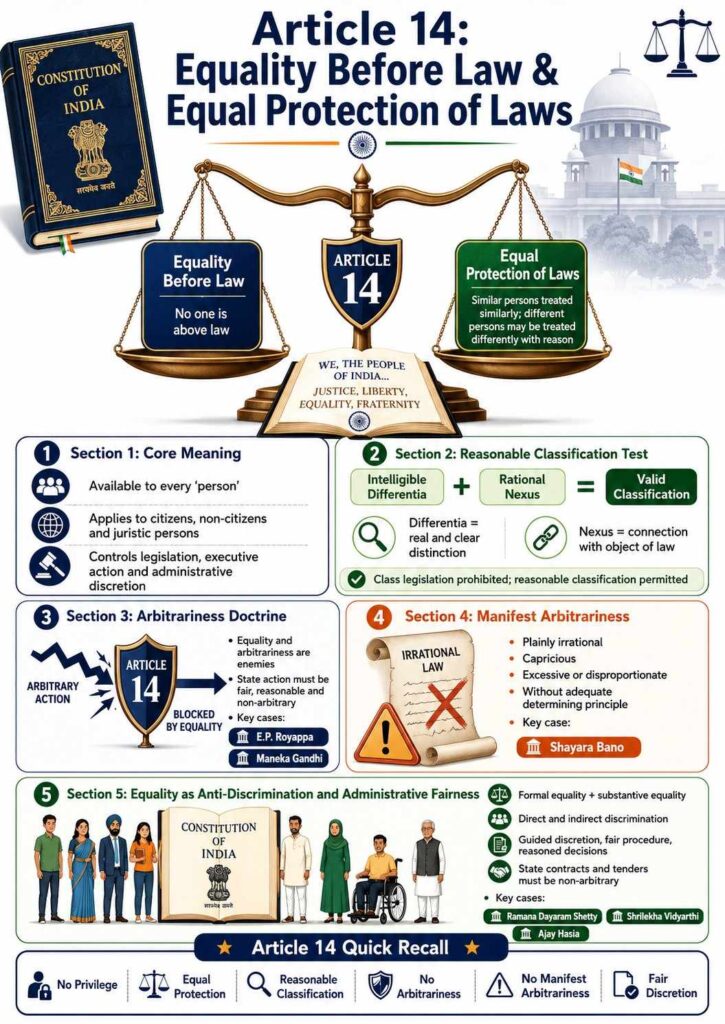
Article 14: Constitutional Text and Core Meaning
➤ Constitutional guarantee: Article 14 of the Constitution of India provides that “The State shall not deny to any person equality before the law or the equal protection of the laws within the territory of India.” This is one of the most powerful fundamental rights because it controls legislation, executive action, administrative discretion, public employment decisions, State contracts, licensing, taxation, welfare schemes and every form of State conduct.
➤ Available to every person: Article 14 uses the word “person”, not merely “citizen”. Therefore, its protection is available not only to Indian citizens but also to non-citizens, juristic persons, companies and associations, wherever State action within India affects them. The State cannot act unequally merely because a person is politically weak, socially marginalised, economically poor, foreign, unpopular or dependent on State permission.
➤ Two expressions in one Article: Article 14 contains two connected but distinct expressions: “equality before law” and “equal protection of laws.” The first is mainly a negative concept requiring absence of special privilege, while the second is a positive concept requiring the State to treat similarly situated persons similarly and to make rational distinctions where real differences exist. The Supreme Court in State of West Bengal v. Anwar Ali Sarkar, 1952 SCR 284 noted that Article 14 combines the English idea of equality before law with the American idea of equal protection.
Equality Before Law
➤ Meaning of equality before law: Equality before law means that every person, whether rich or poor, powerful or weak, public officer or private citizen, is subject to the ordinary law of the land. No one is above law. It rejects arbitrary power, special privilege and unequal legal status.
➤ Rule of law connection: Equality before law is closely connected with the rule of law. In a rule-of-law system, power must be exercised according to law, not according to personal liking, political pressure, private bias or administrative convenience. A government officer cannot say, “I will apply the rule to one person but not to another,” unless there is a lawful and rational basis.
➤ Simple illustration: If a traffic rule applies to all drivers, a minister, judge, police officer, businessperson and ordinary citizen are all bound by it. A public authority cannot exempt a powerful person from the law merely because of status. That is the essence of equality before law.
Equal Protection of Laws
➤ Meaning of equal protection: Equal protection of laws means that persons who are similarly placed must be treated similarly, and persons who are differently placed may be treated differently if the difference is real and relevant to the purpose of the law. It does not mean identical treatment in all situations.
➤ Substantive equality: Equal protection allows the State to make special laws for disadvantaged groups, children, women, labourers, Scheduled Castes, Scheduled Tribes, socially and educationally backward classes, persons with disabilities and other vulnerable groups. Treating unequals equally may itself become inequality.
➤ Simple illustration: A law giving free textbooks to poor schoolchildren is not unconstitutional merely because rich children do not receive the same benefit. The classification is based on economic need and has a rational connection with educational equality.
Equality Before Law and Equal Protection of Laws: Difference Table
| Basis | Equality Before Law | Equal Protection of Laws |
|---|---|---|
| Nature | Negative concept | Positive concept |
| Main idea | No one is above law | Similar persons must receive similar protection |
| Source idea | English rule of law | American equal protection doctrine |
| Focus | Absence of privilege | Rational and fair treatment |
| Permits classification? | Mainly insists on equal legal subjection | Permits reasonable classification |
| Example | A public officer is also bound by criminal law | Special welfare scheme for weaker sections |
Article 14 Does Not Mean Absolute Equality
➤ No mechanical equality: Article 14 does not require that every law must apply identically to every person. Human society contains different classes, occupations, needs, risks and conditions. Therefore, the Constitution permits the State to classify persons, things, areas or situations for legislative and administrative purposes.
➤ Class legislation prohibited: Article 14 prohibits class legislation, meaning hostile, artificial or arbitrary selection of a group for special burden or benefit without rational justification.
➤ Reasonable classification permitted: Article 14 permits reasonable classification, meaning a real and rational grouping based on intelligible differentia and connected with the object of the law. In Budhan Choudhry v. State of Bihar, AIR 1955 SC 191 / 1955 SCR 1045, the Supreme Court clearly stated that Article 14 forbids class legislation but does not forbid reasonable classification.
Doctrine of Reasonable Classification
➤ Two-fold test: A classification is constitutionally valid under Article 14 when it satisfies two conditions:
| Requirement | Meaning |
|---|---|
| Intelligible differentia | The classification must be based on a clear, understandable and real distinction separating persons included in the group from those excluded. |
| Rational nexus | The differentia must have a reasonable connection with the object sought to be achieved by the law. |
➤ Intelligible differentia explained: The word “intelligible” means understandable. The State must be able to explain why one group has been selected and another left out. A classification based on age, income, nature of work, geographical condition, educational qualification, risk level or public need may be intelligible if relevant.
➤ Rational nexus explained: Even if the classification is clear, it must be connected with the purpose of the law. For example, prescribing a higher age requirement for judges may be rational because judicial office requires maturity and legal experience. But prescribing height as a qualification for a desk-based clerical post may fail Article 14 if height has no connection with the work.
➤ Case law — State of West Bengal v. Anwar Ali Sarkar, 1952 SCR 284: The West Bengal Special Courts Act allowed the State Government to send selected cases to special courts with a different procedure. The issue was whether such selective procedure violated Article 14. The Supreme Court held that unguided and uncontrolled selection of cases for special treatment could offend Article 14 because the law did not provide a reasonable basis for choosing which cases would go to special courts. The ratio is that classification must not be vague, unguided or arbitrary; it must rest on a rational principle.
➤ Case law — Budhan Choudhry v. State of Bihar, AIR 1955 SC 191 / 1955 SCR 1045: The petitioners challenged differential criminal procedure. The Supreme Court explained that Article 14 does not forbid classification, but the classification must be founded on intelligible differentia and that differentia must have a rational relation with the object of the law. This case is a foundational authority for the two-fold test of reasonable classification.
➤ Memory aid: “D + N = Valid Classification”
D = Differentia must be intelligible.
N = Nexus must exist with the object of law.
Limits of Reasonable Classification
➤ Over-inclusive classification: A classification may be invalid if it includes persons who have no real connection with the purpose of the law. For example, a law meant to regulate dangerous industries cannot randomly include harmless small shops without a rational reason.
➤ Under-inclusive classification: A classification may be questioned if it excludes persons who are similarly placed in relation to the object of the law. However, courts usually give the legislature some flexibility because laws may be experimental and may deal with problems step by step.
➤ Disguised discrimination: A classification may appear neutral but may operate unfairly against a vulnerable group. Article 14 looks not only at the form of law but also at its effect when the effect reveals irrational or discriminatory State action.
➤ No arbitrary selection: The State cannot pick and choose persons for benefit or burden without a clear standard. When discretion is unguided, excessive or based on irrelevant considerations, Article 14 is attracted.
Arbitrariness Doctrine under Article 14
➤ Shift from formal equality to substantive fairness: Earlier Article 14 was mainly understood through reasonable classification. Later, the Supreme Court expanded Article 14 by holding that arbitrariness itself is a form of inequality. This means that even where no traditional classification is shown, State action may be struck down if it is arbitrary, irrational, unfair or without principle.
➤ Case law — E.P. Royappa v. State of Tamil Nadu, AIR 1974 SC 555 / (1974) 4 SCC 3: The petitioner, a senior IAS officer, challenged his transfer and posting as arbitrary and mala fide. The Supreme Court gave Article 14 a dynamic meaning and held that equality and arbitrariness are sworn enemies. The ratio is that where State action is arbitrary, it is unequal and therefore violates Article 14. This case transformed Article 14 from a narrow classification rule into a broad guarantee against arbitrary State action.
➤ Case law — Maneka Gandhi v. Union of India, AIR 1978 SC 597 / (1978) 1 SCC 248: The petitioner’s passport was impounded without giving reasons initially, raising issues under Articles 14, 19 and 21. The Supreme Court held that procedure affecting personal liberty must be right, just and fair, not arbitrary, fanciful or oppressive. The Court connected Article 14 with reasonableness and fairness, holding that Article 14 strikes at arbitrariness in State action.
➤ Meaning in simple words: If the government acts without reason, without standards, without fairness or by using power for an improper purpose, its action may violate Article 14 even if the action does not fit neatly into a classification problem.
Manifest Arbitrariness
➤ Meaning of manifest arbitrariness: Manifest arbitrariness means arbitrariness that is obvious, clear, excessive or plainly unreasonable. It is not every small defect in law. It refers to legislation or State action that is capricious, irrational, without adequate determining principle, excessive, disproportionate or based on no fair standard.
➤ Use against legislation: The doctrine is important because it allows courts to examine whether even a law made by the legislature is so irrational or excessive that it violates Article 14. Courts remain careful because they do not sit as super-legislatures, but a law cannot survive merely because it is formally enacted if it is plainly arbitrary.
➤ Case law — Shayara Bano v. Union of India, AIR 2017 SC 4609 / (2017) 9 SCC 1: The issue was the constitutional validity of talaq-e-biddat, commonly called instant triple talaq. The Supreme Court, by majority, set aside the practice. Justice R.F. Nariman’s opinion applied the doctrine of manifest arbitrariness and explained that legislation or legal rules may be invalid under Article 14 if they are capricious, irrational, without adequate determining principle or excessive and disproportionate. The ratio relevant to Article 14 is that manifest arbitrariness is a ground for invalidating State-recognised legal norms.
➤ Difference between ordinary arbitrariness and manifest arbitrariness: Ordinary arbitrariness may describe unfair executive conduct; manifest arbitrariness is a stricter standard often used while examining legislation. It requires a higher degree of obvious irrationality.
Equality as an Anti-Discrimination Principle
➤ Anti-discrimination foundation: Article 14 is the general equality clause. Articles 15, 16, 17 and 18 are specific applications of equality in particular areas. Article 15 addresses discrimination on grounds such as religion, race, caste, sex and place of birth. Article 16 applies equality in public employment. Article 17 abolishes untouchability. Article 18 abolishes titles, except constitutionally permitted distinctions.
➤ Article 14 as a broad shield: Even where discrimination does not fall directly under Article 15 or 16, Article 14 may still apply if State action creates unfair exclusion, irrational burden or unequal treatment. Thus, Article 14 is not only about formal sameness; it is also about dignity, fairness and equal concern.
➤ Direct and indirect discrimination: Direct discrimination occurs when law openly treats people differently on an improper basis. Indirect discrimination occurs when a neutral rule disproportionately harms a protected or vulnerable group without adequate justification. For example, a rule may not mention gender but may operate in a manner that excludes women from equal opportunity.
➤ Substantive equality: The anti-discrimination principle under Article 14 supports substantive equality. It asks whether the law actually produces fair treatment in social reality. This is why protective discrimination, reservation, welfare benefits, maternity protection and special measures for vulnerable groups are not automatically unequal; they may be necessary to achieve real equality.
Article 14 and Administrative Discretion
➤ Discretion must be guided: Administrative discretion means power given to an authority to choose between lawful options. Article 14 does not prohibit discretion, but it prohibits unguided, uncontrolled, mala fide, discriminatory or arbitrary discretion.
➤ Administrative authorities must act fairly: Whenever the State grants licences, awards contracts, makes appointments, distributes benefits, cancels permissions, allots land, blacklists contractors or takes disciplinary action, it must follow fair standards. The State cannot act like a private person choosing favourites.
➤ Case law — Ramana Dayaram Shetty v. International Airport Authority of India, AIR 1979 SC 1628 / (1979) 3 SCC 489: The Airport Authority invited tenders for a restaurant and snack bar, prescribing eligibility conditions. A tender was accepted despite non-compliance with the stated conditions. The Supreme Court held that the government and its instrumentalities must act fairly and cannot depart from declared standards arbitrarily. The ratio is that Article 14 applies to State contracts, tenders and public dealings; arbitrariness in awarding State largesse violates equality.
➤ Case law — Kasturi Lal Lakshmi Reddy v. State of Jammu and Kashmir, (1980) 4 SCC 1: The issue concerned grant of State resources and governmental contracts. The Supreme Court held that governmental action in contractual matters must be reasonable, non-arbitrary and in public interest. The State cannot distribute public wealth according to private preference. This case strengthens the principle that Article 14 controls State largesse.
➤ Case law — Kumari Shrilekha Vidyarthi v. State of U.P., AIR 1991 SC 537 / (1991) 1 SCC 212: The State of Uttar Pradesh terminated the appointments of all government counsel by a general order. The Supreme Court held that Article 14 applies even in contractual and public-law employment-related arrangements where the State is involved. The ratio is that arbitrariness is the negation of rule of law, and every State action must satisfy fairness and reasonableness.
➤ Case law — Ajay Hasia v. Khalid Mujib Sehravardi, AIR 1981 SC 487 / (1981) 1 SCC 722: The issue involved admissions to an engineering college controlled by a society substantially connected with the government. The Supreme Court held that bodies that are instrumentalities or agencies of the State are subject to constitutional limitations. The ratio is that Article 14 cannot be avoided by creating government-controlled bodies in corporate or society form.
➤ Practical rule: Administrative discretion survives Article 14 when it is exercised on relevant material, by lawful authority, for proper purpose, according to declared standards, after fair procedure and without bias, mala fides or discrimination.
Article 14 and Natural Justice
➤ Fair hearing as equality: Natural justice is closely connected with Article 14 because arbitrary procedure produces unequal treatment. Where a person is affected by State action, fairness may require notice, opportunity of hearing, disclosure of reasons and an unbiased decision-maker.
➤ Reasoned decisions: A reasoned order helps prevent arbitrary power. When an authority gives reasons, the affected person understands why the decision was taken, and courts can examine whether the decision is lawful.
➤ No rigid formula: Natural justice is flexible. Urgent preventive action, national security concerns, academic evaluation and legislative policy may require different levels of hearing. But complete denial of fairness without justification may violate Article 14.
Article 14 Review: What Courts Usually Examine
| Question | Article 14 relevance |
|---|---|
| Is there unequal treatment? | Similar persons should not be treated differently without reason. |
| Is there classification? | Classification must be based on intelligible differentia. |
| Is there nexus? | The distinction must connect with the object of law. |
| Is the action arbitrary? | State action must not be irrational, capricious or unfair. |
| Is discretion guided? | Administrative power must have standards and limits. |
| Is the action discriminatory in effect? | Neutral rules may still violate equality if unjustified impact is discriminatory. |
| Is the law manifestly arbitrary? | A law may be invalid if it is plainly irrational or excessive. |
Important Conceptual Distinctions
➤ Equality and uniformity: Equality is not the same as uniformity. Uniformity means everyone gets the same treatment. Equality means fair treatment according to relevant circumstances.
➤ Classification and discrimination: Classification is constitutionally permissible when reasonable. Discrimination is constitutionally impermissible when the distinction is hostile, irrational, irrelevant or based on prohibited grounds.
➤ Legislative arbitrariness and executive arbitrariness: Legislative arbitrariness concerns validity of laws. Executive arbitrariness concerns administrative orders, government contracts, transfers, licences, selection processes and policy implementation.
➤ Formal equality and substantive equality: Formal equality asks whether the law treats everyone alike on paper. Substantive equality asks whether the law actually gives fair and equal protection in real life.
Illustrations for Easy Understanding
➤ Valid classification illustration: A law requiring special safety training for pilots but not for bus passengers is valid because pilots perform a specialised safety-sensitive function.
➤ Invalid classification illustration: A municipal rule granting shop licences only to persons belonging to one political party is invalid because political loyalty has no rational nexus with running a shop.
➤ Administrative discretion illustration: If a university announces that admission will be based on merit and interview, it cannot secretly select candidates based on personal influence. Such conduct is arbitrary and violates Article 14.
➤ Manifest arbitrariness illustration: A law allowing cancellation of any business licence “whenever the authority desires” without standards, reasons or remedies may be manifestly arbitrary because it gives naked and uncontrolled power.
Landmark Case Summary Table
| Case | Principle |
|---|---|
| State of West Bengal v. Anwar Ali Sarkar, 1952 SCR 284 | Unguided special procedure may violate Article 14. |
| Budhan Choudhry v. State of Bihar, AIR 1955 SC 191 | Article 14 forbids class legislation but permits reasonable classification. |
| E.P. Royappa v. State of Tamil Nadu, AIR 1974 SC 555 | Equality is antithetical to arbitrariness. |
| Maneka Gandhi v. Union of India, AIR 1978 SC 597 | Article 14 requires fairness, reasonableness and non-arbitrary procedure. |
| Ramana Dayaram Shetty v. International Airport Authority, AIR 1979 SC 1628 | State contracts and tenders must follow fair and non-arbitrary standards. |
| Ajay Hasia v. Khalid Mujib, AIR 1981 SC 487 | State instrumentalities are bound by Article 14. |
| Kumari Shrilekha Vidyarthi v. State of U.P., AIR 1991 SC 537 | Article 14 applies even to State contractual action; arbitrariness negates rule of law. |
| Shayara Bano v. Union of India, AIR 2017 SC 4609 | Manifest arbitrariness is a ground under Article 14. |
Conclusion
➤ Article 14 as the heart of fairness: Article 14 is not a narrow command that everyone must always be treated identically. It is a broad constitutional guarantee that the State must act with fairness, reason, non-discrimination and equal concern.
➤ Three controlling ideas: The modern understanding of Article 14 rests on three major ideas: reasonable classification, non-arbitrariness and substantive anti-discrimination. Reasonable classification allows the State to deal with real differences. The arbitrariness doctrine prevents irrational power. The anti-discrimination principle ensures that equality is meaningful in social reality.
➤ Administrative importance: Article 14 is especially important in administrative law because most citizen-State interactions occur through executive discretion. Licences, tenders, appointments, welfare schemes, disciplinary orders and public benefits must all follow fair standards.
➤ Final essence: Article 14 means that the State must not act by whim, favouritism, hostility, prejudice or irrationality. It must act through law, reason, fairness and constitutional morality. That is why Article 14 is one of the strongest protections against arbitrary power in Indian constitutional law.