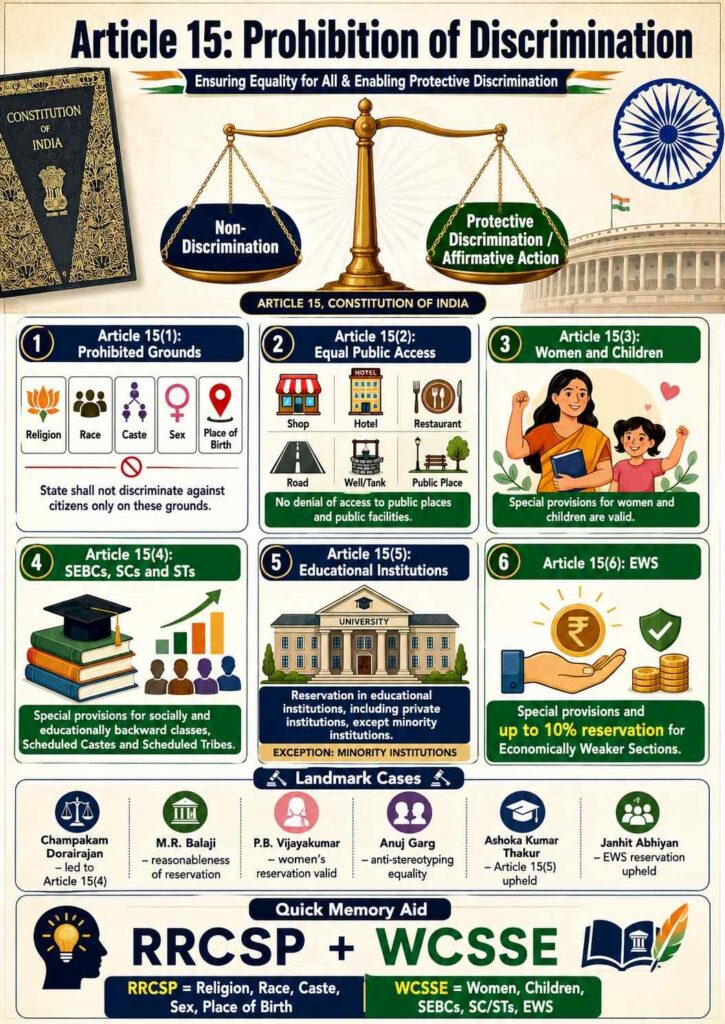
Meaning and Constitutional Purpose of Article 15
➤ Core idea: Article 15 is one of the most important provisions in the Indian Constitution’s Right to Equality framework. It prohibits discrimination against citizens on certain protected grounds and, at the same time, permits the State to make special provisions for disadvantaged groups so that real equality can be achieved.
➤ Equality with social justice: Article 15 should not be understood as a rule of mechanical equality where everyone is treated identically in every situation. Its deeper object is to remove social barriers created by religion, race, caste, sex and place of birth, and to allow protective measures for groups that have historically suffered disadvantage.
➤ Connection with Article 14: Article 14 gives the general guarantee of equality before law and equal protection of laws. Article 15 applies that equality principle to specific grounds of discrimination. Therefore, Article 15 is a specific anti-discrimination provision within the broader equality code of the Constitution.
➤ Article 15 text in substance: Article 15(1) prohibits the State from discriminating against any citizen only on grounds of religion, race, caste, sex, place of birth or any of them. Article 15(2) prohibits denial of access to shops, public restaurants, hotels, places of public entertainment, wells, tanks, roads and public resorts on the same grounds. Article 15(3) to Article 15(6) then create constitutional space for special provisions for women, children, socially and educationally backward classes, Scheduled Castes, Scheduled Tribes and Economically Weaker Sections.
Scope of Article 15: Citizen-Centric Protection
➤ Citizens only: Article 15 protects citizens, unlike Article 14, which protects “any person”. Therefore, a foreigner can invoke Article 14 in India, but Article 15 is generally available only to citizens.
➤ State action under Article 15(1): Article 15(1) is addressed to the State. It prevents the State from making discriminatory laws, policies, executive orders or administrative practices against citizens on prohibited grounds.
➤ Public access under Article 15(2): Article 15(2) has a wider social purpose because it prohibits discriminatory restrictions in access to certain public places and public facilities. Its importance lies in the fact that it attacks caste-based and status-based exclusion in daily public life.
➤ Horizontal effect through public access: Although many fundamental rights are mainly enforceable against the State, Article 15(2) also regulates access to places used by the public, such as shops, hotels and public restaurants. This makes it a powerful constitutional weapon against social exclusion.
Article 15(1): Prohibition of Discrimination by the State
➤ Protected grounds: Article 15(1) prohibits discrimination only on the grounds of religion, race, caste, sex, place of birth or any of them. These grounds were chosen because Indian society has historically seen deep inequalities based on these identities.
➤ Meaning of “discrimination”: Discrimination means unfair, unequal or adverse treatment. Under Article 15, discrimination is unconstitutional when the State treats a citizen unfavourably only because of the citizen’s religion, race, caste, sex or place of birth.
➤ Importance of the word “only”: The word “only” means that a law is invalid under Article 15(1) when the prohibited ground is the sole basis of discrimination. However, modern constitutional interpretation does not allow the State to hide discrimination behind artificial labels. A law apparently based on another ground may still be unconstitutional if its real effect is discriminatory.
➤ Illustration: If a State rule says that people of a particular caste cannot enter a government educational institution, it directly violates Article 15(1). If a rule uses neutral language but practically excludes a protected caste or sex without constitutional justification, it may also be attacked under Articles 14 and 15.
Discrimination on Ground of Religion
➤ Religious neutrality: Article 15(1) prevents the State from treating citizens differently only because they belong to a particular religion. The State cannot deny educational access, public benefits or civil rights merely because a citizen is Hindu, Muslim, Christian, Sikh, Buddhist, Jain, Parsi or belongs to any other faith.
➤ Secular equality: This provision supports the secular character of the Constitution. Secularism in India does not mean hostility to religion; it means equal respect and equal constitutional status for all religions.
➤ Important limitation: Article 15 does not prohibit every classification that incidentally concerns religious communities. For example, welfare measures for genuinely backward groups are not invalid merely because some beneficiaries may belong to a particular religion. The key question is whether the classification is based only on religion or on constitutionally relevant backwardness.
Discrimination on Ground of Race
➤ Race as protected identity: Article 15 prohibits racial discrimination. In India, “race” is relevant in the context of ethnic identity, tribal identity and discrimination against persons from particular regions or communities.
➤ Dignity-based reading: Racial discrimination violates human dignity. A citizen cannot be denied access to public places or State benefits because of appearance, ethnicity, ancestry, physical features or perceived racial origin.
➤ Modern relevance: Discrimination against people from North-East India, tribal communities, or persons targeted because of ethnic appearance may raise concerns under Articles 14, 15 and 21, depending on the facts.
Discrimination on Ground of Caste
➤ Caste as historical oppression: Caste discrimination is one of the central concerns of Article 15. The Constitution rejects the idea that civil rights, public access, educational opportunity or dignity can depend upon caste status.
➤ Article 15(2) and caste exclusion: Article 15(2) is especially important because caste discrimination historically operated through denial of access to wells, tanks, roads, temples, shops, restaurants and other public places. This clause constitutionalises equal access to public life.
➤ Protective discrimination is not caste discrimination: Special provisions for Scheduled Castes, Scheduled Tribes and socially and educationally backward classes do not violate Article 15 merely because caste may be one of the indicators of backwardness. The Constitution itself allows such measures through Article 15(4) and Article 15(5).
➤ Caste cannot be the only mechanical test: In M.R. Balaji v. State of Mysore, AIR 1963 SC 649, the Supreme Court considered a Mysore order reserving 68% seats in educational institutions for backward and more backward classes. The issue was whether such classification and high reservation were valid under Article 15(4). The Court held that caste cannot be the sole and dominant test for determining backwardness and that reservation must remain reasonable; the impugned order was struck down as excessive and constitutionally invalid.
Discrimination on Ground of Sex
➤ Sex equality: Article 15(1) prohibits discrimination only on the ground of sex. It protects citizens from being denied opportunities, benefits or access merely because they are men, women or belong to a gender identity that does not fit traditional categories.
➤ Beyond biological sex: Modern constitutional law reads sex discrimination broadly. Discrimination based on gender stereotypes, pregnancy, marital expectations, gender identity and sexual orientation may violate constitutional equality because such discrimination is rooted in social assumptions about sex and gender roles.
➤ Anti-stereotyping principle: In Anuj Garg v. Hotel Association of India, (2008) 3 SCC 1, the Supreme Court examined a law that restricted women’s employment in premises where liquor was served. The issue was whether a “protective” restriction excluding women from certain employment was valid. The Court held that such paternalistic protection was unconstitutional because it perpetuated gender stereotypes instead of ensuring real safety and equality.
➤ Women’s protection versus women’s autonomy: Article 15(3) permits special provisions for women, but it cannot be used as a cover for laws that reduce women’s agency. A valid special provision must advance equality, dignity and opportunity; it should not lock women into traditional roles.
Discrimination on Ground of Place of Birth
➤ Place of birth protected: The State cannot discriminate against a citizen only because the citizen was born in a particular State, district, city, village or region.
➤ Difference between place of birth and residence: Place of birth is not the same as residence or domicile. A rule based solely on birth in a particular place is generally prohibited under Article 15(1), but residence-based classification may sometimes be examined under Article 14 or other provisions depending on the context.
➤ Illustration: If a government college denies admission only because a student was born outside a particular State, it may violate Article 15(1). But if a limited preference is based on residence and has a rational connection with local educational needs, it may require a separate Article 14 analysis.
Article 15(2): Equal Access to Public Places and Facilities
➤ Public access guarantee: Article 15(2) says no citizen shall, only on the grounds of religion, race, caste, sex, place of birth or any of them, be subjected to any disability, liability, restriction or condition regarding access to shops, public restaurants, hotels, places of public entertainment, wells, tanks, bathing ghats, roads and places of public resort maintained out of State funds or dedicated to public use.
➤ Civil rights dimension: This clause is a constitutional answer to social practices like untouchability, caste exclusion and gender-based public exclusion. It ensures that public life cannot be controlled by private prejudice when facilities are meant for public use.
➤ Relation with Article 17: Article 17 abolishes untouchability. Article 15(2) complements Article 17 by specifically preventing denial of access to public places and utilities on prohibited grounds.
➤ Example: A hotel refusing entry to a citizen because of caste or religion violates Article 15(2). A public well maintained by State funds cannot be restricted to a dominant caste.
Protective Discrimination under Article 15
➤ Meaning of protective discrimination: Protective discrimination means constitutionally permitted favourable treatment for disadvantaged groups. It is not discrimination in the negative sense; it is a method to correct historical and structural inequality.
➤ Formal equality versus substantive equality: Formal equality says everyone should be treated the same. Substantive equality asks whether people are actually placed in equal conditions. Article 15 adopts substantive equality by allowing special provisions for those who need support to reach equal status.
➤ Constitutional basis: Article 15(3), Article 15(4), Article 15(5) and Article 15(6) expressly permit special provisions. These clauses show that the Constitution does not treat affirmative action as an exception to equality in a narrow sense, but as a part of equality itself.
➤ Protective discrimination is controlled power: The State cannot create arbitrary reservations or benefits. Special provisions must have a constitutional purpose, rational basis, proper identification of beneficiaries and reasonable limits.
Article 15(3): Special Provisions for Women and Children
➤ Text and purpose: Article 15(3) states that nothing in Article 15 shall prevent the State from making any special provision for women and children. This allows the State to enact laws and policies addressing women’s disadvantage and children’s vulnerability.
➤ Women-specific measures: Article 15(3) supports provisions such as reservation for women in local bodies, maternity benefits, women’s hostels, separate facilities for safety and dignity, special welfare schemes, and preference or reservation in appropriate contexts.
➤ Children-specific measures: Article 15(3) permits special provisions for children such as free education, nutrition programmes, child protection laws, juvenile justice measures and child welfare schemes.
➤ Yusuf Abdul Aziz case: In Yusuf Abdul Aziz v. State of Bombay, AIR 1954 SC 321; 1954 SCR 930, the accused challenged Section 497 IPC, which punished a man for adultery but did not punish the woman as an abettor. The issue was whether the provision discriminated on the ground of sex. The Supreme Court upheld the provision at that time by relying on Article 15(3), holding that special provisions for women were constitutionally permitted. However, the later decision in Joseph Shine v. Union of India, (2019) 3 SCC 39 struck down adultery as unconstitutional on broader grounds of equality, dignity, autonomy and privacy; therefore, Yusuf Abdul Aziz must now be read historically and not as good law on the validity of adultery.
➤ P.B. Vijayakumar case: In Government of Andhra Pradesh v. P.B. Vijayakumar, (1995) 4 SCC 520, the State provided preference/reservation for women in public employment. The issue was whether Article 15(3) could support such a provision despite Article 16. The Supreme Court held that Article 15(3) is wide enough to include reservation or preference for women and that such measures promote real equality.
➤ Limit of women-protective laws: A law cannot be justified under Article 15(3) merely because it mentions women’s protection. If the law is based on stereotypes, moral policing or exclusion from opportunity, it may be invalid as seen in Anuj Garg.
Article 15(4): Special Provisions for SEBCs, SCs and STs
➤ Text and purpose: Article 15(4) permits the State to make special provisions for the advancement of any socially and educationally backward classes of citizens or for Scheduled Castes and Scheduled Tribes. It was inserted by the Constitution (First Amendment) Act, 1951, after the Supreme Court’s decision in Champakam Dorairajan.
➤ Champakam Dorairajan case: In State of Madras v. Srimathi Champakam Dorairajan, AIR 1951 SC 226; 1951 SCR 525, the Madras Government had a communal reservation order distributing medical and engineering seats among communities. The issue was whether such communal allocation violated Articles 15(1) and 29(2). The Supreme Court struck down the order, holding that admission could not be denied on grounds of religion, race, caste or language in violation of fundamental rights. This decision led to the First Constitutional Amendment, which inserted Article 15(4) to constitutionally permit special provisions for backward classes, SCs and STs.
➤ Socially and educationally backward classes: SEBCs are groups that suffer both social and educational backwardness. Caste may be a relevant factor in identifying backwardness in Indian society, but it cannot be applied mechanically without data or social context.
➤ SCs and STs: Scheduled Castes and Scheduled Tribes receive explicit constitutional recognition because of historical oppression, untouchability, exclusion, land alienation, social isolation and denial of equal opportunity.
➤ Nature of Article 15(4): Article 15(4) is enabling, not mandatory. This means the State has the power to create special provisions, but an individual cannot always demand a particular reservation as a matter of automatic right unless a valid law or policy exists.
Article 15(5): Reservation in Educational Institutions
➤ Text and scope: Article 15(5) allows the State to make special provisions, including reservation, for socially and educationally backward classes, SCs and STs in educational institutions, including private educational institutions, whether aided or unaided by the State, except minority educational institutions under Article 30(1).
➤ Reason for Article 15(5): This clause was inserted to strengthen affirmative action in education, especially after judicial decisions concerning autonomy of private unaided institutions. It gives the State constitutional authority to extend reservation policies to private educational institutions, subject to the exception for minority institutions.
➤ Minority institution exception: Article 15(5) does not apply to minority educational institutions protected under Article 30(1). This preserves the constitutional right of minorities to establish and administer educational institutions of their choice.
➤ Ashoka Kumar Thakur case: In Ashoka Kumar Thakur v. Union of India, (2008) 6 SCC 1, the Supreme Court examined the constitutional validity of Article 15(5) and the Central Educational Institutions (Reservation in Admission) Act, 2006, which provided OBC reservation in central educational institutions. The issue was whether such reservation violated equality and basic structure. The Court upheld the constitutional validity of Article 15(5) and OBC reservation in central educational institutions, while emphasising exclusion of creamy layer among OBCs and the need for proper identification of backward classes.
Article 15(6): Economically Weaker Sections
➤ Text and constitutional change: Article 15(6) was inserted by the Constitution (One Hundred and Third Amendment) Act, 2019. It permits the State to make special provisions, including reservation in educational institutions, for Economically Weaker Sections of citizens other than classes covered by Article 15(4) and Article 15(5). The reservation under Article 15(6) may extend to private educational institutions, aided or unaided, except minority educational institutions under Article 30(1), and may be in addition to existing reservations, subject to a maximum of 10%.
➤ EWS as economic backwardness: Article 15(6) marks an important development because it recognises economic disadvantage as a constitutionally permissible basis for affirmative action, distinct from social and educational backwardness.
➤ Exclusion of SC/ST/OBC from EWS quota: The EWS reservation is meant for economically weaker citizens who are not covered by existing reservation categories under Article 15(4), Article 15(5) and Article 16(4). This exclusion was one of the major constitutional issues in litigation.
➤ Janhit Abhiyan case: In Janhit Abhiyan v. Union of India, 2022 SCC OnLine SC 1540, the Supreme Court, by a 3:2 majority, upheld the validity of the 103rd Constitutional Amendment introducing EWS reservation. The issue was whether reservation based solely on economic criteria, exclusion of SC/ST/OBC communities from EWS quota, and breach of the traditional 50% ceiling damaged the basic structure. The majority held that the amendment did not violate the basic structure and that economic weakness could be a valid basis for affirmative action. The dissent held that exclusion of already disadvantaged classes from EWS benefits was constitutionally problematic.
Article 15 and Reservation: Important Constitutional Principles
➤ Reservation as equality tool: Reservation is not charity. It is a constitutional device to ensure representation, access and advancement of groups historically denied equal opportunity.
➤ Reasonableness of reservation: Reservation must remain within constitutional limits. In M.R. Balaji, the Supreme Court disapproved excessive reservation and suggested that reservation should generally be reasonable and not destroy equality.
➤ 50% ceiling: In Indra Sawhney v. Union of India, 1992 Supp (3) SCC 217, a nine-judge bench examined OBC reservation in public employment under Article 16(4). Although the case directly concerned Article 16, it deeply influenced reservation law generally. The Court upheld OBC reservation, recognised caste as a relevant indicator of backwardness in Indian conditions, introduced the creamy layer principle for OBCs, and held that reservation should ordinarily not exceed 50% except in extraordinary circumstances.
➤ Creamy layer principle: Creamy layer means the advanced sections within a backward class who no longer require reservation benefits. The principle prevents the benefits of reservation from being monopolised by the socially and economically advanced among backward classes.
➤ Vertical and horizontal reservation: Reservation for SCs, STs, OBCs and EWS is generally vertical reservation. Reservation or preference for women, persons with disabilities, ex-servicemen or other categories may operate horizontally within vertical categories. In P.B. Vijayakumar, the Supreme Court accepted women’s reservation/preference as a valid special provision under Article 15(3).
Difference between Article 15(4), Article 15(5) and Article 15(6)
| Basis | Article 15(4) | Article 15(5) | Article 15(6) |
|---|---|---|---|
| Beneficiaries | SEBCs, SCs, STs | SEBCs, SCs, STs | EWS other than classes covered by 15(4) and 15(5) |
| Main focus | Advancement through special provisions | Admission/reservation in educational institutions | Economic weakness-based special provisions and educational reservation |
| Institutions covered | General enabling provision | Educational institutions, including private aided/unaided, except minority institutions | Educational institutions, including private aided/unaided, except minority institutions |
| Nature | Protective discrimination | Educational affirmative action | Economic affirmative action |
| Important case | M.R. Balaji | Ashoka Kumar Thakur | Janhit Abhiyan |
Important Case Laws on Article 15
➤ State of Madras v. Champakam Dorairajan, AIR 1951 SC 226; 1951 SCR 525: The State followed a communal government order distributing seats in medical and engineering colleges among religious and caste groups. The issue was whether such allocation violated Articles 15(1) and 29(2). The Supreme Court struck down the order and held that fundamental rights prevail over directive principles. The decision directly led to the First Constitutional Amendment inserting Article 15(4).
➤ M.R. Balaji v. State of Mysore, AIR 1963 SC 649: The State reserved 68% seats for backward classes, more backward classes, SCs and STs. The issue was whether the reservation was valid under Article 15(4). The Court held that Article 15(4) is for advancement of backward classes but cannot justify excessive reservation or caste-only classification.
➤ Yusuf Abdul Aziz v. State of Bombay, AIR 1954 SC 321; 1954 SCR 930: Section 497 IPC was challenged as discriminatory because it punished only men for adultery. The Supreme Court upheld the provision by relying on Article 15(3), holding that special provisions for women are constitutionally permitted. The case is now important mainly historically because adultery itself was later struck down in Joseph Shine.
➤ Government of Andhra Pradesh v. P.B. Vijayakumar, (1995) 4 SCC 520: The issue was whether preference/reservation for women in State employment could be supported by Article 15(3). The Supreme Court held that Article 15(3) is wide and includes reservation for women, thereby recognising affirmative action for women as part of substantive equality.
➤ Anuj Garg v. Hotel Association of India, (2008) 3 SCC 1: A law restricted employment of women in places where liquor was served. The issue was whether such restriction could be justified as protection. The Supreme Court struck it down, holding that protection cannot be based on stereotypes that deny women equal opportunity.
➤ Ashoka Kumar Thakur v. Union of India, (2008) 6 SCC 1: The Court upheld Article 15(5) and OBC reservation in central educational institutions while requiring exclusion of creamy layer among OBCs and emphasising proper identification of backwardness.
➤ Indra Sawhney v. Union of India, 1992 Supp (3) SCC 217: Though primarily under Article 16, it is central to Indian reservation law. The Court upheld OBC reservation, recognised caste as a relevant factor for backwardness, introduced creamy layer exclusion for OBCs, and laid down the ordinary 50% ceiling rule.
➤ Janhit Abhiyan v. Union of India, 2022 SCC OnLine SC 1540: The Supreme Court upheld the 103rd Amendment and EWS reservation by a 3:2 majority. The majority accepted economic weakness as a permissible basis of affirmative action, while the dissent objected to the exclusion of SC/ST/OBC poor from the EWS quota.
Article 15 and Substantive Equality
➤ Real equality: Article 15 does not merely prohibit hostile discrimination. It also authorises the State to correct inequality through welfare schemes, reservations, preferences and special protections.
➤ No contradiction between equality and reservation: Reservation under Article 15 is not an exception that destroys equality. It is a constitutionally recognised method of achieving equality for groups that cannot compete fairly because of historical disadvantage.
➤ Individual merit and social barriers: The Constitution recognises that merit is not produced in a vacuum. Access to nutrition, schooling, social dignity, safe environment, economic stability and absence of discrimination all influence performance. Article 15 allows the State to address these structural barriers.
➤ Balanced approach: The State must balance social justice with constitutional discipline. It must identify backwardness using relevant data, avoid arbitrary political classification, prevent over-inclusion, exclude creamy layer where applicable, and preserve fairness for all citizens.
Quick Revision Table
| Clause | Main Rule | Protected/Benefited Group | Key Point |
|---|---|---|---|
| Article 15(1) | Prohibits State discrimination | Citizens | Religion, race, caste, sex, place of birth |
| Article 15(2) | Prohibits denial of public access | Citizens | Shops, hotels, restaurants, wells, tanks, roads, public resorts |
| Article 15(3) | Allows special provisions | Women and children | Protective and affirmative measures |
| Article 15(4) | Allows advancement measures | SEBCs, SCs, STs | Inserted after Champakam Dorairajan |
| Article 15(5) | Allows educational reservation | SEBCs, SCs, STs | Includes private institutions, excludes minority institutions |
| Article 15(6) | Allows EWS reservation | Economically weaker sections | Added by 103rd Amendment, upheld in Janhit Abhiyan |
Memory Aid for Article 15
➤ “RRCSP + WCSSE” formula:
RRCSP = Religion, Race, Caste, Sex, Place of birth are prohibited grounds.
WCSSE = Women, Children, SEBCs, SC/STs, EWS are protected through special provisions.
➤ Simple understanding: Article 15 first says, “Do not discriminate against citizens on identity grounds.” Then it says, “But the State may support disadvantaged groups to achieve real equality.”
Conclusion
➤ Constitutional essence: Article 15 is a bridge between non-discrimination and social justice. It prohibits exclusion based on religion, race, caste, sex and place of birth, while allowing special measures for women, children, backward classes, SCs, STs and EWS.
➤ Modern importance: The provision remains central to debates on reservation, gender equality, caste justice, educational access, public dignity, EWS reservation and anti-stereotyping. Its true spirit is not equal treatment in appearance, but equality in substance.
➤ Final takeaway: Article 15 teaches that the Constitution does not accept either social prejudice or blind uniformity. It demands a society where no citizen is excluded because of identity, and where historically disadvantaged groups receive constitutionally valid support to stand equally with others.