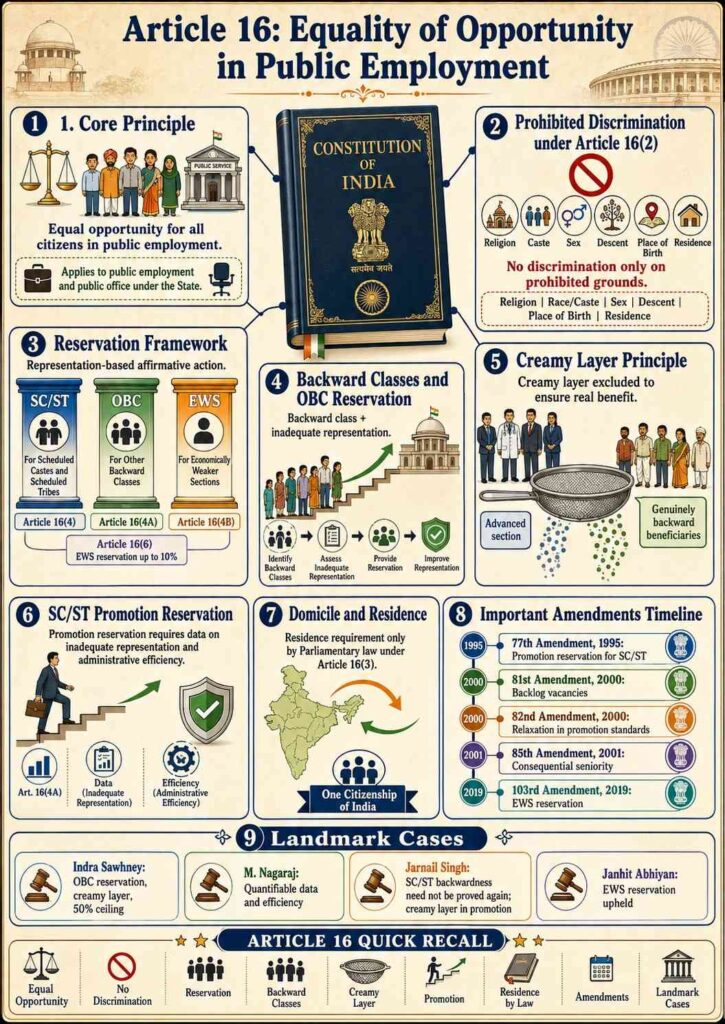
Meaning and Constitutional Purpose of Article 16
• Core idea: Article 16 guarantees equality of opportunity for all citizens in matters relating to employment or appointment to any office under the State. It is a special equality provision dealing specifically with public employment. While Article 14 gives general equality before law and equal protection of laws, Article 16 applies that equality principle to government service, public posts, recruitment, appointment, promotion, reservation and allied service matters. The official constitutional text of Article 16 contains the general guarantee, the prohibition of discrimination, and special enabling clauses for residence requirements, reservation for backward classes, SC/ST promotion reservation, religious or denominational institutions, and EWS reservation.
• Public employment as constitutional trust: Government jobs are not private favours. They are public opportunities funded by public resources. Therefore, the State cannot distribute posts arbitrarily, by patronage, nepotism, caste favouritism, regional bias, sex discrimination or personal preference. Article 16 makes public employment a field of constitutional fairness, where selection must normally be based on equality, open competition, rational classification and valid affirmative action.
• Citizenship requirement: Article 16 protects citizens. Unlike Article 14, which applies to “persons”, Article 16 is confined to citizens because public employment is treated as a special civic opportunity connected with membership of the Indian polity. However, this does not mean that every citizen has a fundamental right to be appointed. The right is to be fairly considered according to lawful rules.
• Relationship with Article 14: Article 16 is a specific application of Article 14. If a recruitment rule violates Article 16, it will usually also offend Article 14. But Article 16 is more precise because it expressly mentions grounds like religion, race, caste, sex, descent, place of birth, residence and also permits certain forms of reservation.
• Equality is not mechanical sameness: Article 16 does not mean that every person must be treated identically in all situations. The Constitution permits reasonable classification and affirmative action to correct historical and structural disadvantages. Therefore, Article 16 contains both formal equality and substantive equality.
Clause-wise Explanation of Article 16
Article 16(1): General Equality of Opportunity
• General guarantee: Article 16(1) says that there shall be equality of opportunity for all citizens in matters relating to employment or appointment to any office under the State. It covers recruitment, eligibility, selection process, appointment, service benefits and, depending on context, promotional opportunities.
• Practical meaning: A public employer must frame rules that are fair, transparent and non-arbitrary. For example, prescribing educational qualifications for a technical post is valid because it has a rational connection with the job. But excluding eligible candidates for reasons unrelated to the post may violate Article 16(1).
• Merit with fairness: Article 16(1) does not create a narrow idea of merit based only on marks. In constitutional law, merit must be understood along with equal access, non-discrimination, representation and efficiency of administration. The State can design policies that balance merit with social justice.
Article 16(2): Prohibition of Discrimination
• Prohibited grounds: Article 16(2) prohibits ineligibility or discrimination in public employment on grounds only of religion, race, caste, sex, descent, place of birth, residence or any of them. This clause prevents direct discrimination in government jobs.
• Grounds only principle: The word “only” is important. If discrimination is solely based on one of the prohibited grounds, it is unconstitutional. But if a rule is based on a valid job-related qualification, it may survive even if it incidentally affects some groups.
• Sex discrimination: Article 16(2) bars discrimination on the ground of sex. In C.B. Muthamma v. Union of India, (1979) 4 SCC 260, the Supreme Court examined service rules affecting women in the Indian Foreign Service. The Court criticised rules that placed women officers at a disadvantage and emphasised that public employment rules cannot reflect gender stereotypes. The ratio was that service conditions must conform to equality and cannot indirectly penalise women for marriage or gender.
• Gender equality in professional access: In Charu Khurana v. Union of India, (2015) 1 SCC 192, female make-up artists challenged discriminatory practices that prevented women from being registered as make-up artists in the film industry. The Supreme Court held that such exclusion violated constitutional equality and dignity. Though the case arose in a professional association context, it strongly reflects the Article 14, 15 and 16 spirit that women cannot be denied occupational opportunity by patriarchal barriers.
Article 16(3): Residence Requirement by Parliamentary Law
• Limited exception for residence: Article 16(3) permits Parliament, not State legislatures, to make a law prescribing residence within a State or Union Territory as a requirement for certain classes of employment or appointment. This is an exception to Article 16(2), which otherwise prohibits discrimination on the ground of residence.
• Why only Parliament: Residence-based eligibility can threaten national unity and equal citizenship. Therefore, the Constitution gives this power only to Parliament so that local preference does not become a tool of narrow regional exclusion.
• Residence is different from place of birth: Article 16(2) prohibits discrimination on place of birth and residence, but Article 16(3) allows Parliament to prescribe residence requirements. A State cannot independently create residence-based exclusion unless constitutionally or statutorily authorised.
• Domicile reservation caution: The Supreme Court has repeatedly treated excessive local preference in public employment with caution because India has one citizenship and public employment cannot be converted into a closed local privilege.
Article 16(4): Reservation for Backward Classes
• Enabling power: Article 16(4) provides that nothing in Article 16 shall prevent the State from making provision for reservation of appointments or posts in favour of any backward class of citizens which, in the opinion of the State, is not adequately represented in the services under the State. This is not a compulsory duty in every case; it is an enabling power.
• Two constitutional conditions: Reservation under Article 16(4) requires:
◦ Backward class of citizens; and
◦ Inadequate representation in State services.
• Backwardness and representation: Article 16(4) is not a poverty relief provision in its original form. It is mainly concerned with group-based social backwardness and inadequate representation in public employment. The State must identify backward classes through relevant material and cannot act on mere political preference.
• Not an exception but equality tool: Earlier, Article 16(4) was sometimes viewed as an exception to Article 16(1). Later constitutional understanding, especially after State of Kerala v. N.M. Thomas, (1976) 2 SCC 310 and Indra Sawhney v. Union of India, 1992 Supp (3) SCC 217, treats reservation as part of substantive equality. It is a method of making equality real for groups historically kept out of State power.
Reservation in Public Employment
• Meaning of reservation: Reservation means earmarking a certain percentage of public posts for constitutionally recognised disadvantaged classes so that they receive fair representation in public services.
• Vertical reservation: Reservation for SCs, STs, OBCs and EWS is generally called vertical reservation because it creates separate social categories. Candidates selected on merit without using reservation are usually counted in the open category, not against reserved quota.
• Horizontal reservation: Reservation for women, persons with disabilities, ex-servicemen and similar categories is usually horizontal reservation because it cuts across vertical categories. For example, women belonging to SC, ST, OBC, EWS and general categories may receive horizontal adjustment within their respective vertical categories.
• Important case on compartmental adjustment: In Saurav Yadav v. State of Uttar Pradesh, (2021) 4 SCC 542, the Supreme Court clarified the operation of vertical and horizontal reservation. The Court held that candidates from reserved categories who qualify on their own merit should not be denied open category seats merely because they belong to a reserved class. The ratio strengthens the principle that reservation should not become a disadvantage for meritorious reserved-category candidates.
• Reservation and equality balance: Reservation is constitutionally valid when it advances representation and equality. It becomes vulnerable when it destroys open competition, lacks data, exceeds constitutional limits without justification, or benefits advanced sections who no longer suffer the relevant disadvantage.
Backward Classes under Article 16(4)
• Class, not individual: Article 16(4) speaks of backward class of citizens, not backward individuals. The inquiry is group-based. A person receives reservation because they belong to a constitutionally recognised backward class, not merely because they are personally poor.
• Caste as relevant but not always sole factor: In Indian society, caste has historically determined social status, occupation, exclusion and access to education. Therefore, caste may be a relevant indicator of backwardness, especially for Hindu social groups and analogous communities. But caste cannot be used mechanically without examining social and educational disadvantage.
• OBC identification: Other Backward Classes are identified through social and educational backwardness, and in public employment Article 16(4) also requires inadequate representation. The Mandal Commission recommendations and later judicial review shaped this area.
• SC/ST position: Scheduled Castes and Scheduled Tribes are constitutionally recognised through Presidential lists under Articles 341 and 342. Their backwardness is linked to untouchability, social exclusion, tribal isolation, historical discrimination and structural deprivation.
Landmark Case: Indra Sawhney v. Union of India
• Case name and citation: Indra Sawhney v. Union of India, 1992 Supp (3) SCC 217, decided by a nine-judge Bench, is the most important case on Article 16(4), OBC reservation, creamy layer and the 50% ceiling.
• Brief facts: The case arose after the Union Government implemented recommendations of the Mandal Commission providing 27% reservation for socially and educationally backward classes in Central services. The policy was challenged on grounds including violation of equality, excessive reservation and improper identification of backward classes.
• Legal issues: The main issues were whether Article 16(4) permits reservation for OBCs, whether caste can be considered, whether economic criteria alone can determine backwardness, whether there should be a ceiling on reservation, whether creamy layer must be excluded, and whether reservation in promotion is permissible.
• Ratio decidendi: The Supreme Court upheld 27% OBC reservation but laid down important limits. It held that Article 16(4) is an enabling provision for backward classes inadequately represented in services; caste can be a relevant factor for identifying backwardness in India; the creamy layer must be excluded from OBC reservation; total reservation should ordinarily not exceed 50%, except in extraordinary situations; and reservation under Article 16(4) is generally for initial appointment, not promotion.
• Importance: Indra Sawhney created the modern constitutional framework for public employment reservation. It protected affirmative action but insisted that reservation must be reasonable, data-based and consistent with equality.
Creamy Layer Principle
• Meaning: The creamy layer means the advanced, socially forward and better-off members within a backward class who have moved sufficiently ahead and should not continue to take reservation benefits meant for the genuinely backward members of that class.
• Purpose: The principle prevents reservation benefits from being cornered by the most advanced families within backward classes. It ensures that affirmative action reaches those who actually need representation support.
• OBC creamy layer: After Indra Sawhney, exclusion of creamy layer became mandatory for OBC reservation. The Court reasoned that if advanced members remain included, the class may no longer remain genuinely backward for reservation purposes.
• Income alone is insufficient: Creamy layer is often implemented through income and status criteria, but its constitutional idea is broader than income. It includes social advancement, high constitutional posts, senior government employment, professional status and economic indicators.
• SC/ST creamy layer in promotions: The creamy layer principle for SC/STs is more complex. Traditionally, creamy layer was not applied to SC/ST reservation at entry level. However, in the context of promotion reservation, the Supreme Court in Jarnail Singh v. Lachhmi Narain Gupta, (2018) 10 SCC 396 held that creamy layer exclusion applies to SC/STs for reservation in promotion and does not alter the Presidential lists under Articles 341 and 342. The Court clarified that applying creamy layer only excludes advanced individuals from promotion reservation benefits; it does not remove the caste or tribe from the constitutional list.
SC/ST Reservation in Promotion under Article 16(4A)
• Background: In Indra Sawhney, the Supreme Court held that Article 16(4) did not permit reservation in promotion. To overcome this effect for SC/STs, Parliament inserted Article 16(4A) through the 77th Constitutional Amendment Act, 1995. The amendment empowered the State to provide reservation in matters of promotion for SCs and STs where they are not adequately represented.
• Consequential seniority: The 85th Constitutional Amendment Act, 2001 amended Article 16(4A) to add the words “with consequential seniority”. This means an SC/ST candidate promoted through reservation may retain seniority flowing from that promotion, subject to constitutional validity and applicable rules. The official amendment materials state that the amendment was intended to provide consequential seniority in promotion by virtue of reservation.
• Enabling, not mandatory: Article 16(4A) does not automatically grant promotion reservation. The State may provide it only if constitutional conditions are satisfied. No employee has an automatic fundamental right to promotion reservation merely because Article 16(4A) exists.
Landmark Case: M. Nagaraj v. Union of India
• Case name and citation: M. Nagaraj v. Union of India, (2006) 8 SCC 212.
• Brief facts: The constitutional validity of the 77th, 81st, 82nd and 85th Amendments relating to reservation in promotion, backlog vacancies, relaxation in qualifying marks and consequential seniority was challenged.
• Legal issue: The issue was whether these amendments damaged the basic structure of the Constitution by violating equality, efficiency and the 50% reservation principle.
• Ratio decidendi: The Supreme Court upheld the constitutional amendments but held that they are enabling provisions. Before granting SC/ST promotion reservation, the State must collect quantifiable data showing inadequacy of representation and must consider administrative efficiency under Article 335. The judgment also spoke of backwardness, inadequacy of representation and efficiency as controlling requirements.
• Importance: M. Nagaraj preserved Parliament’s power to create promotion reservation but made State action data-dependent. The case prevents blanket promotion reservation without factual foundation.
Landmark Case: Jarnail Singh v. Lachhmi Narain Gupta
• Case name and citation: Jarnail Singh v. Lachhmi Narain Gupta, (2018) 10 SCC 396.
• Brief facts: The correctness of M. Nagaraj was reconsidered, particularly the requirement that States must prove backwardness of SCs and STs before granting promotion reservation.
• Legal issue: The central issue was whether M. Nagaraj should be referred to a larger Bench and whether the State must collect data proving backwardness of SCs/STs.
• Ratio decidendi: The Supreme Court held that States need not collect quantifiable data to prove backwardness of SCs/STs because their backwardness is recognised by the Constitution through Articles 341 and 342. However, quantifiable data on inadequacy of representation remains necessary. The Court also applied the creamy layer principle to SC/ST promotion reservation.
• Importance: Jarnail Singh modified M. Nagaraj by removing the requirement of proving SC/ST backwardness afresh, but it retained the need for data on inadequate representation and introduced creamy layer exclusion in promotion reservation.
Landmark Case: B.K. Pavitra II
• Case name and citation: B.K. Pavitra v. Union of India, (2019) 16 SCC 129, commonly called B.K. Pavitra II.
• Brief facts: Karnataka enacted a law granting consequential seniority to SC/ST government servants promoted through reservation. Earlier, in B.K. Pavitra I, the law had faced constitutional difficulty because of insufficient data. Karnataka then conducted a study and enacted a fresh law.
• Legal issue: The question was whether the new consequential seniority law satisfied the constitutional requirements laid down in M. Nagaraj and Jarnail Singh.
• Ratio decidendi: The Supreme Court upheld the law, noting that the State had relied on data and examined representation, backwardness-related factors and administrative efficiency. The Court accepted that consequential seniority can be valid if backed by constitutionally adequate material.
• Importance: B.K. Pavitra II shows that promotion reservation and consequential seniority are not unconstitutional per se. Their validity depends on data, legislative design and compliance with equality and efficiency.
Article 16(4B): Backlog Vacancies and Carry Forward Rule
• Constitutional amendment: Article 16(4B) was inserted by the 81st Constitutional Amendment Act, 2000. It allows the State to treat unfilled reserved vacancies of a year as a separate class of vacancies to be filled in succeeding years.
• Purpose: Sometimes reserved posts remain vacant because suitable candidates are not available in that recruitment year. Article 16(4B) allows such backlog vacancies to be carried forward.
• Effect on 50% ceiling: Article 16(4B) says that carried-forward backlog vacancies are not to be considered together with current year vacancies for determining the 50% ceiling for that year. This gives flexibility to fill historical shortfalls in representation. Government and parliamentary materials describe Article 16(4B) as treating backlog vacancies as a separate class.
Article 335 and Administrative Efficiency
• Textual connection: Article 335 says that claims of SCs and STs shall be taken into consideration consistently with the maintenance of efficiency of administration.
• Balanced approach: Article 335 does not destroy reservation. It requires that representation and efficiency must be harmonised. Equality in public employment includes both fair access for disadvantaged communities and a functioning public administration.
• 82nd Amendment: The 82nd Constitutional Amendment Act, 2000 inserted a proviso to Article 335, allowing relaxation in qualifying marks or standards of evaluation for SC/ST candidates in matters of promotion. The amendment was made after judicial decisions questioned such relaxations in promotion.
Important Constitutional Amendments Related to Article 16
| Constitutional Amendment | Provision affected | Main effect |
|---|---|---|
| 77th Amendment, 1995 | Article 16(4A) | Enabled reservation in promotion for SCs/STs. |
| 81st Amendment, 2000 | Article 16(4B) | Allowed backlog reserved vacancies to be treated as a separate class. |
| 82nd Amendment, 2000 | Article 335 proviso | Allowed relaxation in qualifying marks/standards for SC/ST promotion matters. |
| 85th Amendment, 2001 | Article 16(4A) | Added consequential seniority in SC/ST promotion reservation. |
| 103rd Amendment, 2019 | Article 16(6) | Enabled up to 10% reservation in public employment for Economically Weaker Sections. |
Article 16(6): EWS Reservation
• Constitutional provision: Article 16(6), inserted by the 103rd Constitutional Amendment Act, 2019, enables the State to provide reservation of appointments or posts in favour of Economically Weaker Sections, in addition to existing reservation and subject to a maximum of 10%. The amendment also inserted Article 15(6).
• Economic basis: EWS reservation is different from Article 16(4). Article 16(4) is based on backward class and inadequate representation. Article 16(6) permits reservation based on economic weakness among those not covered by existing SC/ST/OBC reservation.
• Landmark case: In Janhit Abhiyan v. Union of India, 2022 SCC OnLine SC 1540, a five-judge Bench upheld the 103rd Amendment by a 3:2 majority. The majority held that EWS reservation does not violate the basic structure merely because it uses economic criteria or because it excludes classes already covered under existing reservation. The dissent took the view that exclusion of SC/ST/OBC poor from EWS quota offended the equality code. The binding result is that Article 16(6) is constitutionally valid.
Domicile and Residence Requirements in Public Employment
• Basic rule: Article 16(2) prohibits discrimination on the ground of residence. Article 16(3) permits residence requirements only when Parliament makes a law. Therefore, State-made domicile requirements in public employment are constitutionally suspect unless they fall within a valid constitutional or statutory framework.
• AVS Narasimha Rao principle: In A.V.S. Narasimha Rao v. State of Andhra Pradesh, (1969) 1 SCC 839, the Supreme Court considered residence requirements in public employment and emphasised that Article 16(3) vests power in Parliament, not in States. The ratio supports the idea that local residence conditions cannot be freely imposed by States in public employment.
• Kailash Chand Sharma case: In Kailash Chand Sharma v. State of Rajasthan, (2002) 6 SCC 562, preference based on district or rural residence in appointment of teachers was challenged. The Supreme Court held that wholesale preference based on residence or place of origin may violate Articles 14 and 16 unless supported by a constitutionally valid basis. The Court warned against parochialism in public employment.
• Permissible local knowledge: A rule may sometimes require knowledge of local language, local conditions or special qualifications if genuinely connected with the job. But such a rule must not be a disguised residence-based exclusion.
• National citizenship value: India has single citizenship. Article 16 protects the idea that a citizen from one State should not be treated as an outsider for public employment in another State unless the Constitution permits a narrow exception.
Religious and Denominational Institutions under Article 16(5)
• Religious office exception: Article 16(5) permits a law requiring that an incumbent of an office connected with affairs of a religious or denominational institution must belong to a particular religion or denomination.
• Reason: Some offices are inherently religious in character. For example, performance of religious rituals may require adherence to the relevant faith or denomination. Article 16(5) protects religious autonomy while keeping the general equality rule intact for ordinary public employment.
• Limited scope: This clause cannot be used to justify discrimination in secular public posts. It applies only where the office is connected with religious or denominational affairs.
Important Case Law Table for Quick Revision
| Case | Citation | Principle |
|---|---|---|
| General Manager, Southern Railway v. Rangachari | AIR 1962 SC 36 | Earlier view allowed reservation in promotion under Article 16(4), later changed by Indra Sawhney. |
| T. Devadasan v. Union of India | AIR 1964 SC 179 | Excessive carry-forward reservation invalid when it destroys equality of opportunity. |
| State of Kerala v. N.M. Thomas | (1976) 2 SCC 310 | Reservation and relaxations are part of substantive equality, not mere exceptions. |
| Indra Sawhney v. Union of India | 1992 Supp (3) SCC 217 | OBC reservation upheld; creamy layer; 50% ceiling; no promotion reservation under Article 16(4). |
| R.K. Sabharwal v. State of Punjab | (1995) 2 SCC 745 | Post-based roster; reservation relates to posts, not vacancies endlessly. |
| Union of India v. Virpal Singh Chauhan | (1995) 6 SCC 684 | Catch-up seniority principle in promotion context before later amendments. |
| Ajit Singh Januja v. State of Punjab | (1996) 2 SCC 715 | Seniority issues in reserved promotions examined. |
| Ajit Singh II v. State of Punjab | (1999) 7 SCC 209 | Article 16(1) includes right to be considered for promotion; consequential seniority concerns. |
| M. Nagaraj v. Union of India | (2006) 8 SCC 212 | Promotion reservation amendments upheld; quantifiable data and efficiency required. |
| Jarnail Singh v. Lachhmi Narain Gupta | (2018) 10 SCC 396 | No need to prove SC/ST backwardness afresh; inadequacy data needed; creamy layer applies in promotions. |
| B.K. Pavitra II | (2019) 16 SCC 129 | Consequential seniority valid when backed by adequate data. |
| Janhit Abhiyan v. Union of India | 2022 SCC OnLine SC 1540 | 103rd Amendment and EWS reservation upheld by 3:2 majority. |
Conceptual Distinctions under Article 16
• Reservation vs classification: Classification means different treatment based on rational criteria related to the job. Reservation means earmarking posts for constitutionally protected groups. Both must satisfy equality, but reservation has special constitutional rules.
• Backwardness vs poverty: Backwardness under Article 16(4) is group-based social backwardness and inadequate representation. Poverty may be relevant, but after the 103rd Amendment, economic weakness has a separate constitutional route under Article 16(6).
• Adequate representation vs proportionate representation: Article 16(4) uses the phrase “not adequately represented”, not “proportionately represented”. This means the Constitution does not always require exact population proportion in every service. The State must assess adequacy in context.
• Open category is not caste category: Open category seats are open to all candidates, including SC, ST, OBC and EWS candidates who qualify on merit. Treating open category as reserved for general caste candidates would violate equality.
• Reservation in appointment vs reservation in promotion: Article 16(4) deals with reservation in appointments or posts for backward classes. Article 16(4A) specifically deals with promotion reservation for SCs/STs. OBC promotion reservation is not protected in the same way under Article 16(4A).
• Creamy layer vs exclusion from caste list: Creamy layer exclusion does not remove a caste or tribe from the constitutional or backward class list. It only denies reservation benefit to advanced individuals within the group for the relevant purpose.
Illustrations for Understanding Article 16
• Illustration on Article 16(1): A State advertises posts for civil engineers and requires a civil engineering degree. This is valid because the qualification is connected with the job.
• Illustration on Article 16(2): A rule says that only persons born in a particular State can apply for a government post. This is generally unconstitutional because place of birth is a prohibited ground.
• Illustration on Article 16(3): Parliament enacts a law requiring residence in a particular Union Territory for certain local posts. This may be valid because Article 16(3) gives such power to Parliament.
• Illustration on Article 16(4): If OBCs are found socially backward and inadequately represented in State services, the State may reserve posts for them subject to constitutional limitations.
• Illustration on creamy layer: A person belongs to an OBC community, but their parents hold high-ranking posts or cross the prescribed creamy layer criteria. Such person may be excluded from OBC reservation benefit though the community remains backward.
• Illustration on promotion reservation: A State wants to reserve promotions for SC/ST employees. It must examine representation data and administrative efficiency. It cannot simply issue a blanket order without constitutional basis.
Present Legal Position in Simple Points
• Article 16 guarantees equal opportunity in public employment for citizens.
• Article 16(2) prohibits discrimination on religion, race, caste, sex, descent, place of birth, residence or any of them.
• Residence requirement can be imposed only by Parliament under Article 16(3), not casually by States.
• Article 16(4) permits reservation for backward classes of citizens inadequately represented in public services.
• OBC reservation requires creamy layer exclusion after Indra Sawhney.
• Total reservation ordinarily should not exceed 50%, except constitutionally recognised or extraordinary situations; EWS reservation under Article 16(6) has been upheld separately.
• SC/ST promotion reservation is constitutionally permitted under Article 16(4A), but it is enabling and data-dependent.
• Consequential seniority is permitted after the 85th Amendment, but it must satisfy constitutional requirements.
• Backlog vacancies can be carried forward under Article 16(4B).
• EWS reservation up to 10% is valid after the 103rd Amendment and Janhit Abhiyan.
• Creamy layer applies to OBC reservation and, as per Jarnail Singh, applies to SC/ST reservation in promotion.
• Public employment rules must always satisfy equality, fairness, non-arbitrariness and constitutional morality.
Conclusion
• Article 16 as equality plus social justice: Article 16 is not merely a rule of formal equal treatment. It is a constitutional design for fair sharing of State employment opportunities. It prohibits discrimination, prevents arbitrary exclusion, and at the same time permits affirmative action for communities that were historically denied representation.
• Reservation as representation: Reservation under Article 16 is not charity. It is a constitutional method for ensuring that public services reflect the diversity of society and that disadvantaged groups are not permanently excluded from State power.
• Judicial balance: The Supreme Court has maintained a balance between social justice and equality by upholding reservation while imposing safeguards such as creamy layer exclusion, quantifiable data, adequacy of representation, administrative efficiency, post-based roster and reasonable limits.
• Living constitutional provision: Article 16 has evolved through constitutional amendments and landmark judgments. Its modern form covers OBC reservation, SC/ST promotion reservation, backlog vacancies, consequential seniority, EWS reservation, residence restrictions and gender equality in public employment. Its central message remains clear: government employment must be distributed by constitutional fairness, not by privilege, prejudice or exclusion.