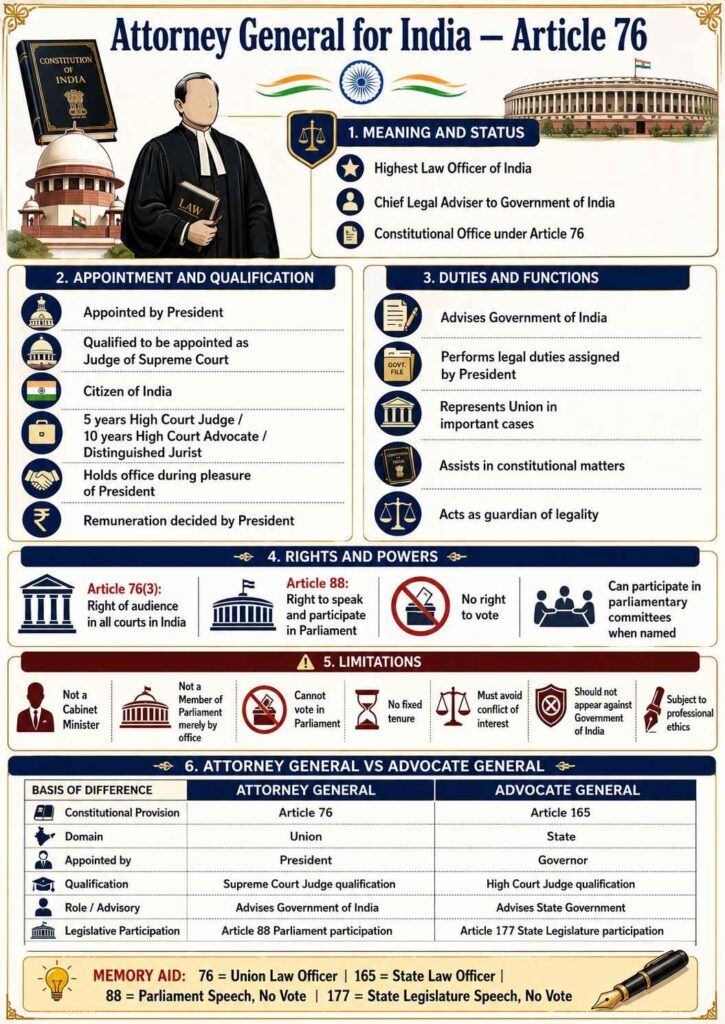
Meaning and Constitutional Position of Attorney General for India
• Constitutional office: The Attorney General for India is a constitutional authority created by Article 76 of the Constitution of India. Article 76 provides for the appointment, qualifications, duties, right of audience, tenure and remuneration of the Attorney General. The office is placed in Part V of the Constitution, which deals with the Union. Article 76 states that the President shall appoint a person qualified to be appointed as a Judge of the Supreme Court as the Attorney General for India.
• Highest law officer: The Attorney General is generally described as the highest law officer of India because he gives legal advice to the Government of India and represents the Union in important constitutional and legal matters. He is not merely a private advocate engaged by the Government; he holds a special constitutional position and acts as the chief legal adviser of the Union Government.
• Bridge between law and government: The Attorney General performs a connecting role between the executive government, courts, and Parliament. He advises the Union Government on legal questions, appears before courts in cases involving the Government of India, and can participate in parliamentary proceedings without voting rights.
• Not a minister: The Attorney General is connected with the Union Executive but is not a member of the Council of Ministers. India has a separate Minister of Law and Justice for political and administrative responsibility over the Law Ministry. The Attorney General gives legal advice and represents the Union, but he does not exercise ministerial power as a Cabinet Minister.
Appointment of Attorney General for India under Article 76
• Appointing authority: Under Article 76(1), the Attorney General for India is appointed by the President of India. In the working of the parliamentary system, the President normally acts on the aid and advice of the Council of Ministers, but the constitutional text expressly says that the appointment is made by the President.
• No special procedure: The Constitution does not prescribe a detailed appointment procedure like consultation with judges, parliamentary approval, a selection committee, or a fixed public notification process. Therefore, the appointment is essentially an executive decision, subject to the minimum constitutional qualification mentioned in Article 76.
• No fixed term: The Constitution does not provide a fixed tenure of five years, six years, or any other definite period. The Attorney General holds office during the pleasure of the President under Article 76(4). This means he can continue so long as the President permits him to hold office.
• Practical convention: Although not expressly written in Article 76, in practice the Attorney General usually resigns when the Government that appointed him changes or resigns. This is because the Attorney General is the legal adviser of the Government of India and must enjoy the confidence of the Government.
• Remuneration: Under Article 76(4), the Attorney General receives such remuneration as the President may determine. The Constitution does not itself fix salary, allowances or service conditions.
Qualifications of Attorney General for India
• Supreme Court Judge qualification: Article 76(1) requires that the Attorney General must be a person who is qualified to be appointed a Judge of the Supreme Court. Therefore, the qualification of the Attorney General is linked to Article 124(3) of the Constitution, which deals with qualifications for appointment as a Supreme Court Judge.
• Citizenship requirement: The person must be a citizen of India, because only an Indian citizen can be appointed as a Judge of the Supreme Court.
• Judicial or advocacy experience: A person is qualified for appointment as a Supreme Court Judge if he has been a Judge of one or more High Courts for at least five years, or has been an advocate of one or more High Courts for at least ten years, or is, in the opinion of the President, a distinguished jurist.
• High professional standing: The office requires deep constitutional understanding, professional integrity, litigation experience, and the ability to advise the Union Government on complex questions involving constitutional law, statutory interpretation, federal relations, public law, criminal law, commercial law, international law and administrative law.
• No requirement of being a Member of Parliament: The Attorney General need not be a Member of Parliament. Article 88 separately gives him the right to speak and participate in parliamentary proceedings, but that right does not make him an MP.
Duties of Attorney General for India
• Legal advice to Government of India: Under Article 76(2), the first duty of the Attorney General is to give advice to the Government of India on legal matters referred to him. This advice may relate to constitutional validity of laws, interpretation of statutes, federal disputes, treaties, government contracts, administrative action, litigation strategy, or any important public law issue.
• Duties assigned by President: Article 76(2) also requires the Attorney General to perform other duties of a legal character assigned or referred to him by the President. This makes his role flexible, because the legal needs of the Government may differ from case to case.
• Constitutional and statutory functions: Article 76(2) further states that the Attorney General shall discharge functions conferred on him by or under the Constitution or any other law. Therefore, his functions are not limited only to Article 76; they may arise under statutes, rules, court procedures, and constitutional practices.
• Representation of Union Government: The Attorney General appears for the Government of India in important cases before the Supreme Court, especially where constitutional interpretation, Centre-State relations, validity of parliamentary laws, national policy, fundamental rights, or institutional questions are involved.
• Article 143 advisory references: The Attorney General may represent the Union in advisory proceedings before the Supreme Court under Article 143, where the President refers questions of law or fact of public importance to the Supreme Court for its opinion. In Special Reference No. 1 of 1964, AIR 1965 SC 745, popularly connected with the Keshav Singh controversy, the President referred questions concerning the relationship between legislative privilege and judicial power; the case is important to understand how high constitutional issues may come before the Supreme Court through advisory jurisdiction.
• Guardian of legality: The Attorney General is expected to assist the Government in acting according to law. His advice should not merely defend every governmental action blindly; the dignity of the office requires independent legal judgment. His role is to protect the legal interests of the Union while respecting constitutional morality, rule of law and judicial independence.
Rights and Powers of Attorney General for India
• Right of audience in all courts: Under Article 76(3), the Attorney General has the right of audience in all courts in the territory of India while performing his duties. This means he can appear before the Supreme Court, High Courts and subordinate courts when his official duty requires such appearance.
• Wider than ordinary advocate’s appearance: An ordinary advocate’s appearance may be regulated by procedural requirements, vakalatnama, court rules, and territorial practice. The Attorney General’s right of audience is constitutionally recognised. However, this right is connected with the performance of his duties and does not mean that he becomes a judge, court officer above all advocates, or a person immune from court discipline.
• Right to participate in Parliament: Under Article 88, the Attorney General has the right to speak in and otherwise take part in proceedings of either House of Parliament, any joint sitting of the Houses, and any committee of Parliament of which he may be named a member. However, Article 88 clearly states that he is not entitled to vote merely because of this right.
• No voting power: The Attorney General can explain legal issues, clarify constitutional points, and assist Parliament during discussion, but he cannot vote unless he separately becomes a member of a House. His parliamentary role is advisory and participatory, not representative in the electoral sense.
• Parliamentary privilege protection: Article 105 deals with powers, privileges and immunities of Parliament and its members. The protections under parliamentary privilege extend, in the relevant manner, to persons who have the constitutional right to speak and participate in parliamentary proceedings. This helps the Attorney General speak freely in Parliament while performing his constitutional role.
• Recognition in constitutional litigation: The Attorney General often appears in landmark constitutional cases to present the Union Government’s position. For example, Kesavananda Bharati v. State of Kerala, (1973) 4 SCC 225; AIR 1973 SC 1461; 1973 Supp SCR 1, involved the scope of Parliament’s power to amend the Constitution and resulted in the basic structure doctrine. The case is not about the office of Attorney General itself, but it shows the importance of Union law officers in major constitutional litigation.
Limitations on Attorney General for India
• Pleasure tenure: The Attorney General holds office during the pleasure of the President. Therefore, he does not enjoy the same security of tenure as judges of the Supreme Court or constitutional authorities like the Comptroller and Auditor General. This makes the office flexible but also requires strong professional independence.
• No right to vote in Parliament: Article 88 gives the Attorney General the right to speak and participate, but not the right to vote. This is a key limitation because he is not an elected representative merely by holding the office.
• Not a member of Cabinet: The Attorney General may advise the Government, but he is not the political head of the Law Ministry. Policy decisions are taken by the Government, while the Attorney General provides legal guidance.
• Cannot advise against Government of India: As a matter of professional propriety and government law officer practice, the Attorney General should not advise or appear against the Government of India. He should also avoid situations where his private professional work conflicts with his official role.
• Restrictions in criminal matters: The Attorney General should not defend an accused person in criminal prosecutions without permission of the Government of India. This avoids conflict between his public duty and private professional engagement.
• Restrictions in company positions: He should not accept appointment as a director in a company or corporation without permission of the Government of India. This restriction prevents conflict of interest and protects the neutrality of the office.
• Not a full-time government servant in the ordinary sense: The Attorney General is not usually treated like a regular civil servant. He may continue private legal practice, but only subject to restrictions, professional ethics and conflict-of-interest limitations. This distinguishes him from ordinary government employees.
• Bound by professional ethics: Even though he holds a constitutional office, he remains subject to standards of legal ethics. He must maintain fairness to the court, confidentiality of government communications, independence of legal opinion, and dignity of the Bar.
• No independent executive power: The Attorney General cannot issue executive orders like a minister, cannot create binding policy on his own, and cannot exercise administrative control over ministries merely because he is the chief legal adviser.
Attorney General and Article 88: Parliamentary Role Explained
• Purpose of Article 88: The Attorney General may need to explain legal implications of Bills, constitutional questions, judicial decisions or government legal positions before Parliament. Article 88 enables him to assist Parliament directly.
• Participation without membership: Article 88 creates a special constitutional arrangement. The Attorney General may speak in Lok Sabha, Rajya Sabha, joint sittings and committees, but this does not make him a member of either House.
• Reason for no vote: Voting is a democratic function of elected or constitutionally nominated members of Parliament. Since the Attorney General is appointed as a legal adviser and not elected as a representative, the Constitution does not give him voting power through Article 88.
• Committee participation: The Attorney General can participate in a parliamentary committee only if he is named as a member of that committee. His role in such committees is usually legal and advisory.
Attorney General and Article 76(3): Right of Audience Explained
• Meaning of right of audience: The right of audience means the right to appear, address and be heard before a court. Article 76(3) gives this right to the Attorney General in all courts throughout India while performing his duties.
• All courts in India: The phrase “all courts in the territory of India” includes the Supreme Court, High Courts and subordinate courts. This gives the Attorney General a nationwide constitutional standing.
• Duty-linked right: The right is not a personal privilege for unlimited private appearance. It is connected with “performance of his duties”. Therefore, the right must be understood in relation to his official role as the Union’s chief legal adviser and representative.
• Difference from Advocate General: This nationwide right of audience is one of the major differences between the Attorney General and the Advocate General. Article 165, which deals with the Advocate General, does not contain an express clause identical to Article 76(3) granting a right of audience in all courts across India.
Important Case-Law and Constitutional References
• In Re Berubari Union, AIR 1960 SC 845: This advisory opinion under Article 143 concerned the implementation of an India-Pakistan agreement relating to Berubari Union and the constitutional method for cession of Indian territory. Its importance for this topic is that it illustrates the kind of serious constitutional questions in which the Union Government, through its law officers including the Attorney General, may place legal submissions before the Supreme Court.
• Special Reference No. 1 of 1964, AIR 1965 SC 745: The facts arose from a conflict involving the U.P. Legislative Assembly, Keshav Singh, the Allahabad High Court and questions of legislative privilege. The legal issue was the constitutional relationship between legislative privilege and judicial power. The Supreme Court held that legislative privileges are important but are subject to constitutional limits, and the High Courts and Supreme Court retain constitutional judicial powers. This case is important because it shows the role of Article 143 references and the need for high-level constitutional assistance in disputes between constitutional organs.
• Kesavananda Bharati v. State of Kerala, (1973) 4 SCC 225; AIR 1973 SC 1461: The facts involved challenges to constitutional amendments affecting fundamental rights and property-related issues. The legal issue was whether Parliament’s amending power under Article 368 was unlimited. The Supreme Court held that Parliament can amend the Constitution but cannot destroy its basic structure. Though not a case on Article 76 directly, it is important because it reflects the Attorney General’s practical importance in major constitutional litigation involving the Union.
Distinction between Attorney General for India and Advocate General for State
| Basis | Attorney General for India | Advocate General for State |
|---|---|---|
| Constitutional provision | Article 76 | Article 165 |
| Level of government | Union Government | State Government |
| Appointing authority | President of India | Governor of the State |
| Qualification | Qualified to be appointed as a Judge of the Supreme Court | Qualified to be appointed as a Judge of a High Court |
| Duties | Advises Government of India on legal matters and performs legal duties assigned by President | Advises State Government on legal matters and performs legal duties assigned by Governor |
| Tenure | Holds office during pleasure of President | Holds office during pleasure of Governor |
| Remuneration | Determined by President | Determined by Governor |
| Right of audience | Express right of audience in all courts in India under Article 76(3) | Article 165 does not expressly provide an identical all-India right of audience |
| Legislative participation | Can speak and participate in Parliament under Article 88, without voting right | Can speak and participate in State Legislature under Article 177, without voting right |
| Status | Highest law officer of India | Highest law officer of the State |
• Core similarity: Both are constitutional law officers. Both advise their respective governments. Both hold office during pleasure. Both have no fixed constitutional term. Both can participate in legislative proceedings without voting rights.
• Core difference: The Attorney General operates at the Union level and is linked with the Supreme Court Judge qualification, while the Advocate General operates at the State level and is linked with the High Court Judge qualification. Article 165 provides that the Governor appoints a person qualified to be appointed as a High Court Judge as Advocate General for the State.
• Legislative parallel: Article 88 gives the Attorney General rights in Parliament, while Article 177 gives the Advocate General similar rights in the State Legislature. Article 177 allows the Advocate General to speak and take part in proceedings of the Legislative Assembly, Legislative Council where it exists, joint sittings, and committees where named, but not to vote.
• Privilege parallel: Article 105 relates to parliamentary privileges at the Union level, while Article 194 relates to powers, privileges and immunities of State Legislatures and also applies to persons who have a constitutional right to speak and participate in State legislative proceedings.
Memory Aid for Quick Revision
| Formula | Meaning |
|---|---|
| 76 = Union Law Officer | Article 76 creates Attorney General for India |
| 165 = State Law Officer | Article 165 creates Advocate General for State |
| 88 = Parliament Speech, No Vote | Attorney General can speak in Parliament but cannot vote |
| 177 = State Legislature Speech, No Vote | Advocate General can speak in State Legislature but cannot vote |
| 76(3) = All Courts Audience | Attorney General has right of audience in all courts in India |
| Pleasure Doctrine | Attorney General holds office during pleasure of President |
Illustrative Examples
• Legal advice example: If the Union Government wants to introduce a Bill that may affect fundamental rights, it may seek advice from the Attorney General on whether the Bill is constitutionally valid.
• Court representation example: If a parliamentary law is challenged before the Supreme Court as violating the Constitution, the Attorney General may appear to defend the law on behalf of the Union Government.
• Parliament example: If a Bill raises complex constitutional questions, the Attorney General may participate in parliamentary discussion under Article 88 and explain the legal position, but he cannot vote on the Bill.
• Conflict-of-interest example: If a private company is litigating against the Government of India, the Attorney General should not advise or represent that company against the Government because it would conflict with his constitutional role.
Conclusion
• Central idea: The Attorney General for India is the Union’s chief constitutional law officer. Article 76 makes him the principal legal adviser to the Government of India, gives him the right of audience in all courts, and places him in a position of high constitutional responsibility.
• Balanced role: The office combines three important functions: advising the executive, assisting courts in important litigation, and helping Parliament understand legal issues. At the same time, the Attorney General is limited by absence of voting power, absence of fixed tenure, conflict-of-interest rules, and professional ethics.
• Distinction from Advocate General: The Advocate General is the corresponding constitutional law officer at the State level under Article 165, but the Attorney General’s office is wider in national importance because it represents the Union and has an express constitutional right of audience in all courts in India.