Introduction: Chief Minister and State Council of Ministers as the Real State Executive
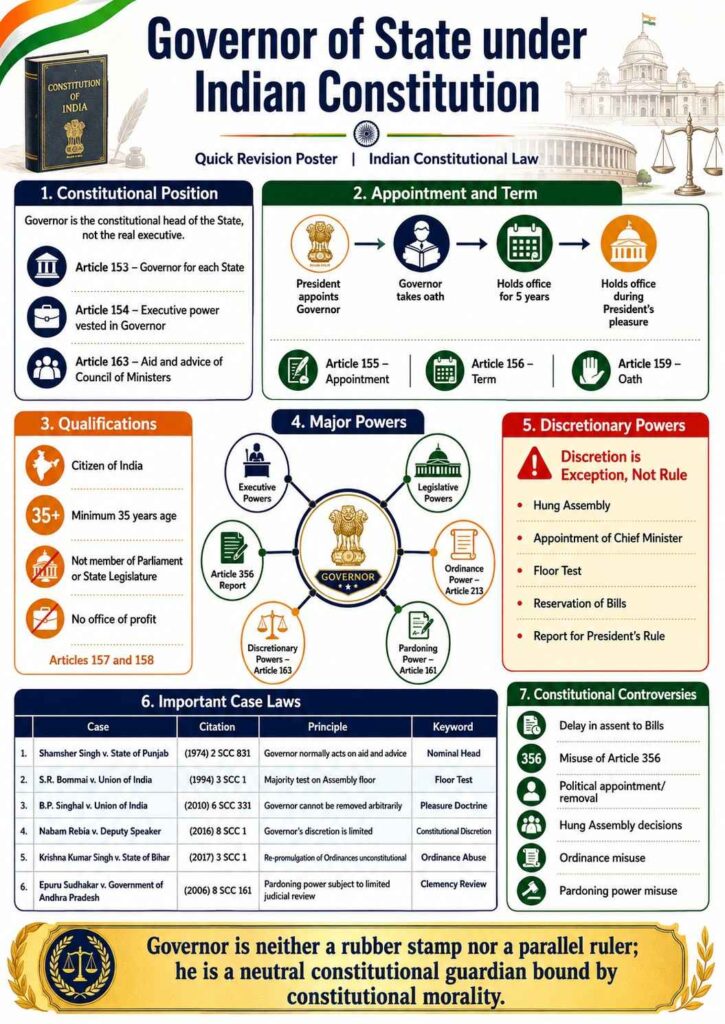
➤ Core idea: In the constitutional scheme of India, the Governor is the nominal or constitutional head of the State, but the Chief Minister and the State Council of Ministers are the real executive authority. This follows from the parliamentary form of government adopted both at the Union and State levels. The State executive is formally vested in the Governor under Article 154, but in ordinary administration the Governor acts on the aid and advice of the Council of Ministers headed by the Chief Minister under Article 163.
➤ Parliamentary principle: The State Council of Ministers is responsible to the elected Legislative Assembly. Therefore, real political power belongs to those who enjoy the confidence of the majority in the Assembly. The Chief Minister is the head of this political executive and acts as the connecting link between the Governor, the Council of Ministers, the Legislature, and the State administration.
➤ Relevant constitutional provisions: The main provisions are Article 163 dealing with the Council of Ministers to aid and advise the Governor, Article 164 dealing with appointment, tenure, collective responsibility, qualifications and size of the Council, Article 166 dealing with conduct of State Government business, and Article 167 dealing with duties of the Chief Minister towards the Governor.
Constitutional Position of the Governor, Chief Minister and Council of Ministers
➤ Nominal and real executive: The Governor represents the formal executive authority of the State, while the Chief Minister and Council of Ministers represent the real executive. The Governor’s name is used for official executive action, but decisions are generally taken by the elected Council of Ministers.
➤ Article 154 – Executive power of State: The executive power of the State is vested in the Governor and is exercised either directly or through officers subordinate to him in accordance with the Constitution. However, this does not mean that the Governor personally runs the State. The power is exercised according to the parliamentary system, mainly through ministerial advice.
➤ Article 162 – Extent of executive power: The executive power of the State extends to matters on which the State Legislature can make laws. This means that, broadly, the State executive can act in matters falling under the State List and, subject to constitutional limits, the Concurrent List.
➤ Article 163 – Aid and advice: There shall be a Council of Ministers with the Chief Minister at the head to aid and advise the Governor, except where the Governor is required by or under the Constitution to act in his discretion. The Constitution also says that if any question arises whether a matter is one where the Governor is required to act in his discretion, the Governor’s decision is final, but this does not make every gubernatorial action immune from judicial review.
➤ Shamsher Singh v. State of Punjab, (1974) 2 SCC 831: In this Constitution Bench decision, probationary judicial officers challenged termination orders issued in the name of the Governor/President. The legal issue was whether the Governor and President act personally or on ministerial advice. The Supreme Court held that the President and Governor are constitutional heads and ordinarily act on the aid and advice of the Council of Ministers. The ratio is that India has a parliamentary system where real executive power is exercised by the elected government, not personally by the constitutional head.
Appointment of Chief Minister
➤ Article 164(1) – Appointment by Governor: The Chief Minister is appointed by the Governor. Other Ministers are appointed by the Governor on the advice of the Chief Minister. This means the Governor formally appoints the Chief Minister, but other Ministers enter the Council only because the Chief Minister recommends them.
➤ Normal situation: When one party or pre-poll alliance clearly secures majority in the Legislative Assembly, the Governor appoints the leader of that majority as Chief Minister. This is a constitutional convention flowing from parliamentary democracy.
➤ Hung Assembly situation: If no party has a clear majority, the Governor may have limited discretion to invite a person who appears most likely to command majority support in the Assembly. However, this discretion is not absolute, personal, political, or arbitrary. It must be guided by objective material and the requirement that the person invited must prove majority on the floor of the House.
➤ Floor test principle: The majority of a Chief Minister or Ministry must normally be tested on the floor of the Legislative Assembly, not by the subjective opinion of the Governor. This protects democratic legitimacy and prevents misuse of constitutional office.
➤ S.R. Bommai v. Union of India, (1994) 3 SCC 1: In this landmark case concerning dismissal of State governments and imposition of President’s Rule under Article 356, the Supreme Court held that majority should ordinarily be tested on the floor of the House. The ratio is that the Governor’s report or subjective assessment cannot replace a legislative floor test when the question is whether the Ministry enjoys majority. This case strengthened federalism, democracy and judicial review over misuse of Article 356.
➤ B.R. Kapur v. State of Tamil Nadu, (2001) 7 SCC 231: In this case, a person who had been convicted and sentenced to imprisonment for more than two years was appointed Chief Minister though she was disqualified from being a legislator. The issue was whether such a disqualified person could be appointed Chief Minister under Article 164. The Supreme Court held that a person suffering from a clear constitutional or statutory disqualification cannot be appointed Chief Minister merely because the majority party chooses that person as leader. The ratio is that majority will cannot override constitutional qualifications and disqualifications.
Appointment of State Council of Ministers
➤ Chief Minister’s advice: After appointment of the Chief Minister, the Governor appoints other Ministers on the advice of the Chief Minister. The Governor cannot ordinarily choose Ministers independently because the Council must be politically led by the Chief Minister.
➤ Categories of Ministers: State Ministers may generally be classified as Cabinet Ministers, Ministers of State, and Deputy Ministers depending upon political practice and allocation of work. The Constitution does not elaborate these categories in detail, but the Cabinet is the inner decision-making body of the Council.
➤ Oath of office and secrecy: Every Minister takes oath before the Governor. The oath signifies constitutional loyalty, faithful discharge of duties, and secrecy regarding official matters. The oath is important because Ministers handle sensitive information relating to administration, law and policy.
➤ Six-month rule under Article 164(4): A person who is not a member of the State Legislature may be appointed as Minister, but must become a member of the Legislature within six consecutive months. If not, the person ceases to be a Minister. This rule permits temporary appointment of non-legislators, but does not permit appointment of a person who is already disqualified from membership.
➤ Minister for Tribal Welfare: Article 164 contains a special proviso that in Chhattisgarh, Jharkhand, Madhya Pradesh and Odisha, there shall be a Minister in charge of tribal welfare, who may also be in charge of welfare of Scheduled Castes, backward classes or any other work.
Size of State Council of Ministers
➤ Article 164(1A) – 15% ceiling: The total number of Ministers, including the Chief Minister, in the Council of Ministers in a State shall not exceed 15% of the total number of members of the Legislative Assembly. However, the number of Ministers, including the Chief Minister, shall not be less than 12. This provision was introduced by the 91st Constitutional Amendment, 2003 to control oversized ministries and reduce political defections through ministerial inducements.
➤ Purpose of the ceiling: Before this limitation, very large Councils of Ministers were sometimes created to satisfy political groups. The constitutional ceiling promotes clean governance, fiscal discipline and cabinet responsibility.
➤ Practical importance: If a State Assembly has 200 members, the maximum number of Ministers including the Chief Minister can be 30. If the Assembly is small, the Council must still have at least 12 Ministers due to the minimum rule.
Tenure of Chief Minister and Ministers
➤ Pleasure of Governor: Article 164 says Ministers hold office during the pleasure of the Governor. But in a parliamentary system, this does not mean personal pleasure of the Governor. It practically means that Ministers continue so long as they enjoy the confidence of the Legislative Assembly and the Chief Minister wants them in the Council.
➤ Chief Minister’s central role: A Minister may be removed if the Chief Minister advises the Governor to drop that Minister. If the Chief Minister resigns, the entire Council of Ministers goes out because the Council is headed by the Chief Minister.
➤ Loss of majority: When the Chief Minister loses majority in the Legislative Assembly, the proper constitutional course is resignation or proving majority through a floor test. The Governor should not dismiss a Ministry merely on suspicion if a floor test is possible.
Collective Responsibility of State Council of Ministers
➤ Article 164(2) – Collective responsibility: The Council of Ministers is collectively responsible to the Legislative Assembly of the State. This is the foundation of parliamentary government at the State level.
➤ Meaning of collective responsibility: The Council functions as one unit before the Legislative Assembly. If the Assembly passes a no-confidence motion or rejects a matter treated as a question of confidence, the entire Council must resign, not merely one Minister.
➤ Unity of policy: Ministers may disagree inside Cabinet meetings, but once a decision is taken, all Ministers must publicly support it. If a Minister cannot support the decision, the proper course is resignation.
➤ Legislative accountability: The Council remains answerable to the Legislative Assembly through questions, debates, motions, budgetary control, committees and no-confidence motions. This ensures that executive power remains accountable to elected representatives.
➤ Individual responsibility: Though Article 164(2) mentions collective responsibility, Ministers also have individual responsibility in practice. A Minister is responsible for the functioning of the department allotted to him. The Chief Minister may ask a Minister to resign for mismanagement, misconduct or political reasons.
➤ Manoj Narula v. Union of India, (2014) 9 SCC 1: This case concerned whether persons with criminal antecedents should be appointed as Ministers. The Supreme Court did not create an additional disqualification beyond the Constitution but emphasised constitutional morality, good governance and the Prime Minister/Chief Minister’s constitutional trust while choosing Ministers. The ratio is that appointment of Ministers is a matter of constitutional responsibility and public trust, even where the Court cannot add new disqualifications.
Powers and Functions of the Chief Minister
➤ Head of Council of Ministers: The Chief Minister forms, leads and coordinates the Council of Ministers. The Chief Minister recommends appointment of Ministers, allocation of portfolios, reshuffling of departments and removal of Ministers.
➤ Policy leadership: The Chief Minister determines the broad policy direction of the State Government. Major decisions on law and order, welfare, finance, development, administration, Centre-State relations and legislative agenda are shaped under the Chief Minister’s leadership.
➤ Link with Governor: The Chief Minister is the main channel of communication between the Governor and the Council of Ministers. Under Article 167, the Chief Minister must communicate decisions of the Council to the Governor and furnish information relating to State administration and legislative proposals.
➤ Legislative leadership: The Chief Minister is usually the leader of the majority party or coalition in the Legislative Assembly. The legislative programme of the State Government, including Bills, budgetary proposals and policy statements, is carried through the House under the Chief Minister’s leadership.
➤ Administrative supervision: The Chief Minister supervises the general administration of the State through Ministers, Chief Secretary, senior bureaucrats and departmental machinery. Though each Minister controls a department, overall coordination belongs to the Chief Minister.
➤ Crisis management: During political instability, natural disasters, communal tension, public health emergencies or law and order crises, the Chief Minister becomes the central executive authority for decision-making and coordination.
Powers and Functions of State Council of Ministers
➤ Executive functions: The Council formulates and implements State policies. It supervises departments such as home, finance, education, health, agriculture, revenue, public works, local government and social welfare.
➤ Legislative functions: The Council decides the legislative agenda of the State. Most Bills introduced in the Legislature are government Bills. Ministers pilot Bills, answer legislative questions and defend policies.
➤ Financial functions: The annual budget is prepared under the authority of the Council of Ministers. No demand for grant can be made except on the recommendation of the Governor, but the real financial planning is done by the elected government. Money Bills and financial proposals are part of the Council’s core responsibility.
➤ Rule-making and delegated legislation: Many statutes authorize the State Government to frame rules, regulations, schemes and notifications. These powers are exercised by the executive departments under ministerial supervision.
➤ Appointment and service matters: The State executive makes administrative appointments and service rules, subject to constitutional provisions, statutory laws, Public Service Commission requirements and judicial review.
➤ Ordinance-related advice: Under Article 213, the Governor may promulgate an Ordinance when the Legislature is not in session, but ordinarily this power is exercised on ministerial advice. The Ordinance has the force of law but must be placed before the Legislature.
Relation Between Governor and Chief Minister
➤ Constitutional cooperation: The relationship between the Governor and Chief Minister should be based on constitutional morality, not political rivalry. The Governor has the right to be informed, to advise and to warn, but not to run the elected government in ordinary matters.
➤ Article 167 duties: The Chief Minister must: communicate to the Governor all decisions of the Council relating to administration and legislative proposals; furnish information as the Governor calls for; and submit for Council consideration any matter decided by a Minister but not considered by the Council, if the Governor so requires.
➤ Governor’s limited discretion: The Governor may have discretion in exceptional situations such as appointment of Chief Minister in a hung Assembly, requiring a floor test where majority is doubtful, reserving certain Bills for President’s consideration, or sending report under Article 356. But discretion must be constitutional, not partisan.
➤ Nabam Rebia and Bamang Felix v. Deputy Speaker, Arunachal Pradesh Legislative Assembly, (2016) 8 SCC 1: This case arose from a political crisis in Arunachal Pradesh where the Governor advanced the Assembly session and fixed the agenda concerning removal of the Speaker. The issue was the scope of the Governor’s discretion under Article 163 and powers relating to the Assembly. The Supreme Court held that the Governor cannot act as an independent political authority and must normally act on aid and advice except in constitutionally specified situations. The ratio is that gubernatorial discretion is limited and cannot be used to disturb the democratic functioning of the elected government.
➤ Shivraj Singh Chouhan v. Speaker, Madhya Pradesh Legislative Assembly, (2020): This case arose during the Madhya Pradesh political crisis when resignations of MLAs created doubt about the majority of the incumbent government. The issue was whether the Governor could call for a floor test. The Supreme Court held that the Governor may call for a floor test when there is objective material suggesting loss of majority, and such action is subject to judicial review. The ratio is that floor test is the safest constitutional method to determine majority, but the Governor’s action must be based on relevant material.
Conduct of State Government Business
➤ Article 166 – Executive action: All executive action of the Government of a State is expressed to be taken in the name of the Governor. Orders and instruments made in the Governor’s name are authenticated according to rules made by the Governor. The Governor also makes rules for convenient transaction of State Government business and allocation of business among Ministers.
➤ Real meaning of Article 166: Though executive action is issued in the name of the Governor, the decision ordinarily belongs to the Minister or Council of Ministers according to the Rules of Business. This maintains formal constitutional structure while preserving elected responsibility.
➤ Cabinet system: The Cabinet takes major policy decisions. Departments prepare proposals, Ministers approve them, and important matters go before the Cabinet. After approval, orders are issued in the name of the Governor.
➤ Bureaucratic execution: Civil servants implement ministerial decisions, but they remain politically neutral and legally bound. Ministers are politically responsible; civil servants are administratively and legally responsible according to service rules.
Governor’s Discretion and Limits in State Executive Functioning
➤ Discretion is exceptional: Article 163 does not create a general discretionary power. It only permits discretion where the Constitution expressly or by necessary implication requires it. Therefore, the Governor cannot replace the elected Ministry’s judgment with personal preference.
➤ Floor test as constitutional remedy: When majority is doubtful, the Governor should normally ask the Chief Minister to prove majority in the Assembly. The Governor should not decide majority through letters, parades, media claims or private meetings if the House can be convened.
➤ Rameshwar Prasad v. Union of India, (2006) 2 SCC 1: This case concerned dissolution of the Bihar Legislative Assembly before it even met, based on the Governor’s report alleging attempts at majority formation through unethical means. The Supreme Court held the dissolution unconstitutional. The ratio is that the Governor’s report must be based on relevant constitutional material and cannot be used to prevent government formation merely because political alignments are disliked.
➤ Constitutional morality: The Governor, Chief Minister and Ministers must respect democratic mandate, federal balance, legislative majority and accountability. Constitutional offices are not meant to be instruments of party politics.
Chief Minister’s Duties under Article 167
➤ Duty to communicate decisions: The Chief Minister must communicate all decisions of the Council of Ministers relating to administration and legislative proposals to the Governor. This keeps the Governor constitutionally informed.
➤ Duty to furnish information: The Governor may call for information relating to State administration and legislative proposals. The Chief Minister must provide such information.
➤ Duty to place matter before Council: If a Minister has taken a decision but the Council has not considered it, the Governor may require the Chief Minister to place that matter before the Council. This ensures collective consideration of important matters.
➤ Practical importance: Article 167 does not make the Governor a superior administrator. It makes the Chief Minister constitutionally accountable to keep the Governor informed, while actual responsibility remains with the elected Council.
State Executive Functioning: Complete Flow of Power
| Constitutional Stage | Main Authority | Practical Meaning |
|---|---|---|
| Formal executive power | Governor | State action is taken in Governor’s name |
| Real executive power | Chief Minister and Council | Policies and decisions are made by elected government |
| Administrative execution | Departments and civil services | Officers implement decisions |
| Legislative accountability | Legislative Assembly | Ministers answer to elected House |
| Majority test | Floor of Assembly | Government survives only with Assembly confidence |
| Constitutional supervision | Courts | Governor’s discretion and executive action may be judicially reviewed |
Important Doctrines and Principles
➤ Aid and advice principle: The Governor ordinarily acts on the aid and advice of the Council of Ministers headed by the Chief Minister.
➤ Collective responsibility principle: The Council of Ministers stands or falls together before the Legislative Assembly.
➤ Floor test principle: Majority must be tested in the House, not in Raj Bhavan.
➤ Constitutional discretion principle: Governor’s discretion is limited, exceptional and subject to constitutional norms.
➤ Constitutional morality principle: Public offices must be exercised in the spirit of democracy, accountability, federalism and responsible government.
➤ Real executive principle: The Chief Minister and Council of Ministers are the real executive because they are accountable to the elected Assembly.
Quick Revision Table of Articles
| Article | Subject | Key Point |
|---|---|---|
| Article 154 | Executive power of State | Vested in Governor |
| Article 162 | Extent of State executive power | Extends to State legislative subjects |
| Article 163 | Council to aid and advise Governor | Governor ordinarily acts on ministerial advice |
| Article 164 | Ministers | Appointment, tenure, collective responsibility, size limit |
| Article 164(1A) | Size of Council | Maximum 15% of Assembly strength, minimum 12 |
| Article 164(2) | Collective responsibility | Council responsible to Legislative Assembly |
| Article 164(4) | Non-legislator Minister | Must become member within 6 months |
| Article 166 | Conduct of business | Executive action in Governor’s name |
| Article 167 | CM’s duties | Communication and information to Governor |
| Article 174 | Sessions, prorogation, dissolution | Governor acts constitutionally, normally on advice |
| Article 200 | Assent to Bills | Governor may assent, withhold, return or reserve |
| Article 213 | Ordinance power | Governor promulgates Ordinance, ordinarily on advice |
| Article 356 | President’s Rule | Governor’s report may be relevant but subject to judicial review |
Memory Aid: “A-C-F-G-R” Formula
➤ A – Appointment: Chief Minister appointed by Governor; Ministers appointed on Chief Minister’s advice.
➤ C – Collective Responsibility: Entire Council is responsible to Legislative Assembly.
➤ F – Floor Test: Majority is proved on the floor of the House.
➤ G – Governor’s Advice Rule: Governor ordinarily acts on aid and advice.
➤ R – Real Executive: Chief Minister and Council of Ministers run the State administration.
Conclusion
➤ Final understanding: The Chief Minister and State Council of Ministers form the backbone of responsible government in the State. The Governor is the constitutional head, but the elected Council headed by the Chief Minister is the real executive. Appointment, removal, collective responsibility, legislative accountability and executive functioning all revolve around the principle that political power must remain answerable to the elected Legislative Assembly.
➤ Balanced constitutional design: The Governor ensures constitutional continuity, the Chief Minister provides political leadership, the Council of Ministers formulates and implements policies, and the Legislative Assembly maintains democratic control. The Supreme Court through cases such as Shamsher Singh, S.R. Bommai, B.R. Kapur, Rameshwar Prasad, Nabam Rebia and Shivraj Singh Chouhan has repeatedly protected the core principle that State executive power must function according to parliamentary democracy, constitutional morality and majority accountability.