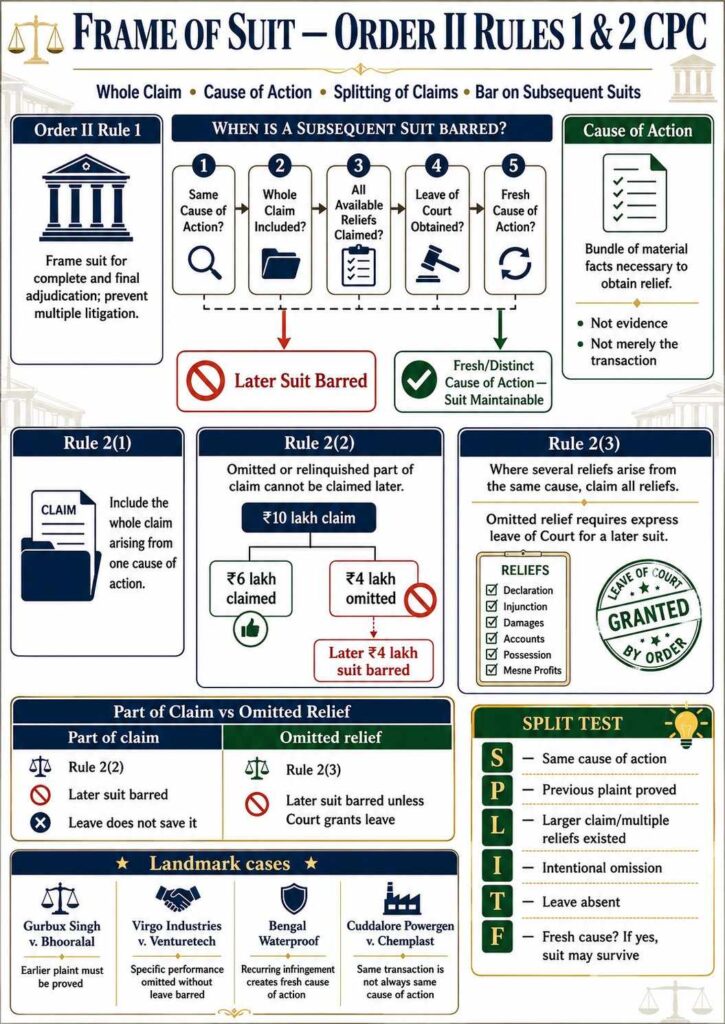
Meaning and Object of Frame of Suit
- Frame of suit: “Frame of suit” means the manner in which a plaintiff structures a civil suit: the facts pleaded, the cause of action relied upon, the claims included, and the reliefs sought. Order II CPC aims to ensure that litigation arising from one dispute is, as far as possible, settled completely in one proceeding.
- Finality: Order II Rule 1 CPC requires every suit to be framed, as far as practicable, so that the Court can finally decide the subjects in dispute and prevent further litigation concerning them. It is a broad procedural principle against fragmented litigation. Unlike Rule 2, Rule 1 does not itself expressly prescribe a specific statutory forfeiture for omission of a claim or relief.
- Anti-multiplicity principle: Order II Rule 2 CPC gives practical effect to Rule 1. Its central purpose is to prevent a defendant from being vexed repeatedly over the same cause of action and to prevent a plaintiff from dividing one complete claim or bundle of remedies into several suits. The rule is therefore directed against both splitting of claims and splitting of reliefs.
- Fairness: The rule protects defendants from harassment, avoids inconsistent findings, conserves judicial time, and requires a plaintiff to disclose and pursue the full case that had already accrued when the first suit was instituted.
Statutory Scheme of Order II Rules 1 and 2 CPC
- Order II Rule 1 CPC — Complete adjudication: Every suit should, as far as practicable, be framed to enable a final decision upon the subjects in dispute and prevent future litigation concerning them.
- Order II Rule 2(1) CPC — Whole claim: Every suit must include the whole claim which the plaintiff is entitled to make in respect of the cause of action. A plaintiff may relinquish a portion of the claim to bring the suit within the pecuniary jurisdiction of a Court.
- Order II Rule 2(2) CPC — Omitted or relinquished portion of claim: Where the plaintiff omits to sue for, or intentionally relinquishes, any portion of the claim, the plaintiff cannot later sue for that omitted or relinquished portion.
- Order II Rule 2(3) CPC — Omitted relief: Where a plaintiff is entitled to more than one relief on the same cause of action, the plaintiff may seek all or some reliefs. However, if a relief is omitted without leave of the Court, the plaintiff cannot later sue for that omitted relief.
- Explanation — One obligation, one cause: An obligation, its collateral security, and successive claims arising from the same obligation are treated as one cause of action for Rule 2. The statutory illustration states that where rent for several past years is already due, a landlord who sues only for one year’s rent cannot later sue for the other accrued years’ rent.
Cause of Action: The Central Test under Order II Rule 2 CPC
- Essential facts: A cause of action is the complete bundle of material facts that the plaintiff must prove, if denied, to obtain a judgment. It does not mean every item of evidence. It also does not depend upon the defence raised by the defendant or merely upon the form of relief claimed.
- Foundation, not label: Courts examine the foundation of each suit. Changing the wording of relief from injunction to declaration, possession, damages, specific performance, or cancellation does not avoid Rule 2 if the new relief rests on the same factual foundation that existed when the first suit was filed.
- Same transaction is not enough: A single transaction may generate more than one cause of action. Order II Rule 2 does not compel a plaintiff to combine every possible cause of action arising from the same transaction. The bar operates only where the earlier and later suits arise from the same cause of action in substance.
- Evidence test: A useful test is whether substantially the same evidence would be required to prove both suits. Where the evidence necessary for the later claim is different, the causes of action are usually different. This test is helpful but must be applied with the actual pleadings and facts of the case.
- Availability test: The omitted claim or relief must have been both entitled to and available to the plaintiff when the first suit was instituted. A plaintiff is not penalised for failing to claim a remedy that had not yet accrued, was impossible to obtain, or depended upon a later event.
Order II Rule 1 CPC: Broad Duty to Avoid Further Litigation
- Practical framing: Rule 1 expects a plaintiff to frame the plaint comprehensively. The plaintiff should identify all material disputes, include connected issues that require adjudication, and avoid filing separate proceedings over matters that can reasonably be resolved together.
- Subjects in dispute: Rule 1 uses the wider expression “subjects in dispute”, whereas Rule 2 specifically uses “cause of action”. Therefore, Rule 1 lays down the broad policy of complete adjudication, while Rule 2 creates the specific bar against later claims and reliefs arising from the same cause of action.
- No automatic forfeiture under Rule 1: Mere non-compliance with Rule 1 does not automatically result in dismissal of a later suit. The strict consequence of losing the right to sue arises under Order II Rule 2(2) and Rule 2(3), where the statutory conditions are established.
Order II Rule 2(1) CPC: Suit Must Include the Whole Claim
- Whole claim: The plaintiff must claim the entire amount, property interest, contractual entitlement, or other substantive claim that has accrued from the particular cause of action.
- Example — Loan claim: A lends B ₹10 lakh under one loan agreement, and the whole amount becomes due. If A sues B only for ₹6 lakh arising from that same due debt, A cannot later sue for the omitted ₹4 lakh.
- Jurisdictional relinquishment: A plaintiff may voluntarily relinquish a part of the claim to bring the matter within the pecuniary jurisdiction of a lower Court. For example, where a claim exceeds the Court’s pecuniary limit, the plaintiff may reduce the claim and sue in that Court. However, this is a permanent relinquishment: the abandoned portion cannot be claimed in a later suit.
- No tactical reservation: A plaintiff cannot intentionally sue for a smaller amount, obtain a convenient forum, and later institute a second suit for the balance. Rule 2 prevents such forum-oriented splitting of claims.
Order II Rule 2(2) CPC: Relinquishment or Omission of Part of Claim
- Claim versus relief: A “claim” generally concerns the substantive extent of what is due or recoverable, such as the balance of money, accrued rent, mesne profits already due, or a portion of property-related entitlement. A “relief” is the judicial remedy sought, such as injunction, declaration, possession, specific performance, or damages.
- Absolute consequence: Under Rule 2(2), once a portion of an accrued claim is omitted or intentionally relinquished, the plaintiff cannot later sue for it. The rule does not provide for leave of the Court to preserve a right to sue later for an omitted portion of the claim.
- Important distinction: Leave of Court is expressly relevant under Rule 2(3), concerning omitted reliefs. It does not cure relinquishment of a part of the claim under Rule 2(2). This distinction was reaffirmed by the Supreme Court in Cuddalore Powergen Corporation Ltd. v. Chemplast Cuddalore Vinyls Ltd., 2025 SCC OnLine SC 82; 2025 INSC 73.
- Illustration — Accrued rent: A landlord has unpaid rent for 2023, 2024 and 2025. If all three years’ rent was due when the suit was filed, but the landlord sues only for 2024 rent, a later suit for the already accrued 2023 or 2025 rent is barred. Rent becoming due after the first suit gives rise to a fresh cause of action and is not barred.
Order II Rule 2(3) CPC: Omission to Sue for One of Several Reliefs
- Several reliefs: One cause of action may entitle a plaintiff to multiple remedies. For example, a breach of an agreement to sell may potentially justify specific performance, injunction against alienation, damages, refund, or cancellation of a competing conveyance, depending upon the facts.
- Mandatory inclusion: Where more than one relief is available on the same cause of action, the plaintiff should ordinarily claim all such reliefs in the first suit.
- Leave of Court: A plaintiff may omit one relief only after obtaining leave from the Court to sue for that relief later. The leave should be expressly sought and expressly granted. A mere statement in the plaint that the plaintiff “reserves the right” to sue later is not a substitute for leave.
- Three requirements for bar: The defendant raising Rule 2(3) must prove:
- Same cause: The second suit is founded on the same cause of action as the first suit.
- Multiple reliefs: The plaintiff was entitled to more than one relief on that cause of action.
- No leave: The plaintiff omitted the later relief without obtaining leave of the Court.
- Burden of proof: The burden is on the defendant who pleads the bar. Since it is a technical bar, it cannot be presumed from broad similarities between the suits.
Difference between Part of Claim and Omitted Relief
| Basis | Part of Claim: Order II Rule 2(2) | Omitted Relief: Order II Rule 2(3) |
|---|---|---|
| Nature | A portion of the substantive entitlement | One of several remedies arising from the same cause |
| Example | Suing for ₹6 lakh out of an accrued ₹10 lakh debt | Seeking injunction but omitting specific performance |
| Effect of omission | Later suit for omitted portion is barred | Later suit for omitted relief is barred |
| Role of leave | Leave does not preserve a later claim for omitted portion | Leave of Court can preserve the omitted relief |
| Core concern | Splitting monetary or substantive claim | Splitting remedies available on same facts |
The Supreme Court has treated these as separate situations: Rule 2(2) concerns omission or relinquishment of a part of the claim, while Rule 2(3) concerns omission of one among several available reliefs.
When a Subsequent Suit Is Not Barred
- Distinct cause of action: A later suit is maintainable where it rests on fresh and distinct material facts, even though the parties, property, agreement, or transaction are substantially connected.
- Fresh accrual: A subsequent breach, subsequent dispossession, fresh infringement, later refusal, fresh denial of title, or a new event creating an independent right may provide a fresh cause of action.
- Unavailable relief: A later suit is not barred where the relief could not have been effectively sought in the first suit because the necessary facts had not yet occurred or the remedy was impossible to obtain at that stage.
- Recurring wrong: In continuing or recurring wrongs, each fresh wrongful act can create a new cause of action. Thus, a claim for future or later infringement is not necessarily barred merely because an earlier suit concerned past infringement.
- Different evidence: Where the later suit requires proof of a different set of essential facts, it is strong evidence that the cause of action is distinct.
Landmark Supreme Court Decisions on Order II Rule 2 CPC
- Gurbux Singh v. Bhooralal, AIR 1964 SC 1810; (1964) 7 SCR 831, Constitution Bench: The plaintiff sued for possession and mesne profits, while the defendant pleaded that an earlier suit concerning mesne profits barred the later claim. The issue was whether the defendant could establish the Rule 2 bar without producing the plaint of the earlier suit. The Supreme Court held that the earlier plaint must be produced in evidence because the Court cannot speculate about the earlier cause of action merely from the reliefs claimed. The ratio is that the defendant must prove identity of causes of action, entitlement to multiple reliefs, and omission without leave.
- Sidramappa v. Rajashetty, (1970) 1 SCC 186; AIR 1970 SC 1059: The Supreme Court clarified that the true test is whether the cause of action forming the basis of the later suit is distinct from the cause of action forming the basis of the earlier suit. Where the foundation of the later suit did not exist in the earlier suit, or the later relief could not have been claimed earlier, Rule 2 does not bar the subsequent suit.
- S. Nazeer Ahmed v. State Bank of Mysore, (2007) 11 SCC 75: A bank had earlier instituted a money suit for loan recovery and later sought to enforce an equitable mortgage. The issue was whether the mortgage suit was barred because the bank had not claimed mortgage relief in the earlier money suit. The Supreme Court held that the defendant had failed to produce the earlier plaint and, on the facts, the causes of action were distinct though connected with the same transaction. The decision confirms that Order II Rule 2 seeks exhaustion of remedies arising from one cause of action, not compulsory joinder of every distinct cause arising from a common transaction.
- M/s Virgo Industries (Eng.) Pvt. Ltd. v. M/s Venturetech Solutions Pvt. Ltd., (2013) 1 SCC 625: The plaintiff first filed injunction suits concerning agreements for sale and later instituted suits for specific performance. It had sought to reserve the right to seek specific performance later, but no leave had actually been granted. The Supreme Court held that the earlier plaint itself showed that the defendant’s conduct had already given a complete cause of action for specific performance. The later suits were barred because the omitted relief was available in the first suits and no leave was obtained. The Court also held that Rule 2 can apply even where the first suit remains pending; disposal of the first suit is not a condition precedent.
- Bengal Waterproof Ltd. v. Bombay Waterproof Manufacturing Co., (1997) 1 SCC 99: The plaintiff’s earlier trademark action concerned prior infringement, while the later suit relied upon continued and recurring acts of trademark infringement and passing off. The issue was whether the second action was barred by Rule 2. The Supreme Court held that fresh recurring infringement gives rise to a fresh cause of action. The case establishes that Rule 2 does not grant a wrongdoer immunity for future continuing wrongs merely because an earlier suit was filed regarding past wrongful acts.
- Pramod Kumar v. Zalak Singh, (2019) 6 SCC 621; AIR 2019 SC 2465: The heirs challenged one sale transaction in an earlier suit and later challenged another sale transaction arising from substantially the same assertion that the property was ancestral and that the alienations were not binding. The Supreme Court held that the later suit was barred because the essential factual foundation and available reliefs already existed when the first suit was filed. The case demonstrates that distinct documents or transactions do not necessarily create distinct causes of action where the core bundle of material facts is identical.
- Cuddalore Powergen Corporation Ltd. v. Chemplast Cuddalore Vinyls Ltd., 2025 SCC OnLine SC 82; 2025 INSC 73: The Supreme Court comprehensively restated the law on Rule 2 while examining suits connected with an agreement for sale, possession, cancellation of authority, and specific performance. It held that the rule requires inclusion of the whole claim arising from one particular cause of action, not every claim arising from the same transaction. The Court emphasised that the omitted relief must have been available when the first suit was instituted, that both plaints must be compared as a whole, and that the plea must be established on evidence rather than inference.
Order II Rule 2 and Order VII Rule 11 CPC
- Procedural distinction: Order VII Rule 11(d) permits rejection of a plaint where the suit appears from the plaint itself to be barred by law. Order II Rule 2, however, ordinarily requires comparison of the earlier plaint and the later plaint, examination of the cause of action, and proof of omission or relinquishment.
- Evidence requirement: Since the Rule 2 plea generally requires evidence of the earlier pleadings, it cannot ordinarily be decided merely by reading the subsequent plaint.
- Current position: In S. Valliammai v. S. Ramanathan, 2026 INSC 372, the Supreme Court held that Order II Rule 2 is not, by itself, a ground for rejection of plaint under Order VII Rule 11(d). The defendant must establish the Rule 2 bar through the relevant pleadings and evidence; the eventual consequence may be refusal of the barred relief or dismissal of the suit, but not automatic rejection of the plaint under Rule 11(d).
Order II Rule 2 and Res Judicata: Difference
- Order II Rule 2: This rule applies where the plaintiff omitted a portion of a claim or omitted an available relief from the same cause of action. The focus is on what should have been claimed at the time of filing the first suit.
- Res judicata under Section 11 CPC: Res judicata applies after a competent Court has finally decided an issue directly and substantially in issue between the parties or their privies.
- Different foundations: Rule 2 is based on omission and splitting of claims; res judicata is based on final adjudication. A first suit need not have been finally decided for Rule 2 to apply, whereas a final former adjudication is essential for res judicata.
- Possible overlap: In appropriate facts, both doctrines may apply. A plaintiff who omits an available consequential relief may face Rule 2, and where an issue has already been finally decided, may additionally face res judicata.
Quick Revision Formula for Applying Order II Rule 2
- S — Same cause: Is the later suit founded on the same essential bundle of facts?
- P — Previous plaint: Has the defendant produced and proved the earlier plaint?
- L — Larger claim or multiple reliefs: Was the plaintiff entitled to the omitted claim or relief when the first suit was filed?
- I — Intentional omission or relinquishment: Was part of the accrued claim omitted, or was an available relief left out?
- T — Leave: Was leave of Court expressly obtained for the omitted relief under Rule 2(3)?
- F — Fresh cause: Did a later event create a fresh, distinct, recurring, or newly available cause of action?
Core principle: A plaintiff must bring the whole accrued claim and all available reliefs arising from one cause of action in one suit. The plaintiff cannot divide that cause of action into successive proceedings merely to seek remedies in stages. However, a genuinely fresh or distinct cause of action remains independently enforceable.