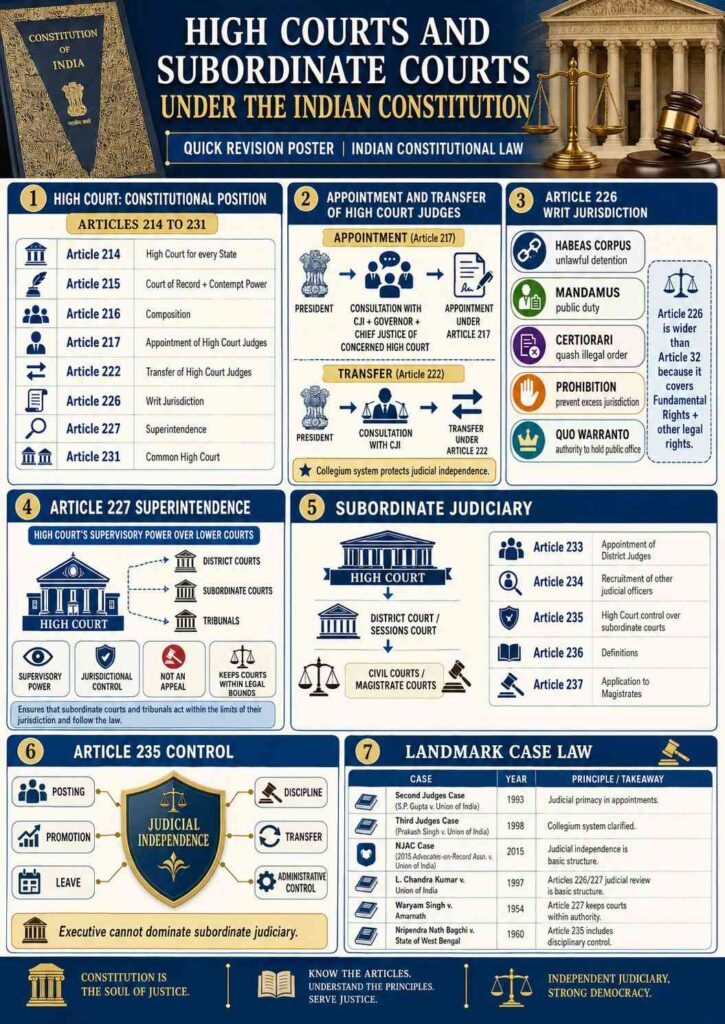
Constitutional Position of High Courts in India
➤ State judiciary as constitutional institution: The High Court is the highest constitutional court at the State level. Articles 214 to 231 of the Constitution deal with High Courts in the States, while Articles 233 to 237 deal with the subordinate judiciary. Article 214 provides that there shall be a High Court for each State. However, Article 231 permits Parliament to establish a common High Court for two or more States or for two or more States and a Union Territory. The Constitution therefore treats the High Court not merely as an ordinary appellate court, but as a constitutional guardian within the State judicial structure.
➤ Independence of judiciary: The High Court performs three major constitutional functions: deciding disputes, protecting fundamental and legal rights through writ jurisdiction, and controlling the subordinate judiciary. Its independence is protected through special provisions on appointment, tenure, salaries, transfer, removal, contempt powers and administrative control over subordinate courts. This structure ensures that justice at the State level is not controlled by the executive.
➤ Position in judicial hierarchy: The High Court stands below the Supreme Court but above District Courts and other subordinate courts within the State. It hears appeals and revisions from subordinate courts, exercises writ jurisdiction against public authorities, and supervises courts and tribunals within its territorial jurisdiction. It is both a court of law and a constitutional authority.
Constitution and Composition of High Courts
➤ Article 216 — Composition: Article 216 states that every High Court shall consist of a Chief Justice and such other Judges as the President may from time to time deem it necessary to appoint. The Constitution does not fix a permanent numerical strength for every High Court. The sanctioned strength may vary depending on pendency, workload, size of the State and administrative requirements.
➤ Chief Justice and puisne judges: The Chief Justice is the administrative head of the High Court. Other judges are commonly called puisne judges. The Chief Justice allocates work, constitutes benches, manages roster arrangements and represents the High Court in constitutional consultations.
➤ Additional and acting judges: Article 224 permits appointment of additional judges for temporary increase in business or arrears, and acting judges when a permanent judge is unable to perform duties. Article 224A also permits appointment of retired judges to sit and act as judges of a High Court with required consent. These provisions are intended to address pendency and temporary judicial requirements.
Appointment of High Court Judges
➤ Article 217 — Appointment: Article 217 provides that every Judge of a High Court shall be appointed by the President by warrant under his hand and seal. In making such appointment, the President consults the Chief Justice of India, the Governor of the State, and in case of appointment of a judge other than the Chief Justice, the Chief Justice of the concerned High Court.
➤ Qualifications: A person is qualified for appointment as a High Court judge if he or she is a citizen of India and has, for at least ten years, held a judicial office in the territory of India, or has, for at least ten years, been an advocate of a High Court or of two or more such courts in succession. This allows appointments both from the judicial service and from the Bar.
➤ Age of retirement: A High Court judge holds office until the age of 62 years. This is different from Supreme Court judges, who retire at 65 years. A judge may resign by writing addressed to the President, may be removed through the constitutional impeachment process, or may be appointed to the Supreme Court or transferred to another High Court.
➤ Collegium system: Though Article 217 uses the word “consultation”, judicial interpretation has transformed the process into the collegium system. Under the present system, appointments to High Courts involve consultation between the High Court collegium, the Supreme Court collegium and the Union Government. The executive formally appoints judges, but the primacy of the judiciary in judicial appointments has been recognised to protect judicial independence.
Evolution of the Collegium System
➤ First Judges Case — S.P. Gupta v. Union of India, 1981 Supp SCC 87: In this case, the Supreme Court initially held that the executive had primacy in judicial appointments and transfers, and that the opinion of the Chief Justice of India was not binding. The dispute involved non-appointment, extension of additional judges and transfer of High Court judges. The ratio was that “consultation” did not mean “concurrence”. This decision gave greater power to the executive, but it was later overruled on the point of primacy.
➤ Second Judges Case — Supreme Court Advocates-on-Record Association v. Union of India, (1993) 4 SCC 441: This landmark nine-judge decision overruled the First Judges Case and held that the Chief Justice of India’s opinion, formed collectively with senior judges, would have primacy in appointments and transfers. The Court reasoned that judicial independence is part of the basic structure of the Constitution. For High Court appointments, the opinion of the Chief Justice of India had to be formed after consultation with senior Supreme Court judges and relevant constitutional authorities.
➤ Third Judges Case — In re Special Reference No. 1 of 1998, (1998) 7 SCC 739: The President sought clarification on the appointment process. The Supreme Court expanded and clarified the collegium system. It held that the Chief Justice of India must consult a plurality of judges. For High Court appointments, the opinion of the CJI must be formed after consultation with senior Supreme Court judges familiar with the affairs of the concerned High Court. This strengthened collective institutional decision-making.
➤ NJAC Case — Supreme Court Advocates-on-Record Association v. Union of India, (2016) 5 SCC 1: The 99th Constitutional Amendment and the National Judicial Appointments Commission Act sought to replace the collegium system. A five-judge Constitution Bench struck down the amendment and the NJAC Act as unconstitutional, holding that judicial primacy in appointments is essential to judicial independence, which is part of the basic structure.
Transfer of High Court Judges
➤ Article 222 — Transfer power: Article 222 empowers the President to transfer a judge from one High Court to another after consultation with the Chief Justice of India. When a judge is transferred, he or she is entitled to compensatory allowance as determined by Parliament.
➤ Purpose of transfer: Transfers may be made for better administration of justice, national integration of judiciary, avoiding local influences, or administrative necessity. However, transfer must not be used as punishment or as a tool of executive pressure, because that would damage judicial independence.
➤ Judicial safeguards: After the Second and Third Judges Cases, consultation with the Chief Justice of India means effective consultation with a collegium of senior judges. The Chief Justice of India’s opinion must be formed on relevant material. This ensures that transfer is not a unilateral executive action.
➤ S.P. Gupta and transfer issue: In S.P. Gupta v. Union of India, 1981 Supp SCC 87, the Supreme Court considered, among other issues, the transfer of High Court judges under Article 222. The earlier view allowed wider executive discretion, but later cases changed the law by giving primacy to the judiciary in transfer and appointment matters.
High Court as Court of Record
➤ Article 215 — Court of record: Article 215 declares that every High Court shall be a court of record and shall have all powers of such a court, including the power to punish for contempt of itself. A court of record has two important features: its records have evidentiary value, and it has inherent power to punish for contempt.
➤ Meaning of court of record: The judgments, proceedings and acts of a High Court are preserved as permanent records. Their authenticity cannot be casually questioned in subordinate proceedings. This gives institutional dignity and legal certainty to the High Court’s judicial work.
➤ Contempt power: The power to punish for contempt protects the authority of the court and the administration of justice. It is not meant to protect personal prestige of judges. It is used when conduct scandalises the court, interferes with judicial proceedings, obstructs justice or wilfully disobeys court orders.
➤ Article 215 and Contempt of Courts Act, 1971: Article 215 is a constitutional power, while the Contempt of Courts Act regulates procedure and limitations. The High Court’s power is inherent, but it is exercised judicially, carefully and in accordance with principles of fairness. Courts have repeatedly stressed that contempt jurisdiction must not be used where ordinary remedies are adequate.
Writ Jurisdiction of High Courts under Article 226
➤ Article 226 — Wide constitutional remedy: Article 226 empowers every High Court to issue directions, orders or writs to any person or authority, including the government, for enforcement of fundamental rights and “for any other purpose”. This makes Article 226 wider than Article 32, because Article 32 is primarily for enforcement of fundamental rights, while Article 226 covers both fundamental rights and other legal rights.
➤ Nature of jurisdiction: Article 226 jurisdiction is discretionary, equitable and constitutional. A person does not get a writ merely because a legal error exists; the High Court examines whether interference is necessary to prevent injustice, illegality or violation of rights.
➤ Five traditional writs: The High Court may issue habeas corpus, mandamus, certiorari, prohibition and quo warranto. These writs are inherited from common law but have been constitutionally adapted in India.
➤ Habeas corpus: This writ protects personal liberty. It commands the authority detaining a person to produce the person before the court and justify the detention. If detention is illegal, the person is released. It is a powerful remedy against unlawful arrest, illegal custody and preventive detention abuse.
➤ Mandamus: Mandamus means “we command”. It is issued to compel performance of a public or statutory duty. It cannot ordinarily be issued to enforce a purely private duty. However, if a private body performs a public function, mandamus may lie.
➤ Certiorari: Certiorari is issued to quash an order of a court, tribunal or authority where there is jurisdictional error, violation of natural justice, error apparent on the face of record, or breach of law.
➤ Prohibition: Prohibition is preventive. It restrains a lower court or tribunal from proceeding in a matter over which it has no jurisdiction or is acting contrary to law. Certiorari quashes; prohibition prevents.
➤ Quo warranto: Quo warranto questions the legal authority of a person holding a public office. If the appointment is contrary to statutory or constitutional requirements, the court may remove the person from office.
Important Supreme Court Cases on Article 226
➤ L. Chandra Kumar v. Union of India, (1997) 3 SCC 261: The Supreme Court held that judicial review by the High Courts under Articles 226 and 227 and by the Supreme Court under Article 32 is part of the basic structure of the Constitution. The issue was whether tribunal decisions could be kept outside High Court scrutiny. The ratio was that tribunal decisions are subject to scrutiny by a Division Bench of the High Court within whose jurisdiction the tribunal falls. This case preserved the High Court’s constitutional role even in the tribunal system.
➤ Andi Mukta Sadguru v. V.R. Rudani, (1989) 2 SCC 691: The Supreme Court held that mandamus under Article 226 can be issued not only against statutory authorities but also against bodies performing public duties. The case involved teachers seeking terminal benefits from a trust-run educational institution. The ratio was that the form of the body is less important than the nature of the duty. This expanded Article 226 as a practical remedy against public duty violations.
➤ Whirlpool Corporation v. Registrar of Trade Marks, (1998) 8 SCC 1: The Supreme Court held that availability of an alternative remedy does not completely bar writ jurisdiction. A writ may still be entertained where fundamental rights are violated, principles of natural justice are breached, the order is without jurisdiction, or the validity of a statute is challenged. This case is important because Article 226 remains flexible where ordinary remedies are ineffective.
➤ Bandhua Mukti Morcha v. Union of India, (1984) 3 SCC 161: The Supreme Court gave liberal standing in public interest litigation involving bonded labour. Though mainly an Article 32 case, its rights-based approach influenced Article 226 PIL jurisdiction. It showed that constitutional courts can act where poverty, helplessness or social disability prevents affected persons from approaching courts.
➤ State of Uttar Pradesh v. Mohammad Nooh, AIR 1958 SC 86: The Supreme Court held that writ jurisdiction can be exercised where there is a serious defect in procedure or violation of natural justice, even if an alternative remedy exists. The case is frequently used to explain that procedural fairness is central to judicial review.
Difference between Article 226 and Article 32
| Basis | Article 226 | Article 32 |
|---|---|---|
| Court | High Court | Supreme Court |
| Scope | Fundamental rights and other legal rights | Fundamental rights |
| Nature | Discretionary remedy | Fundamental right itself |
| Territorial reach | Within High Court’s territorial jurisdiction, subject to cause of action | All India jurisdiction |
| Purpose | Broader judicial review and legal rights enforcement | Direct constitutional remedy for fundamental rights |
➤ Key memory point: Article 32 is itself a fundamental right, while Article 226 is wider in subject matter. Therefore, a High Court under Article 226 can protect both constitutional rights and ordinary legal rights.
Superintendence of High Courts under Article 227
➤ Article 227 — Power of superintendence: Article 227 gives every High Court superintendence over all courts and tribunals throughout the territories over which it exercises jurisdiction. This power includes administrative and judicial superintendence. It ensures that subordinate courts and tribunals act within their jurisdiction and follow law.
➤ Administrative superintendence: The High Court may call for returns, make and issue general rules, prescribe forms for proceedings and entries, and settle tables of fees. This ensures uniformity, discipline and efficiency in subordinate courts.
➤ Judicial superintendence: The High Court may interfere where a subordinate court acts without jurisdiction, refuses to exercise jurisdiction, commits grave dereliction of duty, violates natural justice or causes manifest injustice. However, Article 227 is not a substitute for appeal.
➤ Difference between Article 226 and Article 227: Article 226 is mainly original writ jurisdiction against State action, public authorities or legal wrongs. Article 227 is supervisory jurisdiction over courts and tribunals. Article 226 issues writs; Article 227 keeps subordinate judicial bodies within legal bounds.
Important Supreme Court Cases on Article 227
➤ Waryam Singh v. Amarnath, AIR 1954 SC 215: The Supreme Court held that Article 227 power is to be exercised to keep subordinate courts within the bounds of their authority. The case established that superintendence is not ordinary appellate power. The ratio is that High Courts may interfere where courts act beyond jurisdiction or fail to exercise jurisdiction.
➤ Surya Dev Rai v. Ram Chander Rai, (2003) 6 SCC 675: The Supreme Court discussed the relationship between Articles 226 and 227 and allowed limited interference against orders of civil courts. However, later decisions clarified and limited this view.
➤ Shalini Shyam Shetty v. Rajendra Shankar Patil, (2010) 8 SCC 329: The Supreme Court held that Article 227 must be exercised sparingly and only to keep subordinate courts and tribunals within the bounds of their authority. The High Court should not convert Article 227 into a regular appellate jurisdiction.
➤ Radhey Shyam v. Chhabi Nath, (2015) 5 SCC 423: The Supreme Court clarified that judicial orders of civil courts are not amenable to writ jurisdiction under Article 226, though supervisory jurisdiction under Article 227 may be available in proper cases. This distinction is important for understanding writ and supervisory remedies.
Subordinate Judiciary under the Constitution
➤ Meaning of subordinate judiciary: Subordinate judiciary refers to courts below the High Court, such as District Courts, Civil Courts, Sessions Courts, Chief Judicial Magistrate Courts, Judicial Magistrate Courts and other courts created by law. These courts conduct trials, record evidence, decide civil and criminal disputes and form the foundation of the justice delivery system.
➤ Articles 233 to 237: These provisions protect independence of the district judiciary and subordinate courts. They regulate appointment of District Judges, recruitment of persons other than District Judges, control by the High Court, and application of provisions to magistrates.
➤ Importance: Most litigants interact first with subordinate courts, not the High Court or Supreme Court. Therefore, independence, competence and discipline of subordinate courts are essential to rule of law.
Appointment of District Judges under Article 233
➤ Article 233 — District Judges: Appointments, postings and promotions of District Judges are made by the Governor of the State in consultation with the High Court exercising jurisdiction in relation to that State. This consultation is mandatory and meaningful. The executive cannot ignore the High Court’s opinion in judicial appointments at the district level.
➤ Eligibility from Bar: A person not already in government service is eligible to be appointed as District Judge if he or she has been an advocate or pleader for at least seven years and is recommended by the High Court. This ensures that experienced advocates may directly enter higher judicial service.
➤ Meaning of District Judge: Article 236 explains that “District Judge” includes judge of a city civil court, additional district judge, joint district judge, assistant district judge, chief judge of a small cause court, chief presidency magistrate, sessions judge, additional sessions judge and assistant sessions judge. This is a wide constitutional definition.
Recruitment of Other Judicial Officers under Article 234
➤ Article 234 — Judicial service below District Judge: Appointments of persons other than District Judges to the judicial service of a State are made by the Governor in accordance with rules made after consultation with the State Public Service Commission and the High Court. The High Court’s role is crucial because judicial service is not an ordinary civil service.
➤ Purpose of consultation: The High Court ensures that recruitment standards preserve judicial independence, legal competence and integrity. The Public Service Commission may conduct examinations, but the High Court’s involvement gives the process a judicial character.
➤ Judicial service: Article 236 defines judicial service as a service consisting exclusively of persons intended to fill the post of District Judge and other civil judicial posts inferior to District Judge. This means executive officers cannot be mixed into judicial service in a manner that damages judicial independence.
Control over Subordinate Courts under Article 235
➤ Article 235 — High Court’s control: Article 235 vests control over District Courts and courts subordinate thereto in the High Court. This includes posting, promotion, grant of leave and disciplinary control over persons belonging to the judicial service of the State and holding posts inferior to District Judge.
➤ Constitutional purpose: Article 235 separates the subordinate judiciary from executive control. If the executive controlled postings, promotions and discipline of judges, judicial independence at the grassroots level would be seriously weakened. Article 235 ensures that judicial officers decide cases without fear of executive displeasure.
➤ Scope of control: The High Court’s control includes disciplinary proceedings, suspension, departmental inquiry, assessment of service record, promotion, confirmation, posting and transfer within judicial service. However, formal appointment or dismissal orders may be issued by the Governor according to service rules, but the effective control remains with the High Court.
➤ Administrative and disciplinary meaning: “Control” under Article 235 is a wide word. It is not limited to routine administration. It includes disciplinary jurisdiction because discipline is essential to maintain purity and independence of the judiciary.
Important Supreme Court Cases on Article 235
➤ State of West Bengal v. Nripendra Nath Bagchi, AIR 1966 SC 447: The Supreme Court held that “control” under Article 235 includes disciplinary control. The issue was whether disciplinary action against a District Judge was within the High Court’s authority. The Court held that vesting control in the High Court is essential for independence of subordinate judiciary. This case gave Article 235 a broad and meaningful interpretation.
➤ Shamsher Singh v. State of Punjab, (1974) 2 SCC 831: The Supreme Court held that the High Court has constitutional control over the subordinate judiciary and that executive authorities cannot take over disciplinary control. The case involved judicial officers whose services were terminated. The ratio was that although formal orders may be issued in the name of the Governor, the High Court’s control under Article 235 must be respected.
➤ High Court of Punjab and Haryana v. State of Haryana, (1975) 1 SCC 843: The Supreme Court emphasised that the High Court’s control over subordinate courts is comprehensive and intended to secure independence of the judiciary. The executive cannot interfere with matters that constitutionally belong to the High Court.
➤ All India Judges’ Association v. Union of India, (1992) 1 SCC 119; review in (1993) 4 SCC 288; further directions in (2002) 4 SCC 247: These cases dealt with service conditions, pay scales, retirement age, infrastructure and independence of subordinate judiciary. The Supreme Court recognised that judicial independence is not confined to higher judiciary; it must extend to the district judiciary also.
Relationship between High Courts and Subordinate Courts
➤ Judicial relationship: The High Court hears appeals, revisions, references and petitions arising from subordinate courts. It corrects legal errors, ensures fair trial and maintains uniformity of law within the State.
➤ Supervisory relationship: Under Article 227, the High Court supervises subordinate courts and tribunals to ensure they act within jurisdiction. This power is corrective, not appellate.
➤ Administrative relationship: Under Article 235, the High Court controls postings, promotions, leave and discipline of judicial officers. This is necessary to preserve independence and integrity.
➤ Rule-making relationship: High Courts frame rules for subordinate courts regarding practice, procedure, records, inspection, administrative functioning and case management, subject to constitutional and statutory limits.
Important Powers of High Courts
| Power | Constitutional Source | Simple Meaning |
|---|---|---|
| Court of record | Article 215 | Records have high authority; contempt power exists |
| Writ jurisdiction | Article 226 | Protection of fundamental and legal rights |
| Superintendence | Article 227 | Supervisory control over courts and tribunals |
| Appointment consultation | Articles 217, 233, 234 | Role in judicial appointments |
| Control over subordinate judiciary | Article 235 | Posting, promotion, leave and discipline |
| Appellate and revisional powers | Statutes such as CPC, CrPC/BNSS and special laws | Correction of subordinate court decisions |
High Court Jurisdiction: Original, Appellate and Supervisory
➤ Original jurisdiction: Some High Courts have original civil jurisdiction, especially chartered High Courts such as Bombay, Calcutta, Madras and Delhi in specified matters. Under Article 226, every High Court has original constitutional jurisdiction to entertain writ petitions.
➤ Appellate jurisdiction: High Courts hear civil and criminal appeals from subordinate courts. In criminal matters, appeals may arise from convictions, acquittals or sentences. In civil matters, appeals may arise from decrees and orders depending on statutory provisions.
➤ Revisional jurisdiction: High Courts may exercise revisional powers under procedural laws where subordinate courts commit jurisdictional error or material irregularity. Revision is narrower than appeal.
➤ Supervisory jurisdiction: Article 227 is constitutional superintendence. It is used where ordinary appellate or revisional remedies are inadequate but intervention is necessary to keep courts within legal limits.
Memory Table: Articles 214 to 237
| Article | Keyword | Core Idea |
|---|---|---|
| 214 | High Court for State | Each State shall have a High Court |
| 215 | Court of record | Contempt power and permanent records |
| 216 | Composition | Chief Justice and other judges |
| 217 | Appointment | President appoints High Court judges |
| 222 | Transfer | President may transfer High Court judge after CJI consultation |
| 224 | Additional judges | Temporary judges for arrears/workload |
| 226 | Writs | Writs for fundamental rights and other purposes |
| 227 | Superintendence | Supervision over courts and tribunals |
| 231 | Common High Court | Parliament may create common High Court |
| 233 | District Judges | Appointment by Governor in consultation with High Court |
| 234 | Other judicial officers | Recruitment with High Court and PSC consultation |
| 235 | Control | High Court controls subordinate judiciary |
| 236 | Definitions | Defines District Judge and judicial service |
| 237 | Magistrates | Application of provisions to certain magistrates |
Conceptual Difference: Article 227 and Article 235
| Basis | Article 227 | Article 235 |
|---|---|---|
| Nature | Supervisory jurisdiction | Administrative and disciplinary control |
| Applies to | Courts and tribunals | District Courts and subordinate courts |
| Purpose | Keep courts/tribunals within jurisdiction | Maintain independent judicial service |
| Type of power | Judicial and administrative superintendence | Service control over judicial officers |
| Example | Correcting jurisdictional error of tribunal | Posting, promotion or disciplinary inquiry of judge |
➤ Simple understanding: Article 227 controls the functioning of courts as adjudicatory bodies. Article 235 controls judicial officers as members of the judicial service.
Independence of Subordinate Judiciary
➤ Article 50 connection: Article 50, a Directive Principle, directs the State to separate the judiciary from the executive in the public services of the State. Articles 233 to 235 give practical constitutional effect to this idea by ensuring that the executive does not dominate the subordinate judiciary.
➤ Why independence is essential: A trial judge decides questions of liberty, property, family rights, criminal guilt and civil liability. If such a judge fears transfer, punishment or denial of promotion by the executive, impartial justice becomes impossible.
➤ High Court as protector: The High Court acts as guardian of subordinate judiciary by controlling appointments, postings, promotions and discipline. This protects judges from external pressure and also maintains accountability through internal judicial supervision.
Limitations on High Court Powers
➤ Self-restraint in writs: Although Article 226 is wide, High Courts generally avoid interference where disputed facts require trial, where an effective alternative remedy exists, where the petition is delayed, or where the petitioner lacks clean hands. These are rules of discretion, not absolute bars.
➤ No appellate conversion under Article 227: The High Court cannot treat Article 227 as a second appeal. It does not re-appreciate evidence merely because another view is possible. It interferes only where there is jurisdictional error, perversity, violation of natural justice or grave injustice.
➤ Contempt power restraint: Contempt jurisdiction must be used sparingly. Fair criticism of judgments is not contempt. The power is meant to protect administration of justice, not to silence legitimate legal criticism.
➤ Article 235 and service rules: The High Court’s control is broad but operates within constitutional provisions and valid service rules. Formal orders of appointment, dismissal or removal may require action by the Governor, but the High Court’s constitutional role cannot be bypassed.
Illustrations for Easy Understanding
➤ Illegal detention: If a person is arrested without legal authority and family members do not know where he is kept, a habeas corpus petition may be filed in the High Court under Article 226.
➤ Public duty refusal: If a statutory authority refuses to issue a licence despite fulfilment of all legal conditions, the High Court may issue mandamus directing lawful consideration or performance of duty.
➤ Tribunal exceeds jurisdiction: If a tribunal decides a matter that the statute does not permit it to decide, the High Court may interfere under Articles 226/227.
➤ Subordinate judge disciplinary issue: If allegations of misconduct arise against a Civil Judge, disciplinary control constitutionally belongs to the High Court under Article 235, not to the executive department.
➤ Usurpation of public office: If a person is appointed to a statutory public office without possessing mandatory qualifications, a quo warranto writ may be issued.
Concluding Summary
➤ High Courts as constitutional guardians: High Courts are not merely appellate courts. They are constitutional courts with power to protect rights, supervise courts and tribunals, punish contempt and preserve judicial independence at the State level.
➤ Appointment and transfer: High Court judges are appointed by the President under Article 217 and may be transferred under Article 222. Judicial interpretation through the Second Judges Case, Third Judges Case and NJAC Case has made judicial primacy central to the process.
➤ Writ jurisdiction: Article 226 is one of the broadest remedies in the Constitution. It allows High Courts to enforce fundamental rights as well as other legal rights. Its flexibility makes it one of the most important tools of constitutional governance.
➤ Superintendence and control: Article 227 gives High Courts supervisory power over courts and tribunals, while Article 235 gives control over subordinate judiciary. Together, these provisions ensure that justice delivery below the High Court remains lawful, disciplined and independent.
➤ Subordinate judiciary: Articles 233 to 237 protect the independence of District Judges and judicial officers. Since subordinate courts are the first point of contact for most citizens, their independence is as important as that of the Supreme Court and High Courts.