Micro, Small and Medium-sized Enterprises (MSMEs) constitute a critical component of economies worldwide, contributing to employment, entrepreneurship, innovation, domestic production and participation in international trade. Yet MSMEs continue to face persistent difficulties in obtaining affordable, timely and reliable institutional credit.
One of the central legal and regulatory dimensions of this challenge concerns the architecture of collateral and secured lending. Traditional lending practices have historically relied heavily on immovable property as security, notwithstanding that a substantial share of MSME productive assets is movable or intangible; including inventory, receivables, equipment and other commercial assets. The resulting mismatch between the assets held by MSMEs and the collateral accepted by lenders contributes to the continuing financing gap.
In this background, international commercial law has increasingly moved towards legal frameworks that permit movable and intangible assets to be used more effectively as collateral. The United Nations Commission on International Trade Law’s (UNCITRAL) work is particularly relevant, including the UNCITRAL Model Law on Secured Transactions (2016), the UNCITRAL Guide on Access to Credit for Micro-Small and Medium-sized Enterprises (2023), and the UNCITRAL-UNIDROIT Model Law on Warehouse Receipts (2024). At the same time, commercial assets and trade documentation are becoming increasingly digital. Electronic warehouse receipts, digital receivables, data and tokenised assets raise new questions concerning collateral eligibility, control, priority, authenticity, multiple assignments, cross-border recognition and enforcement. These developments make the interaction between secured transactions, trade finance, technology and dispute resolution an increasingly important area for legal and policy dialogue.
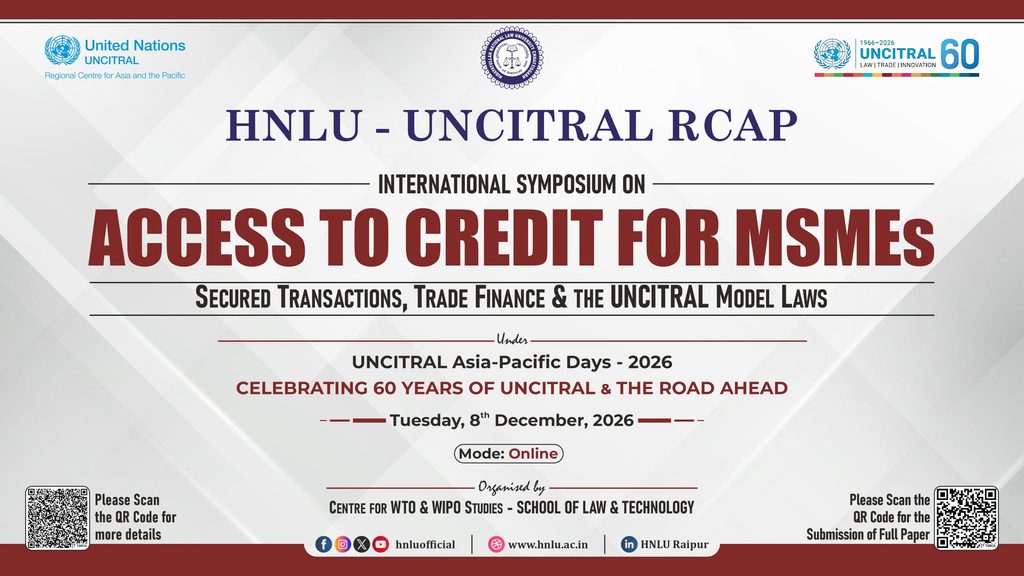
In this background to commemorate 60 years of the of the United Nations Commission on International Trade Law (UNCITRAL), Hidayatullah National Law University (HNLU) Raipur through its Center for WTO & WIPO Studies, School of Law & Technology is organizing International Symposium on “Access to Credit for MSMEs: Secured Transactions, Trade Finance, and the UNCITRAL Model Laws.” The Symposium will examine how modern secured-transactions frameworks can contribute to closing the MSME financing gap, while addressing the practical challenges created by cross-border trade, digitalization and evolving forms of commercial collateral. The Symposium seeks to place UNCITRAL’s legislative and policy work within a broader conversation on MSME finance, trade facilitation, digital commerce and cross-border dispute resolution. Its central premise is that legal reform must ultimately be connected to practical bankability, enforceability, institutional confidence and inclusive access to finance.
Structure of the Symposium
The symposium will consist of the following segments:
- Inaugural Ceremony
- Panel discussion on the theme, “The Future of MSME Finance: UNCITRAL Frameworks, Cross-Border Trade and Emerging Challenges”, and
- Paper presentations in technical sessions
Sub-themes for the research paper submission:
- MSME Credit Gap: Global and Domestic Perspectives
- Movable Assets and Receivables as Collateral
- Creation, Perfection, Registration and Priority of Security Interests
- Enforcement and Creditor Remedies
- Cross-Border Secured Transactions and Conflict of Laws
- Implementation of the UNCITRAL Model Law on Secured Transactions
- Balancing Creditor Protection and Productive Use of MSME Assets
(Sub-themes are indicative and non-exhaustive.)
Call for Papers
- Research papers in English are invited from academicians, researchers, legal practitioners, policymakers, professionals, industry experts, banking and financial-sector professionals, economists, management and business scholars, practitioners, doctoral scholars, and students from India and abroad.
- Contributions are particularly encouraged from diverse and interdisciplinary fields, including law, economics, banking and finance, business and management, international trade, commerce, development studies, public policy, financial technology, and related disciplines.
Full Paper Submission
- Maximum 8,000-10,000 words (inclusive of abstract & footnotes),
- Bluebook citation (21st edition).
- Co-authorship up to two authors allowed.
- Times New Roman, 12pt, 1.5 spacing, Justified Alignment.
Note: Mere submission of a full paper does not guarantee its acceptance for presentation at the Symposium. Papers will be shortlisted based on their quality, originality, academic rigour, and relevance to the theme of Symposium. Only shortlisted papers will be considered for presentation. Selected papers may also be considered for publication in the form of an edited book, subject to the prescribed editorial and publication requirements.
Registration fees: NIL
Link for the Submission of Full Paper
Link for Participation
Brochure Link
Important Dates
- Deadline for the Submission of full paper: 25 November 2026
- Notification of Acceptance of full paper: 28 November 2026
- Deadline for Registration: 1 December 2026
- Date of the International Symposium: 8 December 2026
Contact Information
For further details and queries, please contact:
Dr. Ankit Awasthi
Head – Centre for WTO & WIPO Studies, SLT, HNLU Raipur
Email: cws@hnlu.ac.in
Contact number: +91-7355235075 (WhatsApp/voice call)