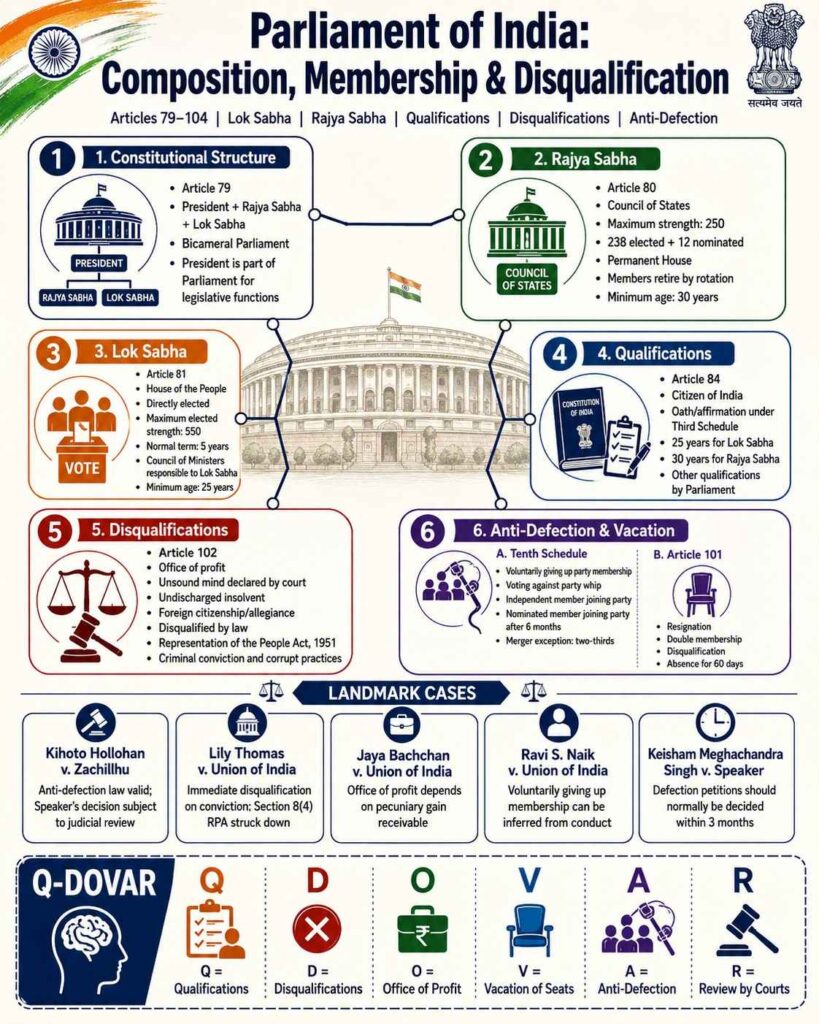
Introduction: Constitutional Position of Parliament in India
❖ Parliament as Union Legislature: The Parliament of India is the supreme legislative organ at the Union level, but it is not legally sovereign like the British Parliament because it is controlled by the written Constitution, federal distribution of powers, fundamental rights, judicial review and basic structure doctrine. Under Article 79, Parliament consists of the President, the Council of States, called Rajya Sabha, and the House of the People, called Lok Sabha. This means that the President is not a member of either House, but is an integral part of Parliament for legislative functions such as summoning, proroguing, addressing Parliament, assenting to Bills and issuing ordinances.
❖ Bicameral Structure: India follows a bicameral parliamentary system at the Union level. Lok Sabha represents the people directly, while Rajya Sabha represents the States and certain Union Territories. The Constitution gives both Houses important legislative powers, but Lok Sabha has special dominance in matters of government responsibility and Money Bills. Rajya Sabha’s official introduction states that the Council of States has a maximum strength of 250, consisting of 238 elected representatives of States and Union Territories and 12 nominated members; its present strength is 245, consisting of 233 elected and 12 nominated members.
Composition of Rajya Sabha under Article 80
❖ Maximum Strength: Under Article 80, Rajya Sabha may have a maximum of 250 members. Out of these, 238 members represent the States and Union Territories, and 12 members are nominated by the President. The nominated members must have special knowledge or practical experience in literature, science, art and social service. The official Rajya Sabha source confirms the same constitutional structure and present strength.
❖ Elected Members of Rajya Sabha: Representatives of the States are elected by the elected members of State Legislative Assemblies. The election is by the system of proportional representation by means of the single transferable vote. This method helps minority parties in State Assemblies obtain representation in Rajya Sabha in proportion to their strength.
❖ Union Territory Representation: Not every Union Territory is represented in Rajya Sabha. Only those Union Territories which have a legislative/electoral arrangement provided by law are represented. The Rajya Sabha source states that representatives of Delhi, Puducherry and Jammu and Kashmir are elected through their respective electoral colleges/legislative assemblies.
❖ Nominated Members: The 12 nominated members are not elected by the people or legislatures. Their purpose is to bring persons of eminence and expertise into parliamentary deliberation. They may participate in debates and vote on ordinary matters, but they cannot vote in the election of the President because the electoral college for the President consists only of elected members of both Houses and elected members of State Legislative Assemblies and certain Union Territory Assemblies.
❖ Continuing Chamber: Rajya Sabha is a permanent House and is not subject to dissolution. However, its members do not hold office permanently. Under Article 83(1), one-third of its members retire every second year, and each member ordinarily has a term of six years.
Composition of Lok Sabha under Article 81
❖ Direct Representation of People: Lok Sabha is the directly elected House of Parliament. It represents the people of India on the basis of territorial constituencies. Its members are chosen by direct election on the basis of adult suffrage under Article 326, which provides for elections on the basis of adult citizenship, subject to qualifications and disqualifications prescribed by the Constitution or law.
❖ Maximum Strength after Anglo-Indian Nomination Ended: After the discontinuance of Anglo-Indian nomination to Lok Sabha, the Constitution permits up to 550 elected members, with not more than 530 members from States and not more than 20 members from Union Territories. The Government of India’s public directory states that the Constitution permits up to 550 members, consisting of 530 from States and 20 from Union Territories.
❖ Actual Elected Strength: The present elected strength of Lok Sabha is ordinarily 543 elected members, unless vacancies exist. Members are elected from single-member territorial constituencies. Seats are distributed among States and Union Territories broadly on population principles, subject to constitutional freezes and delimitation rules.
❖ Duration of Lok Sabha: Under Article 83(2), Lok Sabha continues for five years from the date appointed for its first meeting, unless dissolved earlier. During a national emergency, Parliament may extend this period by law for one year at a time, but not beyond six months after the emergency ceases.
❖ Special Position of Lok Sabha: Lok Sabha is politically more powerful because the Council of Ministers is collectively responsible to it under Article 75(3). A government survives only so long as it enjoys the confidence of Lok Sabha. Money Bills can be introduced only in Lok Sabha, and Rajya Sabha has only recommendatory power in relation to such Bills; the official Rajya Sabha source also explains that Rajya Sabha must return a Money Bill within fourteen days and cannot amend it.
Comparative Table: Lok Sabha and Rajya Sabha
| Basis | Lok Sabha | Rajya Sabha |
|---|---|---|
| Meaning | House of the People | Council of States |
| Constitutional Article | Article 81 | Article 80 |
| Nature | Directly elected House | Indirectly elected and partly nominated House |
| Maximum Strength | 550 elected members after Anglo-Indian nomination ended | 250 members |
| Term | 5 years, unless dissolved earlier | Permanent House; members retire by rotation |
| Election Method | Direct election | Proportional representation by single transferable vote |
| Minimum Age | 25 years | 30 years |
| Government Responsibility | Council of Ministers responsible to Lok Sabha | No power to remove government by no-confidence motion |
| Money Bill Power | Dominant House | Recommendatory role only |
Qualifications for Membership of Parliament under Article 84
❖ Citizenship: A person must be a citizen of India. Citizenship is the first essential condition because Parliament is the national law-making body and membership requires allegiance to India.
❖ Oath or Affirmation: The person must make and subscribe an oath or affirmation according to the form set out in the Third Schedule before a person authorised by the Election Commission. This oath binds the member to bear true faith and allegiance to the Constitution and uphold the sovereignty and integrity of India.
❖ Age Requirement: For Rajya Sabha, the minimum age is 30 years. For Lok Sabha, the minimum age is 25 years. The official Rajya Sabha source also states that Article 84 requires a Rajya Sabha member to be a citizen, take oath/affirmation, and be not less than 30 years of age.
❖ Other Qualifications by Parliament: Article 84 also permits Parliament to prescribe additional qualifications by law. The important law in this field is the Representation of the People Act, 1951. For example, a candidate must be an elector for a parliamentary constituency, subject to special rules for reserved seats.
Disqualifications for Membership under Article 102
❖ Constitutional Grounds: Article 102(1) provides that a person shall be disqualified for being chosen as, and for being, a member of either House of Parliament if he or she:
➤ Office of Profit: Holds any office of profit under the Government of India or the Government of any State, other than an office declared by Parliament by law not to disqualify its holder.
➤ Unsound Mind: Is of unsound mind and stands so declared by a competent court.
➤ Undischarged Insolvent: Is an undischarged insolvent.
➤ Foreign Citizenship or Allegiance: Is not a citizen of India, has voluntarily acquired citizenship of a foreign State, or is under acknowledgment of allegiance or adherence to a foreign State.
➤ Disqualification by Law: Is disqualified by or under any law made by Parliament.
❖ Anti-Defection Ground: Article 102(2) adds that a person shall also be disqualified if disqualified under the Tenth Schedule, which contains the anti-defection law.
Disqualification under the Representation of the People Act, 1951
❖ Statutory Disqualifications: Since Article 102(1)(e) allows Parliament to create disqualifications by law, the Representation of the People Act, 1951 is central to parliamentary membership. Its Chapter III deals with disqualifications such as conviction for certain offences, corrupt practices, dismissal for corruption or disloyalty, government contracts, office under government company and failure to lodge election expenses. The India Code version of the Act lists Sections 8, 8A, 9, 9A, 10 and 10A as major disqualification provisions.
❖ Conviction for Offences under Section 8: Section 8 disqualifies persons convicted for certain serious offences. In many cases, the disqualification starts from the date of conviction and continues for a further period after release. Section 8(3) states that a person convicted of any offence and sentenced to imprisonment for not less than two years shall be disqualified from the date of conviction and shall continue to be disqualified for six years after release.
❖ Corrupt Practices under Section 8A: Section 8A deals with disqualification on the ground of corrupt practices. The statute provides that cases of persons found guilty of corrupt practice are submitted to the President for determining whether the person should be disqualified and for what period; the period cannot exceed six years from the date when the order takes effect.
❖ Dismissal for Corruption or Disloyalty under Section 9: A person dismissed from government service for corruption or disloyalty is disqualified for five years from dismissal. The Act also provides for an Election Commission certificate on whether the dismissal was for corruption or disloyalty.
❖ Government Contract under Section 9A: A person is disqualified if there is a subsisting contract with the government for supply of goods, execution of works or services, because such a relationship may create conflict between public duty and private interest.
❖ Office under Government Company under Section 10: A person holding an office under a government company may be disqualified, subject to statutory conditions, because such an office may create dependency on government-controlled corporate power.
❖ Failure to Lodge Election Expenses under Section 10A: A candidate who fails to lodge an account of election expenses as required by law may be disqualified by the Election Commission.
Office of Profit under Article 102(1)(a)
❖ Meaning of Office of Profit: An office of profit means a position under the Central or State Government which gives the holder some financial gain, advantage or benefit, unless Parliament has declared that office not to disqualify its holder. The object is to protect the independence of legislators and prevent executive influence over MPs through paid or beneficial offices.
❖ Key Ingredients: Courts generally examine whether there is an office, whether it is held under the Government, whether the office carries profit or pecuniary benefit, and whether the government has control over appointment, removal, functions or remuneration.
❖ Profit Need Not Be Actually Received: The important point is that the office must be capable of yielding profit. Actual receipt of money is not always necessary. If the office carries entitlement to salary, allowances, honorarium, residence, vehicle, staff, or other financial advantage beyond compensatory reimbursement, it may become an office of profit.
❖ Jaya Bachchan v. Union of India, AIR 2006 SC 2119; (2006) 5 SCC 266: In this case, Jaya Bachchan, a Rajya Sabha member, was disqualified after the President decided under Article 103 that she held an office of profit. The issue was whether the post held by her carried pecuniary gain. The Supreme Court held that what matters is whether pecuniary gain is receivable in connection with the office, not whether the person actually received it. The Court upheld the disqualification and clarified that an office capable of yielding financial benefit may attract Article 102(1)(a).
❖ Shibu Soren v. Dayanand Sahay, AIR 2001 SC 2583; (2001) 7 SCC 425: In this case, Shibu Soren’s election to Rajya Sabha was challenged on the ground that he held an office of profit as Chairman of the Interim Jharkhand Area Autonomous Council. The Supreme Court examined the nature of the office, government control and benefits attached to it. The Court held that the office was under the State Government and attracted disqualification. The case is important because it shows that the substance of the post, not merely its label, determines whether it is an office of profit.
❖ Exemption by Parliament: Parliament may declare certain offices as not disqualifying. This is done because not every public office creates a real conflict of interest. For example, certain advisory, cultural or parliamentary committee positions may be exempted by law.
Decision on Disqualification under Article 103
❖ President’s Decision: When a question arises whether a sitting MP has become disqualified under Article 102(1), it is referred to the President under Article 103.
❖ Election Commission’s Opinion: Before giving a decision, the President must obtain the opinion of the Election Commission of India, and the President acts according to that opinion. This system ensures that disqualification questions are decided through an independent constitutional body rather than by political majority alone.
❖ Judicial Review: The President’s decision under Article 103 is subject to judicial review if there is illegality, constitutional violation, mala fide exercise of power or procedural unfairness.
Anti-Defection Law under the Tenth Schedule
❖ Purpose of Anti-Defection Law: The Tenth Schedule was inserted by the Constitution (Fifty-second Amendment) Act, 1985 to curb political defections. Its purpose is to prevent elected representatives from abandoning the party mandate for personal gain, office, money or political bargaining. PRS explains that the Tenth Schedule lays down the process by which legislators may be disqualified on the ground of defection by the Presiding Officer on a petition by another member of the House.
❖ Grounds of Defection for Elected Party Members: A member belonging to a political party is disqualified if he or she voluntarily gives up membership of that political party, or votes/abstains from voting contrary to the party direction without prior permission and such act is not condoned within the prescribed time.
❖ Voluntarily Giving Up Membership: This phrase is wider than formal resignation. A member may be treated as having voluntarily given up party membership by conduct, speeches, public alignment with another party, joining rival political activities, or openly acting against the party in a manner showing abandonment of membership.
❖ Independent Members: An independent member is disqualified if, after election, he or she joins any political party. This rule exists because an independent candidate is elected without a party label and cannot later convert that mandate into a party mandate.
❖ Nominated Members: A nominated member may join a political party within six months of taking the seat. If the nominated member joins a political party after expiry of six months, disqualification follows.
❖ Merger Exception: A member is not disqualified if the original political party merges with another political party and at least two-thirds of the members of the legislature party agree to such merger. The earlier “split” exception of one-third members was deleted by the Constitution (Ninety-first Amendment) Act, 2003.
❖ Decision-Maker: The question of disqualification under the Tenth Schedule is decided by the Chairman or Speaker of the House. In Parliament, the Chairman of Rajya Sabha decides cases relating to Rajya Sabha members, and the Speaker of Lok Sabha decides cases relating to Lok Sabha members.
❖ Kihoto Hollohan v. Zachillhu, 1992 Supp (2) SCC 651: This is the leading Constitution Bench decision on the anti-defection law. The petitioners challenged the validity of the Tenth Schedule, arguing that it violated freedom of speech and undermined democratic dissent. The Supreme Court upheld the constitutional validity of the Tenth Schedule, holding that the law aims to curb unprincipled defections. It also held that the Speaker/Chairman acts as a tribunal while deciding disqualification and that the decision is subject to judicial review, although courts should ordinarily not interfere before the Presiding Officer has made a decision.
❖ Ravi S. Naik v. Union of India, 1994 Supp (2) SCC 641: The Supreme Court held that “voluntarily giving up membership” is not confined to formal resignation from party membership. It may be inferred from conduct. This case is important because it prevents legislators from avoiding anti-defection law by not submitting formal resignation while practically deserting the party.
❖ G. Viswanathan v. Speaker, Tamil Nadu Legislative Assembly, (1996) 2 SCC 353: The Supreme Court held that expelled members of a political party do not become independents for purposes of the Tenth Schedule. They continue to be treated as members of the party on whose ticket they were elected, and joining another party may attract disqualification.
❖ Rajendra Singh Rana v. Swami Prasad Maurya, (2007) 4 SCC 270: The Supreme Court held that the Speaker’s decision on defection can be judicially reviewed, especially where constitutional requirements are ignored. The case emphasises that the Presiding Officer cannot defeat anti-defection law by improper delay or legally unsustainable findings.
❖ Keisham Meghachandra Singh v. Speaker, Manipur Legislative Assembly, (2020) 2 SCC 617: The Supreme Court observed that Speakers should decide disqualification petitions under the Tenth Schedule within a reasonable period, normally three months, unless exceptional circumstances exist. This case is important because delay in deciding defection petitions can allow defectors to continue in office and distort democratic mandates.
Vacation of Seats under Article 101
❖ Double Membership of Both Houses: Under Article 101(1), no person can be a member of both Houses of Parliament. If a person is chosen to both Houses, one seat must be vacated according to law.
❖ Membership of Parliament and State Legislature: A person cannot simultaneously remain a member of Parliament and a State Legislature. If elected to both, the person must resign one seat within the legally prescribed period; otherwise, the parliamentary seat may become vacant.
❖ Resignation: Under Article 101(3)(b), a member may resign by writing addressed to the Chairman of Rajya Sabha or Speaker of Lok Sabha, as the case may be. However, the resignation is accepted only if the Presiding Officer is satisfied that it is voluntary and genuine. This prevents forced resignations, fabricated resignations or resignations obtained by coercion.
❖ Disqualification: Under Article 101(3)(a), the seat becomes vacant if a member becomes subject to any disqualification mentioned in Article 102.
❖ Absence for 60 Days: Under Article 101(4), if a member is absent from all meetings of the House for 60 days without permission, the House may declare the seat vacant. In calculating 60 days, periods when the House is prorogued or adjourned for more than four consecutive days are not counted.
❖ Death or Dissolution: A seat also becomes vacant on death of the member. In Lok Sabha, all seats become vacant when the House is dissolved, subject to continuation for limited constitutional purposes until the new House is constituted.
Vacation of Seats and Disqualification: Difference
| Concept | Meaning | Example |
|---|---|---|
| Disqualification | Legal incapacity to be chosen as or continue as MP | Conviction under Section 8 RPA, office of profit, defection |
| Vacation of Seat | Actual seat becomes empty due to constitutional event | Resignation, absence for 60 days, choosing one seat out of two |
| Authority | President/Election Commission or Speaker/Chairman depending on ground | Article 103 or Tenth Schedule |
| Effect | Person loses eligibility or membership | Constituency/seat becomes vacant |
Effect of Criminal Conviction on Membership
❖ Immediate Disqualification after Lily Thomas: Earlier, Section 8(4) of the Representation of the People Act gave sitting MPs and MLAs a protective period, allowing them to continue if they filed an appeal within the prescribed time. This protection was struck down.
❖ Lily Thomas v. Union of India, AIR 2013 SC 2662; (2013) 7 SCC 653: In this case, the petitioners challenged Section 8(4) of the Representation of the People Act, 1951. The Supreme Court held that Parliament had no power to create a special protective rule for sitting legislators different from candidates. It declared Section 8(4) unconstitutional. The result is that if a sitting MP is convicted and sentenced in a manner attracting Section 8, disqualification operates from the date of conviction, subject to relief such as stay of conviction by an appellate court. The India Code text also notes that the relevant protective sub-section was struck down in Lily Thomas.
❖ Stay of Conviction: Merely filing an appeal does not automatically remove disqualification. The appellate court must stay the conviction, not merely suspend the sentence. This distinction is important because disqualification is attached to conviction.
Membership, Oath and Sitting without Qualification
❖ Oath under Article 99: Every member must make and subscribe oath or affirmation before taking the seat. A person elected to Parliament becomes entitled to sit and vote only after fulfilling this requirement.
❖ Penalty under Article 104: If a person sits or votes as a member before complying with Article 99, or when he knows that he is not qualified or is disqualified, he is liable to a monetary penalty for each day of such sitting or voting, recoverable as a debt due to the Union.
Special Note: Reservation and Representation in Lok Sabha
❖ SC/ST Reservation: Lok Sabha contains seats reserved for Scheduled Castes and Scheduled Tribes under constitutional provisions. These are territorial constituencies reserved for candidates belonging to SC/ST communities, but all voters in the constituency vote.
❖ Anglo-Indian Nomination Discontinued: Earlier, Article 331 allowed the President to nominate up to two members of the Anglo-Indian community to Lok Sabha if the community was not adequately represented. This system has been discontinued after the 104th Constitutional Amendment, and therefore the present maximum elected structure is understood without the two nominated Anglo-Indian seats. Government directory information reflects the present constitutional maximum as 550 elected members.
❖ Women’s Reservation Amendment: The Constitution (One Hundred and Sixth Amendment) Act, 2023 provides for reservation of one-third seats for women in Lok Sabha, State Legislative Assemblies and the Legislative Assembly of NCT of Delhi, but its practical operation is linked with census and delimitation as provided in the amendment. The official Gazette text shows that the Act inserted provisions for women’s reservation and was enacted in 2023.
Memory Aid: “Q-DOVAR” for Parliamentary Membership
❖ Q – Qualifications: Citizenship, oath, minimum age, other qualifications by law.
❖ D – Disqualifications: Article 102 and RPA, 1951.
❖ O – Office of Profit: Prevents executive influence over legislators.
❖ V – Vacation of Seats: Article 101 events such as resignation, double membership, absence.
❖ A – Anti-Defection: Tenth Schedule controls political defections.
❖ R – Review: Judicial review applies to disqualification decisions, especially after Kihoto Hollohan.
Conclusion
❖ Core Understanding: The constitutional law of Parliament’s composition, membership and disqualification balances democratic representation with constitutional morality. Lok Sabha gives direct voice to the people, Rajya Sabha gives federal voice to the States and Union Territories, and the President completes Parliament for legislative purposes. Membership is controlled through qualifications under Article 84, disqualifications under Article 102, statutory rules under the Representation of the People Act, 1951, office of profit principles, and anti-defection rules under the Tenth Schedule.
❖ Underlying Principle: The Constitution does not treat parliamentary membership as a private privilege. It is a public constitutional trust. Therefore, rules on office of profit prevent executive patronage; criminal conviction disqualifications protect legislative integrity; anti-defection law protects the electoral mandate; and vacation of seat rules ensure that membership remains genuine, accountable and constitutionally valid.