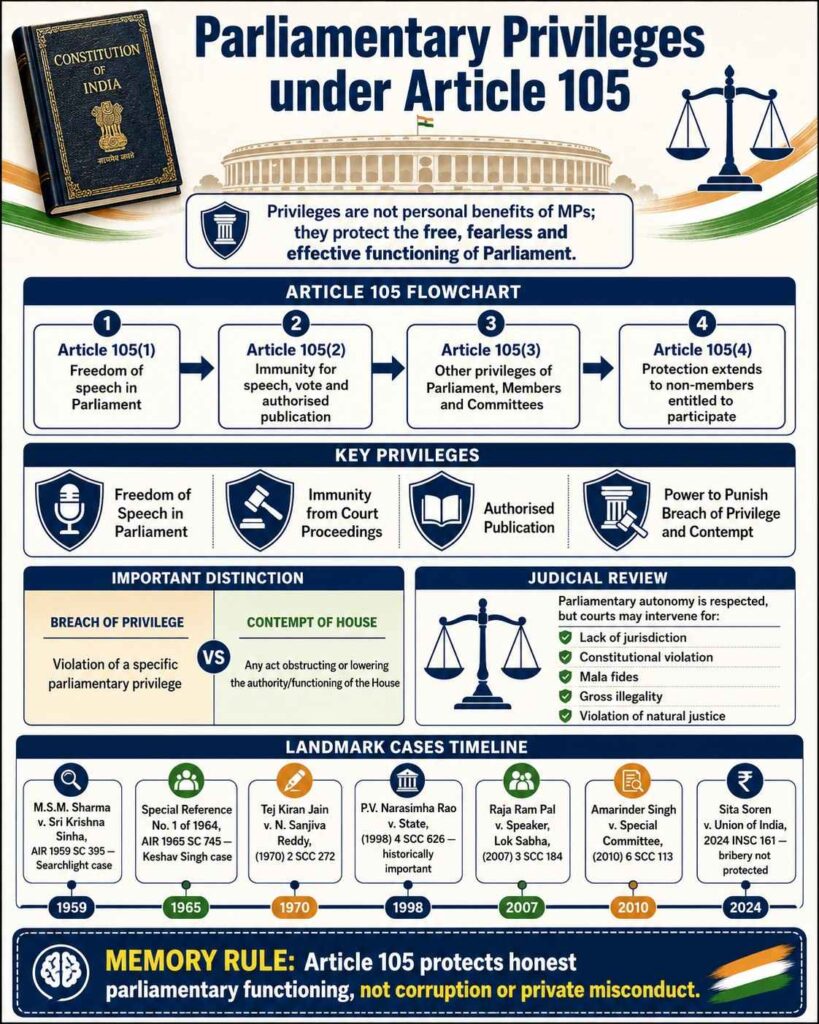
Meaning and Constitutional Purpose of Parliamentary Privileges
➤ Core meaning: Parliamentary privileges are special rights, immunities and powers given to Parliament, its Members and its Committees so that Parliament can function freely, fearlessly and effectively. These privileges are not personal favours to individual Members of Parliament. They exist to protect the dignity, authority and independent functioning of the House.
➤ Functional purpose: The basic idea is that a Member of Parliament must be able to speak, vote, participate in committees, ask questions, criticise government action and represent the public without fear of civil or criminal proceedings merely because of what was said or voted inside Parliament.
➤ Constitutional source: Article 105 of the Constitution deals with the powers, privileges and immunities of both Houses of Parliament, their Members and Committees. Article 194 contains similar provisions for State Legislatures. Article 105 gives express protection to freedom of speech in Parliament, immunity from court proceedings for anything said or any vote given in Parliament or its committees, and immunity for authorised publication of parliamentary proceedings.
➤ Institutional privilege: The privilege belongs primarily to the House as an institution. A Member enjoys it because he or she is part of Parliament. Therefore, privilege cannot be used as a shield for private misconduct, corruption, defamation outside Parliament, or acts unconnected with parliamentary functioning.
➤ Rule of constitutional supremacy: India follows constitutional supremacy, not parliamentary sovereignty in the British sense. Therefore, parliamentary privileges in India are subject to the Constitution, judicial review, fundamental constitutional limitations, and the basic principle that every constitutional authority acts within its jurisdiction.
Article 105 of the Constitution of India
➤ Article 105(1) — Freedom of speech: Article 105(1) says that, subject to the Constitution and the rules and standing orders regulating parliamentary procedure, there shall be freedom of speech in Parliament. This is a special constitutional freedom, different from ordinary freedom of speech under Article 19(1)(a), because it operates inside Parliament and is controlled mainly by constitutional provisions and parliamentary rules.
➤ Article 105(2) — Immunity from court proceedings: Article 105(2) protects a Member from liability in any court for anything said or any vote given by him or her in Parliament or any parliamentary committee. It also protects any person from liability for publication of reports, papers, votes or proceedings if such publication is made by or under the authority of either House.
➤ Article 105(3) — Other privileges: Article 105(3) says that other powers, privileges and immunities of each House, its Members and Committees shall be such as may be defined by Parliament by law; until so defined, they are the privileges that existed immediately before the coming into force of Section 15 of the Constitution (Forty-fourth Amendment) Act, 1978.
➤ Article 105(4) — Application to non-members entitled to participate: Article 105(4) extends the protections of clauses (1), (2) and (3) to persons who have a constitutional right to speak in, or otherwise take part in, parliamentary proceedings or committee proceedings, even though they may not be Members of Parliament.
➤ Important connected provisions: Article 118 empowers each House of Parliament to make rules regulating its procedure and conduct of business, subject to the Constitution. Article 122 protects parliamentary proceedings from being questioned in court merely on the ground of procedural irregularity, but it does not protect substantive illegality or unconstitutionality.
Freedom of Speech in Parliament under Article 105
➤ Meaning of parliamentary speech: Freedom of speech in Parliament means that Members can express views, make allegations, criticise policies, debate Bills, ask questions, move motions, participate in committee discussions and vote without fear of external legal consequences for the speech or vote itself.
➤ Wider than Article 19 speech in one sense: Parliamentary speech is specially protected because ordinary restrictions under Article 19(2) do not operate in the same direct way inside Parliament. However, Article 105(1) itself makes freedom of speech subject to the Constitution and the rules and standing orders of Parliament. Therefore, the freedom is not a licence for disorder, unparliamentary language, or breach of parliamentary discipline.
➤ Internal discipline remains: Although courts cannot generally punish a Member for what is said in Parliament, the House may take disciplinary action under its own rules. The Speaker or Chairman may expunge remarks, require withdrawal of unparliamentary expressions, suspend a Member according to rules, or refer a matter to the Committee of Privileges.
➤ Rajya Sabha explanation: The Rajya Sabha Secretariat’s publication explains that freedom of speech is the most important privilege of Members of Parliament because it enables them to discharge parliamentary duties without fear, and that no action can be taken against a Member in court or before any outside authority for anything said or any vote given in Parliament or its committees.
➤ Practical illustration: If an MP strongly criticises a minister during a debate and makes statements connected with the debate, the MP is protected from court proceedings for that speech. But if the same MP repeats defamatory allegations at a press conference outside Parliament, Article 105(2) will not automatically protect that outside statement because it is not “anything said” in Parliament.
Immunity under Article 105(2)
➤ Nature of immunity: Article 105(2) creates immunity from “proceedings in any court” for two protected parliamentary acts: anything said in Parliament or any committee, and any vote given in Parliament or any committee. The protection is attached to the parliamentary act itself.
➤ Absolute protection for speech and vote: When the speech or vote is within parliamentary proceedings, the immunity is very strong. A court cannot examine whether the statement was true or false, whether it was defamatory, or whether it caused private harm, because allowing such suits would create fear and chill parliamentary debate.
➤ Authorised publication: Article 105(2) also protects publication of parliamentary materials when the publication is “by or under the authority” of either House. This protects official reports, papers, votes and proceedings. The protection is narrower for unauthorised publication by newspapers or private persons.
➤ No immunity for everything done by an MP: Article 105 does not mean that an MP is above law. It does not protect ordinary crimes, private contracts, corruption, violence, or statements made outside parliamentary proceedings. The protection is functional, not personal.
➤ Bribery after Sita Soren: The current position is that bribery connected with a speech or vote is not protected merely because the Member later speaks or votes in the House. The Supreme Court in Sita Soren v. Union of India, 2024 INSC 161 held that the purpose of Articles 105(2) and 194(2) is to protect free legislative speech and voting, not to create immunity for criminal bribery. The Court overruled the majority view in P.V. Narasimha Rao v. State (CBI/SPE), (1998) 4 SCC 626, to the extent it protected bribe-taking legislators who actually voted or spoke as agreed.
Difference between Article 105(1) and Article 105(2)
| Point | Article 105(1) | Article 105(2) |
|---|---|---|
| Subject | Freedom of speech in Parliament | Immunity from court proceedings |
| Nature | Positive freedom to speak in Parliament | Protective shield against litigation |
| Limitations | Subject to Constitution, rules and standing orders | Protects speech/vote from court proceedings |
| Control | Mainly Speaker/Chairman and House rules | Courts are barred from entertaining proceedings on protected speech/vote |
| Example | MP may criticise a Bill in debate | MP cannot be sued for defamation for a protected parliamentary speech |
Breach of Privilege
➤ Meaning of breach of privilege: A breach of privilege occurs when any individual, authority, organisation or even a Member interferes with the privileges, powers or immunities of Parliament, its Members or Committees.
➤ Essential test: The key question is whether the act obstructs or tends to obstruct Parliament, its Committees, or Members in the discharge of their parliamentary duties.
➤ Examples of breach: Threatening an MP for a speech made in Parliament, obstructing a Member from attending the House, serving legal proceedings for something said in Parliament, publishing false or distorted reports of parliamentary proceedings, refusing to appear before a parliamentary committee when summoned, or tampering with committee evidence may amount to breach of privilege.
➤ Member-specific breach: If a Member is threatened, assaulted, intimidated or legally harassed because of a speech or vote in Parliament, it may be treated as breach of privilege because it directly affects the Member’s parliamentary independence. The Rajya Sabha Secretariat notes that molesting, threatening or taking action against a Member on account of anything said in Parliament or a committee may amount to breach of privilege.
➤ House-specific breach: If a publication falsely imputes motives to the House, obstructs a committee, leaks confidential committee reports without authority, or scandalises parliamentary processes in a manner that obstructs functioning, the House may treat it as breach of its collective privilege.
Contempt of House
➤ Meaning of contempt: Contempt of House is broader than breach of privilege. Every breach of privilege may amount to contempt, but contempt may also include acts that do not violate any specific privilege yet obstruct, lower, or tend to lower the authority, dignity or functioning of the House.
➤ Core idea: Contempt is concerned with obstruction or disrespect to the House’s authority. It protects the institution from acts that make parliamentary functioning difficult or impossible.
➤ Examples of contempt: Disobeying orders of the House, refusing to answer a committee without lawful excuse, giving false evidence to a committee, interfering with witnesses, publishing forged parliamentary documents, disorderly conduct within precincts, or scandalising the House in a manner that obstructs its work may be treated as contempt.
➤ Punishments: The House may admonish, reprimand, suspend, imprison for the duration of the session, or in extreme cases expel a Member if the power is validly exercised. The Rajya Sabha publication states that custody or imprisonment for contempt is limited to the duration of the session of the House, and that sincere regret is often accepted by the House in appropriate cases.
➤ Apology and regret: Parliamentary privilege is not mainly punitive. Its purpose is to protect functioning. Therefore, where a person expresses sincere and unconditional apology, the House may decide not to proceed further.
Procedure in Breach of Privilege Matters
➤ Raising the matter: A Member generally gives notice of a question of privilege to the Speaker of Lok Sabha or Chairman of Rajya Sabha. The presiding officer decides whether the matter has consent to be raised.
➤ Preliminary scrutiny: The Speaker or Chairman examines whether the matter is recent, specific, and directly connected with parliamentary privilege. Frivolous, political or remote matters may be rejected.
➤ Reference to Committee: If the matter appears serious, it may be referred to the Committee of Privileges. The committee examines facts, hears concerned persons, considers evidence, and submits a report.
➤ Decision by House: The House may accept, reject or modify the committee’s recommendations. The final decision belongs to the House, subject to constitutional limitations and judicial review where jurisdictional or constitutional illegality is shown.
➤ Natural justice: Though parliamentary proceedings are internal, serious consequences such as suspension, expulsion or imprisonment require fairness. Courts have increasingly insisted that legislative privilege cannot be exercised arbitrarily or in violation of constitutional fundamentals.
Parliamentary Privileges and the Press
➤ Authorised reports protected: Official publication of parliamentary reports, papers, votes and proceedings is protected by Article 105(2). This ensures that Parliament’s official record can be published without fear of court proceedings.
➤ Unauthorised reports not equally protected: Unauthorised publication, especially distorted or expunged material, may invite privilege proceedings if it obstructs or disrespects the House. The Rajya Sabha Secretariat notes that Article 105(2) immunity for publication applies when publication is made by or under the authority of the House, and that it does not automatically extend to newspaper publication of parliamentary proceedings.
➤ Searchlight principle: In Pandit M.S.M. Sharma v. Shri Sri Krishna Sinha, AIR 1959 SC 395, commonly known as the Searchlight case, the editor of a newspaper published parts of Bihar Legislative Assembly proceedings that had been expunged. The issue was whether legislative privilege could override freedom of speech and press. The Supreme Court accepted the importance of legislative privileges and treated the House as having authority over breach of privilege connected with unauthorised publication of proceedings.
Landmark Supreme Court Case Laws on Parliamentary Privileges
Pandit M.S.M. Sharma v. Shri Sri Krishna Sinha, AIR 1959 SC 395
➤ Facts: The editor of the Searchlight newspaper published portions of Bihar Assembly debates that had been expunged by the Speaker. Privilege proceedings were initiated against him.
➤ Issue: Whether publication of expunged legislative proceedings could be punished as breach of privilege, and whether freedom of speech and press under Article 19(1)(a) could defeat legislative privilege.
➤ Ratio: The Supreme Court gave significant weight to legislative privilege and recognised the House’s power to protect its proceedings. The case shows that the press does not have an unrestricted right to publish expunged or unauthorised legislative material merely by invoking press freedom.
Special Reference No. 1 of 1964, AIR 1965 SC 745 — Keshav Singh Case
➤ Facts: The Uttar Pradesh Legislative Assembly committed Keshav Singh, a non-member, to prison for contempt. He filed a habeas corpus petition in the Allahabad High Court. Two judges granted interim bail. The Assembly then passed resolutions against the judges and the advocate, creating a constitutional conflict between legislature and judiciary.
➤ Issue: Whether the legislature’s privilege power was beyond judicial scrutiny, and whether courts could examine detention ordered by a House for contempt.
➤ Ratio: The Supreme Court held that legislatures have power to punish for contempt, including contempt by strangers, but that privilege powers are not completely beyond the Constitution. Courts may examine jurisdictional issues, legality of detention, and constitutional limits. This case is a foundation for the Indian rule that legislative privilege is strong but not sovereign or unlimited.
Tej Kiran Jain v. N. Sanjiva Reddy, (1970) 2 SCC 272
➤ Facts: Certain persons filed a defamation suit against the Speaker, Ministers and MPs for statements allegedly made during a Calling Attention Motion in Lok Sabha.
➤ Issue: Whether Members could be sued in court for allegedly defamatory statements made during parliamentary proceedings.
➤ Ratio: The Supreme Court held that Article 105(2) gives absolute immunity for “anything said” in Parliament. The word “anything” was treated broadly. Therefore, courts cannot entertain proceedings against Members for statements made in Parliament, even if those statements are alleged to be defamatory.
P.V. Narasimha Rao v. State (CBI/SPE), (1998) 4 SCC 626
➤ Facts: The case arose from the JMM bribery controversy, where certain MPs were alleged to have accepted bribes in connection with a no-confidence motion against the government.
➤ Issue: Whether an MP could claim immunity under Article 105(2) from criminal prosecution for accepting a bribe connected with a vote in Parliament.
➤ Earlier majority view: The majority held that MPs who accepted bribes and actually voted in Parliament in accordance with the alleged bargain were protected by Article 105(2), while bribe-givers and an MP who did not vote were not similarly protected.
➤ Current position: This majority view has been overruled by the seven-judge bench in Sita Soren v. Union of India, 2024 INSC 161. Therefore, P.V. Narasimha Rao is now important historically, but it is no longer good law on the point that a bribe-taking legislator can claim immunity merely because the agreed vote or speech was performed.
Raja Ram Pal v. Hon’ble Speaker, Lok Sabha, (2007) 3 SCC 184
➤ Facts: Certain Members of Parliament were expelled after a sting operation alleged that they accepted money for asking questions in Parliament.
➤ Issue: Whether Parliament has power to expel Members for conduct amounting to contempt or breach of privilege, and whether such expulsion is subject to judicial review.
➤ Ratio: The Supreme Court upheld Parliament’s power to expel Members in appropriate privilege cases. At the same time, it held that parliamentary privilege is subject to judicial review on limited grounds such as lack of jurisdiction, constitutional violation, mala fides, gross illegality, or violation of fundamental constitutional mandates. The Court rejected the idea that the House is the sole and final judge in every sense.
Amarinder Singh v. Special Committee, Punjab Vidhan Sabha, (2010) 6 SCC 113
➤ Facts: The Punjab Vidhan Sabha expelled Captain Amarinder Singh for alleged misconduct relating to a land exemption matter during his tenure as Chief Minister.
➤ Issue: Whether legislative privilege could be used to expel a Member for executive acts not directly obstructing the functioning of the House.
➤ Ratio: The Supreme Court held that privilege jurisdiction must have a functional link with the House’s legislative functioning. Misconduct outside the House cannot automatically be treated as breach of privilege unless it obstructs or affects the House’s functioning. This case narrows arbitrary use of privilege for political punishment.
Sita Soren v. Union of India, 2024 INSC 161
➤ Facts: The appellant, a legislator, was accused of accepting a bribe in relation to a Rajya Sabha election vote. She claimed immunity under Article 194(2), relying on the earlier P.V. Narasimha Rao ruling under Article 105(2).
➤ Issue: Whether legislative immunity protects a Member from criminal prosecution for bribery connected with speech or vote in the House.
➤ Ratio: The seven-judge bench held that Articles 105(2) and 194(2) protect free speech and voting in the House, not corruption. The offence of bribery is complete when the bribe is accepted or agreed to be accepted; it does not depend on whether the Member later performs the promised vote or speech. The Court held that a claim of privilege cannot defeat criminal law where the criminal act exists independently of the protected speech or vote.
Judicial Review of Parliamentary Privileges
➤ Basic principle: Courts do not interfere with ordinary internal procedure of Parliament. Article 122 prevents courts from questioning parliamentary proceedings merely because of procedural irregularity. However, if the issue is substantive illegality, constitutional violation, lack of jurisdiction, mala fides, or violation of constitutional limitations, judicial review is available.
➤ Procedural irregularity vs constitutional illegality: A procedural irregularity is a minor defect in the manner of conducting proceedings, such as timing, order of business or internal procedure. Constitutional illegality is a deeper defect, such as acting beyond power, violating natural justice in a serious punitive matter, punishing conduct unrelated to parliamentary functioning, or violating express constitutional provisions.
➤ Raja Ram Pal test: The Supreme Court in Raja Ram Pal made it clear that courts will not sit as appellate bodies over Parliament’s internal decisions, but they can examine whether the House acted within constitutional limits. This creates a balanced model: Parliament has autonomy, but not absolute immunity from constitutional scrutiny.
➤ Keshav Singh foundation: The Keshav Singh advisory opinion established that legislative privilege cannot destroy the jurisdiction of constitutional courts. If a person is detained under a privilege order, courts may examine whether the detention is legal and whether the House acted within power.
➤ Article 122 protection is not total: Article 122 does not say that courts can never examine parliamentary action. It only bars challenge on the ground of “irregularity of procedure.” Therefore, an unconstitutional exercise of privilege cannot be saved by calling it an internal proceeding.
Parliamentary Privileges and Fundamental Rights
➤ Complex relationship: Parliamentary privileges sometimes conflict with fundamental rights such as freedom of speech, personal liberty and equality. Indian courts have attempted to balance legislative autonomy with constitutional rights.
➤ Article 19 and press freedom: In the Searchlight case, privilege was given priority over press freedom in the context of unauthorised publication of expunged proceedings. However, later constitutional jurisprudence has become more cautious about unchecked privilege powers.
➤ Article 21 and liberty: If a person is detained for contempt of House, personal liberty is involved. After the development of Article 21 jurisprudence, any serious deprivation of liberty must satisfy fairness, legality and constitutional reasonableness.
➤ Article 14 and non-arbitrariness: Exercise of privilege cannot be arbitrary, discriminatory or mala fide. Parliament and Legislatures are constitutional bodies and must act within constitutional boundaries.
Distinction between Privilege, Immunity and Power
| Concept | Meaning | Example |
|---|---|---|
| Privilege | Special right necessary for parliamentary functioning | Right of House to regulate internal proceedings |
| Immunity | Protection from legal proceedings | No court case for speech or vote in Parliament |
| Power | Authority to act against obstruction | Punishing contempt or breach of privilege |
Important Memory Chart
| Area | Key Rule |
|---|---|
| Speech in Parliament | Protected under Article 105(1) and 105(2) |
| Vote in Parliament | Protected from court proceedings |
| Bribe for vote/speech | Not protected after Sita Soren |
| Authorised publication | Protected under Article 105(2) |
| Unauthorised publication | May attract privilege action |
| Breach of privilege | Violation of specific privilege |
| Contempt of House | Broader obstruction to authority or functioning |
| Judicial review | Available for jurisdictional error, illegality, mala fides and constitutional violation |
| Mere procedural irregularity | Protected from court interference under Article 122 |
Final Conceptual Summary
➤ Parliamentary privileges protect democracy: They ensure that Parliament can debate, deliberate and hold the executive accountable without external intimidation.
➤ Article 105 is the centre: It protects freedom of speech, voting, authorised publication and other privileges necessary for parliamentary functioning.
➤ Freedom is not lawlessness: A Member has strong protection for parliamentary speech and vote, but not for bribery, corruption or private misconduct.
➤ Breach and contempt protect the House: Breach of privilege protects specific privileges, while contempt protects the general dignity, authority and functioning of Parliament.
➤ Judicial review preserves constitutional supremacy: Courts respect parliamentary autonomy but may intervene when privilege is exercised beyond jurisdiction or in violation of the Constitution.
➤ Current settled position: After Sita Soren v. Union of India, parliamentary immunity cannot be used as a shield against prosecution for bribery. The Constitution protects honest legislative functioning, not criminal corruption.