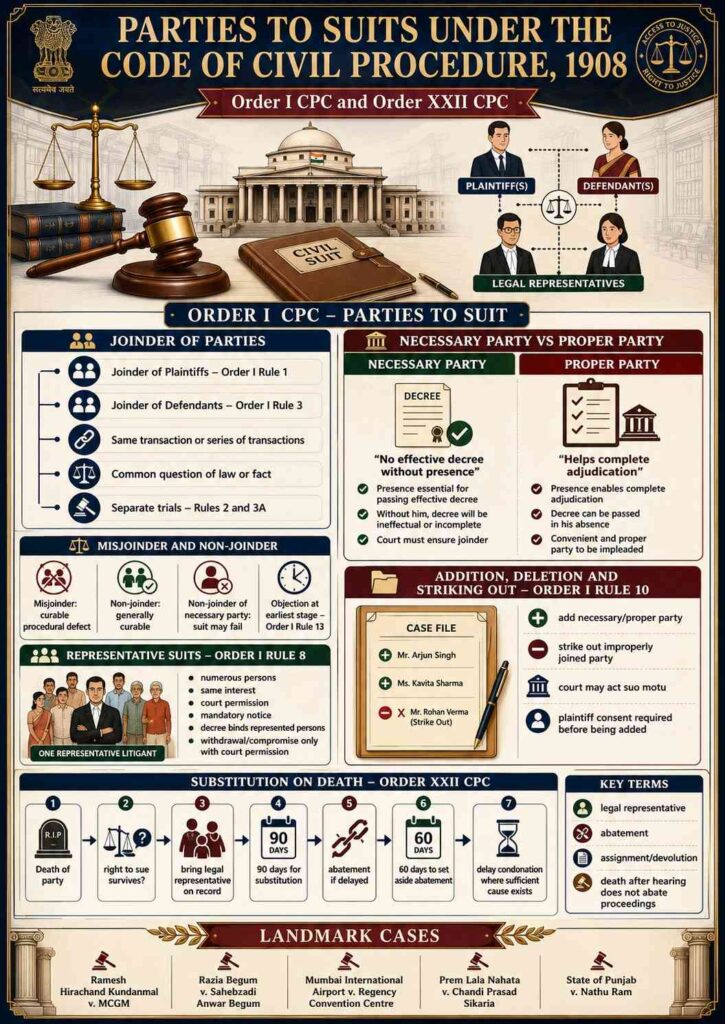
Meaning and Object of Parties to a Suit
- Basic idea: A “party” is a person whose legal rights, liabilities, or interests are directly involved in a civil suit. The person who institutes the suit is the plaintiff; the person against whom relief is claimed is the defendant. Correctly identifying parties is vital because a court should ordinarily pass a decree only after giving every affected person an opportunity to be heard.
- Object of Order I: Order I of the Code of Civil Procedure, 1908 regulates who may be joined as plaintiffs or defendants and how defects in the array of parties may be corrected. Its central purpose is to secure a complete, effective and final decision in one proceeding, while avoiding unnecessary multiplicity of suits, delay and inconsistent decrees.
- Dominus litis principle: The plaintiff is generally the dominus litis, meaning the master of the suit and normally entitled to choose the persons against whom relief is sought. However, this freedom is not absolute. The court may add a necessary or proper party even against the plaintiff’s preference where that person’s presence is required for effective and complete adjudication.
Joinder of Plaintiffs and Defendants
Joinder of Plaintiffs under Order I Rule 1 CPC
- Two-fold test: Several persons may join as plaintiffs in one suit where both conditions are satisfied: first, their right to relief arises out of the same act, transaction, or series of acts or transactions; secondly, separate suits would raise at least one common question of law or fact.
- Joint, several or alternative rights: The right claimed by the plaintiffs may be joint, several, or in the alternative. For example, co-owners who claim that a common property was illegally trespassed upon may sue together because their claims arise from the same transaction and involve common questions.
- Separate trial safeguard: Under Order I Rule 2 CPC, where joinder of plaintiffs may embarrass or delay the trial, the court may require them to elect who will proceed, order separate trials, or make another appropriate order. Thus, joinder is encouraged for convenience, but not at the cost of an unmanageable trial.
Joinder of Defendants under Order I Rule 3 CPC
- Common transaction test: Several persons may be joined as defendants where the right to relief is alleged to arise from the same act, transaction, or series of transactions, and separate suits would involve a common question of law or fact.
- Alternative liability: Defendants may be joined even where the plaintiff is uncertain as to which of them is legally liable. The plaintiff need not first determine the precise liability of every defendant before filing the suit.
- Illustration: A consignor may sue a carrier, warehouse operator and insurer together where goods were lost during transportation and it is uncertain at which stage the loss occurred. The court may determine which defendant is liable and to what extent.
- Separate trials for defendants: Order I Rule 3A CPC empowers the court to order separate trials or make another suitable order where joinder of defendants would embarrass or delay the trial.
Ancillary Rules on Joinder
- Judgment against fewer parties: Under Order I Rule 4 CPC, the court may grant relief to one or more plaintiffs who prove entitlement and may pass a decree against one or more defendants according to their respective liabilities. An amendment is not required merely because all jointly named parties are not ultimately found entitled or liable.
- Different reliefs: Under Order I Rule 5 CPC, every defendant need not be interested in every relief claimed in the suit. This permits a properly structured composite suit where different reliefs arise from the same factual foundation.
- Same contract: Order I Rule 6 CPC permits joinder of persons jointly, severally, or jointly and severally liable under the same contract, including parties to bills of exchange, hundis and promissory notes.
- Doubt about liability: Order I Rule 7 CPC permits joinder of two or more defendants where the plaintiff is uncertain from whom redress should be obtained. The court may decide which defendant is liable and the extent of that liability.
Necessary Party and Proper Party
Necessary Party
- Meaning: A necessary party is a person without whose presence no effective decree can be passed. The decree may become ineffective, incomplete, unenforceable, or liable to cause contradictory results if that person is absent.
- Effect of absence: Non-joinder of a necessary party is a serious defect. Order I Rule 9 CPC expressly protects suits from failure due to misjoinder or non-joinder, but its proviso excludes the non-joinder of a necessary party. Therefore, where a necessary party cannot be added, the suit may fail.
- Practical test: Ask: “Can the court pass an effective and enforceable decree without this person?” If the answer is no, that person is necessary.
Proper Party
- Meaning: A proper party is one in whose absence an effective decree can technically be passed, but whose presence is necessary for a complete, final and comprehensive adjudication of the issues already involved in the suit.
- Practical test: Ask: “Can the dispute be more completely and fairly decided if this person is before the court, without changing the basic nature of the suit?” If yes, that person may be a proper party.
- Distinction: Every necessary party is important for effective adjudication; a proper party is important for complete adjudication. Absence of a proper party does not automatically defeat the suit, whereas absence of a necessary party may do so.
Landmark Case: Ramesh Hirachand Kundanmal v. Municipal Corporation of Greater Bombay
- Rule and ratio: In Ramesh Hirachand Kundanmal v. Municipal Corporation of Greater Bombay, (1992) 2 SCC 524, the plaintiff challenged a municipal demolition notice relating to structures at a service station. Hindustan Petroleum Corporation Ltd., the lessee of the land, sought impleadment as a defendant. The Supreme Court held that a necessary party is one without whom no effective order can be made, while a proper party is one whose presence is required for a complete and final decision even though an effective order may be possible without that person. The Court clarified that impleadment is governed by judicial discretion under Order I Rule 10 CPC; a person cannot be added merely because he possesses relevant evidence, commercial interest, or arguments. The proposed party must have a direct legal interest in the controversy and should be bound by the result of the suit.
Landmark Case: Razia Begum v. Sahebzadi Anwar Begum
- Direct interest principle: In Razia Begum v. Sahebzadi Anwar Begum, AIR 1958 SC 886; [1959] SCR 1111, a dispute concerning marital status and legitimacy led persons whose rights in the estate could be affected to seek impleadment. The Supreme Court explained that, in property disputes, a person ordinarily requires a direct legal interest in the subject matter, not merely a commercial or sentimental interest. In declaratory suits regarding status or legal character, the court may adopt a wider approach because such a declaration can affect persons claiming through the parties in the future.
Landmark Case: Mumbai International Airport Pvt. Ltd. v. Regency Convention Centre and Hotels Pvt. Ltd.
- Judicial discretion principle: In Mumbai International Airport Pvt. Ltd. v. Regency Convention Centre and Hotels Pvt. Ltd., (2010) 7 SCC 417, a party sought impleadment in a suit for specific performance involving airport premises and the Airport Authority of India. The Supreme Court held that Order I Rule 10(2) does not confer an unrestricted right upon strangers to enter litigation. It grants the court judicial discretion to add or strike out parties according to reason, fairness and the requirements of effective adjudication. A person with only a possible future interest, or one whose addition would unnecessarily alter the nature of the suit, need not be impleaded.
Misjoinder and Non-Joinder of Parties
Misjoinder of Parties
- Meaning: Misjoinder occurs where persons are improperly joined as plaintiffs or defendants despite not satisfying the statutory requirements for joinder.
- Effect: Misjoinder is generally a curable procedural defect. The court may strike out an improperly joined party, direct election between plaintiffs, order separate trials, or separate causes of action. It does not ordinarily make the suit itself non-maintainable.
Non-Joinder of Parties
- Meaning: Non-joinder means omission to include a person who should have been made a party.
- Ordinary non-joinder: Where the omitted person is not necessary, the court may proceed with the rights and interests of the parties before it.
- Necessary-party exception: Where the omitted person is necessary, the defect is fundamental. The court should ordinarily require impleadment under Order I Rule 10 CPC; if the necessary party cannot be added, the suit may be dismissed.
Objection and Waiver under Order I Rule 13 CPC
- Earliest opportunity: Objections based on misjoinder or non-joinder must be raised at the earliest possible opportunity and, where issues are settled, at or before settlement of issues.
- Waiver: An objection not raised in time is deemed waived unless the ground arose later. This rule prevents parties from remaining silent during trial and raising technical objections only after an adverse outcome.
Landmark Case: Prem Lala Nahata v. Chandi Prasad Sikaria
- Misjoinder is procedural: In Prem Lala Nahata v. Chandi Prasad Sikaria, (2007) 2 SCC 551, a mother and daughter jointly sued a defendant for separate amounts allegedly due to them. The defendant sought rejection of the plaint on the ground of misjoinder of parties and causes of action. The Supreme Court held that a suit defective for misjoinder is not “barred by law” for the purpose of Order VII Rule 11(d) CPC. The court remains competent to try the suit and may require election, direct separation of claims, or otherwise cure the defect.
Representative Suits under Order I Rule 8 CPC
Nature of a Representative Suit
- Collective litigation: A representative suit is filed or defended by one or more persons on behalf of numerous persons having the same interest in the suit.
- Purpose: It avoids the need for every affected person to be individually joined. It is especially useful in disputes involving residents of a locality, members of an association, beneficiaries of a common fund, worshippers, consumers, or persons having a common right in property.
- Same interest, not identical cause of action: The persons represented must have the same interest in the litigation. The Explanation to Order I Rule 8 clarifies that they need not all possess an identical cause of action. The real requirement is a common interest in the relief or issue involved.
Essential Requirements
- Numerosity: There must be numerous persons. The rule is designed for a class or group, not merely a few individuals seeking their separate personal claims.
- Common interest: The persons represented must share the same legal interest in the subject matter and the relief sought.
- Permission or direction: One or more persons may sue, be sued or defend on behalf of the group with the permission of the court, or pursuant to a direction of the court.
- Mandatory notice: After permission or direction is granted, the court must issue notice of institution of the suit to all interested persons, either through personal service where practicable or by public advertisement where personal service is impracticable.
- Right to join: Any person represented may apply under Order I Rule 8(3) to be made a party to the suit.
- Binding decree: A decree passed in a valid representative suit binds all persons on whose behalf or for whose benefit the suit is instituted or defended.
- Due diligence safeguard: If the representative plaintiff or defendant does not prosecute the matter diligently, the court may substitute another person having the same interest.
- Withdrawal and compromise: A representative claim cannot be abandoned, withdrawn or compromised without court permission and notice to the persons represented. This safeguard prevents representatives from prejudicing the rights of the larger group.
Landmark Case: Aliyathammuda Beethathebiyyappura Pookoya v. Pattakal Cheriyakoya
- Protection of represented persons: In Aliyathammuda Beethathebiyyappura Pookoya v. Pattakal Cheriyakoya, 2019 SCC OnLine SC 953, the dispute concerned the customary right to the office of mutawalli of a mosque. The Supreme Court explained that Order I Rule 8 enables adjudication of matters affecting a large group without requiring every interested person to be individually impleaded. It further emphasised that a compromise in a representative suit requires leave of the court under Order XXIII Rule 3B, after appropriate notice to interested persons, because a compromise decree may bind persons who are not individually named in the litigation.
Addition, Deletion and Striking Out of Parties under Order I Rule 10 CPC
Wrong Plaintiff and Substitution under Rule 10(1)
- Bona fide mistake: Where a suit has been instituted in the name of the wrong plaintiff, or where there is doubt regarding the correct plaintiff, the court may substitute or add the correct plaintiff at any stage.
- Conditions: The court must be satisfied that the mistake was made bona fide and that substitution or addition is necessary to determine the real matter in controversy.
- Consent requirement: No person can be added as a plaintiff without consent. This protects a person from being forced to litigate as a claimant.
Addition and Striking Out under Rule 10(2)
- Wide power: The court may, at any stage of proceedings, either upon application or suo motu, strike out the name of a person improperly joined as plaintiff or defendant.
- Addition of parties: The court may add a person who ought to have been joined, or whose presence is necessary to enable the court effectually and completely to adjudicate upon and settle all questions involved in the suit.
- Terms: The court may impose just terms, including costs, amendment of pleadings or conditions intended to avoid prejudice.
- Amended plaint and service: When a new defendant is added, the plaint should ordinarily be amended and fresh copies of the plaint and summons must be served on the new defendant so that the person receives a fair opportunity to contest.
- Limitation caution: Addition of a defendant may raise limitation issues. The court must consider the applicable limitation law, particularly where the claim against the newly added defendant is already time-barred.
Substitution of Parties under Order XXII CPC
Death of a Party and Survival of Right to Sue
- Survival test: Under Order XXII Rule 1 CPC, death does not cause abatement if the right to sue survives. The first question is therefore not whether a party has died, but whether the cause of action is personal or survives to or against the estate.
- Legal representative: Section 2(11) CPC defines “legal representative” as a person who represents the estate of a deceased person. It includes an intermeddler with the estate and, where a person sued or sued in a representative character dies, the person upon whom the estate devolves. It is broader than the expression “legal heir.”
Death of Plaintiff or Defendant
- Surviving co-parties: Under Order XXII Rule 2 CPC, where the right to sue survives exclusively to surviving plaintiffs or against surviving defendants, the court records that fact and the suit continues without substitution.
- Death of plaintiff: Under Order XXII Rule 3 CPC, where a sole plaintiff dies, or one among several plaintiffs dies and the right does not survive solely to the survivors, the legal representative must be brought on record.
- Death of defendant: Under Order XXII Rule 4 CPC, where a sole defendant dies, or one among several defendants dies and the right does not survive against the remaining defendants alone, the legal representative must be substituted.
- Defence of legal representative: A legal representative brought on record may take every defence appropriate to the character of a representative of the deceased person.
Abatement and Limitation
- Ninety-day period: An application for substitution is ordinarily required within 90 days from the date of death under Article 120 of the Limitation Act, 1963.
- Automatic abatement: If substitution is not sought within the prescribed period, the suit or appeal abates as against the deceased party.
- Setting aside abatement: Article 121 allows 60 days to apply for setting aside the abatement. If that period also expires, an application for condonation of delay under Section 5 of the Limitation Act must accompany the application for setting aside abatement.
- Correct sequence: The proper sequence is: substitution application within 90 days; if delayed, application to set aside abatement within the following 60 days; and if delayed beyond that period, applications for substitution and setting aside abatement along with delay condonation.
Landmark Case: Om Prakash Gupta alias Lalloowa v. Satish Chandra
- Procedure after delay: In Om Prakash Gupta alias Lalloowa v. Satish Chandra, 2025 INSC 183, the Supreme Court considered substitution proceedings in long-pending specific-performance litigation. It clarified that failure to file substitution within 90 days causes automatic abatement. A party cannot merely seek condonation of delay in filing substitution after abatement; the party must seek setting aside of abatement under Order XXII Rule 9 and, where necessary, seek condonation of delay in filing that application. The judgment stresses procedural sequencing while preserving the court’s power to restore proceedings on proof of sufficient cause.
Special Provisions under Order XXII
- Exemption from substitution: Under Order XXII Rule 4(4), the court may exempt the plaintiff from substituting legal representatives of a defendant who did not file a written statement or who, after filing it, failed to appear and contest the suit. A judgment in such circumstances has the same effect as if pronounced before the defendant’s death.
- Ignorance of death: Under Rule 4(5), if the plaintiff genuinely did not know about the defendant’s death and consequently failed to seek substitution in time, the court must give due regard to that ignorance while considering delay condonation.
- No legal representative: Under Rule 4A, where a deceased party has no legal representative, the court may proceed without a representative or appoint the Administrator-General, an officer of the court, or another suitable person to represent the deceased estate.
- Question of legal representation: Under Rule 5, the court decides disputes regarding whether a person is or is not the legal representative of the deceased party.
- Death after hearing: Under Rule 6, if a party dies after conclusion of hearing but before judgment, there is no abatement. Judgment may be pronounced as though death had not occurred.
- Marriage and insolvency: Marriage of a female party does not abate the suit under Rule 7. Insolvency of a plaintiff does not automatically abate a suit that the assignee or receiver may continue for creditors’ benefit under Rule 8.
- Assignment or devolution: Under Rule 10, where an interest is assigned, created or devolves during pendency of a suit, the court may permit the suit to continue by or against the person upon whom the interest has devolved.
Landmark Case: State of Punjab v. Nathu Ram
- Joint and indivisible decree: In State of Punjab v. Nathu Ram, AIR 1962 SC 89, compensation had been awarded jointly to two brothers in land-acquisition proceedings. During the State’s appeal, one brother died and his legal representatives were not brought on record within time. The Supreme Court held that where the decree is joint and indivisible, proceedings against surviving parties may become incapable of continuation because the appellate court cannot modify the decree concerning surviving parties without affecting the final decree in favour of the deceased party. The key consideration is whether continuation would produce contradictory or ineffective decrees.
Quick Revision Matrix
| Issue | Main CPC Provision | Core Rule |
|---|---|---|
| Joinder of plaintiffs | Order I Rule 1 | Same transaction + common question |
| Joinder of defendants | Order I Rule 3 | Same transaction + common question |
| Separate trials | Order I Rules 2 and 3A | Court may prevent embarrassment or delay |
| Necessary party | Order I Rules 9 and 10 | No effective decree possible without that person |
| Proper party | Order I Rule 10 | Presence helps complete adjudication |
| Misjoinder | Order I Rules 9 and 13 | Curable defect; objection must be timely |
| Representative suit | Order I Rule 8 | Numerous persons with same interest |
| Addition/deletion | Order I Rule 10 | Court may add, strike out or substitute parties |
| Death of party | Order XXII Rules 1–4 | Substitute legal representatives if right survives |
| Abatement | Order XXII Rule 9 | Restore only on sufficient cause |
| Assignment during suit | Order XXII Rule 10 | Continuation by or against transferee with leave |