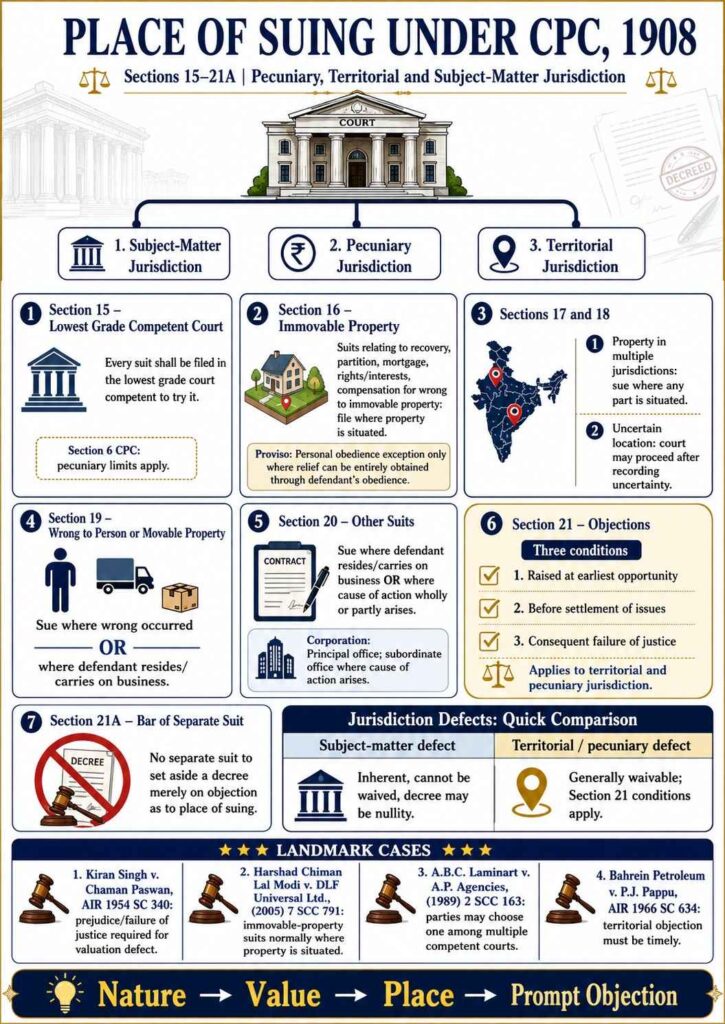
Meaning and Purpose of Place of Suing
• Core idea — “Place of suing” means the legally proper court in which a civil suit must be instituted. Sections 15 to 20 of the Code of Civil Procedure, 1908 (“CPC”) allocate suits among courts according to three principal jurisdictional requirements: subject-matter jurisdiction, pecuniary jurisdiction, and territorial jurisdiction. Sections 21 and 21A then regulate when an objection to a wrongly chosen court may be raised and when a later suit challenging a decree is barred.
• Jurisdictional triad — A court must ordinarily satisfy all three requirements. First, it must be competent to adjudicate the nature of the dispute; secondly, it must be competent considering the monetary valuation of the suit; and thirdly, it must be the proper court considering the location of property, defendant, wrong, or cause of action.
| Type of jurisdiction | Main question | Primary legal source | Effect of defect |
|---|---|---|---|
| Subject-matter jurisdiction | Is this court legally empowered to decide this kind of dispute? | Section 9 CPC and special statutes | Usually fundamental; cannot be created by consent or waiver |
| Pecuniary jurisdiction | Is the value of the suit within this court’s monetary limit? | Sections 6 and 15 CPC; local civil-courts laws | Objection must satisfy Section 21(2) |
| Territorial jurisdiction | Is this the correct geographical forum? | Sections 16–20 CPC | Objection must satisfy Section 21(1) |
• Forum sequence — A litigant should identify the forum in this order: nature of suit → monetary value → territorial connection. For example, a suit for possession of land must first be filed before a court competent to entertain property litigation, then before a court having pecuniary competence, and finally in the territorial jurisdiction where the land is situated.
• No jurisdiction by agreement — Parties may select one among two or more courts which already have jurisdiction, but they cannot, merely through contract, confer jurisdiction on a court that otherwise lacks it. This principle is especially important in contracts containing clauses such as “only Delhi courts shall have jurisdiction” or “subject to Mumbai jurisdiction.”
Subject-Matter Jurisdiction Under the CPC
• Nature-based competence — Subject-matter jurisdiction concerns the legal authority of a court to decide the particular category of dispute. Section 9 CPC gives civil courts jurisdiction to try suits of a civil nature unless their jurisdiction is expressly or impliedly barred. However, a special statute may confer exclusive authority upon a tribunal, revenue authority, rent controller, family court, commercial court, or another designated forum.
• Inherent defect — A defect of subject-matter jurisdiction is fundamentally different from a mere error regarding territorial limits or monetary valuation. A court that lacks inherent competence over the subject matter cannot acquire it through consent, acquiescence, waiver, silence, or an agreement between the parties.
• Nullity principle — In Kiran Singh v. Chaman Paswan, AIR 1954 SC 340; (1955) 1 SCR 117, the Supreme Court considered the effect of a jurisdictional defect arising from incorrect valuation. The Court explained the general principle that a decree passed by a court lacking jurisdiction is a nullity and may be challenged even at the stage of execution or collateral proceedings. At the same time, it carefully distinguished ordinary pecuniary or valuation defects from absence of inherent jurisdiction: a decree is not set aside merely because a valuation error changed the appellate forum; prejudice or a consequent failure of justice must be established.
• Landmark distinction — In Harshad Chiman Lal Modi v. DLF Universal Ltd., AIR 2005 SC 4446; (2005) 7 SCC 791, the Supreme Court classified jurisdiction into territorial, pecuniary, and subject-matter jurisdiction. The dispute concerned a purchaser seeking specific performance, possession, and injunction regarding property situated in Gurgaon, Haryana, while proceedings were instituted in Delhi. The Court held that territorial and pecuniary objections are subject to Section 21 CPC, but absence of subject-matter jurisdiction is an inherent defect which cannot be cured by consent or waiver.
Pecuniary Jurisdiction and Section 15 CPC
• Statutory rule — Section 15 CPC provides that every suit shall be instituted in the court of the lowest grade competent to try it. The provision seeks proper distribution of civil work and prevents higher courts from being burdened with matters that can be tried by lower courts.
• Meaning of “competent” — The lowest-grade court must still be competent regarding both the nature of the dispute and the value of the claim. Section 15 does not independently create pecuniary jurisdiction; the monetary limits of civil courts are generally determined by State legislation, civil-courts statutes, notifications, and applicable High Court rules.
• Section 6 CPC — Section 6 CPC states that, unless expressly provided otherwise, nothing in the CPC gives a court jurisdiction over suits whose value exceeds the ordinary pecuniary limits of that court. Thus, a court cannot entertain a suit merely because Section 15 directs filing in the lowest competent court; the court must actually possess the prescribed monetary competence.
• Valuation — Pecuniary jurisdiction generally depends upon the valuation stated in the plaint, subject to the court’s power to examine whether that valuation is arbitrary, artificial, or contrary to statutory valuation rules. The valuation for court-fee purposes and the valuation for jurisdiction may sometimes be governed by different statutory rules.
• Effect of wrong valuation — A mere error in valuation does not automatically invalidate a decree. Under Section 21(2), an appellate or revisional court will entertain an objection to pecuniary jurisdiction only where the objection was raised at the earliest opportunity, ordinarily before settlement of issues, and where the error has caused a consequent failure of justice.
• Kiran Singh rule — In Kiran Singh v. Chaman Paswan, AIR 1954 SC 340; (1955) 1 SCR 117, the dispute involved incorrect valuation that affected the appellate forum. The Supreme Court held that a change in the appellate forum, by itself, does not establish prejudice. The party challenging the decree must show that the overvaluation or undervaluation directly and prejudicially affected the merits of the case. This decision remains the leading authority on the requirement of real prejudice in valuation-related jurisdictional objections.
• Practical consequence — Where a plaint is presented before a court lacking pecuniary competence, the normal procedural course is return of the plaint for presentation before the proper court under Order VII Rule 10 CPC, rather than adjudication of the dispute on merits by an incompetent forum.
Territorial Jurisdiction for Immovable Property: Section 16 CPC
• Situs principle — Section 16 embodies the principle that suits concerning rights in immovable property should ordinarily be instituted in the court within whose territorial jurisdiction the property is situated. The court where the property lies is ordinarily best placed to pass an effective decree concerning title, possession, partition, mortgage, or other proprietary rights.
• Recovery of property — Section 16(a) applies to suits for recovery of immovable property, with or without rent or profits. A suit for possession of land, house, flat, agricultural holding, or other immovable property must ordinarily be filed where that property is situated.
• Partition — Section 16(b) covers suits for partition of immovable property. Therefore, a co-owner seeking division, separate possession, or allotment of a share in property must ordinarily sue in the court where the property is located.
• Mortgage disputes — Section 16(c) applies to suits for foreclosure, sale, or redemption in cases involving a mortgage of, or charge upon, immovable property. Since the dispute directly concerns proprietary rights over land or buildings, the situs court has jurisdiction.
• Rights or interests in property — Section 16(d) covers suits for determination of any other right to, or interest in, immovable property. This provision is broad and includes suits involving specific performance coupled with possession, declaration of title, easementary rights, injunctions related to land, and similar proprietary claims.
• Wrong to immovable property — Section 16(e) applies to suits for compensation for wrong to immovable property. For example, a claim for compensation arising from unlawful demolition, unauthorised excavation, damage to a building, destruction of crops, or injury to land is governed by Section 16(e), not Section 19.
• Movables under attachment — Section 16(f) applies to suits for recovery of movable property actually under distraint or attachment. Its scope is limited to movable property that is under the stated legal restraint.
• Property in India — The Explanation to Section 16 clarifies that “property” in this section means property situated in India.
Proviso to Section 16: Personal Obedience Exception
• Exceptional relief — The proviso to Section 16 permits filing either where the property is situated or where the defendant resides, carries on business, or personally works for gain, but only when two conditions are fulfilled: the property is held by or on behalf of the defendant, and the entire relief sought can be obtained through the defendant’s personal obedience.
• Restricted operation — This exception is narrow. It is based on the equitable idea that certain reliefs can effectively be enforced against a person rather than directly against the property. It does not permit parties to ignore the situs of immovable property where an effective decree requires control over the property itself.
• Harshad Chiman Lal Modi case — In Harshad Chiman Lal Modi v. DLF Universal Ltd., AIR 2005 SC 4446; (2005) 7 SCC 791, the plaintiff sought specific performance, possession, and permanent injunction concerning a plot in Gurgaon. The Supreme Court held that the suit fell within Section 16(d) because it concerned determination of rights in immovable property. Since possession was also sought, the relief could not be obtained entirely through the defendant’s personal obedience; therefore, the proviso did not apply and the Delhi court lacked territorial jurisdiction.
Property Situated in More Than One Jurisdiction: Sections 17 and 18 CPC
• Section 17 — multiple locations — Where immovable property is situated within the territorial jurisdiction of different courts, the suit may be instituted in any court within whose local limits any part of the property is situated. However, the chosen court must be competent to entertain the entire claim with reference to the value of the subject matter.
• Illustration — Suppose a partition suit concerns agricultural land partly situated in District A and partly in District B. The plaintiff may file in the competent court of either district, provided that court has pecuniary competence to try the complete suit.
• Section 18 — uncertain boundaries — Section 18 applies where it is uncertain within the local limits of which of two or more courts the immovable property is situated. A court may entertain the suit after recording a statement that there is genuine ground for such uncertainty. The resulting decree has the same effect as though the property were actually situated within that court’s territorial limits.
• Appellate limitation — Where no such statement was recorded, an appellate or revisional court will not ordinarily entertain the objection unless there was no reasonable ground for uncertainty when the suit was instituted and the wrong forum caused a consequent failure of justice.
• Memory aid — Section 16 = one property location; Section 17 = property in several locations; Section 18 = uncertain location.
Compensation for Wrongs to Person or Movable Property: Section 19 CPC
• Special plaintiff option — Section 19 applies to suits for compensation for wrongs done to a person or to movable property. Where the wrong occurs in one territorial jurisdiction and the defendant resides, carries on business, or personally works for gain in another, the plaintiff may sue in either place.
• Wrong to person — Assault, battery, physical injury, defamation, and other personal wrongs may attract Section 19 where the location of the wrong and the defendant’s residence or business location differ.
• Wrong to movable property — Damage to goods, conversion of movable articles, wrongful detention of movable property, or injury to a vehicle may fall within the principle of Section 19 where compensation is claimed.
• Statutory illustrations — The CPC itself gives illustrations involving a Delhi resident committing assault in Calcutta and publishing defamatory material in Calcutta. In both illustrations, the plaintiff may sue either where the wrong occurred or where the defendant resides.
• Important distinction — Compensation for wrong to immovable property falls under Section 16(e); compensation for wrong to a person or movable property falls under Section 19. This distinction prevents a plaintiff from using Section 19 to bypass the situs rule applicable to land or buildings.
Other Suits and Cause of Action: Section 20 CPC
• Residual provision — Section 20 applies to suits not covered by Sections 16 to 19. It is a residuary territorial-jurisdiction provision and should not be used to avoid the specific rules governing immovable property, property under attachment, or compensation for wrongs.
• Defendant’s residence — Under Section 20(a), a suit may be instituted where the defendant, or every defendant where there is more than one, actually and voluntarily resides, carries on business, or personally works for gain at the time of commencement of the suit.
• Several defendants — Under Section 20(b), where there are multiple defendants, a suit may be filed where any one defendant resides or carries on business, provided the court grants leave or the other defendants acquiesce in the institution of the suit.
• Cause of action — Under Section 20(c), a suit may be instituted where the cause of action wholly or in part arises. A cause of action means every material fact that the plaintiff must prove to obtain a judgment; it does not include evidence or the defendant’s anticipated defence.
• Contract disputes — In contractual litigation, material parts of the cause of action may arise where the contract was made, where acceptance was communicated, where performance was required, where payment was to be made, or where breach occurred. The relevance of each fact depends upon the specific pleadings and contract terms.
• Corporation rule — The Explanation to Section 20 treats a corporation as carrying on business at its sole or principal office in India. Where the cause of action arises at a place where it has a subordinate office, the corporation is deemed to carry on business at that subordinate-office location in relation to that cause of action.
• Jurisdiction clauses — In A.B.C. Laminart Pvt. Ltd. v. A.P. Agencies, Salem, AIR 1989 SC 1239; (1989) 2 SCC 163, a Gujarat manufacturer agreed to supply goods to a Salem buyer under a contract containing the clause “subject to Kaira jurisdiction.” The Supreme Court held that where two or more courts otherwise possess jurisdiction, parties may validly agree to confine disputes to one such court. The clause must, however, be construed carefully; jurisdiction cannot be conferred upon a court with which the dispute has no legal territorial connection.
• Drafting lesson — Expressions such as “only,” “alone,” “exclusive,” or wording that clearly shows exclusion of other competent courts are generally stronger indicators of an exclusive-jurisdiction agreement. Ambiguous wording is construed in light of the full contract and surrounding circumstances.
Objections to Jurisdiction: Section 21 CPC
• Policy of waiver — Section 21 recognises that objections concerning territorial and pecuniary jurisdiction are not treated in the same manner as lack of subject-matter jurisdiction. A party cannot remain silent, allow the suit to proceed, and then challenge the decree merely because the suit was filed in an inconvenient or technically incorrect territorial forum.
| Provision | Objection covered | Conditions for raising it in appeal or revision |
|---|---|---|
| Section 21(1) | Place of suing / territorial jurisdiction | Raised at earliest opportunity; before or at settlement of issues where issues are settled; consequent failure of justice |
| Section 21(2) | Pecuniary jurisdiction | Same three conditions |
| Section 21(3) | Local limits of executing court | Raised at earliest opportunity in execution; consequent failure of justice |
• Three-part test — For Section 21(1) and 21(2), the objector must establish: early objection, objection before settlement of issues where applicable, and consequent failure of justice. Failure of justice requires genuine prejudice; it is not enough to show a technical error in forum selection.
• Earliest opportunity — An objection should ordinarily be specifically pleaded in the written statement and pressed before the trial court proceeds substantially on merits. A party who actively participates without timely protest may be treated as having waived an objection to territorial jurisdiction.
• Bahrein Petroleum principle — In Bahrein Petroleum Co. Ltd. v. P.J. Pappu, AIR 1966 SC 634; (1966) 1 SCR 461, an employee instituted a claim at Cochin, though neither the defendants’ residence or business nor the cause of action had a territorial connection with Cochin. The defendants objected to jurisdiction from the outset. The Supreme Court held that territorial objections may be waived, but there was no waiver where the defendants had consistently protested jurisdiction. It further clarified that where the objection is raised before trial on merits, the issue should be decided at that stage; the requirement of showing failure of justice is especially relevant when the objection is raised after a decision on merits.
• Execution-stage objection — Section 21(3) applies where objection is taken to the competence of the executing court with reference to local limits. It must be raised at the earliest possible opportunity in the execution proceedings, and the objector must show consequent failure of justice.
• Territorial defect versus inherent defect — In Seth Hiralal Patni v. Sri Kali Nath, AIR 1962 SC 199; (1962) 2 SCR 747, the dispute arose from money claims connected with business transactions and an arbitral award in proceedings on the Original Side of the Bombay High Court. The Supreme Court distinguished a defect in local territorial jurisdiction from absence of inherent jurisdiction. It held that a decree cannot ordinarily be attacked in execution merely for a territorial defect that could have been waived, whereas a decree passed by a court lacking inherent jurisdiction remains vulnerable.
Bar of Separate Suit: Section 21A CPC
• Statutory bar — Section 21A bars a separate suit seeking to set aside a decree on a ground based on an objection as to the place of suing. Thus, a party cannot file a fresh civil suit merely to challenge an earlier decree on the ground that the original court was territorially inappropriate.
• Former suit — The Explanation states that “former suit” means the suit which has been decided before the decision in the suit questioning the decree, irrespective of which suit was instituted first.
• Limited scope — Section 21A is confined to objections based on the place of suing. It does not convert a court lacking inherent subject-matter competence into a competent court, nor does it erase the distinction between a waivable territorial defect and a fundamental jurisdictional nullity.
Consolidated Revision Framework
• Step One: Nature — Ask whether the court has authority over this category of dispute. This is the subject-matter jurisdiction inquiry.
• Step Two: Value — Ask whether the suit valuation falls within the court’s monetary limits. This is the pecuniary jurisdiction inquiry under Sections 6 and 15 CPC.
• Step Three: Location — Ask which territorial rule applies:
- Immovable property: Section 16;
- Property spread across courts: Section 17;
- Uncertain property location: Section 18;
- Wrong to person or movable property: Section 19;
- Other civil suits: Section 20.
• Step Four: Objection — Ask whether the defendant objected promptly and whether the incorrect forum caused actual prejudice. Section 21 governs territorial and pecuniary objections; it does not cure absence of subject-matter jurisdiction.
• Memory formula — Nature → Value → Place → Prompt Objection.