Introduction to the Supreme Court of India
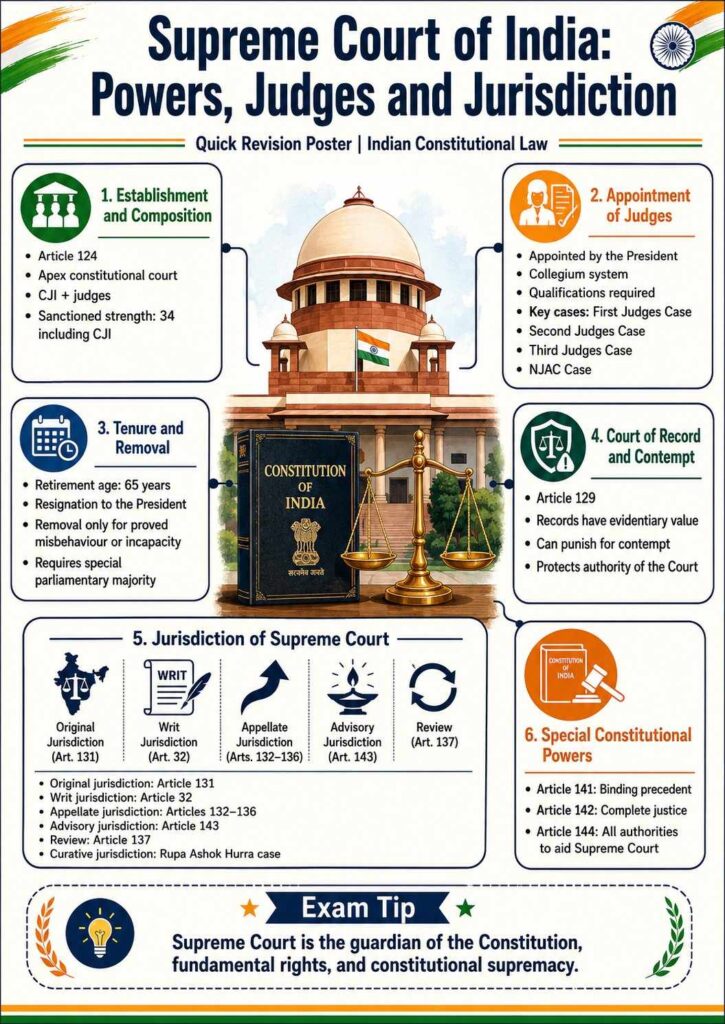
➤ Apex Court: The Supreme Court of India is the highest constitutional court and final court of appeal in India. It is the guardian of the Constitution, protector of fundamental rights, final interpreter of constitutional law, and the highest appellate authority in civil, criminal, constitutional and other legal matters.
➤ Constitutional Position: The Supreme Court is established under Part V, Chapter IV of the Constitution of India, covering Articles 124 to 147. Its authority is not merely statutory but constitutional, which means its basic existence and essential powers flow directly from the Constitution.
➤ Core Function: The Supreme Court performs three major roles: it decides disputes, protects fundamental rights, and maintains the supremacy of the Constitution. It acts as a check on legislative and executive action through judicial review.
➤ Binding Nature: Under Article 141, the law declared by the Supreme Court is binding on all courts within India. This makes the Supreme Court not only a dispute-settling court but also a law-declaring institution for the entire country.
Establishment of the Supreme Court of India
➤ Article 124 Foundation: Article 124(1) provides that “there shall be a Supreme Court of India” consisting of the Chief Justice of India and such number of other judges as Parliament may by law prescribe. Originally, the Constitution provided for the Chief Justice of India and not more than seven other judges, unless Parliament increased the number by law.
➤ Commencement: The Supreme Court of India came into existence on 28 January 1950, shortly after the Constitution of India came into force on 26 January 1950. It replaced the Federal Court of India and also took over the appellate jurisdiction earlier exercised by the Judicial Committee of the Privy Council in certain matters.
➤ Seat of Supreme Court: Under Article 130, the Supreme Court sits in Delhi, but the Chief Justice of India may, with the approval of the President, appoint another place as the seat of the Court. In practice, the principal seat remains New Delhi.
➤ Historical Importance: Before independence, the Federal Court was created under the Government of India Act, 1935. However, the Supreme Court under the Constitution is much wider in jurisdiction because it combines constitutional, federal, appellate, advisory, writ, review and special leave jurisdiction.
Composition and Strength of the Supreme Court
➤ Constitutional Composition: The Supreme Court consists of the Chief Justice of India and other judges. The exact number of judges is not fixed permanently in the Constitution; Parliament can increase it by law under Article 124(1).
➤ Sanctioned Strength: The Supreme Court’s sanctioned strength was last increased by the Supreme Court (Number of Judges) Amendment Act, 2019 to 34 judges including the Chief Justice of India. In May 2026, the Union Cabinet approved a proposal to introduce the Supreme Court (Number of Judges) Amendment Bill, 2026 to increase the number of judges from 33 to 37 excluding the CJI, meaning a total strength of 38 including the CJI, but cabinet approval and statutory enactment must be distinguished.
➤ Benches: The Supreme Court works through smaller benches, generally of two or three judges. Constitutional matters involving a substantial question of law as to interpretation of the Constitution are heard by a bench of at least five judges under Article 145(3).
➤ Constitution Benches: Larger benches of five, seven, nine, eleven or thirteen judges are constituted for important constitutional issues, reconsideration of earlier precedents, and questions of national importance.
Appointment of Judges of the Supreme Court
➤ Constitutional Provision: Under Article 124(2), every judge of the Supreme Court is appointed by the President of India by warrant under his hand and seal after consultation with such judges of the Supreme Court and High Courts as the President may deem necessary. For appointment of a judge other than the CJI, consultation with the Chief Justice of India is mandatory.
➤ Qualifications: A person must be a citizen of India and must satisfy one of the following qualifications: at least five years as a judge of a High Court or two or more High Courts in succession; at least ten years as an advocate of a High Court or two or more High Courts in succession; or, in the opinion of the President, be a distinguished jurist.
➤ Collegium System: Although the Constitution uses the word “consultation,” judicial interpretation has developed the collegium system, where the judiciary has primacy in appointments. For appointment of Supreme Court judges, the collegium generally consists of the Chief Justice of India and four senior-most judges of the Supreme Court.
➤ First Judges Case — S.P. Gupta v. Union of India, 1981 Supp SCC 87: The issue was whether executive opinion or judicial opinion had primacy in judicial appointments and transfers. The Court held that “consultation” did not mean “concurrence,” giving primacy to the executive. This case is historically important but was later overruled on the point of executive primacy.
➤ Second Judges Case — Supreme Court Advocates-on-Record Association v. Union of India, (1993) 4 SCC 441: The issue was the meaning of “consultation” under Articles 124 and 217. The Court overruled the First Judges Case and held that the opinion of the CJI, formed collectively with senior judges, has primacy in judicial appointments. This judgment created the collegium system and linked judicial appointments to judicial independence.
➤ Third Judges Case — In re Special Reference No. 1 of 1998, AIR 1999 SC 1: The President referred questions regarding the appointment and transfer of judges. The Supreme Court clarified that the CJI must consult a collegium of the four senior-most Supreme Court judges for Supreme Court appointments, and that if two judges in the collegium give strong adverse opinions, the recommendation should not be made.
➤ NJAC Case — Supreme Court Advocates-on-Record Association v. Union of India, (2016) 5 SCC 1: The issue was the constitutional validity of the 99th Constitutional Amendment and the National Judicial Appointments Commission Act, 2014. The Supreme Court struck down the NJAC framework as violative of the basic structure, holding that judicial independence is part of the basic structure of the Constitution.
Tenure and Conditions of Office
➤ Retirement Age: A Supreme Court judge holds office until the age of 65 years, unless he resigns earlier or is removed according to the constitutional procedure.
➤ Resignation: A judge may resign by writing under his hand addressed to the President of India.
➤ Post-Retirement Restriction: Under Article 124(7), a person who has held office as a judge of the Supreme Court cannot plead or act in any court or before any authority within the territory of India. This protects the dignity and independence of the office.
➤ Salary and Service Conditions: Salaries, allowances, leave and pension of Supreme Court judges are determined by law. These service conditions cannot be varied to their disadvantage after appointment, except during a financial emergency.
Removal of Supreme Court Judges
➤ Grounds of Removal: A judge of the Supreme Court can be removed only on the ground of proved misbehaviour or incapacity under Article 124(4).
➤ Special Majority: Removal requires an address by each House of Parliament, supported by a majority of the total membership of that House and by a majority of not less than two-thirds of the members present and voting. The address must be presented to the President in the same session.
➤ Judicial Independence: The difficult removal process protects judges from political pressure. A judge cannot be removed merely because the government disagrees with his judgments.
➤ Judges Inquiry Mechanism: Parliament may regulate the procedure for investigation and proof of misbehaviour or incapacity under Article 124(5). This is implemented through the Judges Inquiry Act, 1968.
➤ Key Understanding: The process is often loosely called “impeachment,” but technically the Constitution uses the language of removal by Presidential order after parliamentary address.
Supreme Court as a Court of Record
➤ Article 129: The Supreme Court is a court of record and has all powers of such a court, including the power to punish for contempt of itself.
➤ Meaning of Court of Record: A court of record has two main features: its records and judgments have evidentiary value and are preserved as authoritative records; and it has inherent power to punish contempt.
➤ Article 141 Connection: Since the law declared by the Supreme Court is binding on all courts in India, its judgments are not merely decisions between parties but authoritative statements of law.
Contempt Power of the Supreme Court
➤ Constitutional Power: The contempt power flows from Article 129. The Court also has supportive powers under Article 142, which enables it to pass orders necessary for complete justice.
➤ Purpose: Contempt jurisdiction protects the authority of the Court, ensures obedience to judicial orders, and maintains public confidence in the administration of justice.
➤ Civil Contempt: Civil contempt generally involves wilful disobedience of a judgment, decree, direction, order, writ or undertaking given to a court.
➤ Criminal Contempt: Criminal contempt generally involves acts that scandalise the court, lower its authority, prejudice judicial proceedings, or interfere with administration of justice.
➤ Supreme Court Bar Association v. Union of India, (1998) 4 SCC 409: The issue was whether the Supreme Court, while exercising contempt jurisdiction, could suspend an advocate’s licence to practise. The Court held that contempt power is constitutional, but punishment must be within legally recognised limits; disciplinary control over advocates belongs to the Bar Council under the Advocates Act. This case is important because it explains that contempt power is strong but not unlimited.
➤ Pallav Sheth v. Custodian, (2001) 7 SCC 549: The Court clarified the limitation principles under the Contempt of Courts Act, 1971, and held that contempt proceedings must be initiated within the statutory framework, while also recognising the constitutional nature of contempt jurisdiction.
Original Jurisdiction of the Supreme Court
➤ Article 131: The Supreme Court has exclusive original jurisdiction in disputes between the Government of India and one or more States, between the Government of India and any State or States on one side and one or more States on the other, or between two or more States, where the dispute involves a question of law or fact on which the existence or extent of a legal right depends. The Supreme Court’s official description also states that its original, appellate and advisory jurisdiction includes such federal disputes.
➤ Exclusive Nature: In Article 131 matters, no other court can try the dispute. This makes the Supreme Court the federal umpire between Union and States.
➤ Legal Right Requirement: Mere political disagreement is not enough. The dispute must involve a legal right.
➤ State of Karnataka v. Union of India, (1977) 4 SCC 608: The issue was whether a State could sue the Union under Article 131 in relation to Union inquiries against State ministers. The Court held that Article 131 is wide enough to cover legal disputes between Union and State, provided a legal right is involved.
Writ Jurisdiction of the Supreme Court
➤ Article 32: Article 32 gives the right to move the Supreme Court for enforcement of fundamental rights. The Court may issue directions, orders or writs, including habeas corpus, mandamus, prohibition, quo warranto and certiorari.
➤ Heart of Fundamental Rights: Article 32 is itself a fundamental right. It is a direct constitutional remedy when a fundamental right is violated.
➤ Scope: Article 32 is narrower than Article 226 because Article 32 is limited to enforcement of fundamental rights, whereas High Courts under Article 226 may issue writs for fundamental rights as well as “any other purpose.”
➤ Writs Explained:
• Habeas Corpus: Protects personal liberty by requiring production of a detained person before the Court.
• Mandamus: Commands a public authority to perform a legal duty.
• Certiorari: Quashes orders of inferior courts or tribunals acting without jurisdiction or in violation of natural justice.
• Prohibition: Prevents inferior courts or tribunals from exceeding jurisdiction.
• Quo Warranto: Questions the legal authority of a person holding a public office.
➤ A.K. Gopalan v. State of Madras, AIR 1950 SC 27: The issue was preventive detention and personal liberty under Article 21. The early approach of the Court was narrow, treating fundamental rights as separate compartments.
➤ Maneka Gandhi v. Union of India, (1978) 1 SCC 248: The issue was whether impounding of passport without fair procedure violated Article 21. The Court expanded Article 21 and held that procedure must be just, fair and reasonable. This case transformed writ jurisdiction by making Article 21 a broad guarantee of fairness.
➤ Kesavananda Bharati v. State of Kerala, (1973) 4 SCC 225: The issue was whether Parliament’s power to amend the Constitution was unlimited. A thirteen-judge bench held that Parliament may amend the Constitution but cannot destroy its basic structure. Judicial review and constitutional supremacy became protected constitutional principles.
Appellate Jurisdiction of the Supreme Court
➤ Constitutional Appeals: The Supreme Court hears appeals in constitutional, civil and criminal matters under Articles 132 to 136.
➤ Article 132: An appeal lies to the Supreme Court from any judgment, decree or final order of a High Court if the case involves a substantial question of law as to interpretation of the Constitution.
➤ Article 133: Civil appeals may lie to the Supreme Court where the case involves substantial questions of law of general importance and the High Court certifies that the question needs to be decided by the Supreme Court.
➤ Article 134: Criminal appeals may lie in serious criminal cases, such as where the High Court reverses acquittal and sentences the accused to death, or withdraws a case from a subordinate court and sentences the accused to death, or certifies the case as fit for appeal.
➤ Article 134A: The High Court may grant a certificate for appeal to the Supreme Court under Articles 132, 133 or 134.
➤ Article 136 — Special Leave Petition: Article 136 gives the Supreme Court discretionary power to grant special leave to appeal from any judgment, decree, determination, sentence or order in any cause or matter passed by any court or tribunal in India, except courts or tribunals relating to the Armed Forces.
➤ Discretionary Nature: Article 136 is not a regular right of appeal. It is an extraordinary discretionary jurisdiction used where there is grave injustice, substantial question of law, perversity, violation of natural justice, or serious miscarriage of justice.
➤ Pritam Singh v. State, AIR 1950 SC 169: The Court held that special leave jurisdiction should be used sparingly and in exceptional cases.
➤ Kunhayammed v. State of Kerala, (2000) 6 SCC 359: The Court explained the doctrine of merger in the context of SLPs. If special leave is refused without a speaking order, the lower court decision does not merge into the Supreme Court order; but once leave is granted and appeal is decided, merger applies.
Advisory Jurisdiction of the Supreme Court
➤ Article 143: The President may refer to the Supreme Court any question of law or fact of public importance on which the President considers it expedient to obtain the Court’s opinion.
➤ Nature of Opinion: Advisory opinion is not exactly the same as a judgment in a regular dispute between parties. However, it carries high constitutional value and is generally respected.
➤ Article 143(1): The President may refer questions of law or fact of public importance.
➤ Article 143(2): The President may refer disputes arising out of pre-Constitution treaties, agreements, covenants or similar instruments, where Article 131 may not apply because of its proviso.
➤ In re Kerala Education Bill, 1957, AIR 1958 SC 956: The President referred questions regarding the constitutional validity of provisions of the Kerala Education Bill. The Supreme Court gave an advisory opinion explaining minority educational rights under Article 30. This case is important for understanding how advisory jurisdiction helps prevent constitutional conflict.
➤ In re Berubari Union, AIR 1960 SC 845: The issue was whether Indian territory could be transferred to Pakistan by executive action or required constitutional amendment. The Supreme Court advised that cession of territory required constitutional amendment. This opinion shaped constitutional law on territory and sovereignty.
➤ Special Reference No. 1 of 1998, AIR 1999 SC 1: This advisory reference clarified the collegium system and judicial appointments, showing that Article 143 can be used for important constitutional institutional questions.
Review Jurisdiction of the Supreme Court
➤ Article 137: The Supreme Court has power to review any judgment pronounced or order made by it, subject to laws made by Parliament and rules made under Article 145.
➤ Purpose: Review jurisdiction allows correction of serious errors, mistakes apparent on the face of the record, or miscarriage of justice.
➤ Limited Scope: Review is not an appeal in disguise. A party cannot use review merely because it is dissatisfied with the outcome.
➤ Mohd. Arif v. Registrar, Supreme Court of India, (2014) 9 SCC 737: The issue was whether death sentence review petitions should be heard in open court. The Court held that in death penalty cases, review petitions must be heard in open court by a bench of three judges, recognising the irreversible nature of death sentence and the importance of procedural fairness.
Curative Jurisdiction of the Supreme Court
➤ Meaning: Curative petition is a judicially created remedy available after dismissal of a review petition. It is meant to prevent gross miscarriage of justice and abuse of process.
➤ Source: Curative jurisdiction is not expressly written in the Constitution. It was evolved by the Supreme Court under its inherent powers and constitutional duty to do justice.
➤ Rupa Ashok Hurra v. Ashok Hurra, (2002) 4 SCC 388: The issue was whether a final judgment of the Supreme Court could be reconsidered after dismissal of review. A five-judge Constitution Bench held that in rare cases, to prevent abuse of process and cure gross miscarriage of justice, the Court may entertain a curative petition. Grounds include violation of principles of natural justice, reasonable apprehension of bias, or other exceptional circumstances.
➤ Strict Conditions: A curative petition must generally be accompanied by certification by a senior advocate, and it is first circulated to the three senior-most judges and the judges who passed the impugned judgment, if available.
➤ Union Carbide Curative Proceedings: In the Bhopal gas tragedy curative proceedings, the Supreme Court reaffirmed that curative jurisdiction is extremely narrow and cannot be treated as a routine second review.
Other Important Powers and Jurisdiction
➤ Article 142 — Complete Justice: The Supreme Court may pass such decree or order as is necessary for doing complete justice in any cause or matter pending before it. This is a unique constitutional power enabling the Court to mould relief according to justice.
➤ Article 139A — Transfer of Cases: The Supreme Court may transfer cases involving the same or substantially same questions of law from High Courts to itself or transfer cases from one High Court to another.
➤ Article 144 — Duty to Aid Supreme Court: All civil and judicial authorities in India must act in aid of the Supreme Court.
➤ Article 145 — Rule-Making Power: The Supreme Court may make rules for regulating its practice and procedure, subject to law made by Parliament and with Presidential approval.
Memory Table: Key Articles on Supreme Court of India
| Article | Subject | Core Idea |
|---|---|---|
| Article 124 | Establishment, composition, appointment, tenure, removal | Creates Supreme Court and governs judges |
| Article 129 | Court of record | Includes contempt power |
| Article 131 | Original jurisdiction | Federal disputes involving legal rights |
| Article 132 | Constitutional appeals | Substantial constitutional questions |
| Article 133 | Civil appeals | Civil matters of general legal importance |
| Article 134 | Criminal appeals | Serious criminal appellate matters |
| Article 136 | Special leave | Extraordinary discretionary appeal power |
| Article 137 | Review | Review of Supreme Court judgments/orders |
| Article 141 | Binding precedent | Law declared by Supreme Court binds all courts |
| Article 142 | Complete justice | Broad remedial power |
| Article 143 | Advisory jurisdiction | President may seek opinion |
| Article 144 | Authorities to aid Supreme Court | Binding institutional duty |
| Article 145 | Rules of Court | Procedure-making power |
Conclusion
➤ Constitutional Guardian: The Supreme Court of India is not merely the highest appellate court; it is the constitutional guardian of liberty, federalism, judicial review and rule of law.
➤ Institutional Balance: Its powers under Articles 32, 131, 136, 137, 141, 142 and 143 make it a unique institution combining the roles of constitutional court, federal court, appellate court, rights court and advisory body.
➤ Judicial Independence: Appointment, tenure, removal protection, contempt power, court of record status and binding precedent together preserve the dignity and independence of the Supreme Court.
➤ Practical Importance: For understanding Indian Constitutional Law, the Supreme Court must be studied as both an institution and a constitutional mechanism through which fundamental rights, federal balance, separation of powers and constitutional supremacy are practically enforced.