
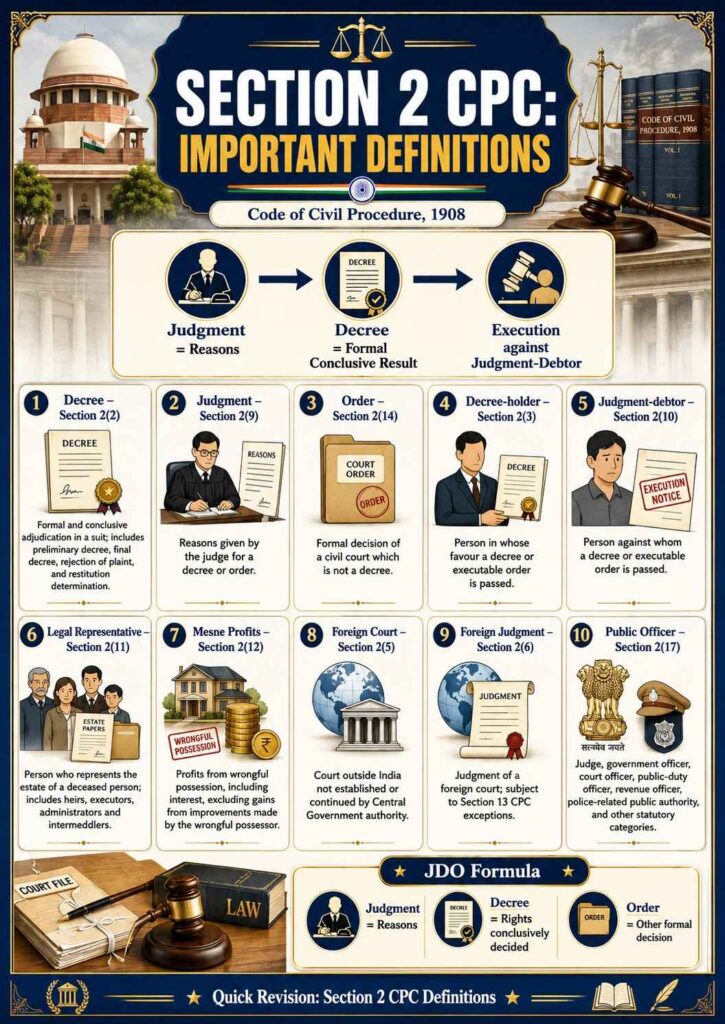
Core Purpose of Section 2 CPC Definitions
• Interpretive role — Section 2 supplies the technical meanings of important expressions used throughout the CPC. These meanings ordinarily control wherever the expressions occur, unless the subject or context requires a different interpretation.
• Practical importance — The definitions decide major procedural questions: whether an appeal lies, whether execution can be initiated, who may continue proceedings after death of a party, whether compensation for wrongful possession can be claimed, and whether a foreign decision can be recognised or executed in India.
• Memory key —
Judgment = reasons
Decree = conclusive formal result in a suit
Order = formal decision which is not a decree
Decree-holder = person entitled to execute
Judgment-debtor = person liable under an executable decree or order
The statutory definitions of these expressions are contained in Section 2 CPC.
| Expression | Provision | Quick Meaning |
|---|---|---|
| Decree | Section 2(2) | Formal and conclusive adjudication in a suit |
| Decree-holder | Section 2(3) | Person in whose favour decree or executable order is made |
| Foreign Court | Section 2(5) | Court outside India not established or continued by Central Government |
| Foreign Judgment | Section 2(6) | Judgment of a foreign court |
| Judgment | Section 2(9) | Statement of reasons for a decree or order |
| Judgment-debtor | Section 2(10) | Person against whom decree or executable order is made |
| Legal representative | Section 2(11) | Person legally representing estate of deceased person |
| Mesne profits | Section 2(12) | Profits from wrongful possession, including interest |
| Order | Section 2(14) | Formal expression of a civil court decision which is not a decree |
| Public officer | Section 2(17) | Person falling within statutory categories of public authority |
Decree under Section 2(2) CPC
Meaning and Essential Ingredients of a Decree
• Formal expression — A decree is not merely the court’s oral conclusion or a finding recorded in a judgment. It is the formal expression of the court’s adjudication. Order XX Rule 6 requires the decree to agree with the judgment and clearly specify the relief granted or other determination in the suit.
• Adjudication — There must be a judicial determination by a competent civil court. A ministerial, administrative, or purely procedural act does not become a decree merely because it affects a party.
• Suit requirement — The adjudication must arise in a suit. Therefore, every decision in every proceeding is not automatically a decree.
• Rights of parties — The adjudication must determine the rights of parties concerning all or any matter in controversy in the suit. It must concern substantive rights rather than merely regulate procedure.
• Conclusive determination — The decision must be conclusive so far as the court passing it is concerned. It need not end the entire litigation; it may conclusively decide one stage or one part of the controversy.
• Illustration — In a suit for possession, a determination that the plaintiff is owner and entitled to recover possession conclusively decides rights. When formally drawn up, it is a decree.
Preliminary, Final and Partly Preliminary Decrees
• Preliminary decree — A decree is preliminary when further proceedings remain necessary before the suit can be completely disposed of. It conclusively determines rights at that stage but leaves further work, such as accounts, division by metes and bounds, or calculation of amounts.
• Final decree — A decree is final when it completely disposes of the suit and leaves nothing further for judicial determination by the trial court.
• Partly preliminary and partly final decree — A decree may finally decide one matter while leaving another matter for further inquiry. For example, in a mortgage suit, liability may be determined finally while the amount payable or enforcement consequences may require further proceedings.
• Partition illustration — In a partition suit, the preliminary decree declares each co-owner’s share. The final decree actually divides the property by metes and bounds or specifies the separate allotments.
• Case law – Venkata Reddy v. Pethi Reddy, AIR 1963 SC 992 — The dispute concerned the legal character of a preliminary decree and whether it was merely tentative because a final decree remained to be passed. The Supreme Court held that a preliminary decree in a partition or mortgage suit is conclusive regarding the matters decided by it, even though it may not itself be executable. The ratio is that finality does not depend upon immediate executability; a party dissatisfied with a preliminary decree must challenge it at the appropriate stage rather than wait for the final decree.
• Case law – Shankar Balwant Lokhande (Dead) through LRs v. Chandrakant Shankar Lokhande, (1995) 3 SCC 413; AIR 1995 SC 1211 — In a partition-related dispute, the Court considered the position of a final decree and the procedural steps necessary before it becomes enforceable. The Supreme Court explained that a partition suit continues until the final decree is passed; where the final decree requires engrossment on proper stamp paper, enforceability arises only after the decree is duly prepared, signed and sealed in accordance with law. The ratio is that the preliminary decree declares rights, whereas the properly drawn final decree gives executable form to the ultimate division.
Matters Included and Excluded from a Decree
• Deemed decree — Section 2(2) expressly treats the following as decrees even though they may not fit the ordinary meaning:
- rejection of a plaint; and
- determination of a question under Section 144 CPC, dealing with restitution.
• Rejection of plaint — An order rejecting a plaint, including under Order VII Rule 11 CPC, is treated as a decree because it conclusively terminates the suit at that stage. The remedy is ordinarily an appeal as against a decree.
• Restitution — When a decree is reversed or varied, Section 144 enables the court to restore parties to the position they would have occupied but for the earlier decree. A determination under Section 144 is deemed to be a decree.
• Excluded adjudications — The following are not decrees:
- an adjudication from which an appeal lies as an appeal from an order; and
- an order dismissing a suit for default.
• Dismissal for default — When a suit is dismissed because the plaintiff does not appear, there is no adjudication on merits. Therefore, it is not a decree. The appropriate remedy may be restoration under Order IX CPC, subject to the applicable requirements.
• Historical amendment — Before the 1976 amendment, the definition also referred to determinations under Section 47 CPC. The Code of Civil Procedure (Amendment) Act, 1976 omitted that reference. Consequently, a Section 47 determination is generally treated as an order rather than a deemed decree, though it remains subject to the CPC’s separate appeal provisions.
Decree and Execution
• Execution principle — A decree is the enforceable command of the court. The executing court must ordinarily execute it as it stands and cannot reopen the merits of the original dispute.
• Case law – Topanmal Chhotamal v. Kundomal Gangaram, AIR 1960 SC 388 — A decree against a partnership firm was sought to be executed in a manner that raised issues concerning the liability of persons connected with the firm. The Supreme Court held that an executing court cannot go behind the decree: it must take the decree as binding and conclusive between the parties, though it may interpret an ambiguity to give proper effect to it. The ratio protects the distinction between adjudication of rights in the suit and enforcement of those adjudicated rights in execution.
Decree-holder under Section 2(3) CPC
• Meaning — A decree-holder is any person in whose favour a decree has been passed or an order capable of execution has been made.
• Not limited to plaintiff — Usually, the successful plaintiff is the decree-holder. However, a defendant may also become a decree-holder where costs, a counterclaim, a set-off, restitution, or another executable relief is granted in that defendant’s favour.
• Executable order — The definition includes a person in whose favour an executable order has been made. Therefore, the expression is wider than a person holding only a decree.
• Joint decree-holders — Where a decree is jointly passed in favour of several persons, one or more may apply for execution for the benefit of all, unless the decree itself provides otherwise.
• Transferee of decree — A transferee by written assignment or operation of law may apply for execution under Order XXI Rule 16 CPC. The transferee executes subject to the equities which the judgment-debtor could have asserted against the original decree-holder.
• Illustration — A obtains a money decree against B. A is the decree-holder and B is the judgment-debtor. If A assigns the decree validly to C, C may seek execution under Order XXI Rule 16.
Judgment under Section 2(9) CPC
Meaning and Function of a Judgment
• Reasoned foundation — A judgment is the statement given by the judge of the grounds for a decree or order. It explains the court’s reasoning: what the dispute was, what issues arose, what the court decided, and why it reached that decision.
• Sequence — The ordinary sequence is: hearing of the case → judgment → drawing up of decree. Section 33 CPC provides that after hearing the case, the court shall pronounce judgment and a decree shall follow on that judgment.
• Order XX Rule 4 — A judgment of courts other than Courts of Small Causes must contain:
- a concise statement of the case;
- points for determination;
- decision on those points; and
- reasons for the decision.
• Difference from decree — A judgment contains the reasons; a decree formally records the conclusive adjudication and relief. A judgment may result in either a decree or an order.
• Case law – Balraj Taneja v. Sunil Madan, (1999) 8 SCC 396; AIR 1999 SC 3381 — In a suit for specific performance, the defendant failed to file a written statement, and the question was whether the court could mechanically decree the suit under Order VIII Rule 10 CPC. The Supreme Court held that even where a defendant defaults, the court must apply its mind to the pleadings and material before it. The ratio is that a judgment must satisfy Section 2(9) and Order XX Rule 4: it cannot be a mechanical declaration unsupported by reasons, findings, and judicial consideration of the plaintiff’s entitlement.
Order under Section 2(14) CPC
• Meaning — An order is the formal expression of any decision of a civil court which is not a decree.
• Residual category — Every formal civil court decision is either a decree or an order. Where the decision does not satisfy the statutory requirements of a decree, it is ordinarily an order.
• Interlocutory nature — Many orders are interim or procedural, such as orders granting or refusing temporary injunction, appointing a receiver, granting adjournment, directing discovery, or deciding an application during the suit.
• Executable order — Some orders are capable of execution, for example an order directing payment of money, delivery of property, or compliance with an injunction. Section 36 CPC applies provisions relating to execution of decrees, as far as applicable, to execution of orders.
• Appeal distinction — Every original decree is generally appealable under Section 96 CPC, subject to statutory exceptions. In contrast, an appeal from an order lies only where the CPC or another law expressly permits it, principally under Section 104 and Order XLIII Rule 1 CPC.
| Basis | Judgment | Decree | Order |
|---|---|---|---|
| Main function | Gives reasons | Formally records conclusive adjudication in a suit | Formally records a decision not amounting to decree |
| Nature | Explanatory | Conclusive | May be interim or final |
| Appeal | Usually challenged through appeal from decree/order | Generally appealable under Section 96 | Appeal only if expressly permitted |
| Execution | Not independently executed | Normally executable | Executable only when capable of execution |
Judgment-debtor under Section 2(10) CPC
• Meaning — A judgment-debtor is any person against whom a decree has been passed or an order capable of execution has been made.
• Execution focus — The term becomes important at the execution stage. The judgment-debtor is the person legally bound to satisfy the decree or executable order.
• Not always defendant — Although usually the defendant is the judgment-debtor, a plaintiff may become judgment-debtor where the plaintiff is directed to pay costs, make restitution, or comply with an executable direction.
• Legal representative liability — If a judgment-debtor dies before complete satisfaction of the decree, execution may proceed against the legal representative. However, liability is limited to the extent of the deceased’s property that came into the legal representative’s hands and was not duly disposed of.
Legal Representative under Section 2(11) CPC
Meaning and Scope
• Estate representation — A legal representative is a person who in law represents the estate of a deceased person.
• Inclusive definition — The definition is deliberately broad. It includes:
- legal heirs;
- executors;
- administrators;
- persons who have possession or control of the estate;
- persons who intermeddle with the estate; and
- in representative litigation, the person on whom the estate devolves after death of the party suing or sued in that representative capacity.
• Intermeddler — An intermeddler is a person who, without lawful authority, deals with or takes control of the deceased person’s estate in a manner suggesting assumption of its management. Such a person can be treated as legal representative to protect the estate and persons dealing with it.
• Not identical with heir — A legal representative need not always be the ultimate heir entitled to inherit. The central question is whether that person represents the estate for the purpose of the proceeding.
• Case law – Custodian of Branches of Banco National Ultramarino v. Nalini Bai Naique, 1989 Supp (2) SCC 275; AIR 1989 SC 1589 — The case arose from a dispute about abatement after the death of a party and the proper person to represent the deceased estate. The Supreme Court held that Section 2(11) is inclusive and wide; it is not confined to legal heirs alone. A person who may not inherit the estate can nevertheless be a legal representative where that person represents, administers, or possesses the estate. The ratio is that procedural representation of the estate, rather than strict succession title alone, controls the application of Section 2(11).
Legal Representative under Order XXII CPC
• Substitution — Where a party dies and the right to sue survives, the court must bring the legal representative on record under Order XXII CPC.
• Summary inquiry — Order XXII Rule 5 requires the court to determine who is or is not the legal representative when a dispute arises. This inquiry is made for continuation of the proceeding; it does not ordinarily finally decide disputed succession rights or title to the estate.
• Case law – Jaladi Suguna (Deceased) through LRs v. Satya Sai Central Trust, (2008) 8 SCC 521 — The dispute involved the procedure for bringing persons on record after the death of a litigant. The Supreme Court held that merely filing an application for substitution does not automatically bring a person on record; the court must decide the application and determine whether the proposed person should represent the estate. The ratio is that substitution under Order XXII is a judicial act based on a summary determination, not an automatic consequence of a claim of heirship.
• Execution limitation — Under Section 50 CPC, the estate of the deceased judgment-debtor can be proceeded against, but the legal representative is not personally liable beyond the property of the deceased that actually came into his or her hands.
Mesne Profits under Section 2(12) CPC
Meaning and Elements
• Wrongful possession — Mesne profits are profits which a person in wrongful possession of property actually received or could, with ordinary diligence, have received.
• Compensatory object — Mesne profits compensate the person lawfully entitled to possession for the benefits wrongfully enjoyed by another person. They are not a punishment and are generally in the nature of damages for deprivation of use and income.
• Essential formula —
Mesne profits = actual profits received + profits reasonably obtainable with ordinary diligence + interest − profits due to improvements made by wrongful possessor
• Interest — Interest on mesne profits forms part of the statutory definition.
• Exclusion of improvements — Profits attributable to improvements made by the person in wrongful possession are excluded. The owner can recover the benefit naturally arising from the property, but not the additional gain exclusively created through the trespasser’s own improvements.
• Distinction from rent — Rent arises from lawful possession under a contract, lease, tenancy, or other legal arrangement. Mesne profits arise after possession becomes wrongful, for example after lawful tenancy has ended and the occupant continues in possession without authority.
• Assessment — The court may consider market rent, actual income, comparable rentals, nature of property, location, evidence of earnings, and the profits that ordinary diligence could have produced. No rigid universal formula applies.
• Case law – Lucy Kochuvareed v. P. Mariappa Gounder, (1979) 3 SCC 150; AIR 1979 SC 1214 — In execution proceedings connected with a specific performance dispute concerning a factory property, the parties contested the rate and period of mesne profits. The Supreme Court treated mesne profits as compensatory damages and upheld an assessment based on reliable evidence of the property’s real rental value where more precise evidence of actual profits was unavailable. The ratio is that wrongful possession is the foundation of mesne profits and their assessment must be moulded according to the justice of the case, not through an inflexible formula.
Mesne Profits under Order XX Rule 12 CPC
• Possession suit — In a suit for recovery of possession of immovable property, the court may pass a decree for possession and may also grant mesne profits or direct an inquiry into them.
• Future mesne profits — The court may direct an inquiry from institution of the suit until the earliest of:
- delivery of possession to the decree-holder;
- relinquishment of possession by the judgment-debtor with notice through court; or
- expiry of three years from the date of decree.
• Final decree after inquiry — Where the court directs an inquiry into rent or mesne profits, a final decree is passed according to the result of that inquiry.
Foreign Court under Section 2(5) CPC
• Meaning — A foreign court is a court situated outside India that is not established or continued by the authority of the Central Government.
• Location and authority test — Two elements are important:
- the court must be situated outside India; and
- it must not be a court established or continued by Central Government authority.
• Practical relevance — The expression is important because Sections 13 and 14 CPC determine the conclusiveness of foreign judgments, while Section 44A provides a special execution mechanism for decrees of superior courts in notified reciprocating territories.
Foreign Judgment under Section 2(6) CPC
Meaning and Recognition
• Meaning — A foreign judgment means the judgment of a foreign court.
• Not automatically enforceable — Merely because a decision is a foreign judgment does not mean that it can automatically be recognised or executed in India. Its conclusiveness is governed principally by Sections 13 and 14 CPC.
• Section 13 rule — A foreign judgment is generally conclusive regarding a matter directly adjudicated between the same parties, or persons claiming under them under the same title, unless one of the statutory exceptions applies.
• Six exceptions — A foreign judgment is not conclusive where:
- the foreign court lacked competent jurisdiction;
- it was not given on merits;
- it is based on an incorrect view of international law or refuses to recognise applicable Indian law;
- the proceedings were opposed to natural justice;
- it was obtained by fraud; or
- it sustains a claim founded on breach of Indian law.
• Section 14 presumption — A certified copy of a foreign judgment raises a rebuttable presumption that the foreign court had competent jurisdiction. The presumption can be displaced by proving lack of jurisdiction.
• Memory aid – CMINFL test —
Competent jurisdiction
Merits
International law and applicable Indian law
Natural justice
Fraud
Law in force in India
Execution of Foreign Decrees under Section 44A CPC
• Reciprocating territory — A certified copy of a decree of a superior court in a notified reciprocating territory may be filed before an Indian District Court and executed as if passed by that District Court.
• Money decree requirement — For Section 44A, “decree” generally covers a money decree or judgment. It excludes taxes, similar charges, fines, penalties, and arbitration awards.
• Section 13 safeguard — Even in execution under Section 44A, the Indian District Court must refuse execution if the foreign decree falls within any Section 13 exception.
• Case law – Alcon Electronics Pvt. Ltd. v. Celem S.A. of FOS 34320 Roujan, France, (2017) 2 SCC 253 — An English court passed a reasoned order on jurisdiction and costs after both parties had participated by producing material and arguments. The judgment-debtor resisted execution in India, contending that the foreign order was interlocutory and not on merits. The Supreme Court held that a foreign decision is on merits when parties had a fair opportunity to present their case and the foreign court considered rival submissions before giving a reasoned decision. The ratio is that a reasoned foreign costs order from a notified superior court may be executable under Section 44A, unless it falls within Section 13 CPC.
• Case law – International Woollen Mills v. Standard Wool (U.K.) Ltd., (2001) 5 SCC 265; AIR 2001 SC 2134 — A foreign decree was sought to be enforced in India, raising the question whether an ex parte decree had been given on merits. The Supreme Court held that an ex parte decree is not automatically non-conclusive; it may be on merits where the foreign court considered evidence and applied its mind to the claim. However, a decree granted merely because of default, without judicial examination of the merits, is not enforceable under Section 13(b) CPC.
• Case law – Satya v. Teja Singh, (1975) 1 SCC 120 — A husband obtained a foreign divorce decree after asserting a foreign domicile, and the wife challenged its validity in India. The Supreme Court held that a foreign judgment procured by fraud, including fraud relating to jurisdictional facts such as domicile, is not conclusive under Section 13 CPC. The ratio is that Indian courts are not bound to recognise a foreign judgment where the foreign court’s jurisdiction was fraudulently invoked or where statutory requirements of conclusiveness are not met.
• Case law – Y. Narasimha Rao v. Y. Venkata Lakshmi, (1991) 3 SCC 451 — A foreign matrimonial decree was relied upon in India despite the wife not having effectively submitted to the foreign court’s jurisdiction. The Supreme Court held that recognition of foreign matrimonial judgments depends on jurisdictional competence, grounds recognised by Indian matrimonial law, fairness of procedure, and genuine opportunity to contest. The ratio is that a foreign divorce decree cannot defeat Indian matrimonial rights merely because it has been issued abroad.
Public Officer under Section 2(17) CPC
Meaning and Categories
• Broad functional definition — A public officer is a person falling within any one of the categories listed in Section 2(17). The definition is not confined to one government department or designation.
• Judicial category — Every judge is a public officer.
• All-India Service category — Every member of an All-India Service is a public officer.
• Armed forces category — Commissioned or gazetted officers serving in military, naval, or air forces under the Government are covered.
• Court officer category — Officers of courts of justice performing judicial or quasi-judicial functions are covered. This includes persons whose duties involve investigation or report on legal or factual matters, authentication or custody of documents, execution of judicial process, administration of oaths, interpretation, maintenance of order, or other duties specially authorised by a court.
• Confinement category — Any person holding an office by virtue of which that person can place or keep another person in confinement is included.
• Public protection category — Government officers whose duties include prevention of offences, giving information about offences, bringing offenders to justice, or protecting public health, safety, or convenience are public officers.
• Government property and revenue category — Officers responsible for government property, government revenue, pecuniary interests of Government, surveys, assessments, contracts, revenue process, or protection of Government’s financial interests fall within the definition.
• General public-duty category — Every person in Government service or pay, or remunerated by fees or commission for performance of public duty, is included.
The statutory categories of public officer are extensive and are set out in Section 2(17)(a)–(h) CPC.
Procedural Relevance of Public Officer
• Official-capacity suits — The expression is particularly important in suits against Government or public officers for acts purporting to be done in official capacity.
• Section 80 notice — Subject to the urgent-relief exception under Section 80(2), a suit against a public officer in respect of an official act generally requires prior written notice and a two-month waiting period.
• Urgent relief — Where urgent or immediate relief is sought, the court may permit institution without prior notice under Section 80(2), but ordinarily cannot grant relief without giving the Government or public officer a reasonable opportunity to show cause.
• Caution — A person should not be treated as a public officer simply because the person performs some public-facing activity. The person must fit within one or more statutory categories in Section 2(17), read with the context of the particular proceeding.
Rapid Revision Summary
• Decree — Formal, conclusive adjudication of rights in a suit; may be preliminary, final, or partly both.
• Judgment — Reasons given by the judge for a decree or order.
• Order — Formal civil court decision which is not a decree.
• Decree-holder — Person entitled to enforce a decree or executable order.
• Judgment-debtor — Person legally bound to satisfy a decree or executable order.
• Legal representative — Person representing the deceased’s estate; wider than legal heir.
• Mesne profits — Compensatory profits arising from wrongful possession, including interest but excluding gains due to the wrongdoer’s improvements.
• Foreign court — Court outside India not established or continued by Central Government authority.
• Foreign judgment — Judgment of a foreign court; conclusive only subject to Section 13 CPC.
• Public officer — Person falling within one of the statutory governmental, judicial, public-duty, or public-protection categories.