1.1 Meaning and Scope of Section 9 CPC
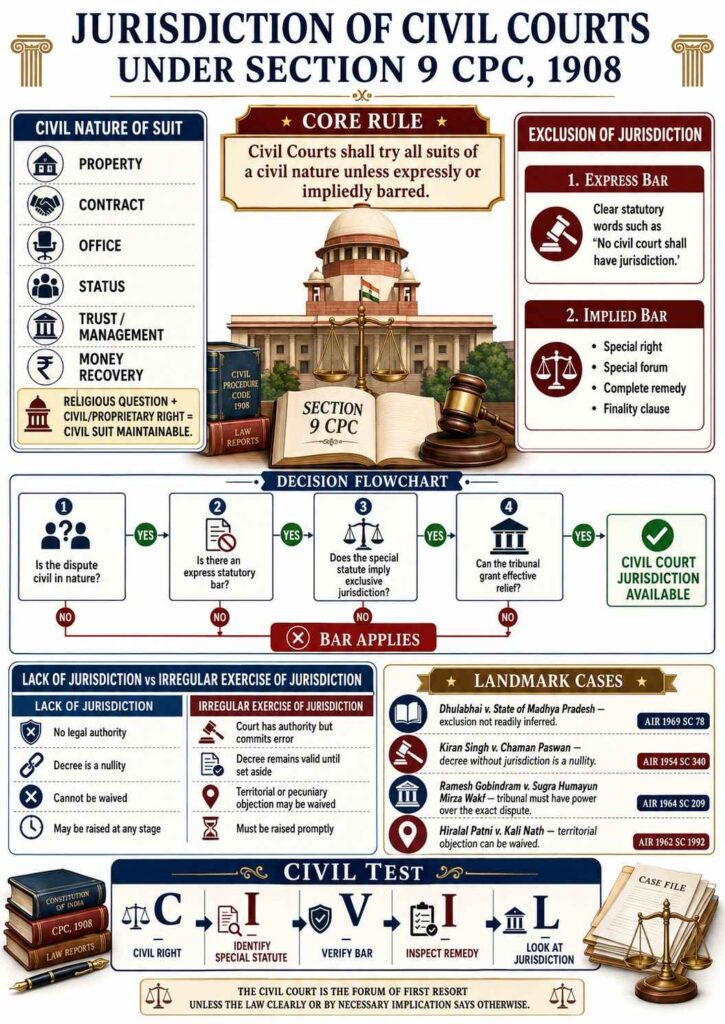
🔹 Basic Rule: Section 9 of the Code of Civil Procedure, 1908 creates a broad presumption in favour of civil courts. It provides that: “The Courts shall … have jurisdiction to try all suits of a civil nature excepting suits of which their cognizance is either expressly or impliedly barred.” Thus, a civil court can ordinarily entertain every suit involving a civil right unless a statute clearly or necessarily excludes its power.
🔹 Three Essential Conditions: For Section 9 to apply, there must be:
• a suit, ordinarily instituted by presentation of a plaint under Section 26 CPC;
• a dispute of a civil nature; and
• no express or implied statutory bar against the civil court’s jurisdiction.
🔹 Meaning of Jurisdiction: Jurisdiction means the legal authority of a court to receive, try and decide a matter. It includes authority over:
• the subject matter of the dispute;
• the territory or place where the dispute may be tried;
• the pecuniary value of the claim; and
• the parties or property involved.
🔹 Section 9 is Not the Only Requirement: Even where the suit is of a civil nature and is not barred, the court must also be competent under other CPC provisions. For example, Section 6 restricts a court from entertaining suits beyond its pecuniary limits; Section 15 requires filing in the court of the lowest grade competent to try it; and Section 16 generally requires suits concerning immovable property to be filed where the property is situated.
🔹 “Subject to the Provisions Herein Contained”: The opening words of Section 9 make the civil court’s jurisdiction subject to other provisions of the CPC. Therefore, even a civil suit may be affected by provisions such as Section 10 on stay of suit, Section 11 on res judicata, Section 15 on the proper court, and Sections 16–20 on place of suing.
1.2 Presumption in Favour of Civil Court Jurisdiction
🔹 General Presumption: Civil court jurisdiction is the rule; exclusion is the exception. A court should not readily assume that its jurisdiction has been taken away merely because a special tribunal, authority or departmental forum exists.
🔹 Burden of Proof: The party asserting that the civil court has no jurisdiction bears the burden of showing the statutory bar. The statute, its scheme, the remedies given and the powers of the special forum must be carefully examined.
🔹 Important Principle: A special statute may create a special authority, but creation of that authority alone does not automatically eliminate civil court jurisdiction. The intention to exclude must be clear from express words or must arise by necessary implication.
1.3 Civil Nature of Suit under Section 9 CPC
🔹 Core Test: A suit is of a civil nature when it concerns the determination, enforcement or protection of a private legal right, civil status, property right, office, management right, contractual right or other legally enforceable civil interest.
🔹 Substance Over Form: The court examines the real substance of the dispute and the principal relief claimed. A party cannot convert a non-civil dispute into a civil suit merely by clever drafting; similarly, a civil dispute does not lose its character merely because it has a religious, social or organisational background.
🔹 Examples of Civil Nature: The following ordinarily involve civil rights:
• ownership, possession, partition or inheritance of property;
• recovery of money, damages, rent or contractual dues;
• right to hold an office attached to property, institution or endowment;
• right to manage a trust, temple, church, mosque, society or institution where legal or proprietary rights are involved;
• civil status, such as legitimacy, marriage-related property rights or succession;
• right to salary, emoluments or benefits attached to an office.
🔹 Purely Religious Questions: A dispute involving only religious doctrine, ritual, ceremony, faith or spiritual belief may not by itself be civil. However, where the religious issue is connected with an enforceable right to property or office, the civil court may decide the necessary religious question incidentally.
🔹 Explanation I to Section 9: A suit concerning a right to property or office is of a civil nature even if the decision depends entirely upon questions relating to religious rites or ceremonies.
🔹 Explanation II to Section 9: It is immaterial whether the office has fees attached to it or whether it is attached to a particular place. These explanations make the expression “civil nature” intentionally broad. They were inserted by the 1976 amendment to the CPC with effect from 1 February 1977.
🔹 Illustration: A dispute between two groups over the management of a temple and the right to appoint its priest may be civil if it affects property, office, salary, management or legal control. In contrast, a mere disagreement over the preferred method of prayer, without any associated legal or proprietary right, may not independently create a civil suit.
Landmark Case: Civil Nature of Religious and Institutional Disputes
🔹 Most Rev. P.M.A. Metropolitan v. Moran Mar Marthoma, 1995 Supp (4) SCC 286: The dispute arose from the Malankara Church and involved questions of ecclesiastical authority, church administration and control of church-related rights and property. The issue was whether the civil court could entertain a matter having religious elements. The Supreme Court held that where civil, proprietary, administrative or office-related rights are involved, the civil court has jurisdiction even though resolution may require consideration of religious practices or church rules. The guiding principle is that the court does not decide theological correctness as such; it decides enforceable civil rights.
1.4 Express Bar of Civil Court Jurisdiction
🔹 Meaning: An express bar exists where a statute uses direct words excluding the jurisdiction of civil courts. Common expressions include:
• “No civil court shall have jurisdiction”;
• “The decision of the Tribunal shall be final”;
• “No suit shall lie”;
• “The matter shall be decided only by the designated authority.”
🔹 Strict Construction: Even an express bar must be interpreted carefully. The court must determine:
• what exact dispute is barred;
• which relief is barred;
• whether the special authority can grant the relief sought; and
• whether the suit challenges an action wholly outside the statute.
🔹 Finality Clause: A statutory clause stating that an authority’s order is “final” is relevant but not always conclusive. The court must still examine whether the statute intended to exclude civil remedies for the particular dispute.
Landmark Case: Revenue Forum and Express Statutory Bar
🔹 Hatti v. Sunder Singh, AIR 1971 SC 2320; (1971) 2 SCR 163: The dispute concerned a claim relating to bhumidhari rights under the Delhi Land Reforms Act. A civil suit was filed to question rights that the statute placed within the competence of revenue authorities. The Supreme Court considered whether the civil court could decide the matter despite the statutory revenue mechanism. It held that where the special statute specifically creates rights, identifies the competent revenue forum and provides the prescribed procedure, the civil court’s jurisdiction is excluded in respect of matters assigned to that forum. The case illustrates a true statutory bar where the special law provides an exclusive adjudicatory structure.
1.5 Implied Bar of Civil Court Jurisdiction
🔹 Meaning: An implied bar does not arise from direct exclusionary words. It arises where the scheme of the statute shows that the legislature intended the special forum to decide the matter exclusively.
🔹 Necessary Implication Test: A civil court’s jurisdiction is impliedly barred only when the special statute:
• creates a new right or liability unknown to ordinary law;
• establishes a special tribunal or authority to determine that right or liability;
• provides a complete procedure and remedy;
• gives finality to the decision of the special authority; and
• substantially provides the reliefs ordinarily available before a civil court.
🔹 Mere Alternative Remedy is Insufficient: The existence of an appeal, departmental remedy or tribunal does not automatically bar a civil suit. The statutory mechanism must indicate an intention to replace the civil court for that category of dispute.
🔹 Adequate Remedy: Where the special statute provides an effective remedy for correcting errors, the civil court will generally respect the statutory route. However, if the authority acts outside the statute, violates fundamental procedure or cannot grant the essential relief, civil jurisdiction may survive.
Landmark Case: The Seven Principles on Exclusion of Jurisdiction
🔹 Dhulabhai v. State of Madhya Pradesh, AIR 1969 SC 78; (1968) 3 SCR 662: Tobacco dealers challenged sales-tax assessments and recovery under the Madhya Bharat Sales Tax Act, contending that the levy and proceedings were unlawful. The issue was whether the statutory taxation machinery barred a civil suit. The Supreme Court laid down the leading principles governing exclusion of civil court jurisdiction. It held that where a statute gives finality to orders of special tribunals and provides adequate remedies, civil jurisdiction may be excluded; however, exclusion is not readily inferred, and a civil suit may still lie where statutory provisions are not complied with, fundamental principles of judicial procedure are violated, or the authority acts beyond the statute.
🔹 Dhulabhai Principles Simplified:
• Finality plus remedy: A finality clause with an adequate statutory remedy may exclude the civil court.
• Express bar: Where the bar is express, the statutory scheme and remedies are relevant, though adequacy is not always decisive.
• Implied bar: Where no express bar exists, the court must examine whether the statute creates a special right, a special forum and a complete remedy.
• Ultra vires action: A civil court may intervene where the authority acts wholly outside the statute or violates fundamental procedural safeguards.
• Illegal levy or recovery: If a statute does not provide a mechanism for refund or correction of an unconstitutional or unlawful exaction, a civil suit may remain available.
• Assessment errors: Errors within the statutory assessment process ordinarily belong to the statutory authorities and appellate bodies.
• No easy exclusion: The exclusion of civil court jurisdiction cannot be presumed lightly.
Landmark Case: Special Tribunal Does Not Automatically Oust Civil Court
🔹 Firm Seth Radha Kishan v. Administrator, Municipal Committee, Ludhiana, AIR 1963 SC 1547; (1964) 2 SCR 273: A firm sought refund of terminal tax collected by a municipal committee under the Punjab Municipal Act. The issue was whether the existence of statutory assessment and appeal provisions automatically prevented a civil suit. The Supreme Court held that the mere conferment of special jurisdiction on a tribunal does not by itself exclude the civil court. Where a statute creates a liability and provides a complete special remedy, that remedy should normally be followed; however, a civil suit may lie where the authority acts outside the Act, abuses its power or levies a tax on something not taxable at all.
Landmark Case: Tribunal Must Have Power Over the Exact Dispute
🔹 Ramesh Gobindram v. Sugra Humayun Mirza Wakf, (2010) 8 SCC 726; (2010) 3 SCC (Civ) 553: The dispute concerned eviction of a tenant from wakf property. The issue was whether the Wakf Tribunal had jurisdiction over a landlord–tenant eviction dispute merely because the property was wakf property. The Supreme Court held that civil court jurisdiction cannot be excluded unless the statute gives the tribunal power over that specific type of dispute and authorises it to grant the relevant relief. Since the statute then in force did not clearly confer eviction jurisdiction on the tribunal, the civil court remained competent. The broader principle is that a tribunal cannot assume jurisdiction by implication beyond what the statute confers.
1.6 Practical Test for Deciding Whether Civil Court Jurisdiction Is Excluded
🔹 Step One — Identify the Right: Ask whether the claim concerns property, possession, office, contract, status, money, management or another enforceable civil right.
🔹 Step Two — Identify the Special Statute: Determine whether a special enactment governs the right, liability or relief claimed.
🔹 Step Three — Read the Exact Provision: Look for express exclusionary words, finality clauses, special forums, appeal provisions and limitation periods.
🔹 Step Four — Compare Reliefs: Ask whether the statutory tribunal can grant the same effective relief that the plaintiff seeks from the civil court.
🔹 Step Five — Examine the Allegation: Distinguish between:
• an authority acting wrongly within its statutory powers; and
• an authority acting wholly outside the statute or without jurisdiction.
🔹 Step Six — Apply the Presumption: If doubt remains, civil court jurisdiction is ordinarily retained because exclusion cannot be inferred casually.
1.7 Jurisdictional Error
🔹 Meaning: A jurisdictional error occurs when a court or tribunal either:
• assumes jurisdiction that it does not possess;
• refuses to exercise jurisdiction that it does possess; or
• exercises jurisdiction in a manner forbidden by law or with material procedural irregularity.
🔹 Error Within Jurisdiction: A court may have jurisdiction to decide a matter but may decide it wrongly on facts or law. Such a mistake is generally an error within jurisdiction. It does not automatically make the decree void; it is normally corrected through appeal, review or revision.
🔹 Error Outside Jurisdiction: Where the court lacks legal authority over the subject matter, or where a statute bars it from entertaining the matter, the defect goes to the root of the case. The resulting decree may be a nullity.
🔹 Section 115 CPC: Revision under Section 115 CPC is concerned with jurisdictional defects where a subordinate court:
• exercised jurisdiction not vested in it;
• failed to exercise jurisdiction vested in it; or
• acted illegally or with material irregularity while exercising jurisdiction. Revision is not a substitute for a full appeal on facts or ordinary legal errors.
Landmark Case: Decree Passed Without Jurisdiction Is a Nullity
🔹 Kiran Singh v. Chaman Paswan, AIR 1954 SC 340; 1955 1 SCR 117: The suit had been wrongly valued, which affected the appellate forum that heard the matter. The issue was whether a decree passed by a court lacking jurisdiction could be treated as valid merely because the parties had proceeded before it. The Supreme Court held that a decree passed without jurisdiction is a nullity and its invalidity may be raised in execution proceedings or even collaterally. At the same time, the Court clarified that an objection based on pecuniary or territorial jurisdiction must ordinarily show prejudice or failure of justice before the decree is disturbed.
Landmark Case: Inherent Lack of Jurisdiction Cannot Be Waived
🔹 Sushil Kumar Mehta v. Gobind Ram Bohra, (1990) 1 SCC 193: The case concerned the effect of a decree where the competence of the court under a special statutory framework was questioned. The issue was whether such a decree could operate as res judicata despite an inherent jurisdictional defect. The Supreme Court held that a decree passed by a court lacking subject-matter jurisdiction, or jurisdiction going to the root of the matter, is coram non judice and a nullity. Consent, acquiescence, waiver or an earlier erroneous decision cannot confer inherent jurisdiction where the statute denies it.
Landmark Case: Wrong Exercise Is Different from Absence of Jurisdiction
🔹 Rafique Bibi v. Sayed Waliuddin, (2004) 1 SCC 287: The validity and executability of a decree were challenged during execution. The issue was whether every legal or procedural error in a decree makes it void. The Supreme Court held that a decree becomes a nullity only where the court has usurped jurisdiction that it never possessed; a mere wrong or irregular exercise of jurisdiction does not render the decree void. An executing court can treat a decree as void only where the lack of inherent jurisdiction is patent, not where the objection requires re-examination of the merits.
1.8 Lack of Jurisdiction and Irregular Exercise of Jurisdiction: Distinction
| Basis | Lack of Jurisdiction | Irregular or Wrong Exercise of Jurisdiction |
|---|---|---|
| Authority of Court | The court has no legal authority to entertain the matter. | The court has authority but commits an error while using it. |
| Typical Example | Subject matter is assigned exclusively to a tribunal, revenue authority or special court. | Court wrongly interprets evidence, misapplies procedure or commits an error of law. |
| Effect on Decree | Decree is generally void, non est or a nullity. | Decree is valid until set aside by appeal, review or revision. |
| Waiver or Consent | Cannot be cured by consent, waiver or acquiescence. | Some objections, especially territorial or pecuniary objections, may be waived. |
| Stage of Objection | Can ordinarily be raised at any stage if inherent lack is shown. | Must usually be raised promptly in the trial court or appellate proceedings. |
| Execution Stage | Executing court may refuse to enforce a decree that is patently void for lack of jurisdiction. | Executing court cannot generally go behind the decree to correct ordinary errors. |
🔹 Section 21 CPC: Objections relating to place of suing or pecuniary jurisdiction must be raised at the earliest possible opportunity and ordinarily before settlement of issues. Further, an appellate or revisional court will not interfere unless there has been a consequent failure of justice.
🔹 Important Caution: Territorial jurisdiction is ordinarily treated differently from subject-matter jurisdiction. However, where a suit directly concerns immovable property outside the court’s territorial limits, Section 16 may prevent the court from granting an effective decree concerning that property.
Landmark Case: Section 16 and Immovable Property
🔹 Harshad Chiman Lal Modi v. DLF Universal Ltd., (2005) 7 SCC 791: The suit sought specific performance and possession relating to immovable property, while the property was situated outside the territorial jurisdiction of the court approached. The issue was whether the parties’ agreement or convenience could confer jurisdiction on that court. The Supreme Court held that suits concerning rights in immovable property must normally be filed where the property is situated because a court cannot grant an effective decree in respect of property beyond its territorial reach. Parties cannot create jurisdiction by consent where the statute does not confer it.
Landmark Case: Territorial Objection May Be Waived
🔹 Hiralal Patni v. Kali Nath, AIR 1962 SC 199; (1962) 2 SCR 747: A suit was instituted on the original side of the Bombay High Court, and a territorial objection was raised after the parties had proceeded with the matter and agreed to reference through the court. The issue was whether the territorial defect made the proceedings void. The Supreme Court held that an objection to local jurisdiction does not ordinarily go to the inherent competence of the court and may be waived. The case explains why Section 21 CPC requires timely objection and proof of failure of justice.
1.9 Procedural Stages for Raising Jurisdictional Objections
🔹 Return of Plaint — Order VII Rule 10 CPC: Where the court lacks jurisdiction but another competent court can entertain the suit, the plaint should ordinarily be returned for presentation before the proper court.
🔹 Rejection of Plaint — Order VII Rule 11(d) CPC: Where the suit appears from the plaint itself to be barred by law, the plaint must be rejected. The court examines the plaint averments and documents relied upon by the plaintiff; it does not decide disputed facts by relying upon the written statement.
Landmark Case: Bar Must Be Apparent from the Plaint
🔹 Kamala v. K.T. Eshwara Sa, (2008) 12 SCC 661: The defendant sought rejection of the plaint on the ground that the suit was barred by law. The issue was whether the court could rely on the defence and disputed facts while deciding an application under Order VII Rule 11(d). The Supreme Court held that the question of statutory bar at the plaint-rejection stage must be determined primarily from the plaint and the documents annexed to it. The defendant’s version or evidence cannot be used to defeat the plaint at that threshold stage.
1.10 Constitutional Limitation on Ouster Clauses
🔹 Civil Court and Constitutional Court Are Different: Section 9 concerns ordinary civil court jurisdiction. It does not itself determine the constitutional powers of the High Courts under Articles 226 and 227 or of the Supreme Court under Article 32.
Landmark Case: Judicial Review Cannot Be Completely Excluded
🔹 L. Chandra Kumar v. Union of India, (1997) 3 SCC 261: The petition challenged provisions associated with tribunals and the attempted exclusion of High Court judicial review. The issue was whether Parliament could completely remove the power of constitutional courts to review decisions of tribunals. The Supreme Court held that judicial review under Articles 226, 227 and 32 forms part of the basic structure of the Constitution. Tribunals may act as forums of first instance within their statutory fields, but their decisions remain subject to judicial review by constitutional courts.
1.11 Quick Revision Formula
🔹 CIVIL Test for Section 9 CPC:
• C — Civil right: Is there an enforceable legal, proprietary, office-related or status-related right?
• I — Identify statute: Does a special law govern the dispute?
• V — Verify bar: Is the bar express, or does it arise by necessary implication?
• I — Inspect remedy: Can the special forum provide an effective and complete remedy?
• L — Look at jurisdiction: Does the chosen court have subject-matter, territorial and pecuniary competence?
1.12 Key Takeaways
🔹 Section 9 Rule: Civil courts can try all suits of a civil nature unless jurisdiction is expressly or impliedly barred.
🔹 Civil Nature: Property, office, management, contract, status and enforceable private rights are ordinarily civil matters.
🔹 Religious Element: Religious questions do not oust civil jurisdiction where property, office or civil rights are involved.
🔹 Express Bar: Clear statutory language may exclude civil jurisdiction.
🔹 Implied Bar: It exists only where the statutory scheme demonstrates an intention to create an exclusive and effective alternative forum.
🔹 Jurisdictional Error: Not every mistake is jurisdictional. A wrong decision within jurisdiction is generally correctable by appeal or revision; a decision without inherent jurisdiction is void.
🔹 Waiver: Territorial and pecuniary objections may be waived if not promptly raised and if no failure of justice is shown. Subject-matter jurisdiction cannot ordinarily be created by consent or waiver.