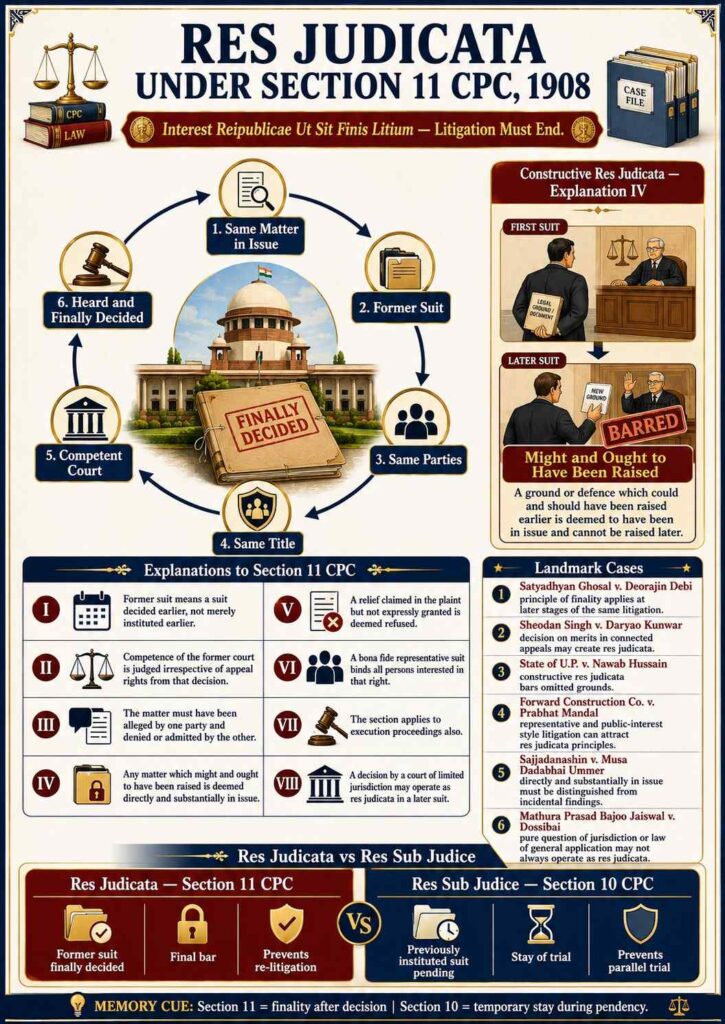
Meaning and Public-Policy Basis of Res Judicata
- Meaning: Res judicata literally means “a matter already adjudicated.” It prevents a court from trying a suit or issue that has already been conclusively decided between the concerned parties by a competent court. Section 11 of the Code of Civil Procedure, 1908 (“CPC”) is the principal statutory provision embodying this rule.
- Purpose: The doctrine serves three connected purposes: finality of litigation, protection against repeated harassment, and judicial economy. A person should not be made to contest the same dispute repeatedly, and courts should not spend time deciding questions that have already been conclusively resolved.
- Maxims: The doctrine rests on important legal maxims:
- Interest reipublicae ut sit finis litium — it is in the interest of the State that litigation must come to an end.
- Nemo debet bis vexari pro una et eadem causa — no person should be vexed twice for the same cause.
- Res judicata pro veritate accipitur — a matter adjudicated is accepted as truth between the parties.
The Supreme Court has recognised these maxims as the foundation of the doctrine.
- Nature: Res judicata is based on public policy and justice. It may operate even where the earlier decision appears erroneous; the proper remedy is appeal, review, revision, or another legally available challenge, not a fresh attempt to reopen the concluded issue.
- Rule of finality: The doctrine does not merely protect private parties. It also preserves the authority of judicial decisions and prevents inconsistent findings by different courts on the same dispute.
- Scope beyond Section 11: Section 11 directly applies to suits and issues. However, the broader doctrine of res judicata has also been applied by courts at successive stages of the same litigation and, where appropriate, in other proceedings to preserve finality.
Statutory Rule under Section 11 CPC
Section 11 provides, in substance, that no court shall try a suit or issue where the matter directly and substantially in issue was directly and substantially in issue in a former suit between the same parties, or persons claiming under them, litigating under the same title, before a competent court, and was heard and finally decided by that court.
Core Conditions of Res Judicata
| Condition | Requirement |
|---|---|
| Same matter in issue | The matter in the later suit must be directly and substantially the same as the matter in the earlier suit. |
| Former suit | The earlier suit must have been decided before the later suit is decided. |
| Same parties or privies | Parties must be the same, or claim through the same persons. |
| Same title | Parties must litigate in the same legal capacity or character. |
| Competent court | The earlier court must have been competent to decide the subsequent suit or issue. |
| Final decision | The matter must have been heard and finally decided. |
The Supreme Court in Sheodan Singh v. Daryao Kunwar, AIR 1966 SC 1332; (1966) 3 SCR 300, identified these conditions. The dispute arose from connected property suits in which decisions in some appeals became final. The Court considered whether those decisions barred further litigation on the same issues. It held that res judicata applies when the same matter was directly and substantially in issue, between the same parties or their privies, litigated under the same title, before a competent court, and was heard and finally decided. It also clarified that the date of decision, rather than the date of institution, determines whether a suit is a “former suit.”
Matter Directly and Substantially in Issue
- Central issue: A matter is directly and substantially in issue when it is a material and essential issue that must be decided for granting or refusing relief in the suit.
- Not merely incidental: A matter is not directly and substantially in issue merely because it was mentioned, discussed, or incidentally considered. A collateral or incidental finding will ordinarily not create res judicata.
- Necessary-and-essential test: The practical test is whether the earlier court had to decide the issue in order to decide the principal dispute. If the earlier decision could have been reached without deciding that issue, the issue may only have been incidental.
- Pleadings-based inquiry: The court must compare the pleadings, issues, evidence where necessary, and judgment in the earlier suit with the pleadings and issues in the later suit. It is unsafe to infer the earlier controversy merely from a short summary in the earlier judgment.
- Decision, not reasoning: What generally operates as res judicata is the adjudicated issue or right, not every observation or reason stated in the judgment. A finding made only for a limited purpose may not bar a later suit involving a different substantive right.
Illustration: A sues B for possession of land on the basis of title. B denies A’s ownership. The court decides that A is the owner and decrees possession. In a later suit between A and B concerning the same property, B cannot again deny A’s ownership if title was essential to the earlier decree.
Illustration: A sues B only for temporary injunction based on possession. The court observes that A appears to have title, but decides the case only on possession. If title was not necessary for the injunction decision, that observation may not prevent a later comprehensive title suit.
The Supreme Court in Sajjadanashin Sayed Md. B.E. Edr. v. Musa Dadabhai Ummer, (2000) 3 SCC 350, considered whether a finding was directly and substantially in issue or merely collateral. The Court explained that the decisive question is whether adjudication of that issue was material and essential to the earlier judgment. A finding on title in an injunction suit can operate as res judicata only where title was necessarily required to decide the injunction claim; where the earlier suit was confined to possessory rights, a title finding may remain incidental.
The Supreme Court in Syed Mohd. Salie Labbai v. Mohd. Hanifa, (1976) 4 SCC 780, examined disputes relating to religious rights and income associated with a mosque. The issue was whether an earlier decision had conclusively determined the rights asserted in the later proceeding. The Court held that the best method is first to identify the cases pleaded by the parties in the earlier litigation and then determine precisely what the earlier judgment actually decided. The case remains important for the rule that res judicata cannot be applied through assumptions or vague similarity between two disputes.
Former Suit
- Meaning of former suit: Under Explanation I to Section 11, a “former suit” is a suit decided before the suit in question, whether or not it was instituted earlier.
- Decision date controls: A suit instituted later can still become the “former suit” if it is decided earlier than the other suit.
- Finality: The earlier decision must have achieved finality. A pending appeal, a decision set aside in appeal, or an unresolved issue may affect the applicability of res judicata.
- Same litigation: The principle can also operate between different stages of the same proceeding. Once an issue is finally decided at an earlier stage, parties cannot ordinarily reopen it at a later stage of the same litigation.
The Supreme Court in Satyadhyan Ghosal v. Deorajin Debi, [1960] 3 SCR 590, arose from tenancy and ejectment proceedings under the Calcutta Thika Tenancy law. The parties disputed whether an earlier order regarding the statutory protection available to the tenants barred reconsideration of the issue. The Court held that res judicata promotes finality and can apply between different stages of the same litigation. However, it also clarified that not every interlocutory order becomes permanently conclusive; an interlocutory order which does not finally terminate the issue may be challenged in an appeal from the final decree where law permits.
Same Parties, Parties Claiming Under Them, and Same Title
- Identity of parties: The later suit must be between the same parties as the earlier suit, or between persons who claim under those parties.
- Privies and representatives: Section 11 covers successors-in-interest, legal representatives, transferees, assignees, heirs, and others who derive their claim through a party to the former suit.
- Same title: “Same title” means the same legal capacity or character in which a person litigates. A person suing as an individual in one proceeding and later as a trustee, guardian, legal representative, or office-holder may not necessarily be litigating under the same title.
- Co-defendants and co-plaintiffs: Res judicata can operate even between co-defendants or co-plaintiffs where there was a real conflict between them, resolution of that conflict was necessary for granting relief, and the conflict was finally decided.
- Representative litigation: In bona fide litigation concerning a public right or a private right claimed in common, persons interested in that right can be bound even though they were not individually named as parties.
Competent Court
- Basic requirement: The court deciding the former suit must have been competent to try the subsequent suit or the issue raised in the subsequent suit.
- Competence concerns jurisdiction: Competence generally concerns jurisdiction over the subject matter, pecuniary jurisdiction, territorial jurisdiction where relevant, and statutory authority to decide the issue.
- Explanation II: Competence is determined irrespective of any provisions relating to a right of appeal from the earlier decision.
- Limited jurisdiction courts: Explanation VIII provides that an issue heard and finally decided by a court of limited jurisdiction, competent to decide that issue, can operate as res judicata in a later suit even though that limited court was not competent to try the later suit as a whole.
The Supreme Court in Sulochana Amma v. Narayanan Nair, (1994) 2 SCC 14, dealt with the effect of findings recorded in an earlier injunction suit. The Court held that a finding on title may operate as res judicata in a later title suit where title was directly and substantially in issue and the earlier forum was competent to decide that issue. The case is also associated with the principle reflected in Explanation VIII: a decision by a forum of limited or special jurisdiction may bind the parties in a subsequent proceeding if that forum was competent to decide the particular issue.
Heard and Finally Decided
- Adjudication required: The issue must have been actually adjudicated and finally decided by the competent court.
- Merits and finality: A dismissal after adjudication can create res judicata. However, a matter that was never decided on merits cannot ordinarily satisfy the requirement that it was “heard and finally decided.”
- Different procedural bars: Withdrawal, abandonment, dismissal for default, rejection of a plaint, limitation, and other procedural outcomes may create different legal consequences under the CPC, but they must not be mechanically treated as res judicata without examining whether Section 11 is truly satisfied.
- Order XXIII distinction: Withdrawal of a suit without liberty may bar a fresh suit under Order XXIII Rule 1(4), but this is not identical to res judicata because there may be no prior adjudication on the merits.
Explanations to Section 11 CPC
| Explanation | Rule and Effect |
|---|---|
| Explanation I | A former suit is one decided earlier, even if instituted later. |
| Explanation II | Competence is determined irrespective of the right of appeal. |
| Explanation III | The issue must have been alleged by one party and admitted or denied, expressly or impliedly, by the other. |
| Explanation IV | Matters that “might and ought” to have been raised as attack or defence are deemed to have been directly and substantially in issue. |
| Explanation V | A relief claimed in the plaint but not expressly granted is deemed refused. |
| Explanation VI | Bona fide representative litigation concerning public rights or common private rights binds all interested persons. |
| Explanation VII | Section 11 applies to execution proceedings; references to suit and former suit include execution proceedings. |
| Explanation VIII | An issue finally decided by a competent court of limited jurisdiction can bind parties in a later suit. |
These Explanations expand the practical operation of Section 11 and prevent parties from defeating the doctrine through procedural technicalities.
Constructive Res Judicata under Explanation IV
- Meaning: Constructive res judicata is a deemed form of res judicata. It bars not only matters actually raised and decided, but also matters which a party had the opportunity and obligation to raise in the earlier suit but deliberately or negligently omitted.
- Twin test: Explanation IV applies where the omitted matter:
- Might have been raised in the earlier proceeding; and
- Ought to have been raised because it was material, connected with the dispute, and within the legitimate scope of the earlier action.
- Purpose: The rule prevents piecemeal litigation. A party cannot split defences or grounds of attack and bring them forward one by one in separate proceedings.
- Deemed decision: In constructive res judicata, the matter may not have been actually heard. The law treats it as having been in issue because the party had a fair opportunity and duty to raise it earlier.
Illustration: A sues B for declaration of title over a property. B contests the suit only on the ground that A’s sale deed is invalid but does not raise the available defence that the claim is barred by limitation. If limitation was a necessary and available defence in the earlier suit, B may be barred from raising it in a later proceeding connected with the same controversy.
The Supreme Court in State of Uttar Pradesh v. Nawab Hussain, (1977) 2 SCC 806; AIR 1977 SC 1680, dealt with a police officer dismissed from service. He first challenged the dismissal in writ proceedings on certain grounds but later filed a civil suit raising an additional ground that the dismissing authority lacked competence. The Court held that a party cannot reserve one available ground for later litigation after already challenging the same action in earlier proceedings. The omitted ground was barred by constructive res judicata because it might and ought to have been raised earlier.
The Supreme Court in Forward Construction Co. v. Prabhat Mandal (Regd.), Andheri, (1986) 1 SCC 100, involved successive public-interest challenges relating to the use of land reserved for a BEST bus depot in Mumbai. The Court held that an adjudication is final not only regarding matters actually decided but also regarding matters that parties might and ought to have raised as part of the same controversy. It clarified that Explanation IV applies to grounds of both attack and defence. The Court also held that representative or public-interest litigation can bind interested persons only where the earlier litigation was bona fide and concerned a genuinely common right.
The Supreme Court recently reaffirmed the principle in Parvatewwa v. Channappa, 2026 INSC 697, where a party who knew of an adverse claim but omitted to seek appropriate relief in the first suit attempted to agitate the matter in a later suit. The Court applied Explanation IV and held that a party cannot reopen a connected issue that should have been pursued in the earlier litigation.
Explanation V: Relief Claimed but Not Granted
- Deemed refusal: Where the plaint claims a relief but the decree does not expressly grant it, the relief is deemed to have been refused for Section 11 purposes.
- Practical effect: A plaintiff cannot ordinarily file a fresh suit merely to seek a relief that was claimed in the earlier plaint but not granted by the decree.
- Careful reading required: The decree, issues, and judgment must be read together. A relief not expressly granted may have been intentionally rejected, impliedly rejected, or rendered unnecessary by another finding.
Explanation VI: Representative and Public Rights
- Representative capacity: Where persons litigate bona fide concerning a public right or a private right claimed in common for themselves and others, every interested person is treated as claiming through the litigating representatives.
- Bona fides essential: The earlier litigation must be genuine, representative, and conducted in the common interest. A collusive, mala fide, or purely private litigation cannot ordinarily bind all interested persons.
- Public-interest litigation: Res judicata may apply to public-interest litigation, but courts carefully examine whether the earlier case genuinely represented the public right claimed.
Evidence and Procedure for Raising Res Judicata
- Specific plea: Res judicata should ordinarily be specifically pleaded by the party relying on it.
- Proof burden: The party raising the plea must establish the earlier pleadings, issues, judgment, decree, and the identity of the matters in dispute.
- Essential documents: Ordinarily, copies of the plaint, written statement, framed issues, judgment, and decree in the former suit should be placed on record.
- Exception: In a suitable case, the judgment alone may suffice where it comprehensively records the pleadings, issues, and conclusions. However, a court should not speculate about what was actually in issue.
The Supreme Court in V. Rajeshwari v. T.C. Saravanabava, (2004) 1 SCC 551, considered a plea that a later suit was barred by res judicata. The Court held that res judicata is a rule of estoppel by judgment founded on finality and the principle that no person should be vexed twice for the same cause. It further held that merely raising the plea is insufficient: the party must substantiate it with the pleadings, issues, and judgment in the former case, unless the earlier judgment itself contains all necessary details.
- Preliminary issue: Res judicata can sometimes be decided as a preliminary issue. However, where its determination depends upon disputed facts, comparison of documents, or evidence regarding the earlier litigation, the court may need a full trial.
- Order VII Rule 11: A plaint should not automatically be rejected under Order VII Rule 11(d) on the ground of res judicata merely because the defendant asserts such a bar. The court must examine whether the bar is apparent from the plaint and the legally admissible material relevant at that stage.
Limits and Important Qualifications
- Change in facts: A material change in facts after the earlier decision may create a fresh cause of action and prevent res judicata from applying.
- Change in law: A substantial change in the governing law may affect whether an earlier decision remains binding in a later proceeding.
- Jurisdictional errors: A decision involving a pure question of jurisdiction, or one that validates something prohibited by law, may not operate as res judicata in the ordinary manner because procedural finality cannot override substantive law.
- Pure question of law: A pure abstract question of law, unrelated to the factual foundation of a right, is generally not treated in the same way as an adjudicated issue of fact or a mixed question of law and fact.
The Supreme Court in Mathura Prasad Bajoo Jaiswal v. Dossibai N.B. Jeejeebhoy, (1970) 1 SCC 613, considered whether an earlier legal finding could bar subsequent litigation. The Court held that a previous decision on a matter in issue can bind parties, including on mixed questions of law and fact. However, a pure legal question unrelated to the factual basis of the parties’ rights, a question of jurisdiction, a later statutory change, or an earlier decision validating something prohibited by law may not operate as res judicata.
Res Judicata and Res Sub Judice: Distinction
| Basis | Res Judicata — Section 11 CPC | Res Sub Judice — Section 10 CPC |
|---|---|---|
| Stage | Earlier matter has already been finally decided. | Earlier suit is still pending. |
| Object | Prevents re-litigation of concluded issues. | Prevents parallel trials of substantially identical pending suits. |
| Effect | Bars trial of the later suit or issue. | Stays trial of the later suit; institution is not barred. |
| Foundation | Finality of judicial decisions. | Avoidance of conflicting decisions while litigation is pending. |
Quick Revision Framework
- R — Resolved issue: Was the same matter already directly and substantially decided?
- E — Earlier suit: Was there a former suit decided before the present matter?
- S — Same parties: Are the parties identical, or do they claim through the earlier parties?
- J — Jurisdiction: Was the former court competent to decide the issue?
- U — Under same title: Are parties litigating in the same legal capacity?
- D — Decision final: Was the issue heard and finally decided?
- I — Issue essential: Was the issue material and necessary, not merely incidental?
- C — Constructive bar: Could and should the omitted ground have been raised earlier?
- A — Actual record: Have pleadings, issues, judgment, and decree from the former case been produced?
- T — True public policy: Does applying the doctrine promote finality without defeating substantive justice?