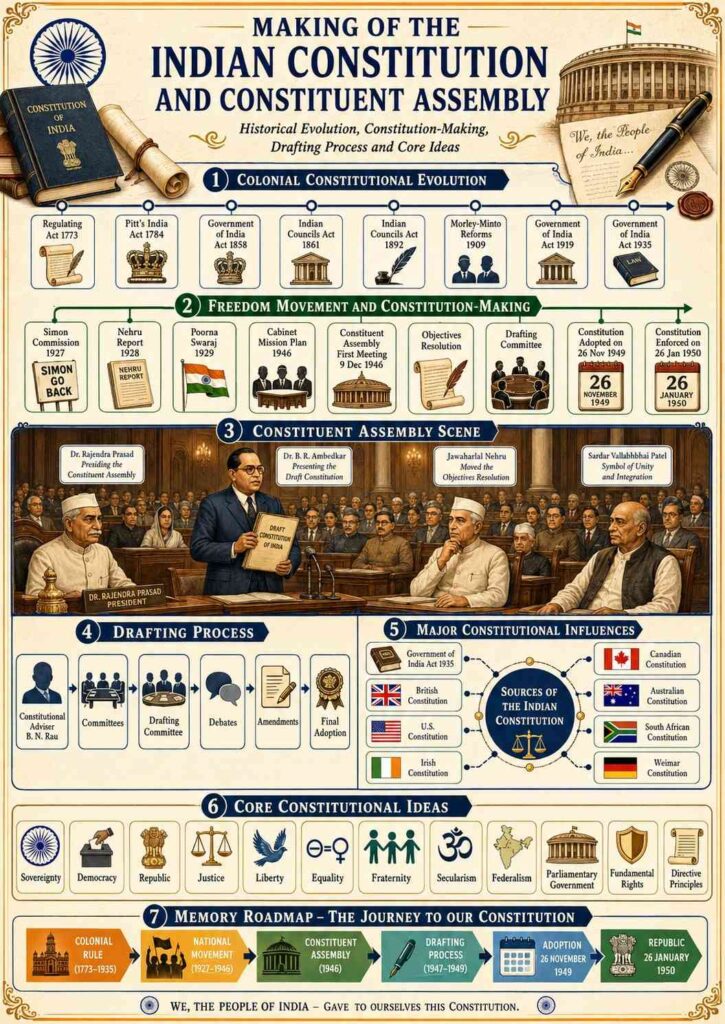
Introduction: Meaning and Importance of Constitution-Making in India
➤ Constitution as supreme law: The Constitution of India is the basic legal document which establishes the structure of the State, distributes powers between institutions, protects rights of citizens, and lays down the goals of governance. It is not merely a legal text; it is also a political, social and moral document reflecting India’s struggle against colonial rule, social inequality and arbitrary power.
➤ Indian Constitution as a historical product: The Constitution did not appear suddenly on 26 January 1950. It was the result of a long constitutional evolution beginning from the East India Company’s rule, followed by Crown rule, gradual introduction of representative institutions, nationalist demands for self-government, and finally the Constituent Assembly’s detailed debates.
➤ People’s sovereignty: The opening words of the Preamble, “We, the people of India”, show that the Constitution derives its authority from the people, not from the British Parliament or any colonial authority. The Constitution of India was adopted on 26 November 1949 and came into force on 26 January 1950.
Colonial Background of Indian Constitutional Law
➤ Company rule to Crown rule: Indian constitutional development began under British colonial control. Initially, the East India Company exercised political and administrative power. Over time, the British Parliament enacted several laws to regulate the Company and later the Crown’s administration in India.
➤ Regulating Act, 1773: This Act was the first major attempt by the British Parliament to regulate the affairs of the East India Company in India. It established the office of the Governor-General of Bengal and created the Supreme Court at Calcutta. Its importance lies in the fact that it introduced centralized control and judicial institutions in British India.
➤ Pitt’s India Act, 1784: This Act strengthened British governmental control over the East India Company by creating a system of dual control. The Company continued commercial functions, but political supervision increased through the British Government. This marked the beginning of clearer parliamentary control over Indian administration.
➤ Charter Acts: The Charter Acts, especially the Charter Act of 1833 and Charter Act of 1853, contributed to centralisation and legislative development. The Charter Act of 1833 made the Governor-General of Bengal the Governor-General of India and created a central legislative authority. The Charter Act of 1853 separated legislative and executive functions in the Governor-General’s Council and introduced limited competition for civil services.
➤ Government of India Act, 1858: After the Revolt of 1857, the East India Company’s rule ended and India came directly under the British Crown. The Act transferred power from the Company to the Crown and created the office of Secretary of State for India. This was an important constitutional shift because India was no longer governed by a trading corporation but by the British Crown.
➤ Indian Councils Act, 1861: This Act introduced Indians into legislative councils in a limited way. It also recognised the principle of decentralised legislative power by restoring legislative powers to Bombay and Madras. However, representation was still limited, nominated and controlled.
➤ Indian Councils Act, 1892: This Act slightly expanded legislative councils and allowed limited discussion of budgets. Though members were not directly elected, the system of recommendation by bodies such as municipalities and universities indirectly introduced an electoral principle.
➤ Indian Councils Act, 1909: Also known as the Morley-Minto Reforms, this Act introduced separate electorates for Muslims. This was a major constitutional development because it formally introduced communal representation into Indian politics. While it increased Indian participation in councils, it also deepened communal political divisions.
Government of India Act, 1919: Beginning of Responsible Government in Limited Form
➤ Montagu-Chelmsford Reforms: The Government of India Act, 1919 was based on the Montagu-Chelmsford Reforms. It was described as a step towards the progressive realisation of responsible government in British India, but it retained strong British control. The Indian National Congress rejected it, and Annie Besant famously criticised it as “unworthy of England to offer and India to accept.”
➤ Dyarchy in provinces: The most important feature of the 1919 Act was dyarchy at the provincial level. Provincial subjects were divided into “transferred subjects” and “reserved subjects.” Transferred subjects like education and public health were administered by Indian ministers responsible to legislatures, while reserved subjects like finance, police and law and order remained under the control of the Governor and his officials.
➤ Bicameral central legislature: The Act introduced a bicameral legislature at the Centre consisting of the Council of State and Legislative Assembly. However, the Governor-General retained extensive overriding powers.
➤ Limited franchise: Voting rights were restricted and based on property, education and other qualifications. Therefore, the system did not represent universal democracy.
➤ Review clause: The Act contained a provision for review after ten years. This led to the appointment of the Simon Commission in 1927.
➤ Importance: The 1919 Act is important because it introduced constitutional vocabulary such as responsible government, ministerial responsibility and provincial legislative participation. However, it failed because real power remained with the British executive.
Simon Commission, Nehru Report and Demand for a Constituent Assembly
➤ Simon Commission, 1927: The British Government appointed the Simon Commission to review the working of the 1919 Act. It had no Indian member, which led to widespread protest under the slogan “Simon Go Back.”
➤ Nehru Report, 1928: In response to the challenge that Indians could not agree on a constitutional framework, an all-party committee chaired by Motilal Nehru prepared the Nehru Report. It demanded Dominion Status, fundamental rights, responsible government and a federal structure. It was an important Indian attempt to draft constitutional principles.
➤ Poorna Swaraj Resolution, 1929: The demand for complete independence was adopted by the Indian National Congress at Lahore in 1929. This transformed the constitutional struggle from limited reforms to full sovereignty.
➤ Demand for Constituent Assembly: The idea that Indians should frame their own Constitution gradually became central to the freedom movement. It reflected the principle that a Constitution must be made by the people or their representatives, not imposed by a colonial Parliament.
Government of India Act, 1935: Immediate Constitutional Predecessor
➤ Largest colonial constitutional statute: The Government of India Act, 1935 was the most detailed constitutional law enacted by the British for India. It served as the basic constitutional framework in the final years of British rule and influenced many structural features of the Indian Constitution.
➤ Provincial autonomy: The Act abolished dyarchy in provinces and introduced provincial autonomy. Elected provincial governments could function in several fields, but Governors retained special responsibilities and reserve powers.
➤ Proposed All-India Federation: The Act proposed a federation of British Indian provinces and princely states. However, the federal part never fully came into operation because the princely states did not join as required.
➤ Three legislative lists: The Act divided legislative powers into Federal List, Provincial List and Concurrent List. This idea influenced the Union List, State List and Concurrent List under the Constitution of India.
➤ Federal Court: The Act established the Federal Court of India, which began functioning in 1937. This was an important predecessor of the Supreme Court of India.
➤ Public Service Commissions and RBI: The Act provided for public service commissions and contributed to institutional development. It also created the Reserve Bank of India and strengthened administrative structure
➤ Limitations: The Act did not provide full responsible government at the Centre. The Governor-General and Governors retained overriding powers. Defence, external affairs and key executive matters remained under British control.
➤ Importance for the Constitution: Many administrative and federal provisions of the Constitution were adapted from the 1935 Act, but the Constitution transformed them into a democratic, republican and sovereign framework.
Cabinet Mission Plan, 1946: Birth of the Constituent Assembly
➤ British decision to transfer power: After the Second World War, Britain’s political and economic position weakened, and Indian demand for independence became irresistible. The Labour Government in Britain expressed willingness to facilitate constitution-making by Indians.
➤ Cabinet Mission members: The Cabinet Mission came to India in March 1946. Its members were Lord Pethick-Lawrence, Sir Stafford Cripps and A.V. Alexander. The Mission and Viceroy Lord Wavell issued the Cabinet Mission Plan on 16 May 1946.
➤ Main purpose: The Plan sought to create machinery through which Indians could frame their own Constitution. It tried to reconcile the Indian National Congress demand for a united India and the Muslim League demand for Pakistan.
➤ Rejection of Pakistan: The Plan rejected the demand for a separate Pakistan and proposed an Indian Union consisting of British Indian provinces and princely states.
➤ Proposed federal structure: The Union was to deal with limited subjects such as foreign affairs, defence and communications. Provinces were grouped into sections and were given considerable autonomy. This grouping scheme later became controversial.
➤ Constituent Assembly: The Plan provided for a Constituent Assembly to frame the Constitution. Members were to be elected indirectly by provincial legislative assemblies, and princely states were to nominate their representatives.
➤ Legal significance: The Constituent Assembly was created under the Cabinet Mission Plan. During the initial stages, the Assembly recognised this source of legal legitimacy while also moving towards the higher principle of popular sovereignty.
Constituent Assembly: Composition and Nature
➤ Indirectly elected body: The Constituent Assembly was not elected by universal adult franchise. Its members were indirectly elected by members of provincial legislative assemblies. However, it represented a wide range of political, social, regional and intellectual opinion.
➤ Original strength: The original strength of the Assembly was 389 members. After Partition, the strength was reduced to 299.
➤ First meeting: The Constituent Assembly met for the first time on 9 December 1946. Sachchidananda Sinha acted as temporary chairman. Dr. Rajendra Prasad was later elected as permanent President of the Assembly.
➤ Boycott by Muslim League: The Muslim League initially boycotted the Assembly because of political disagreement over Pakistan. This affected the representative character of the Assembly in its early stage.
➤ After Partition: After the Indian Independence Act, 1947 and Partition, the Constituent Assembly became the sovereign constitution-making body for India and also functioned as the Dominion Legislature.
➤ Diversity: The Assembly included lawyers, freedom fighters, administrators, scholars, social reformers and representatives of different communities. Important members included Dr. B.R. Ambedkar, Jawaharlal Nehru, Sardar Vallabhbhai Patel, Dr. Rajendra Prasad, Alladi Krishnaswami Ayyar, K.M. Munshi, Gopalaswami Ayyangar, Hansa Mehta, Durgabai Deshmukh and many others.
Objectives Resolution: Philosophical Foundation of the Constitution
➤ Moved by Jawaharlal Nehru: Jawaharlal Nehru moved the Objectives Resolution on 13 December 1946. It was adopted in January 1947. The debates around it formed a major part of the early work of the Assembly.
➤ Core ideas: The Resolution declared India’s resolve to become an independent sovereign republic. It emphasised justice, equality, freedom, safeguards for minorities, and the dignity of the individual.
➤ Basis of Preamble: The Objectives Resolution later became the foundation of the Preamble. The Preamble’s ideals of justice, liberty, equality and fraternity reflect this constitutional philosophy.
➤ Importance: The Resolution converted the freedom struggle’s political goals into constitutional principles. It linked national independence with social transformation.
Committees of the Constituent Assembly
➤ Committee system: The Assembly worked through several committees. This made the drafting process systematic, specialised and detailed.
➤ Important committees: Major committees included the Union Powers Committee, Union Constitution Committee, Provincial Constitution Committee, Advisory Committee on Fundamental Rights, Minorities and Tribal and Excluded Areas, Drafting Committee, Rules Committee and Steering Committee.
➤ Role of Sardar Patel: Sardar Vallabhbhai Patel chaired important committees dealing with fundamental rights, minorities and provincial constitutions. His role was significant in balancing unity, rights and minority safeguards.
➤ Role of B.N. Rau: Sir B.N. Rau served as Constitutional Adviser. He studied constitutional systems of several countries and prepared an initial draft. His comparative constitutional work helped the Assembly adopt suitable provisions from different jurisdictions.
Drafting Committee and Dr. B.R. Ambedkar
➤ Formation: The Drafting Committee was appointed on 29 August 1947. Dr. B.R. Ambedkar was its Chairman.
➤ Members: The Drafting Committee included Dr. B.R. Ambedkar, N. Gopalaswami Ayyangar, Alladi Krishnaswami Ayyar, K.M. Munshi, Mohammad Saadulla, B.L. Mitter and D.P. Khaitan. Due to resignations and deaths, some changes occurred later.
➤ Ambedkar’s contribution: Dr. Ambedkar played a central role in explaining, defending and refining the Draft Constitution. His legal clarity, social vision and understanding of constitutional morality deeply influenced the final document.
➤ Draft Constitution: B.N. Rau’s initial draft was considered by the Drafting Committee. The Drafting Committee prepared the Draft Constitution, which was introduced by Dr. Ambedkar in the Assembly on 4 November 1948.
➤ Deliberative drafting: The Constitution was not mechanically copied from foreign constitutions. Each borrowed provision was debated and adapted to Indian conditions.
Drafting Process and Adoption of the Constitution
➤ Time taken: The Constituent Assembly worked for nearly 2 years and 11 months. According to the Constitution of India database, the Assembly sat for 167 days to frame the Constitution, and its final session was on 24 Jan
➤ Debates: The Constituent Assembly Debates are spread across 12 volumes and record detailed discussions from 9 December 1946 to 24 January 1950.
➤ Amendments: Thousands of amendments were proposed and many were debated. This shows that the Constitution was made through discussion, disagreement and reasoned compromise.
➤ Adoption: The Constitution was adopted on 26 November 1949. This date is celebrated as Constitution Day.
➤ Enforcement: The Constitution came into force on 26 January 1950. The date was chosen because 26 January had historical importance as the day associated with the Poorna Swaraj declaration.
➤ Republican transformation: On 26 January 1950, India ceased to be a Dominion and became a sovereign democratic republic.
Major Constitutional Influences on the Indian Constitution
➤ Government of India Act, 1935: The strongest structural influence came from the Government of India Act, 1935. Federal scheme, office of Governor, public service commissions, emergency-style administrative provisions, lists of legislative subjects and judiciary-related structures were influenced by it.
➤ British Constitution: Parliamentary government, cabinet responsibility, rule of law, legislative procedure and the idea of single citizenship were influenced by British constitutional practice.
➤ United States Constitution: Fundamental Rights, judicial review, independence of judiciary, written Constitution and removal of judges through impeachment show American influence.
➤ Irish Constitution: Directive Principles of State Policy were influenced by the Irish Constitution. These principles direct the State to promote social and economic justice.
➤ Canadian Constitution: A strong Centre with federal features and residuary powers with the Union reflect Canadian influence.
➤ Australian Constitution: Concurrent List, freedom of trade and commerce, and aspects of federal relations show Australian influence.
➤ Weimar Constitution of Germany: Emergency provisions were influenced partly by the Weimar model, although India adapted them to its own circumstances.
➤ South African Constitution: The procedure for amendment and election of members of the Rajya Sabha were influenced by South African constitutional practice.
➤ Soviet influence: The ideals of social and economic justice influenced later constitutional development. Fundamental Duties, inserted by the 42nd Amendment in 1976, show Soviet influence, though they were not part of the original Constitution.
➤ Indian sources: The Constitution also drew heavily from Indian experience: the freedom struggle, social reform movements, anti-caste movements, nationalist debates, provincial government experience under the 1935 Act, and the need to integrate princely states.
Preamble: Soul of the Constitution
➤ Philosophical summary: The Preamble declares India to be a sovereign, socialist, secular, democratic republic and promises justice, liberty, equality and fraternity. The words “socialist” and “secular” were inserted by the 42nd Constitutional Amendment in 1976; however, the values behind them were already present in the constitutional scheme.
➤ Berubari Union case: In In Re: Berubari Union, AIR 1960 SC 845, the Supreme Court considered the Preamble as a key to understanding the Constitution but held that it was not a source of substantive power. The case arose from the proposed transfer of Berubari territory to Pakistan. The Court held that territory could be ceded only through constitutional amendment. This case is important because it began judicial discussion on the legal value of the Preamble.
➤ Kesavananda Bharati case: In Kesavananda Bharati v. State of Kerala, (1973) 4 SCC 225, the Supreme Court held that Parliament can amend the Constitution under Article 368, but it cannot destroy the basic structure of the Constitution. The Court recognised the Preamble as part of the Constitution and used its ideals to identify basic constitutional values. This case is the foundation of the basic structure doctrine.
➤ LIC of India case: In LIC of India v. Consumer Education and Research Centre, (1995) 5 SCC 482, the Supreme Court treated the Preamble as part of the Constitution’s guiding vision and connected it with social justice and dignity. The case shows that constitutional interpretation must promote human dignity and welfare.
Fundamental Rights and Social Revolution
➤ Rights against colonial arbitrariness: Fundamental Rights were included because colonial rule had shown how unchecked State power could suppress liberty. The Constitution therefore guarantees rights such as equality, freedom, protection of life and personal liberty, religious freedom, cultural and educational rights, and constitutional remedies.
➤ Article 32: Dr. Ambedkar described Article 32 as the heart and soul of the Constitution because it gives citizens the right to directly approach the Supreme Court for enforcement of Fundamental Rights.
➤ Social equality: The Constitution did not merely create political democracy; it sought social democracy. Provisions abolishing untouchability, prohibiting discrimination and allowing affirmative action were designed to transform Indian society.
➤ State of Madras v. Champakam Dorairajan: In State of Madras v. Champakam Dorairajan, AIR 1951 SC 226, the Supreme Court held that Fundamental Rights prevail over Directive Principles when there is a conflict. The case led to the First Constitutional Amendment, which inserted Article 15(4), enabling special provisions for socially and educationally backward classes. This case shows the early tension between individual rights and social justice.
Directive Principles of State Policy
➤ Meaning: Directive Principles are non-justiciable principles that guide the State in making laws and policies. They aim to establish social and economic democracy.
➤ Purpose: While Fundamental Rights restrict State power, Directive Principles guide State action towards welfare. They include principles relating to livelihood, equal pay, education, public health, organisation of village panchayats and protection of environment.
➤ Minerva Mills case: In Minerva Mills Ltd. v. Union of India, (1980) 3 SCC 625, the Supreme Court held that harmony between Fundamental Rights and Directive Principles is part of the basic structure. The case clarified that neither individual liberty nor social welfare can completely override the other.
Federalism and Strong Centre
➤ Need for unity: India adopted a federal system with a strong Centre because Partition, communal violence, princely states and regional diversity required national unity and administrative stability.
➤ Union of States: Article 1 describes India as a Union of States. This phrase reflects the idea that Indian federalism is not based on a compact among sovereign states; instead, the Union is indestructible though states may be reorganised.
➤ Legislative lists: The Constitution distributes subjects into Union List, State List and Concurrent List. This model was influenced by the Government of India Act, 1935 but modified to fit a democratic republic.
➤ Emergency provisions: Emergency powers strengthen the Centre in times of war, external aggression, armed rebellion, constitutional breakdown or financial instability.
➤ S.R. Bommai case: In S.R. Bommai v. Union of India, (1994) 3 SCC 1, the Supreme Court held that federalism and secularism are part of the basic structure. The case restricted arbitrary use of Article 356 and strengthened constitutional federalism.
Parliamentary Democracy
➤ Responsible government: India adopted the parliamentary system because Indians had experience with legislative institutions under British rule and provincial autonomy under the 1935 Act.
➤ Council of Ministers: The executive is collectively responsible to the Lok Sabha. This ensures accountability of government to elected representatives.
➤ President and Prime Minister: The President is the constitutional head, while real executive power is exercised by the Council of Ministers headed by the Prime Minister.
➤ Reason for adoption: The Assembly preferred parliamentary democracy over presidential government because it allows continuous accountability, debate and removal of the executive without revolution or instability.
Secularism and Minority Protection
➤ Historical need: India’s religious diversity and the trauma of Partition made secularism and minority protection essential. The Constitution protects freedom of conscience and the right to profess, practise and propagate religion.
➤ Cultural and educational rights: Articles 29 and 30 protect minorities’ language, script, culture and educational institutions.
➤ T.M.A. Pai Foundation case: In T.M.A. Pai Foundation v. State of Karnataka, (2002) 8 SCC 481, the Supreme Court explained the scope of minority and non-minority educational rights under Articles 29 and 30. The case is important for understanding institutional autonomy and minority protection.
Integration of Princely States and Constitutional Unity
➤ Princely states problem: At independence, India had British Indian provinces and hundreds of princely states. Their integration was necessary for political unity.
➤ Role of Sardar Patel and V.P. Menon: Sardar Vallabhbhai Patel and V.P. Menon played decisive roles in integrating princely states into the Indian Union through instruments of accession and political negotiations.
➤ Constitutional outcome: The Constitution created one Union with a common citizenship, integrated judiciary, all-India services and strong central institutions.
Why the Indian Constitution is Both Borrowed and Original
➤ Borrowed principles: Many provisions were inspired by foreign constitutions, but borrowing does not mean lack of originality. Constitutional borrowing is common in modern constitution-making.
➤ Indian adaptation: The framers adapted every idea to Indian conditions. Fundamental Rights were shaped by colonial experience, Directive Principles by social justice needs, federalism by diversity, and parliamentary democracy by institutional familiarity.
➤ Transformative character: The Constitution was designed not only to govern India but to transform it. It aimed to move society from hierarchy to equality, from colonial subjecthood to citizenship, and from arbitrary power to constitutional governance.
Timeline of Constitutional Development
| Year | Development | Constitutional Importance |
|---|---|---|
| 1773 | Regulating Act | Beginning of parliamentary control over Company administration |
| 1784 | Pitt’s India Act | Stronger British governmental supervision |
| 1858 | Government of India Act | Transfer from Company rule to Crown rule |
| 1861 | Indian Councils Act | Limited Indian participation in legislative councils |
| 1892 | Indian Councils Act | Indirect electoral principle introduced |
| 1909 | Morley-Minto Reforms | Separate electorates and expanded councils |
| 1919 | Government of India Act | Dyarchy and limited responsible government |
| 1935 | Government of India Act | Provincial autonomy, federal scheme, legislative lists |
| 1946 | Cabinet Mission Plan | Constituent Assembly created |
| 1947 | Indian Independence Act | India became independent Dominion |
| 1949 | Constitution adopted | Adopted on 26 November 1949 |
| 1950 | Constitution enforced | India became Republic on 26 January 1950 |
Memory Aid: Core Sources of the Indian Constitution
| Source | Major Influence |
|---|---|
| Government of India Act, 1935 | Federal structure, lists, governors, public service commissions |
| British Constitution | Parliamentary system, rule of law, cabinet responsibility |
| U.S. Constitution | Fundamental Rights, judicial review, independent judiciary |
| Irish Constitution | Directive Principles of State Policy |
| Canadian Constitution | Strong Centre and residuary powers |
| Australian Constitution | Concurrent List and trade provisions |
| South African Constitution | Amendment procedure and Rajya Sabha election method |
Conclusion: Legacy of the Making of the Constitution
➤ Democratic achievement: The making of the Indian Constitution was a remarkable democratic exercise. The framers had to address Partition, poverty, illiteracy, diversity, social inequality and administrative complexity, yet they created a stable constitutional framework.
➤ Blend of continuity and change: The Constitution retained useful administrative structures from colonial laws, especially the Government of India Act, 1935, but transformed them by placing sovereignty in the people and establishing democracy, rights and constitutional supremacy.
➤ Living Constitution: The Constitution is not frozen in 1950. Through amendments, judicial interpretation and democratic practice, it continues to evolve. However, its basic ideals—justice, liberty, equality, fraternity, constitutional morality, secularism, democracy and rule of law—remain central.
➤ Final understanding: The Constituent Assembly did not merely draft a legal document. It converted India’s freedom struggle into a constitutional order. The Constitution represents India’s collective decision to be governed by law, reason, rights, democracy and social justice.